
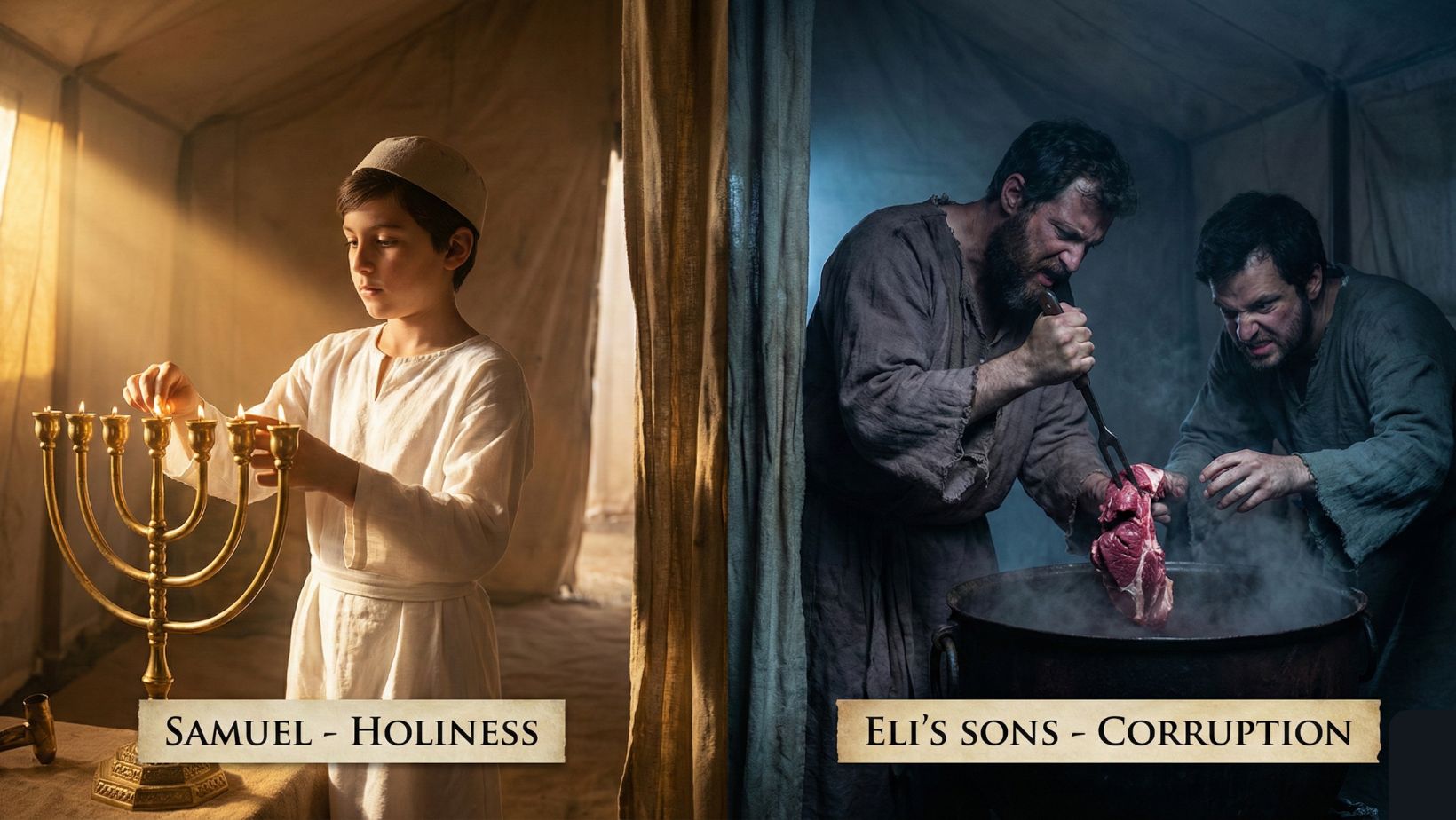
1 Samuel 2 presents a stark study in contrasts. It begins with Hannah’s magnificent prayer—a poetic theological declaration that celebrates God’s sovereignty and His power to reverse human fortunes. This song of praise stands in sharp opposition to the subsequent description of Eli’s sons, Hophni and Phinehas. While Hannah dedicates her son to holiness, the established priests desecrate the tabernacle through greed and sexual immorality. The narrative alternates between the spiritual growth of the boy Samuel and the deepening corruption of Eli’s house. The chapter concludes with a terrifying prophecy from an unnamed “man of God,” declaring the end of Eli’s lineage and promising the rise of a “faithful priest” who will serve God’s anointed king—a prophecy with immediate historical fulfillment and ultimate Messianic significance.
1. Hannah’s Song: The Theology of Reversal (1 Samuel 2:1–10)
1 Then Hannah prayed: “My heart rejoices in the Lord! The Lord has made me strong. Now I have an answer for my enemies; I rejoice because you rescued me. 2 No one is holy like the Lord! There is no one besides you; there is no Rock like our God. 3 “Stop acting so proud and haughty! Don’t speak with such arrogance! For the Lord is a God who knows what you have done; he will judge your actions. 4 The bow of the mighty is now broken, and those who stumbled are now strong. 5 Those who were well fed are now starving, and those who were starving are now full. The childless woman now has seven children, and the woman with many children wastes away. 6 The Lord gives both death and life; he brings some down to the grave but raises others up. 7 The Lord makes some poor and others rich; he brings some down and lifts others up. 8 He lifts the poor from the dust and the needy from the garbage dump. He sets them among princes, placing them in seats of honor. For all the earth is the Lord’s, and he has set the world in order. 9 “He will protect his faithful ones, but the wicked will disappear in darkness. No one will succeed by strength alone. 10 Those who fight against the Lord will be shattered. He thunders against them from heaven; the Lord judges throughout the earth. He gives power to his king; he increases the strength of his anointed one.”
Commentary:
- A Model for Mary (v. 1): Hannah’s prayer, often called the “Magnificat of the Old Testament,” serves as the structural prototype for Mary’s song in Luke 1:46–55. Both celebrate God’s intervention for the humble.
- The Horn (v. 1): The phrase “The Lord has made me strong” is literally “My horn is exalted in the Lord.” In animal imagery, the horn represents strength, dignity, and victory. Hannah’s dignity, once crushed by barrenness, is now restored.
- God as Rock (v. 2): This metaphor emphasizes stability and immutability. In a chaotic period of the Judges, Hannah affirms that Yahweh is the only secure foundation.
- The Great Reversal (v. 4–5): Hannah introduces a key biblical theme: God turns the world upside down. The mighty are broken; the stumbling are strengthened; the hungry are fed. This challenges the ancient assumption that wealth and power were automatic signs of divine favor.
- Seven Children (v. 5): “Seven” represents completeness or perfection in Hebrew numerology. Though Hannah physically bore six children (Samuel plus five mentioned in v. 21), she claims the ideal number “seven” to signify her complete restoration.
- Sovereignty over Life and Death (v. 6): Hannah attributes absolute power to Yahweh. He is not just a fertility deity; He controls Sheol (the grave) and life itself. This foreshadows the resurrection hope.
- The Pillars of the Earth (v. 8): The imagery of “pillars” refers to the foundational structures of the world. Hannah asserts that the moral order is as fixed as the physical order—God creates the world, so He has the right to judge it.
- First Mention of “Messiah” (v. 10): The prayer concludes with a prophetic look forward. Hannah speaks of a “king” and an “anointed one” (Hebrew: Mashiach or Messiah). Since Israel had no king at this time, this is a prophetic utterance looking toward David, and ultimately, Jesus Christ.
2. The Corruption of the Priesthood (1 Samuel 2:11–17)
11 Then Elkanah returned home to Ramah without Samuel. And the boy served the Lord by assisting Eli the priest. 12 Now the sons of Eli were scoundrels who had no respect for the Lord 13 or for their duties as priests. Whenever anyone offered a sacrifice, Eli’s sons would send over a servant with a three-pronged fork. 14 While the meat of the sacrificed animal was still boiling, the servant would stick the fork into the pot and demand that whatever it brought up be given to Eli’s sons. All the Israelites who came to worship at Shiloh were treated this way. 15 Sometimes the servant would come even before the animal’s fat had been burned on the altar. He would demand raw meat before it had been boiled so he could use it for roasting. 16 The man offering the sacrifice might reply, “Take as much as you want, but the fat must be burned first.” Then the servant would demand, “No, give it to me now, or I’ll take it by force.” 17 So the sin of these young men was very serious in the Lord’s sight, for they treated the Lord’s offerings with contempt.
Commentary:
- Worthless Men (v. 12): The NLT uses “scoundrels,” but the Hebrew is sons of Belial (worthlessness/wickedness). They held the office of priest but lacked the relationship with God (“had no respect for the Lord”).
- Liturgical Abuse (v. 13–14): According to Leviticus 7:31–34, priests were allotted specific portions (the breast and right thigh). Eli’s sons invented their own rule, using a “three-pronged fork” to indiscriminately grab whatever they could. This turned worship into a “lucky dip” for their own gain.
- Stealing from God (v. 15–16): The fat belonged to the Lord (Leviticus 3:16) and was to be burned on the altar as a pleasing aroma. By demanding raw meat before the fat was burned, they were prioritizing their appetite over God’s portion. They were effectively stealing from Yahweh.
- Rule by Force (v. 16): The priesthood was designed to be a service of mediation; Hophni and Phinehas turned it into a mafia-like racket, using threats of violence against worshipers.
- Contempt for the Offering (v. 17): Their greatest sin was not just theft, but causing the people to “treat the Lord’s offering with contempt” (or abhor it). They made religion repulsive to the people.
3. Samuel’s Growth and Hannah’s Blessing (1 Samuel 2:18–21)
18 But Samuel, though he was only a boy, served the Lord. He wore a linen garment like that of a priest. 19 Each year his mother made a small coat for him and brought it to him when she came with her husband for the sacrifice. 20 Before they returned home, Eli would bless Elkanah and his wife and say, “May the Lord give you other children to take the place of this one she gave to the Lord.” 21 And the Lord blessed Hannah, and she conceived and gave birth to three sons and two daughters. Meanwhile, Samuel grew up in the presence of the Lord.
Commentary:
- The Linen Ephod (v. 18): Samuel is described wearing a linen ephod. This was a priestly garment. Though Samuel was a child and technically a Levite (not of the Aaronic line by strict genealogy in some interpretations, though 1 Chron 6 clarifies his Levitical roots), he is depicted functioning in a priestly capacity, filling the void left by Eli’s corrupt sons.
- The Little Robe (v. 19): This touching detail highlights Hannah’s ongoing motherly love. She could not raise him daily, but she clothed him annually. As he grew physically, she ensured his covering grew with him.
- Divine Compensation (v. 20–21): Eli blesses Hannah again. God does not remain in debt to anyone; Hannah gave one son and received five more (three sons, two daughters).
4. The Rebuke and Divine Judgment (1 Samuel 2:22–26)
22 Now Eli was very old, but he was aware of what his sons were doing to the people of Israel. He knew, for instance, that his sons were seducing the young women who assisted at the entrance of the Tabernacle. 23 Eli said to them, “I have been hearing reports from all the people about the wicked things you are doing. 24 Why do you keep sinning? You must stop, my sons! The reports I hear among the Lord’s people are not good. 25 If someone sins against another person, God can mediate for the guilty party. But if someone sins against the Lord, who can intercede?” But Eli’s sons wouldn’t listen to their father, for the Lord was already planning to put them to death. 26 Meanwhile, the boy Samuel grew taller and grew in favor with the Lord and with the people.
Commentary:
- Sexual Immorality (v. 22): The corruption moves from greed to lust. The sons were sleeping with women serving at the Tabernacle, reminiscent of pagan cult prostitution practices (e.g., Canaanite fertility cults), thereby completely desecrating Israel’s holy space.
- Eli’s Weak Leadership (v. 23–24): Eli confronts his sons with words (“Why do you keep sinning?”), but takes no action. As High Priest and Judge, he had the authority to remove them from office or execute judgment, but he only offered a verbal reprimand. He honored his sons more than God (see v. 29).
- The Danger of Presumption (v. 25): Eli articulates a terrifying theological truth: offenses against God are far more perilous than civil disputes because there is no higher court of appeal.
- Divine Hardening (v. 25): The text says they did not listen “for the Lord was already planning to put them to death.” This is similar to the hardening of Pharaoh’s heart. They had persisted in sin so long that God confirmed them in their rebellion, handing them over to judgment.
- Samuel’s Contrast (v. 26): This verse echoes Luke 2:52 regarding Jesus. While the old priesthood rots, the new leadership grows in “favor with God and man.”
5. The Prophecy Against the House of Eli (1 Samuel 2:27–36)
27 One day a man of God came to Eli and gave him this message from the Lord: “I revealed myself to your ancestors when they were Pharaoh’s slaves in Egypt. 28 I chose your ancestor Aaron from among all the tribes of Israel to be my priest, to offer sacrifices on my altar, to burn incense, and to wear the priestly garments as he served me. And I assigned the sacrificial offerings to you priests. 29 So why do you scorn my sacrifices and offerings? Why do you give your sons more honor than you give me—for you and they have become fat from the best offerings of my people Israel! 30 “Therefore, the Lord, the God of Israel, says: I promised that your branch of the tribe of Levi would always be my priests. But I will honor those who honor me, and I will despise those who think lightly of me. 31 The time is coming when I will put an end to your family, so it will no longer serve as my priests. All the members of your family will die before their time. None will reach old age. 32 You will watch with envy as I pour out prosperity on the people of Israel. But no members of your family will ever live out their days. 33 The few not cut off from serving at my altar will survive, but only so their eyes can go blind and their hearts break, and their children will die a violent death. 34 And to prove that what I have said will come true, I will cause your two sons, Hophni and Phinehas, to die on the same day! 35 “Then I will raise up a faithful priest who will serve me and do what I desire. I will establish his family, and they will be priests to my anointed kings forever. 36 Then all the survivors from your family will come begging for money and food. They will say, ‘Please give me a job among the priests so I will have enough to eat.’”
Commentary:
- The Man of God (v. 27): An unnamed prophet (pre-Samuel prophetic figure) delivers the death sentence to Eli’s dynasty.
- The Root Sin (v. 29): The indictment is precise: “Why do you give your sons more honor than you give me?” Idolatry is not just bowing to statues; it is valuing any person or thing more than God. Eli was an idolater of his own family.
- Revocation of Promise (v. 30): God explains that His promises often have implied conditions of obedience. “I will honor those who honor me” is the governing principle of God’s dealings with humanity.
- The Sign (v. 34): The simultaneous death of Hophni and Phinehas (which occurs in 1 Samuel 4) will be the proof that the prophecy is active.
- The Faithful Priest (v. 35): This prophecy has layers of fulfillment:
- Samuel: Who functions as a priest and transitions the nation.
- Zadok: In the time of Solomon, Abiathar (Eli’s descendant) is deposed and Zadok takes the priesthood (1 Kings 2:27, 35), fulfilling this word historically.
- Jesus Christ: The ultimate “Faithful Priest” who serves forever and intercedes perfectly (Hebrews 2:17).
Theological Significance of 1 Samuel 2
- Divine Sovereignty and Reversal: The chapter teaches that power, wealth, and status are temporary. God is the active agent in history who “brings down” the arrogant and “lifts up” the humble.
- The Severity of Spiritual Leadership: Leadership is a dangerous calling. Eli’s failure to restrain his sons resulted in a generational curse. God holds leaders to a stricter standard (James 3:1).
- Worship Integrity: God cares deeply about how He is worshiped. Treating the holy things of God as common or as a means for personal gain invites judgment.
- Parental Responsibility: Loving one’s children means disciplining them. Eli’s passive parenting is presented as a spiritual failure.
Practical Applications
- Avoiding “Familial Idolatry”: We must check if we are honoring our family, career, or comfort more than God. True love for family involves leading them in righteousness.
- The Principle of Honor: “I will honor those who honor me.” This is a life principle. When we make choices that prioritize God’s reputation, He takes care of ours.
- Hope for the Marginalized: Hannah’s song is a comfort to the barren, the poor, and the oppressed. It reminds us that our current struggle is not the final chapter.
- Discernment in Worship: We must ensure our worship is focused on God, not on the “entertainment” or “benefits” we receive.
Final Insight
1 Samuel 2 establishes the trajectory for the rest of the book: the old, corrupt, and heavy structure (represented by Eli, who was physically heavy and spiritually blind) must give way to the new, hearing, and obedient instrument of God (Samuel). It is a warning that God is not held hostage by anyone’s lineage or office; if His representatives grow corrupt, He will raise up new ones from the dust.







Leave a Reply