
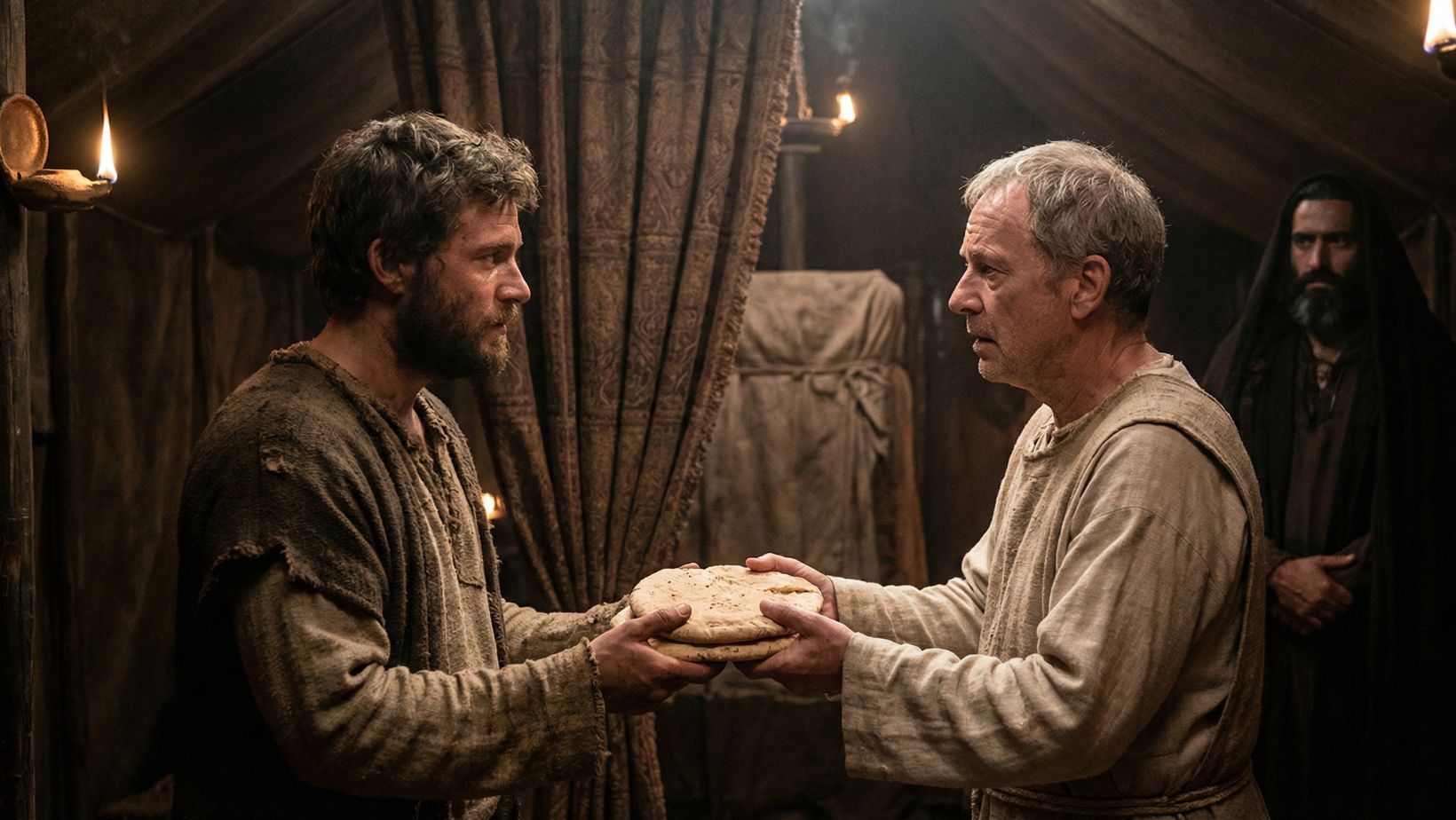
1 Samuel 21 marks the beginning of David’s life as a fugitive. Stripped of his position, his wife, and his best friend, David flees to Nob, a city of priests. In a state of desperation, he lies to the high priest Ahimelech to obtain holy bread and the sword of Goliath. His presence is noted by Doeg the Edomite, a spy for Saul, foreshadowing a future massacre. David then flees to Gath, the hometown of Goliath, seeking asylum among the Philistines. Recognizing the danger of being discovered as the slayer of their champion, David feigns madness to escape with his life. The chapter portrays a raw, unpolished David who resorts to deception and acting to survive, yet God preserves him through it all.
1. Desperation at Nob (1 Samuel 21:1–6 NLT)
1 David went to the town of Nob to see Ahimelech the priest. Ahimelech trembled when he saw him. “Why are you alone?” he asked. “Why is no one with you?” 2 “The king has sent me on a private matter,” David said. “He told me not to tell anyone why I am here. I have told my men where to meet me later. 3 Now, what is there to eat? Give me five loaves of bread or anything else you have.” 4 “We don’t have any regular bread,” the priest replied. “But there is the holy bread, which you can have if your young men have not slept with any women recently.” 5 “Don’t worry,” David replied. “I never allow my men to be with women when we are on a campaign. And since they stay clean even on ordinary trips, how much more on this one!” 6 So the priest, who was Ahimelech, gave him the holy bread. There was no other bread available but the Bread of the Presence that was placed before the Lord in the Tabernacle. It had just been replaced that day with fresh bread.
Commentary:
- Nob (v. 1): Located just north of Jerusalem, Nob had become the central sanctuary after the destruction of Shiloh.
- Ahimelech’s Fear (v. 1): Ahimelech is the great-grandson of Eli. He trembles because seeing a high-ranking commander like David alone and unarmed suggests something is terribly wrong (either a secret mission or he is a fugitive).
- The Lie (v. 2): David fabricates a story about a “private matter” for the King. This deception endangers the priests, as later revealed in Chapter 22. David is operating in “survival mode,” not high moral integrity.
- The Bread of the Presence (v. 4-6):
- The Law: Leviticus 24:5-9 stated this bread (12 loaves representing the tribes) was to be eaten only by priests in a holy place.
- The Exception: Ahimelech prioritizes human need (hunger/survival) over ritual law, provided there is ceremonial purity (no sexual relations).
- Jesus’ Interpretation: Jesus cites this incident in Matthew 12:3-4 to teach that mercy supersedes ritual. He defends his disciples plucking grain on the Sabbath by pointing to David, arguing that the law was made for man, not man for the law.
2. The Sword and the Spy (1 Samuel 21:7–9 NLT)
7 Now Doeg the Edomite, Saul’s chief herdsman, was there that day, having been detained before the Lord. 8 David asked Ahimelech, “Do you have a spear or sword? The king’s business was so urgent that I didn’t even have time to grab a weapon or anything else.” 9 “I only have the sword of Goliath the Philistine, whom you killed in the valley of Elah,” the priest replied. “It is wrapped in a cloth behind the ephod. Take that if you want it, for there is nothing else here.” “There is nothing like it!” David replied. “Give it to me!”
Commentary:
- Doeg the Edomite (v. 7): A sinister figure introduced in the background. As an Edomite, he was a foreigner but had risen to high rank (“chief herdsman”) in Saul’s administration. He was “detained before the Lord,” possibly for a vow or cleansing ritual. His presence is a ticking time bomb.
- The Sword of Goliath (v. 9):
- Symbolism: It was kept as a relic/trophy “behind the ephod” (priestly garment).
- “There is nothing like it”: David reclaiming this sword is powerful. It reminds him of his greatest victory at his moment of lowest defeat. The weapon once used against God’s people is now used by God’s anointed.
3. Flight to Gath: Into the Lion’s Den (1 Samuel 21:10–15 NLT)
10 So David escaped from Saul and went to King Achish of Gath. 11 But the officers of Achish were unhappy about his being there. “Isn’t this David, the king of the land?” they asked. “Isn’t he the one the people honor with dances, singing, ‘Saul has killed his thousands, and David his ten thousands’?” 12 David heard these comments and was very afraid of what King Achish of Gath might do to him. 13 So he pretended to be insane, scratching on doors and drooling down his beard. 14 “Finally, King Achish said to his men, “Must you bring me a madman? We already have enough of them around here! 15 Why should I let someone like this be my guest?”
Commentary:
- Gath (v. 10): This is shocking. David flees to the capital city of the Philistines—the hometown of Goliath!
- “King of the Land” (v. 11): The Philistines recognize David’s true status better than Saul does. They quote the viral song (“David his ten thousands”), realizing this is the man who slaughtered their people.
- The Ruse of Madness (v. 13): Realizing he is trapped, David uses psychological warfare.
- Symptoms: “Scratching on doors” (clawing) and “drooling.” In the ancient world, madness was often seen as an omen or a curse from the gods; people were afraid to harm madmen for fear of bad luck.
- Psalm 34 and 56: The superscriptions of these Psalms indicate David wrote them during this time. They reveal that while he was acting crazy on the outside, he was crying out to God in sanity on the inside (“I sought the Lord, and he answered me,” Ps 34:4).
- Achish’s Reaction (v. 14): The deception works. Achish dismisses him as a harmless lunatic rather than a dangerous rival.
Theological Significance of 1 Samuel 21
- Ritual vs. Moral Law: This chapter sets a major biblical precedent. Human life is more sacred than religious objects. The showbread was holy, but David’s life was holier.
- God’s Protection in Failure: David lies and deceives, yet God still protects him. This doesn’t endorse lying, but it highlights God’s grace. He preserves His anointed even when His anointed is acting imperfectly.
- The Low Point: The future King is reduced to a drooling madman in enemy territory. God often strips leaders of their dignity to build their dependency.
Practical Applications
- Survival Faith: Sometimes faith looks like dignity (fighting Goliath), and sometimes it looks like undignified survival (drooling in Gath). God is with us in both.
- The Danger of “Doegs”: We must be discerning. Not everyone “detained before the Lord” (in church/religious settings) is a friend. Doeg was religious but treacherous.
- Resourcefulness: David used what he had—a lie, a sword, and an acting performance—to survive. While we aim for truth, this chapter acknowledges the desperate measures required in life-or-death persecution.
Final Insight
1 Samuel 21 strips David of everything except his life. He has no army, no truth, and no dignity. He is surviving on consecrated bread and his own spit. Yet, this “madman” is the only hope for Israel. It is the beginning of the “School of the Wilderness” that will forge his character.







Leave a Reply