
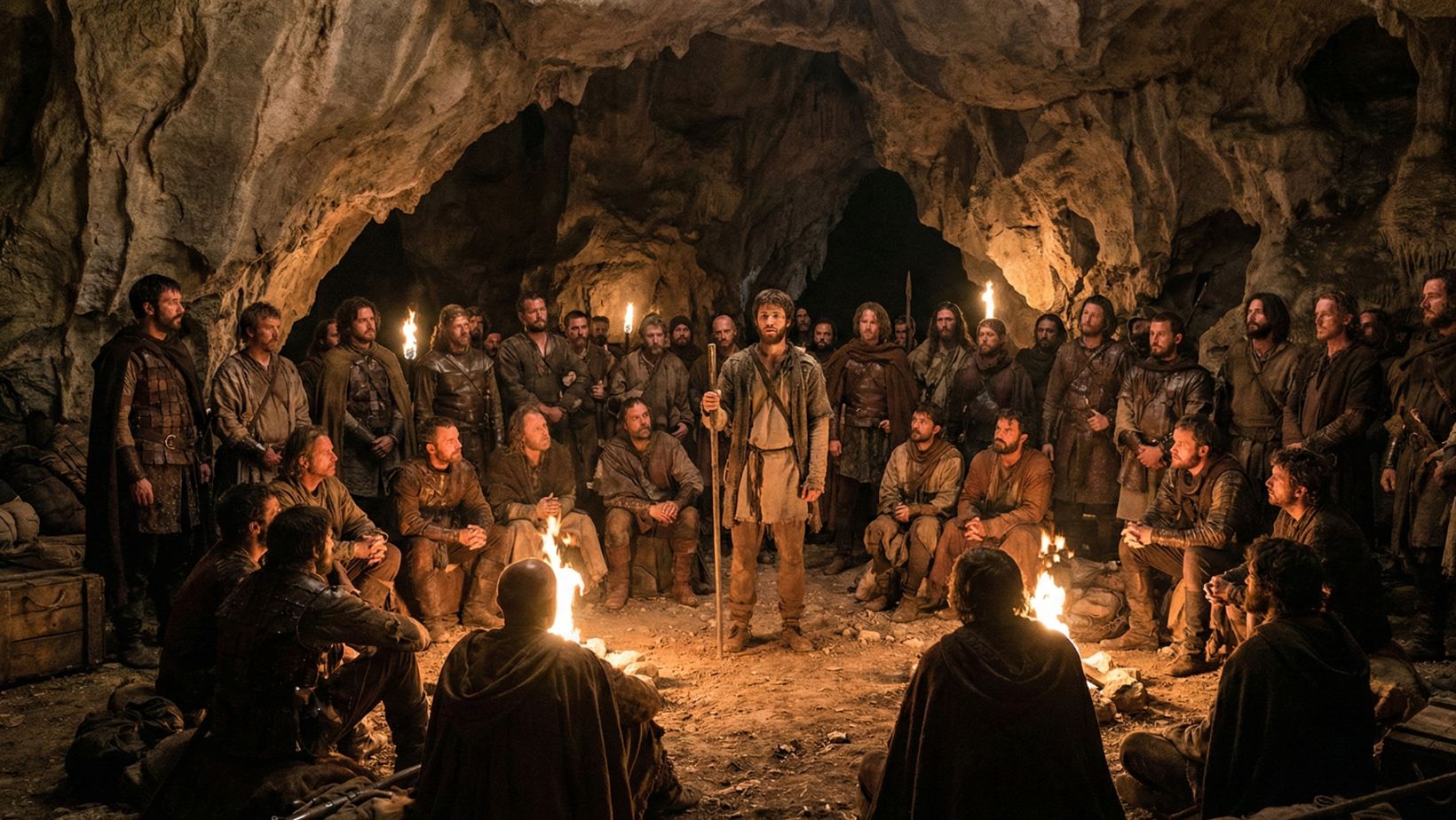
1 Samuel 22 is a chapter of stark contrasts: the birth of a community and the death of a priesthood. It begins in the Cave of Adullam, where David transitions from a solitary fugitive to the commander of a “motley crew” of outcasts—the embryo of his future army. In contrast, Saul’s reign descends into totalitarian brutality. Fueled by paranoia and the treacherous report of Doeg the Edomite, Saul orders the massacre of the priests of Nob for aiding David. The chapter establishes the moral watershed of the book: David protects the outcasts, while Saul slaughters the holy ones.
1. The Cave of Adullam: The Band of Outcasts (1 Samuel 22:1–5 NLT)
1 So David left Gath and escaped to the cave of Adullam. When his brothers and his father’s family heard about it, they went there to see him. 2 Then others began coming—men who were in trouble or in debt or who were just discontented—until David was the captain of about 400 men. 3 Later David went to Mizpeh in Moab. He asked the king of Moab, “Please let my father and mother live here with you until I know what God is going to do for me.” 4 So he brought his parents to the king of Moab, and they stayed there as long as David was living in the stronghold. 5 One day the prophet Gad told David, “Leave the stronghold and return to the land of Judah.” So David went to the forest of Hereth.
Commentary:
- Adullam (v. 1): Located in the Shephelah (foothills) between Philistia and Judah. It was a “no man’s land” riddled with limestone caves, perfect for hiding.
- The 3D Army (v. 2): David’s first followers are not elite soldiers but society’s rejects:
- Distressed: Those under pressure/stress.
- In Debt: Those crushed by the economic policies (likely Saul’s high taxation).
- Discontented: Literally “bitter of soul.” Those wronged by the system.
- Insight: David becomes the captain of the broken. This foreshadows Christ, who came not for the healthy, but for the sick. These men (initially 400, later 600) become the legendary “Mighty Men” (2 Sam 23).
- Moab Connection (v. 3-4): David takes his parents to Moab.
- Prophetic Guidance (v. 5): The prophet Gad (who becomes David’s seer later) commands him to leave the safety of the fortress and go back to Judah.
2. Saul’s Paranoia and Doeg’s Betrayal (1 Samuel 22:6–10 NLT)
6 The news of his arrival was known to Saul. At that time the king was sitting beneath the tamarisk tree on the hill at Gibeah, holding his spear and surrounded by his officers. 7 “Listen here, you men of Benjamin!” Saul shouted to his officers when he heard the news. “Has that son of Jesse promised every one of you fields and vineyards? Has he promised to make you all generals and captains in his army? 8 Is that why you have conspired against me? For not one of you told me when my own son made a solemn pact with the son of Jesse. You’re not even sorry for me. Think of it! My own son—encouraging him to kill me, as he is trying to do this very day!” 9 Then Doeg the Edomite, who was standing there with Saul’s men, spoke up. “When I was at Nob,” he said, “I saw the son of Jesse talking to the priest, Ahimelech son of Ahitub. 10 Ahimelech asked the Lord to find out what David should do. Then he gave David food and the sword of Goliath the Philistine.”
Commentary:
- The Court Scene (v. 6): Saul holds his spear—the symbol of his rule by force. He sits under a tree (a primitive throne room), surrounded by “men of Benjamin.” He has resorted to tribal nepotism, trusting only his own clansmen.
- Saul’s Pity Party (v. 8): Saul plays the victim. “You’re not even sorry for me.” He accuses his son Jonathan of encouraging David to kill him, which is a delusional lie.
- Doeg the Opportunist (v. 9-10): Doeg speaks up to curry favor.
- The Half-Truth: He reports the facts (food, sword, inquiry) but omits the context (David lied to Ahimelech). He frames the priest as a co-conspirator to secure his own promotion.
3. The Massacre at Nob (1 Samuel 22:11–19 NLT)
11 King Saul immediately sent for Ahimelech and all his family, who were the priests at Nob. 12 … 13 “Why have you conspired against me?” Saul demanded… 14 “But sir,” Ahimelech replied, “is there anyone among all your servants who is as faithful as David, your son-in-law? Why, he is the captain of your bodyguard and a highly honored member of your own household! 15 This was certainly not the first time I had consulted God for him! May the king not accuse me and my family in this matter, for I knew nothing at all of any plot against you.” 16 “You will surely die, Ahimelech, along with your entire family!” the king shouted. 17 And he ordered his bodyguards, “Kill these priests of the Lord, for they are allies and conspirators with David! They knew he was running away from me, but they didn’t tell me!” But Saul’s men refused to kill the Lord’s priests. 18 Then the king said to Doeg, “You do it.” So Doeg the Edomite turned on them and killed them that day, eighty-five priests in all, still wearing their priestly garments. 19 Then he went to Nob, the city of the priests, and killed the priests’ families—men and women, children and babies, and all the cattle, donkeys, sheep, and goats.
Commentary:
- Ahimelech’s Defense (v. 14): Ahimelech defends David’s character (“faithful,” “son-in-law”). He exposes the insanity of Saul’s accusation: Of course I helped him; he’s your top general!
- The Unlawful Order (v. 17): Saul orders the execution of Yahweh’s anointed priests.
- The Executioner (v. 18): Doeg, a foreigner with no reverence for Yahweh, has no such qualms. He slaughters 85 men “wearing the linen ephod.”
- Total War (v. 19): The brutality extends to the city of Nob. Saul treats Nob exactly as he was supposed to treat Amalek (herem warfare—killing men, women, babies, animals).
- The Tragic Irony: In Chapter 15, Saul refused to kill the wicked Amalekites. In Chapter 22, he completely destroys the holy city of priests. He spares the wolves but slaughters the shepherds.
4. The Survivor and the Psalm (1 Samuel 22:20–23 NLT)
20 Only Abiathar, one of the sons of Ahimelech, escaped and fled to join David. 21 When he told David that Saul had killed the priests of the Lord, 22 David exclaimed, “I knew it! When I saw Doeg the Edomite there that day, I knew he would tell Saul. Now I have caused the death of all your father’s family. 23 Stay here with me, and don’t be afraid. I will protect you with my own life, for the same person who wants to kill me wants to kill you. You will be safe with me.”
Commentary:
- Abiathar (v. 20): The sole survivor escapes to David, likely bringing the Ephod (High Priestly garment) with him. This transfers the priesthood from Saul to David. Saul now has the crown but no access to God; David has the priest and the prophet (Gad).
- David’s Responsibility (v. 22): Unlike Saul, who blamed everyone else (“the people,” “Samuel,” “Jonathan”), David immediately owns his sin. “I have caused the death.”
- Psalm 52: David wrote Psalm 52 about this event, condemning Doeg: “Why do you boast of evil, O mighty man?”
- The Promise of Safety (v. 23): “Stay with me… You will be safe.” David offers sanctuary. The man who caused the danger becomes the only shield from it.
Theological Significance of 1 Samuel 22
- The Two Kingdoms: The chapter vividly contrasts two types of rule. Saul’s kingdom is built on force, paranoia, and the slaughter of the innocent. David’s kingdom is a refuge for the distressed, the indebted, and the persecuted priesthood.
- Fulfillment of Prophecy: The slaughter at Nob is the grim fulfillment of the curse on the House of Eli (1 Samuel 2:31-33), where God predicted the cutting off of Eli’s line. Doeg is the sword, but God’s judgment stands behind history.
- Guilt by Association: The priests died simply for helping the Lord’s Anointed. This foreshadows the persecution of believers who align themselves with Christ (the Anointed) in a hostile world.
Practical Applications
- Leadership and Conscience: The guards who refused to kill the priests (v. 17) teach us that there is a higher law than the King’s command. We must have the courage to say “no” to authority when it demands sin.
- Owning Your Mess: David’s lie at Nob had catastrophic consequences. While we cannot undo the past, true leadership requires owning the fallout (“I have caused the death”) and working to protect the survivors.
- Adullam Ministry: The church is called to be an “Adullam”—a place where the distressed, indebted, and discontented can come to the Anointed One and be transformed into an army of “mighty men.”
Final Insight
1 Samuel 22 is the darkest hour for the priesthood but the beginning of the true Kingdom. Saul has cut his last tie with Heaven by murdering God’s representatives. From this point on, he is a walking dead man, while David, surrounded by outcasts and the lone priest, carries the hope of Israel in a cave.







Leave a Reply