
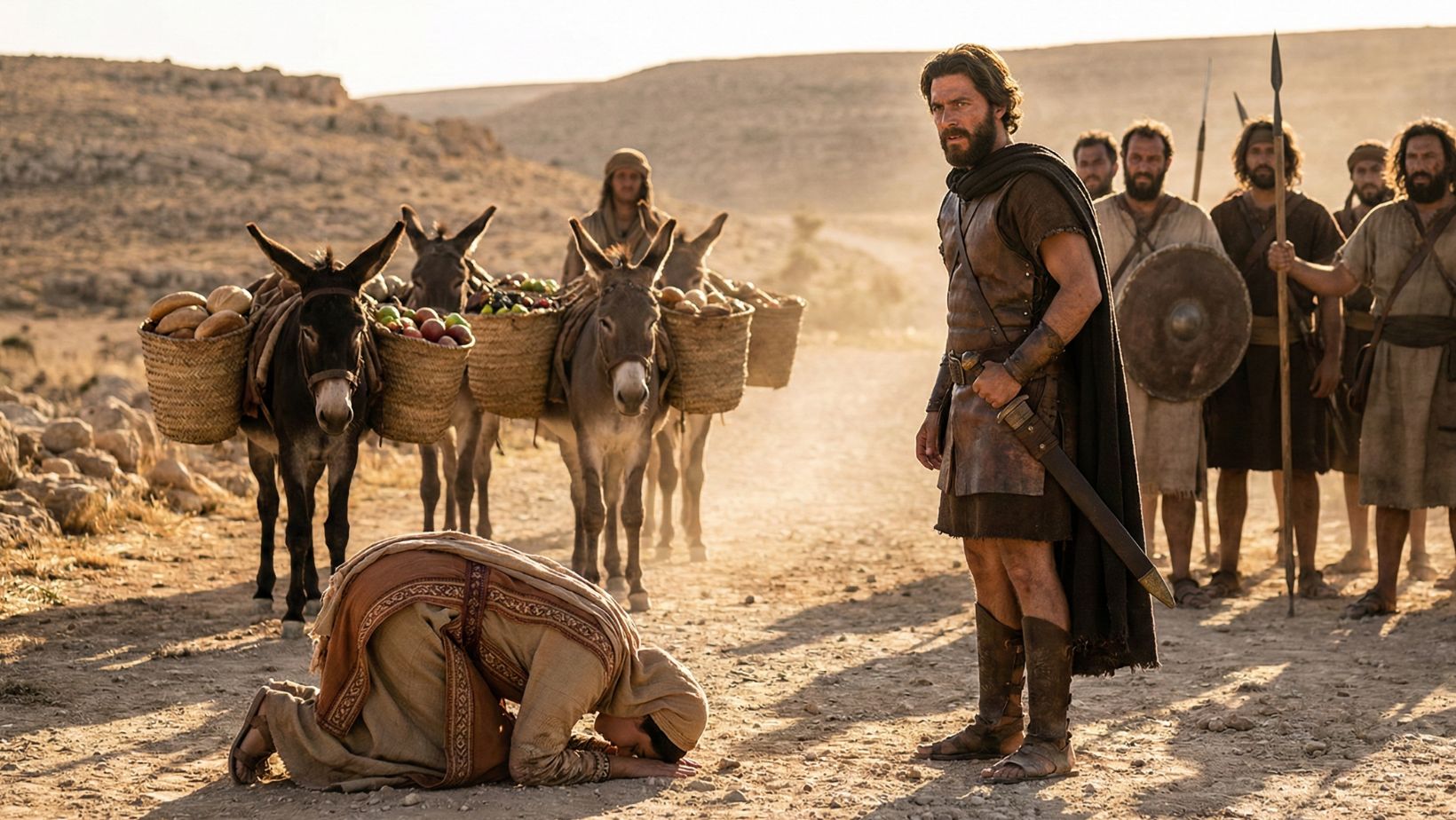
1 Samuel 25 is a masterclass in diplomacy, restraint, and divine justice. It opens with the somber note of Samuel’s death, leaving David without his spiritual mentor. The narrative then zooms in on a conflict in the Judean wilderness between David and a wealthy but foolish landowner named Nabal. When Nabal insults David and refuses to show hospitality despite David’s protection of his flocks, David marches to slaughter Nabal’s entire household. The catastrophe is averted by Nabal’s wife, Abigail, whose quick thinking, generous gifts, and prophetic wisdom stop David from committing mass murder. The chapter contrasts the folly of Nabal (whose name means “Fool”) with the wisdom of Abigail, ending with God striking Nabal dead and David marrying the widow who saved him from himself.
1. The Death of Samuel and the Fool of Maon (1 Samuel 25:1–3 NLT)
1 Now Samuel died, and all Israel gathered for his funeral. They buried him at his house in Ramah. Then David moved down to the wilderness of Maon. 2 There was a wealthy man from Maon who owned property near the town of Carmel. He had 3,000 sheep and 1,000 goats, and it was sheep-shearing time. 3 This man’s name was Nabal, and his wife, Abigail, was a sensible and beautiful woman. But Nabal, a descendant of Caleb, was crude and mean in all his dealings.
Commentary:
- The End of an Era (v. 1): “Samuel died.” The last link to the theocracy and the restraint on Saul is gone. David is now spiritually on his own.
- Geography (v. 2): Maon and Carmel were in the rugged hill country south of Hebron.
- The Character Contrast (v. 3):
- Nabal: The name literally means “Fool” or “Senseless.” He is described as “crude and mean” (literally: “hard and evil in his deeds”). He is a descendant of Caleb (a noble lineage), proving that heritage doesn’t guarantee character.
- Abigail: Described as “sensible” (good understanding) and “beautiful.” She is the total package of wisdom and appearance.
2. The Request and the Insult (1 Samuel 25:4–13 NLT)
4 When David heard that Nabal was shearing his sheep, 5 he sent ten of his young men to Carmel with this message for Nabal: 6 “Peace and prosperity to you, your family, and everything you own! … 7 I have heard that you are shearing your sheep. While your shepherds were with us, we did not harm them, and nothing was ever stolen from them… 8 Ask your own men, and they will tell you this is true. So would you please be kind to us, since we have come at a time of celebration? Please give us any provisions you might have on hand.” … 10 “Who is this fellow David?” Nabal sneered to the young men. “Who does this son of Jesse think he is? There are lots of servants these days who run away from their masters. 11 Should I take my bread and my water and my meat that I’ve slaughtered for my shearers and give it to a band of outlaws who come from who knows where?” … 13 “Get your swords!” was David’s reply as he strapped on his own. …About 400 men started out with David…
Commentary:
- The Context of “Protection Racket” (v. 7): David wasn’t begging; he was collecting a customary gratuity. In the wilderness, David’s army acted as a wall of protection against Bedouin raiders and wild animals. Nabal profited from David’s presence.
- Sheep-Shearing (v. 8): This was a festival time, like harvest, characterized by feasting and generosity.
- The Insult (v. 10): Nabal doesn’t just say “no”; he attacks David’s legitimacy.
- David’s Rage (v. 13): David snaps. The man who spared Saul (Ch 24) is ready to massacre Nabal over a bread insult. It shows that we are often more patient with big enemies (Saul) than small annoyances (Nabal).
3. Abigail’s Intercession (1 Samuel 25:14–31 NLT)
14 Meanwhile, one of Nabal’s servants went to Abigail and told her, “David sent messengers from the wilderness to greet our master, but he screamed insults at them. 15 These men were very good to us, and we never suffered any harm from them… 16 In fact, day and night they were like a wall of protection to us and the sheep. 17 You need to know this and figure out what to do, for there is going to be trouble for our master and his whole family. He’s so ill-tempered that no one can even talk to him!” 18 Abigail wasted no time. She quickly gathered 200 loaves of bread, two wineskins full of wine, five sheep that had been slaughtered and dressed, five measures of roasted grain, 100 clusters of raisins, and 200 fig cakes… 23 When Abigail saw David, she quickly got off her donkey and bowed low before him. 24 she said, “I accept all blame in this matter, my lord… 25 I know Nabal is a wicked and ill-tempered man; please don’t pay any attention to him. He is a fool, just as his name suggests. But I never even saw the young men you sent. 26 …the Lord has kept you from murdering and taking vengeance into your own hands. 28 …For the Lord will surely make you a lasting dynasty… 29 Even when you are chased by those who seek to kill you, your life is safe in the care of the Lord your God, secure in his treasure pouch! But the lives of your enemies will disappear like stones shot from a sling! 30 When the Lord has done all he promised and has made you leader of Israel, 31 don’t let this be a blemish on your record.”
Commentary:
- The Servant’s Testimony (v. 14-17): The servants know Nabal is a “son of Belial” (worthless/wicked) and cannot be reasoned with. They turn to the true leader of the house: Abigail.
- Diplomacy by Food (v. 18): Abigail understands that hungry soldiers are angry soldiers. She sends a massive feast ahead to pacify them (similar to Jacob appeasing Esau).
- Abigail’s Speech (v. 24-31): This is one of the most persuasive speeches in the Bible.
- Taking the Blame (v. 24): She absorbs the guilt, disarming David’s anger.
- Defining Nabal (v. 25): She confirms Nabal is a fool, effectively saying, “Don’t get blood on your sword killing an idiot; he’s beneath you.”
- Prophetic Insight (v. 28): She affirms David’s “lasting dynasty” (years before the Davidic Covenant in 2 Sam 7). She sees what her husband missed.
- The Sling Metaphor (v. 29): She uses David’s own history (“stones shot from a sling”) to encourage him that God will handle his enemies.
- Future Regret (v. 31): She appeals to his conscience: “Don’t do something today that you will regret when you are King.” She protects his future legacy.
4. David’s Response and Nabal’s End (1 Samuel 25:32–38 NLT)
32 David replied to Abigail, “Praise to the Lord, the God of Israel, who has sent you to meet me today! 33 Thank God for your good sense! Bless you for keeping me from murder and from carrying out vengeance with my own hands. 34 For I swear by the Lord… if you had not quickly come to meet me, not one of Nabal’s men would have been alive tomorrow morning.” … 36 When Abigail arrived home, she found that Nabal was throwing a huge party and was celebrating like a king. He was very drunk, so she didn’t tell him anything about her meeting with David until dawn the next day. 37 In the morning, when Nabal was sober, his wife told him what had happened. As a result he had a stroke, and he lay paralyzed on his bed like a stone. 38 About ten days later, the Lord struck Nabal, and he died.
Commentary:
- David’s Humility (v. 32): David is teachable. He recognizes God’s voice in a woman’s wisdom. He praises her “good sense” (discretion).
- The “Stroke” (v. 37): “His heart died within him, and he became as a stone.” The shock of realizing how close he came to death—and perhaps the financial loss of the gift Abigail gave—caused a medical crisis (stroke/heart attack).
- Divine Execution (v. 38): “The Lord struck Nabal.”
5. Marriage and Politics (1 Samuel 25:39–44 NLT)
39 When David heard that Nabal was dead, he said, “Praise the Lord, who has avenged the insult I received from Nabal… Now the Lord has paid Nabal back for all his evil.” Then David sent messengers to Abigail to ask her to become his wife. … 42 Abigail wasted no time… she became his wife. 43 David also married Ahinoam from Jezreel, making both of them his wives. 44 Saul, meanwhile, had given his daughter Michal, David’s wife, to a man from Gallim named Palti son of Laish.
Commentary:
- The Marriage Proposal (v. 39): In the ancient world, marrying the widow of a wealthy Calebite was a shrewd political move. It gave David influence in the region of Hebron (where he would later be crowned king).
- Polygamy (v. 43): David marries Abigail and Ahinoam. While allowed in the OT, polygamy always brings trouble in David’s household (rivalry between children).
- Michal Given Away (v. 44): Saul burns the bridge completely by giving David’s first wife to another man. This was intended to delegitimize David’s claim to the throne through marriage.
Theological Significance of 1 Samuel 25
- Restraining Grace: God often uses wise counselors (like Abigail) to stop us from sinning when our temper flares. David calls her intervention a mission “from the Lord” (v. 32).
- The Character of the Fool: Nabal represents the person who lives only for this life (“eating like a king,” v. 36), hoards resources, and despises God’s anointed. His end is sudden and tragic.
- God as Avenger: This chapter proves the thesis of Romans 12:19. David did not need to lift a finger against Nabal; God handled the judgment perfectly and with better timing.
Practical Applications
- The Power of Soft Answers: Abigail proves that “a soft answer turns away wrath” (Proverbs 15:1). Her humility disarmed 400 armed men. Diplomacy is often stronger than force.
- Looking at the “Bundle”: Abigail reminded David that his life was “bound in the bundle of the living” with God. When we feel threatened, we must remember we are securely held by God, so we don’t need to panic or lash out.
- Wait for 10 Days: Nabal died 10 days later. Sometimes we just need to wait a little while to see God deal with a situation that frustrates us. Impatience leads to sin; patience leads to worship.
Final Insight
1 Samuel 25 is a sandwich of wisdom between two slices of foolishness (Saul in Ch 24 and Ch 26). David nearly fails the test by acting like Nabal (angry and vengeful), but he is saved by a woman who acts like Christ—interceding, bearing the burden, and bringing peace.







Leave a Reply