
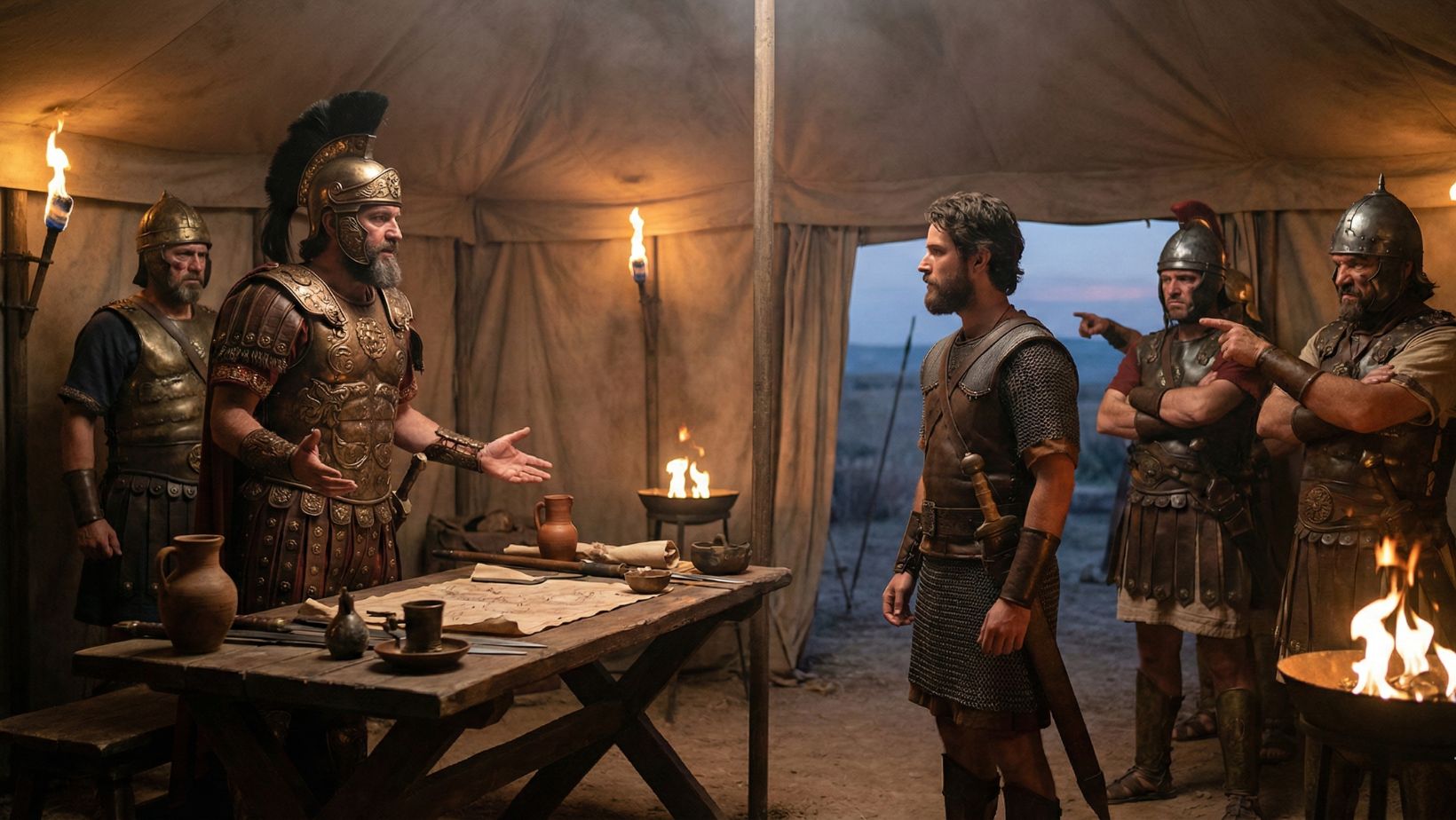
1 Samuel 29 functions as a crucial “escape hatch” narrative in the life of David. While Saul is receiving his death sentence at Endor (Chapter 28), David is in a precarious situation at Aphek. He has marched out with the Philistine army, ostensibly to fight against King Saul and Israel. If David fights, he destroys his claim to the throne of Israel; if he refuses, he risks being executed by the Philistines for treason. In a turn of divine providence, the Philistine commanders—remembering David’s past victories—reject him. They force King Achish to send David home. This rejection is God’s protection, sparing David from a moral catastrophe and setting him up to rescue his own family in the next chapter.
1. The Philistine Commanders Reject David (1 Samuel 29:1–5)
1 The entire Philistine army now mobilized at Aphek, and the Israelites camped at the spring in Jezreel. 2 As the Philistine rulers were leading out their troops in groups of hundreds and thousands, David and his men marched at the rear with King Achish. 3 But the Philistine commanders demanded, “What are these Hebrews doing here?” And Achish told them, “This is David, the servant of King Saul of Israel. He’s been with me for years, and I’ve never found a single fault in him from the day he arrived until today.” 4 But the Philistine commanders were angry. “Send him back to the town you gave him!” they demanded. “He can’t go into the battle with us. What if he turns against us in battle and becomes our adversary? Is there any better way for him to reconcile with his master than by turning on our heads? 5 Isn’t this the same David about whom the women of Israel sing in their dances: ‘Saul has killed his thousands, and David his ten thousands’?”
Commentary:
- Geographical Context (v. 1): The armies gather at Aphek. This is significant because Aphek was the site of a previous disastrous defeat for Israel where the Ark of the Covenant was captured (1 Samuel 4). The Israelites are camped at the spring in Jezreel (near Gilboa), preparing for the battle where Saul will die.
- The Providential Conflict (v. 3): Achish, the King of Gath, trusts David implicitly, defending him as a loyal servant. However, the other “Philistine commanders” (the lords of the other four city-states: Ashdod, Ashkelon, Ekron, and Gaza) are deeply suspicious.
- “These Hebrews” (v. 3): The commanders use the term “Hebrews” (Ivrim) as a derogatory ethnic slur, marking David as an outsider who does not belong.
- Military Logic (v. 4): The commanders are strategically astute. They fear a “fifth column” attack—that David will switch sides mid-battle to regain favor with Saul. Historically, Hebrew mercenaries had defected from the Philistines before (1 Samuel 14:21), giving the commanders valid precedent for their fear.
- The Song Returns (v. 5): The commanders quote the hit song of Israel: “Saul has killed his thousands, and David his ten thousands” (first seen in 1 Samuel 18:7).
2. Achish Dismisses David (1 Samuel 29:6–11)
6 So Achish finally summoned David and said to him, “I swear by the Lord that you have been a trustworthy ally. I think you should go with me into battle, for I’ve found no fault in you from the day you arrived until today. But the other Philistine rulers won’t hear of it. 7 Please, go back quietly and don’t do anything to offend the Philistine rulers.” 8 “What have I done to deserve this treatment?” David demanded. “What have you found in your servant since the day I came to you? Why can’t I go and fight the enemies of my lord the king?” 9 But Achish insisted, “As far as I’m concerned, you’re as perfect as an angel of God. But the Philistine commanders are afraid to have you with them in the battle. 10 Now get up early in the morning, and leave with your men as soon as it gets light.” 11 So David and his men started back early in the morning to return to the land of the Philistines, while the Philistine army went on to Jezreel.
Commentary:
- Achish’s Swear (v. 6): Achish swears “by the Lord” (literally As Yahweh lives). This is stunning irony. A Philistine king swears by the God of Israel to affirm David’s integrity, while the King of Israel (Saul) is consulting a medium. It shows how convinced Achish was of David’s loyalty.
- David’s Protest (v. 8): David protests, asking, “Why can’t I go and fight?”
- Interpretation: Scholars debate whether this is genuine or a brilliant bluff.
- If genuine: David had become so darkened by his time among the Philistines that he was actually willing to fight God’s people.
- If a bluff (more likely): David maintains his cover to the very end. He feigns offense so that Achish doesn’t suspect he is secretly relieved. He refers to “the enemies of my lord the king”—ambiguous language that could refer to Achish or Saul.
- Interpretation: Scholars debate whether this is genuine or a brilliant bluff.
- “Angel of God” (v. 9): Achish compares David to an “angel of God” (Malak Elohim). This mirrors the woman of Tekoa’s description of David later (2 Samuel 14:17). It highlights David’s charisma and ability to inspire loyalty, even in his enemies.
- The Timing (v. 10-11): Achish orders an early morning departure. This is critical timing. By leaving immediately, David and his men are removed from the war zone and begin the three-day march back to Ziklag. This timing places them in the exact position necessary to handle the catastrophe awaiting them in Chapter 30 (the Amalekite raid). If they had stayed even one more day, their families might have been lost forever.
Theological Significance of 1 Samuel 29
- Providence through Rejection: This chapter is a prime example of God closing a door to save His servant. David was walking into a trap of his own making. God used the hostility of the Philistine commanders to rescue David from a situation where he would have either sinned against Israel or died as a traitor. Sometimes, rejection by people is protection by God.
- God’s Restraining Grace: God prevented David from shedding Israelite blood. David was destined to be King of Israel; had he participated in the Battle of Gilboa (where Saul and Jonathan died), he would have been forever viewed as a usurper and a murderer of the Lord’s anointed. God preserved David’s reputation despite David’s questionable decisions.
- The Blindness of the World: Achish represents the “world” that can be easily deceived by a believer’s exterior behavior, while the commanders represent the hostility of the world that remembers the believer’s true allegiance.
Practical Applications
- Trusting God in Rejection: When we are rejected from a job, a relationship, or an opportunity, it is easy to feel bitter. However, we should consider that God might be using that rejection to keep us from a situation that would be spiritually or morally damaging.
- The Danger of Compromise: David’s alliance with Achish put him in an impossible bind. Living too close to the “enemy” (morally or spiritually) eventually forces a choice where there are no good options. We should avoid putting ourselves in positions where our loyalty to God is tested by our alliances with the world.
- God’s Timing is Perfect: The forced departure seemed like an insult, but it was a rescue mission. We must trust that when God moves us, He is positioning us for the next battle we need to fight (in David’s case, saving his family in Chapter 30).
Final Insight
1 Samuel 29 serves as the quiet before the storm. It juxtaposes Saul’s active rebellion in Chapter 28 with David’s passive deliverance. While Saul is condemned to die, David is graciously dismissed to live. It shows that even when God’s servants wander into compromising situations, God’s sovereign hand is capable of extracting them to preserve His greater purpose for their lives.







Leave a Reply