
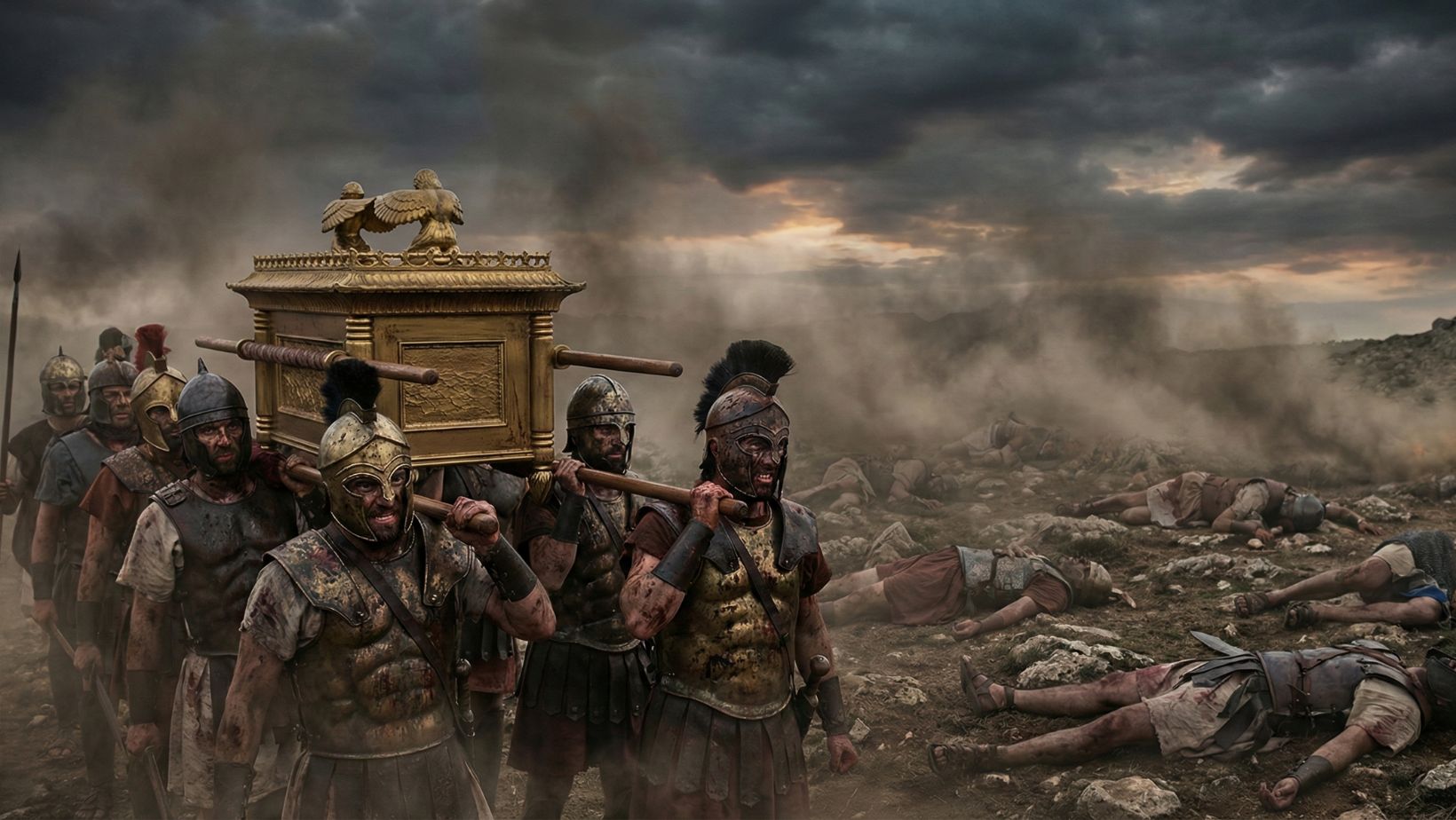
1 Samuel 4 details the tragic fulfillment of the prophecy given to Samuel in the previous chapter. It chronicles a disastrous double defeat of Israel by the Philistines. In a desperate and superstitious attempt to force God’s hand, the Israelites bring the Ark of the Covenant onto the battlefield, treating it like a good luck charm. The result is catastrophic: 30,000 soldiers are killed, Eli’s two corrupt sons (Hophni and Phinehas) die, and the Ark of God is captured by the enemy. The chapter concludes with the death of Eli and his daughter-in-law, who names her newborn son “Ichabod,” signifying that “the glory has departed from Israel.”
1. The First Defeat (1 Samuel 4:1–2 NLT)
1 At that time Israel was at war with the Philistines. The Israelite army camped near Ebenezer, and the Philistines camped at Aphek. 2 The Philistines attacked and defeated the Israelite army, killing about 4,000 men.
Commentary:
- The Aggressors (v. 1): The Philistines were a sea-faring people who settled on the southern coast of Canaan. They were technologically superior (possessing iron weapons) and were Israel’s primary nemesis during this era.
- Geography (v. 1): Aphek was a strategic location at the northern edge of the Philistine plain, a launching point for invasions into the hill country of Israel. The Israelites camped at Ebenezer (“Stone of Help”), though the name was likely given later by Samuel (1 Sam 7:12), used here by the narrator anachronistically for clarity.
- The Lack of Inquiry (v. 2): Unlike successful battles in Joshua’s time or later under David, there is no record here of Israel inquiring of the Lord before engaging in battle. They went out in their own strength and lost 4,000 men.
2. A Superstitious Solution (1 Samuel 4:3–9 NLT)
3 After the battle was over, the troops retreated to their camp, and the elders of Israel asked, “Why did the Lord allow us to be defeated by the Philistines?” Then they said, “Let’s bring the Ark of the Covenant of the Lord from Shiloh. If we carry it into battle with us, it will save us from our enemies.” 4 So they sent men to Shiloh to bring the Ark of the Covenant of the Lord of Heaven’s Armies, who sits enthroned between the cherubim. Hophni and Phinehas, the sons of Eli, were also there with the Ark of the Covenant of God. 5 When all the Israelites saw the Ark of the Covenant of the Lord entering the camp, their shout of joy was so loud it made the ground shake! 6 “What’s going on?” the Philistines asked. “What’s all the shouting about in the Hebrew camp?” When they were told it was because the Ark of the Lord had arrived, 7 they panicked. “The gods have come into their camp!” they cried. “This is a disaster! We have never had to face anything like this before! 8 Help! Who can save us from these mighty gods of Israel? They are the same gods who destroyed the Egyptians with plagues when Israel was in the wilderness. 9 Fight as never before, Philistines! If you don’t, we will become the Hebrews’ slaves just as they have been ours! Stand up like men and fight!”
Commentary:
- The Right Question, Wrong Answer (v. 3): The elders correctly ask, “Why did the Lord allow us to be defeated?” acknowledging God’s sovereignty. However, instead of repenting of their national sin or consulting Samuel, they devise a mechanical solution: use the Ark.
- The Object vs. The Person (v. 3): They said, “It will save us.” They placed their faith in the wooden box (the object) rather than in Yahweh (the Person). This is the essence of idolatry—using spiritual forms to manipulate outcomes without relational submission.
- The Presence of Corruption (v. 4): The Ark is accompanied by Hophni and Phinehas. Their presence signals doom, as they are currently under a divine death sentence (1 Sam 2:34). It is absurd to expect God’s blessing when led by leaders who despise Him.
- Psychological Warfare (v. 5-7): The arrival of the Ark boosts Israel’s morale and terrifies the Philistines. The Philistines, being polytheists, assume the Ark is a literal deity (“The gods have come”).
- Irony of Memory (v. 8): The Philistines remember the Exodus and the plagues better than Israel does. They fear the God of the Exodus, while Israel treats Him casually.
- Philistine Resolve (v. 9): Fear drives the Philistines to fight harder (“Stand up like men”), whereas false confidence makes Israel fight poorly.
3. The Great Disaster (1 Samuel 4:10–11 NLT)
10 So the Philistines fought desperately, and Israel was defeated again. The slaughter was great; 30,000 Israelite soldiers died that day. The survivors turned and fled to their tents. 11 The Ark of God was captured, and Hophni and Phinehas, the two sons of Eli, were killed.
Commentary:
- Total Defeat (v. 10): The strategy backfires completely. Instead of losing 4,000, they lose 30,000. It is a massacre.
- Prophecy Fulfilled (v. 11): Two specific signs given to Eli come to pass:
- Hophni and Phinehas die on the same day (predicted in 1 Sam 2:34).
- The capture of the Ark: This was unthinkable to the Israelite mind. It signified that God had abandoned His throne in Israel. God preferred to go into exile among pagans rather than remain with a corrupt people who tried to manipulate Him.
4. The Death of Eli (1 Samuel 4:12–18 NLT)
12 A man from the tribe of Benjamin ran from the battlefield and arrived at Shiloh later that same day. He had torn his clothes and put dust on his head to show his grief. 13 Eli was waiting beside the road to watch, for he was trembling with anxiety about the Ark of God. When the messenger arrived and told what had happened, the whole town began to cry out. 14 “What is all this noise about?” Eli asked. The messenger rushed over to Eli and told him the news. 15 (Eli was ninety-eight years old and blind.) 16 “I have just come from the battlefield,” the messenger told him. “I fled from there today.” “What happened, my son?” Eli demanded. 17 “Israel has been defeated by the Philistines,” the messenger replied. “The people have been slaughtered, and your two sons, Hophni and Phinehas, were also killed. And the Ark of God has been captured.” 18 When the messenger mentioned what had happened to the Ark of God, Eli fell backward from his seat beside the gate. He broke his neck and died, for he was old and overweight. He had been Israel’s judge for forty years.
Commentary:
- The Messenger (v. 12): Jewish tradition (Midrash) suggests this runner was Saul (a Benjaminite), though the text does not explicitly say so.
- Eli’s Anxiety (v. 13): Eli is sitting by the gate “trembling.” He knows the spiritual danger of taking the Ark. Though he is a weak father, his heart still cares for the things of God.
- The Four Blows (v. 17): The news is delivered in escalating severity:
- Israel fled.
- Great slaughter (30,000 dead).
- Your sons are dead (Personal tragedy).
- The Ark is captured (Theological catastrophe).
- The Cause of Death (v. 18): It is specifically “when the messenger mentioned… the Ark of God” that Eli falls. He could bear the death of his sons, but the loss of the Ark—the separation of God’s glory from His people—was too much.
- Physical Note (v. 18): The text mentions he was “heavy” (overweight). This connects back to 1 Sam 2:29, where the “man of God” accused Eli of “fattening” himself on the choice parts of the offerings. His physical state, a result of his sons’ corruption, contributes to his death.
5. Ichabod: The Glory Departs (1 Samuel 4:19–22 NLT)
19 Eli’s daughter-in-law, the wife of Phinehas, was pregnant and near her time of delivery. When she heard that the Ark of God had been captured and that her father-in-law and husband were dead, she went into labor and gave birth. 20 She died in childbirth, but before she passed away the midwives tried to encourage her. “Don’t be afraid,” they said. “You have a baby boy!” But she did not answer or pay attention. 21 She named the child Ichabod (which means “Where is the glory?”), for she said, “Israel’s glory is gone.” She named him this because the Ark of God had been captured and because her father-in-law and husband were dead. 22 Then she said, “The glory has departed from Israel, for the Ark of God has been captured.”
Commentary:
- Tragic Labor (v. 19): The shock induces labor. Phinehas’s wife is one of the few tragic figures in this house who seems to have genuine spiritual sensitivity.
- A Joyless Birth (v. 20): In ancient culture, the birth of a son was the highest joy. Here, she “did not answer or pay attention.” The national and spiritual loss outweighed the personal joy of birth.
- Ichabod (v. 21): The name Ichabod (Hebrew: Iy-kavod) literally translates to “No Glory” or “Where is the Glory?”
- The Theological Climax (v. 22): She repeats the phrase: “The glory has departed.”
- The Kabod (Glory): This refers to the weighty, visible presence of God (Shekinah) that dwelt above the Cherubim.
- With the Ark gone, the Tabernacle at Shiloh was just an empty tent. The structure remained, but the Essence had left. This marks the end of the Shiloh era (see Jeremiah 7:12-14).
Theological Significance of 1 Samuel 4
- God Cannot Be Manipulated: The Israelites treated the Ark like a talisman. This chapter teaches that God is not a tool to be used for human ends. Possessing the symbols of religion (Ark, cross, Bible) without a relationship of obedience offers no protection.
- Judgment Begins at the House of God: Before God dealt with the Philistines (which He does in chapter 5), He first judged His own people for their corruption.
- The Departure of Glory: This is a major theme in Scripture (see Ezekiel 10). When God’s people persist in sin, His presence eventually withdraws, leaving them to the natural consequences of their choices.
Practical Applications
- Faith vs. Superstition: We must examine our own faith. do we trust in God Himself, or do we trust in religious routines, objects, or past experiences to save us?
- The Danger of Presumption: Entering spiritual battles with unconfessed sin and without seeking God’s specific will is a recipe for disaster.
- Valuing God’s Presence: Eli’s death shows that for a true believer, the loss of God’s presence should be more grievous than the loss of life or family. We should treasure the Holy Spirit’s presence above all else.
Final Insight
1 Samuel 4 is one of the darkest chapters in Israel’s history. It strips away every false prop—the army, the priesthood, and even the physical Ark—leaving the nation completely naked before its enemies. Yet, this total dismantling was necessary to clear the way for Samuel’s reformation and the eventual rise of a king who would seek God’s heart.







Leave a Reply