
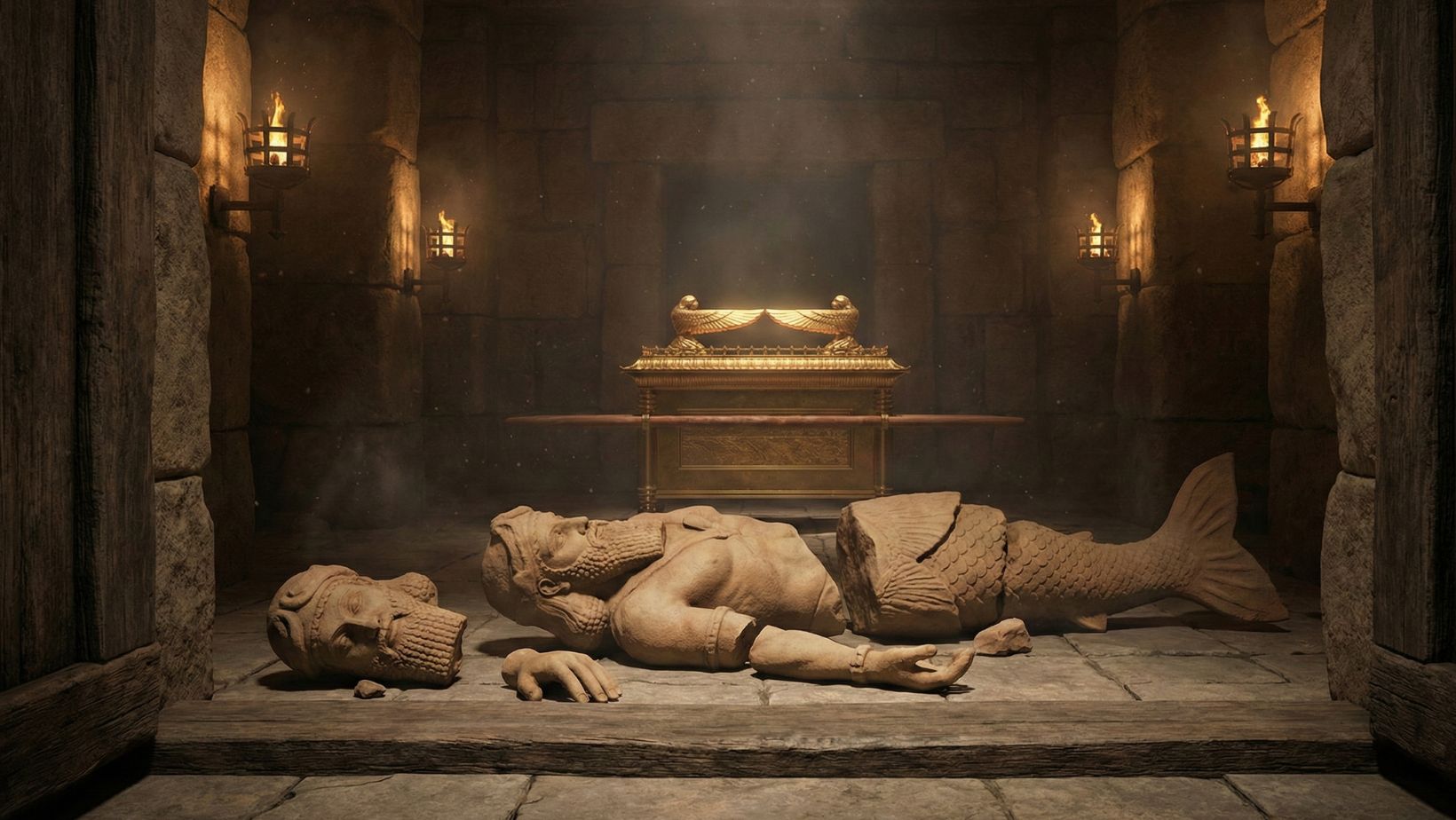
1 Samuel 5 is a narrative rich with divine irony and theological power. While Israel mourns the loss of the Ark, assuming God has been defeated, the Ark itself goes on a victorious “tour” through the major cities of the Philistines. The chapter demonstrates that Yahweh does not need an army to defend His reputation. He invades the temple of Dagon, humiliating the Philistine false god, and then strikes the Philistine populace with a plague of tumors. The chapter shifts the Philistine attitude from triumphant celebration to terrified desperation, as they realize they have captured a Power they cannot control.
1. Yahweh vs. Dagon: The Battle of the Gods (1 Samuel 5:1–5 NLT)
1 After the Philistines captured the Ark of God, they took it from the battlefield at Ebenezer to the city of Ashdod. 2 They carried the Ark of God into the temple of Dagon and placed it beside an idol of Dagon. 3 But when the citizens of Ashdod went to see it the next morning, Dagon had fallen with his face to the ground in front of the Ark of the Lord! So they took Dagon and put him back in his place. 4 But when they went to see it the next morning, Dagon had fallen with his face to the ground in front of the Ark of the Lord. This time, Dagon’s head and hands had broken off and were lying in the doorway. Only the trunk of his body was left intact. 5 (That is why to this day neither the priests of Dagon nor anyone who enters the temple of Dagon in Ashdod steps on the threshold. Instead, they jump over it.)
Commentary:
- Ashdod and Dagon (v. 1-2): Ashdod was one of the five major Philistine cities (the Pentapolis). Placing the Ark in Dagon’s temple was not just storage; it was a victory ritual. In the ancient Near East, placing a captured god’s image in your god’s temple signified that your god had conquered the rival deity. They viewed Yahweh as a vassal to Dagon.
- Dagon’s Identity: Dagon was a major Semitic deity, often associated with grain (fertility) or represented as a fish-god (merman-like figure). He was the father of Baal in some pantheons.
- The First Morning: Forced Worship (v. 3): The Philistines find Dagon “face to the ground.” This is the universal posture of worship. The irony is sharp: The conqueror (Dagon) is bowing to the captive (Yahweh).
- “Put him back in his place”: This highlights the impotence of idols. Dagon cannot even stand up without human help (contrast with Isaiah 46:1–7).
- The Second Morning: Execution (v. 4): The judgment escalates. Dagon is not just bowing; he is dismembered.
- Head removed: Signifies loss of wisdom and authority.
- Hands removed: Signifies loss of power and strength.
- Location: They are lying in the “doorway” or threshold—a place where people walk. The god is treated as refuse.
- The Threshold Superstition (v. 5): The event was so traumatic it created a permanent liturgical custom among the Philistines to avoid stepping on the threshold.
2. The Plague of Ashdod (1 Samuel 5:6–8 NLT)
6 Then the Lord’s heavy hand struck the people of Ashdod and the nearby villages with a plague of tumors. 7 When the people of Ashdod saw what was happening, they said, “The Ark of the god of Israel must not stay here any longer! His hand is heavy upon us and upon Dagon our god.” 8 So they called together the rulers of the five Philistine towns and asked, “What should we do with the Ark of the god of Israel?” The rulers replied, “Move it to the town of Gath.” So they moved the Ark of the god of Israel to Gath.
Commentary:
- The Heavy Hand (v. 6): The phrase “heavy hand” (Hebrew: kaved) is a pun. The word for “glory” (kavod) comes from the root for “heavy.” Israel lost the “glory” (ch. 4), but the Philistines are feeling the “heaviness” of God’s presence in a negative way.
- The Nature of the Plague (v. 6): The text mentions “tumors” (Hebrew: apholim).
- Older translations use “emerods” (hemorrhoids).
- Modern scholarship, linking this with the mention of “rats/mice” in Chapter 6, often suggests Bubonic Plague, which causes painful swelling of lymph nodes (buboes) in the groin and armpits.
- Regardless of the medical diagnosis, it was painful, humiliating, and deadly.
- The Political Council (v. 8): The Philistine government was a confederation of five city-states (Ashdod, Gaza, Ashkelon, Gath, Ekron). They convene to solve the “Yahweh problem.”
- The Decision to Move (v. 8): They treat the Ark like a radioactive object or a hot potato. They assume the plague is local to Ashdod or coincidental, so they send it to Gath.
3. Panic in Gath and Ekron (1 Samuel 5:9–12 NLT)
9 But when the Ark arrived at Gath, the Lord’s heavy hand fell on its men, young and old; he struck them with a panic and with tumors. 10 So they sent the Ark of God to the town of Ekron, but when the people of Ekron saw it coming they cried out, “They are bringing the Ark of the god of Israel here to kill us and our people!” 11 The people summoned the Philistine rulers again and begged them, “Please send the Ark of the god of Israel back to its own country, or it will kill us all.” For the deadly plague from God had already begun, and great fear was sweeping across the town. 12 Those who didn’t die were afflicted with tumors; and the cry of the town rose to heaven.
Commentary:
- Escalation in Gath (v. 9): Gath was likely the largest Philistine city (home of Goliath). The strategy of moving the Ark failed; the plague followed immediately, proving the deity was attached to the Ark and was omnipresent. The “panic” suggests a riot or social breakdown.
- Rejection at Ekron (v. 10): By the time the Ark reaches Ekron (the northernmost city), the reputation of Yahweh has preceded it. The people of Ekron view the arrival of the Ark not as a victory parade, but as a death sentence (“to kill us and our people”).
- Deadly Destruction (v. 11-12): The situation becomes critical. It is no longer just sickness; it is “deadly destruction.” The mortality rate is high (“Those who didn’t die were afflicted”).
- The Cry to Heaven (v. 12): This mirrors the cry of the Israelites in Egypt (Exodus 2:23). The irony is complete: The Philistines, who thought they had captured Israel’s God, are now begging to be released from His grip. They are forced to acknowledge His supremacy.
Theological Significance of 1 Samuel 5
- Monotheism in a Polytheistic World: The ancient worldview was that a nation’s defeat meant their god was weak. God destroys this logic. He allowed Israel to be defeated to judge their sin (Ch 4), but He defeats Dagon to show that He is not subject to human armies. He fights His own battles.
- The Incompatibility of God: The Philistines tried to add Yahweh to their pantheon (syncretism). The falling of Dagon shows that Yahweh will not share space with idols. He demands exclusive worship.
- God’s Presence as Blessing or Curse: The Ark was the source of joy and victory for a faithful Israel, but it became a source of death and plague for the rebellious Philistines. The presence of God is a consuming fire—purifying to some, destructive to others.
Practical Applications
- God Defends His Own Name: We often feel the need to “defend” God or the Church. This chapter reminds us that God is perfectly capable of defending His own glory. Our job is to be faithful, not to be His bodyguards.
- No Compromise with Idols: Just as the Ark could not coexist with Dagon, the Holy Spirit cannot coexist with idols in the human heart. If we try to bring God into a life cluttered with other “gods” (money, power, self), He will eventually topple them.
- The Danger of Treating God Commonly: The Philistines treated the Ark as a trophy/curio. Many today treat Jesus as a “lucky charm” or just another spiritual teacher to add to their shelf. God demands to be Lord of all, or He is not Lord at all.
Final Insight
1 Samuel 5 presents a God who is untamable. The Israelites couldn’t force Him to work for them, and the Philistines couldn’t contain Him as a prisoner. The chapter serves as a bridge: it proves that while Israel (the people) had failed, Yahweh (the God) had not. The King is still on the throne, even if His throne is currently sitting in a pagan temple, smashing idols in the dark.







Leave a Reply