
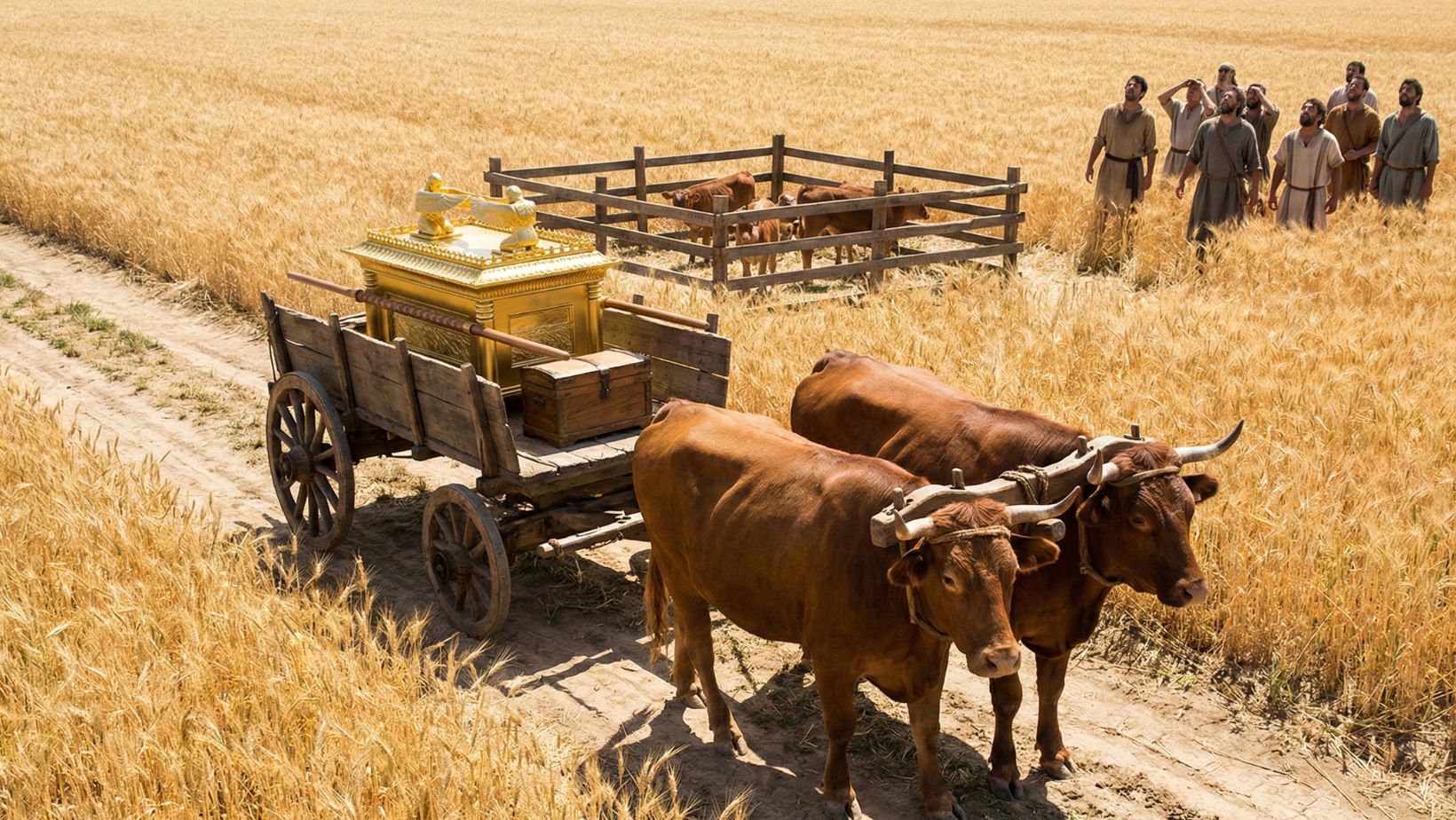
1 Samuel 6 describes the resolution of the “Ark crisis.” After seven months of plague and devastation, the Philistines are desperate to return the Ark of the Covenant to Israel but want to ensure their suffering was truly divine judgment and not just bad luck. They devise a test involving two milk cows and a cart, accompanied by a guilt offering of golden tumors and rats. The cows miraculously ignore their maternal instincts and head straight for the Israelite border town of Beth-shemesh. The chapter concludes with a mixture of joy and terror: the Israelites welcome the Ark, but their lack of reverence leads to another deadly outbreak, prompting them to send the Ark away to Kiriath-jearim.
1. The Pagan Inquiry and the Guilt Offering (1 Samuel 6:1–9 NLT)
1 The Ark of the Lord remained in Philistine territory seven months. 2 The Philistines called for their priests and diviners and asked them, “What should we do with the Ark of the Lord? Tell us how to send it back to its own country.” 3 “If you send the Ark of the God of Israel away,” they replied, “do not send it empty. You must present a guilt offering to him. Then you will be healed, and you will know why his hand has not been lifted from you.” 4 “What sort of guilt offering should we send?” they asked. And they were told, “Since the plague has struck both you and your five rulers, make five gold tumors and five gold rats, just like those that have ravaged your land. 5 Make these likenesses of the tumors and of the rats that are ruining your land, and give glory to the God of Israel. Perhaps he will stop afflicting you and your gods and your land. 6 Don’t be stubborn and rebellious as Pharaoh and the Egyptians were. They wouldn’t let Israel go until God had ravaged them with dreadful plagues. 7 “Now build a new cart, and find two cows that have just given birth to calves and have never been yoked. Hitch the cows to the cart, but take their calves away and keep them in a pen. 8 Place the Ark of the Lord on the cart, and put the box containing the gold objects for your guilt offering next to it. Then let the cows go wherever they want. 9 Watch how they go. If they go up the road to their own land of Beth-shemesh, then we will know that it is the Lord who has done this great evil to us. But if they go in the other direction, then we will know that it was not his hand that struck us but that it just happened by chance.”
Commentary:
- The Duration (v. 1): “Seven months” indicates a complete cycle of suffering. The Philistines held out as long as they could before breaking.
- The Consultation (v. 2): They consult “diviners” (magic/sorcery practitioners), not just priests. This highlights the pagan worldview—trying to find the right magical formula to appease the deity.
- The Guilt Offering (v. 3): The concept of asham (reparation/guilt offering) was known in the ancient Near East. It acknowledges that they have trespassed against a deity’s property (the Ark) and must pay restitution.
- Sympathetic Magic (v. 4-5): The offering consists of “five gold tumors and five gold rats.”
- Rats/Mice: This is the first explicit mention that the plague involved rodents, strongly supporting the theory of Bubonic Plague, which is transmitted by rat fleas.
- Logic: By making images of the affliction and sending them away, they hoped to send the disease away with them.
- Historical Memory (v. 6): The Philistine priests use the Exodus narrative as a warning. The hardening of Pharaoh’s heart was a well-known cautionary tale even among pagans. They are wiser than Pharaoh, choosing to yield before total destruction.
- The Impossible Test (v. 7-9): The test is rigged to fail naturally:
- Untrained Cows: Cows that have “never been yoked” would wildy resist pulling a cart.
- Maternal Instinct: Cows that have “just given birth” would naturally run back to their crying calves, not walk away from them.
- The Direction: Beth-shemesh was about 10 miles away, uphill.
- Conclusion: If the cows pull the cart uphill, away from their calves, and straight to Israel, it is undeniable proof of supernatural compulsion.
2. The Miraculous Return (1 Samuel 6:10–16 NLT)
10 So these instructions were carried out. Two cows were hitched to the cart, and their calves were shut up in a pen. 11 Then the Ark of the Lord and the box containing the gold rats and gold tumors were placed on the cart. 12 And surely enough, the cows went straight up the road toward Beth-shemesh, lowing as they went. They kept to the highway and did not turn to the right or to the left. The rulers of the Philistines followed them as far as the border of Beth-shemesh. 13 The people of Beth-shemesh were harvesting wheat in the valley, and when they looked up and saw the Ark, they were overjoyed. 14 The cart came into the field of a man named Joshua and stopped beside a large rock. So the people broke up the wood of the cart for a fire and killed the cows and sacrificed them to the Lord as a burnt offering. 15 Several men of the tribe of Levi lifted the Ark of the Lord and the box containing the gold rats and gold tumors from the cart and placed them on the large rock. Many sacrifices and burnt offerings were offered to the Lord that day by the people of Beth-shemesh. 16 The five Philistine rulers watched all this and then returned to Ekron that same day.
Commentary:
- The Cows’ Behavior (v. 12): The cows went “straight up the road… lowing as they went.”
- Lowing: This detail is poignant. They were moaning for their calves (emotional distress) but kept walking toward Israel (supernatural compulsion). It illustrates that nature obeys the Creator even against its own instincts.
- Beth-shemesh (v. 13): This was a designated Levitical city (Joshua 21:16), meaning the inhabitants were priests/Levites who should have known how to handle the Ark.
- The Harvest (v. 13): It was the wheat harvest (May/June). The return of the Ark coincides with a time of provision, contrasting the famine in Ruth 1.
- Spontaneous Worship (v. 14): The cart stops at a “large rock” (serving as a natural altar). The people use the materials at hand (cart wood, cows) for a sacrifice.
- Note on Sacrifice: While female animals (cows) were generally not used for burnt offerings (Leviticus 1:3 specifies males), this was an emergency, spontaneous situation, and God accepted the gesture.
- The Philistine Witnesses (v. 16): The rulers verified the delivery. They returned to Ekron convinced that Yahweh was the cause of their misery.
3. Irreverence and Judgment (1 Samuel 6:17–21 NLT)
17 The five gold tumors sent by the Philistines as a guilt offering to the Lord were gifts from the rulers of Ashdod, Gaza, Ashkelon, Gath, and Ekron. 18 The gold rats were to represent all the Philistine towns, both the fortified cities and the country villages controlled by the five rulers. The large rock at Beth-shemesh, where they set the Ark of the Lord, stands there to this day in the field of Joshua as a witness to what happened. 19 But the Lord killed seventy men from Beth-shemesh because they looked into the Ark of the Lord. The people mourned because of the heavy blow the Lord had dealt them. 20 “Who is able to stand in the presence of the Lord, this holy God?” they cried out. “Where can we send the Ark from here?” 21 So they sent messengers to the people at Kiriath-jearim and told them, “The Philistines have returned the Ark of the Lord. Come here and get it!”
Commentary:
- Inventory of Judgment (v. 17-18): The text lists the cities to memorialize the victory. The gold rats represented not just the five capitals, but all the “country villages,” implying the plague devastated the entire region.
- The Sin of Beth-shemesh (v. 19): “They looked into the Ark.”
- The Violation: Numbers 4:20 strictly forbade even the Kohathite Levites from looking at the holy objects for even a moment, under penalty of death. The men of Beth-shemesh treated the Ark with curiosity rather than reverence, perhaps lifting the lid (the Mercy Seat) to see the tablets of stone.
- The Number of Dead: The NLT reads “seventy men.” Some Hebrew manuscripts and the KJV read “fifty thousand and seventy.” Most scholars believe “70” is the correct original number, as Beth-shemesh was a small village that could not hold 50,000 people. The larger number likely arose from a scribal error or copyist gloss.
- The Question of Holiness (v. 20): “Who is able to stand…?” This is the central theological question of the chapter.
- The Philistines learned God is too heavy/holy for them (Ch 5).
- The Israelites now learn God is too holy even for them, if they approach Him casually.
- God is not “safe” for anyone who disregards His command.
- Passing the Buck (v. 21): Like the Philistines before them, the Israelites now want to move the Ark away to avoid danger. They call Kiriath-jearim (a nearby town) to come fetch it.
Theological Significance of 1 Samuel 6
- Sovereignty Over Nature: God demonstrates that He commands not only nations but the animal kingdom. The cows overriding their maternal instinct serves as a sign to the pagans that Yahweh is the Lord of Creation.
- The Necessity of Atonement: Even pagans instinctively understood that “guilt” requires a “guilt offering.” They knew sin had a cost that must be paid to stop judgment.
- The Holiness of God: This is the dominant theme. God is not a mascot. Whether you are a pagan Philistine or a covenant Israelite (Levite), violating God’s holiness brings death. Familiarity (being God’s people) does not grant a license for irreverence.
Practical Applications
- Responding to God’s Discipline: The Philistines (v. 6) were wise enough to learn from history (Pharaoh) and not harden their hearts. When we feel God’s discipline, we should soften our hearts quickly rather than resisting.
- Reverence in Worship: We live in an era of “casual Christianity.” The slaughter at Beth-shemesh reminds us that while God is our Father, He is also a Consuming Fire. We should approach Him with awe, not treating the things of God (communion, scripture, prayer) as common or trivial.
- Testing God: The Philistines set up a test for God, and graciously, He met it to prove Himself to them. While we are generally told not to “test the Lord,” God is willing to provide evidence to those who are genuinely seeking the truth about who He is.
Final Insight
1 Samuel 6 serves as a bridge between the judgment of the nations and the purification of Israel. The Ark returns, but Israel is not yet ready to receive it properly. The joy of the harvest turned into mourning because the people had forgotten that the God who saves is also the God who commands. It sets the stage for Samuel to call the nation to national repentance in the next chapter.







Leave a Reply