
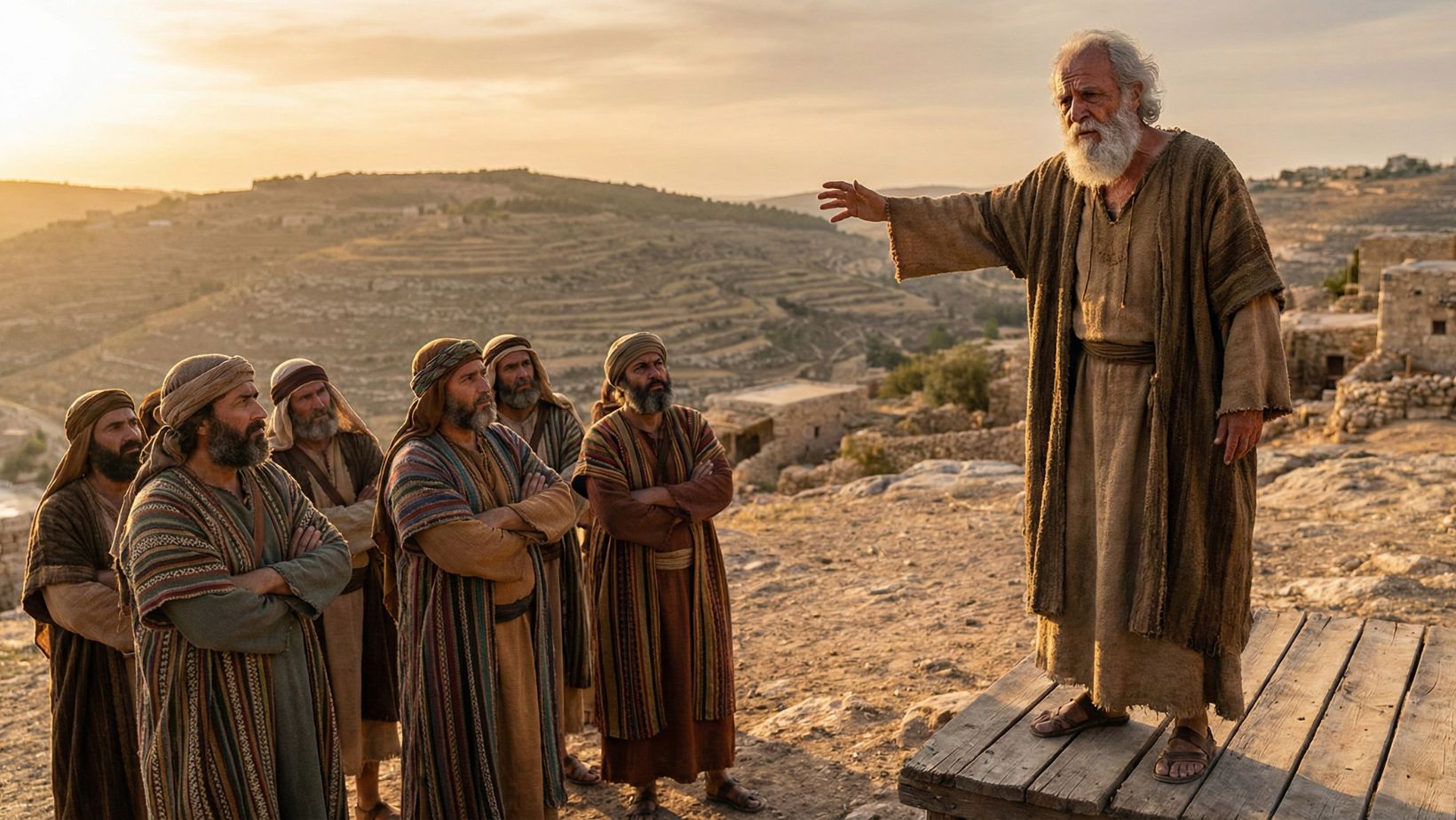
1 Samuel 8 records one of the most critical constitutional shifts in biblical history: the transition from a theocracy (rule by God through judges) to a monarchy (rule by a human king). The chapter is triggered by a crisis of succession—Samuel is aging, and his sons are corrupt. The elders of Israel use this political vacuum to demand a king “like all the nations.” Although Samuel perceives this as a personal rejection, God reveals it is a theological rejection of His kingship. Samuel issues a stern warning about the heavy cost of a monarchy (taxation, conscription, and loss of freedom), but the people insist. God ultimately grants their request, allowing them to choose their own form of government, even to their own detriment.
1. The Crisis of Leadership (1 Samuel 8:1–3 NLT)
1 As Samuel grew old, he appointed his sons to be judges over Israel. 2 Joel and Abijah, his oldest sons, held court in Beersheba. 3 But they were not like their father, for they were greedy for money. They accepted bribes and perverted justice.
Commentary:
- The Recurring Pattern (v. 1): History repeats itself. Just as Eli was a godly priest with wicked sons (Hophni and Phinehas), Samuel is a godly prophet with wicked sons. It highlights the biblical reality that godliness is not hereditary; faith must be chosen by each generation.
- Geographical Placement (v. 2): Samuel stationed them in Beersheba, the southernmost city of Israel. This was far from his headquarters in Ramah, perhaps giving them autonomy that they abused.
- The Nature of Corruption (v. 3):
- “Greedy for money”: They used their office for personal gain.
- “Perverted justice”: They violated the core requirement of a judge (Deuteronomy 16:19), selling verdicts to the highest bidder. This instability threatened the social fabric of the nation.
2. The Demand for a King (1 Samuel 8:4–9 NLT)
4 Finally, all the elders of Israel met at Ramah to discuss the matter with Samuel. 5 “Look,” they told him, “you are now old, and your sons are not like you. Give us a king to judge us like all the other nations have.” 6 Samuel was displeased with their request and went to the Lord for guidance. 7 “Do everything they say to you,” the Lord replied, “for they are rejecting me, not you. They don’t want me to be their king any longer. 8 Ever since I brought them from Egypt they have continually abandoned me and followed other gods. And now they are giving you the same treatment. 9 Do as they ask, but solemnly warn them about the way a king will reign over them.”
Commentary:
- The Elders’ Logic (v. 5): The elders presented a pragmatic argument based on three points:
- Samuel’s age (instability).
- His sons’ corruption (injustice).
- “Like all the other nations”: This was the root desire. They wanted conformity. They were tired of being a “peculiar people” dependent on an invisible God. They wanted a visible figurehead like their pagan neighbors (Egypt, Moab, Philistia).
- Samuel’s Reaction (v. 6): Samuel feels personally rejected. He has spent his life interceding for them (Ch 7), and now they want to replace his system.
- God’s Perspective (v. 7): God corrects Samuel’s hurt. The issue is theological, not personal. “They are rejecting me.”
- By asking for a king, they were declaring that Yahweh’s protection was insufficient.
- They preferred a human army they could see over a divine warrior they had to trust.
- The Divine Concession (v. 9): God allows it. This is an example of God’s “permissive will.” He grants their request not because it is good for them, but because He respects their freedom to choose, even if they choose poorly.
3. The Warning: The Cost of Monarchy (1 Samuel 8:10–18 NLT)
10 So Samuel passed on the Lord’s warning to the people who were asking him for a king. 11 “This is how a king will reign over you,” Samuel said. “The king will draft your sons and assign them to his chariots and his charioteers, making them run before his chariots. 12 Some will be generals and captains in his army, some will be forced to plow in his fields and harvest his crops, and some will make his weapons and chariot equipment. 13 The king will take your daughters from you and force them to cook and bake and make perfumes for him. 14 He will take away the best of your fields and vineyards and olive groves and give them to his own officials. 15 He will take a tenth of your grain and your grape harvest and distribute it among his officers and attendants. 16 He will take your male and female slaves and demand the best of your cattle and donkeys for his own use. 17 He will demand a tenth of your flocks, and you will be his slaves. 18 When that day comes, you will beg for relief from this king you are demanding, but then the Lord will not help you.”
Commentary:
- The Keyword “Take” (v. 11-17): In the Hebrew text, the verb laqach (“to take”) appears six times in this section. Samuel outlines a regime of extraction. A king exists to take from the people to sustain his own power.
- Conscription (v. 11-12):
- Military Draft: Sons will become cannon fodder (“run before his chariots”).
- Labor Draft: The king will nationalize labor for his own agriculture and industry (weapons manufacturing), moving people away from their family inheritance.
- Appropriation of Property (v. 14): Eminent domain. The king will seize the “best” land to pay off his political cronies (“his own officials”). This later happens with Ahab and Naboth’s vineyard (1 Kings 21).
- Taxation (v. 15, 17): “He will take a tenth.”
- Loss of Freedom (v. 17): “You will be his slaves.” They were redeemed from slavery in Egypt to serve God; now they are returning to a form of slavery under a human master.
- Closed Heavens (v. 18): Samuel warns that when they eventually cry out because of the king’s oppression, God will not answer. They are making a binding choice.
4. The Stubborn Refusal (1 Samuel 8:19–22 NLT)
19 But the people refused to listen to Samuel’s warning. “Even so, we still want a king,” they said. 20 “We want to be like the nations around us. Our king will judge us and lead us into battle and fight for us.” 21 So Samuel repeated to the Lord what the people had said, 22 and the Lord replied, “Do as they say, and give them a king.” Then Samuel agreed and sent the people home.
Commentary:
- Willful Blindness (v. 19): “Even so…” The people do not argue with Samuel’s facts; they simply don’t care about the cost. They are driven by fear and envy of other nations.
- The Specific Desire (v. 20): “Fight for us.”
- Samuel’s Mediation (v. 21): Samuel faithfully reports back to God. He does not stage a coup or refuse to step down. He models submission to God’s plan, even when that plan involves his own obsolescence.
- The Die is Cast (v. 22): “Give them a king.” God authorizes the monarchy. This sets the stage for the selection of Saul in the next chapter.
Theological Significance of 1 Samuel 8
- Rejection of God’s Kingship: The central sin of Israel was not wanting a political leader (God eventually intended for kings, see Deut 17), but wanting a king in place of God, to secure them in a way that didn’t require faith.
- The Trap of Conformity: The desire to be “like all the nations” is the antithesis of holiness. Holiness means “set apart.” Israel traded their unique identity as a Kingdom of Priests for the common identity of a political state.
- God’s Permissive Will: This chapter teaches that God sometimes grants our requests as a form of judgment. If we insist on something outside of His perfect will, He may let us have it so we can learn the hard lesson of why we shouldn’t have wanted it.
Practical Applications
- Be Careful What You Pray For: We often beg God for things (a specific job, relationship, status) that might actually enslave us. We must learn to pray, “Not my will, but Yours be done.”
- Trusting the Invisible: We are often tempted to trust visible structures (bank accounts, governments, influential people) more than the invisible God. We want a “king we can see” rather than the God we must trust.
- Leadership Succession: The failure of Samuel’s sons serves as a warning to leaders. Success in ministry does not guarantee success in the family. We must prioritize the discipleship of our own homes.
Final Insight
1 Samuel 8 is a tragedy of exchange. Israel exchanged liberty under God for tyranny under man. They exchanged the supernatural protection of Yahweh for the conventional military of a king. It reminds us that whenever we try to secure our lives through human means rather than divine trust, we inevitably lose our freedom.







Leave a Reply