
Summary of 2 Samuel 1
2 Samuel 1 marks a pivotal transition in the history of Israel, shifting the focus from the reign of Saul to the rise of David. The chapter opens in the aftermath of the Philistine victory at Mount Gilboa, where King Saul and his son Jonathan have fallen. David, currently residing in Ziklag after his own battle against the Amalekites, receives news of the tragedy from an Amalekite messenger who claims to have killed Saul, expecting a reward. Instead of celebrating the death of his pursuer, David executes the messenger for daring to kill the Lord’s anointed. The chapter concludes with David’s “Song of the Bow,” a poignant and masterful lament honoring Saul and Jonathan. This passage establishes David’s character: he is not a power-hungry usurper but a loyal servant who respects God’s timing and sovereignty.
1. The Amalekite’s Report (2 Samuel 1:1–10 NLT)
1 After the death of Saul, David returned from his victory over the Amalekites and spent two days in Ziklag. 2 On the third day a man arrived from Saul’s army, with his clothes torn and dirt on his head. When he came to David, he bowed low to the ground in deep respect. 3 “Where have you come from?” David asked. “I escaped from the Israeli camp,” the man replied. 4 “What happened?” David demanded. “Tell me how the battle went.” The man replied, “Our entire army fled from the battle. Many of the men are dead, and Saul and his son Jonathan are also dead.” 5 “How do you know Saul and his son Jonathan are dead?” David demanded of the young man. 6 “I happened to be on Mount Gilboa,” the man replied, “and there I saw Saul leaning on his spear with the enemy chariots and charioteers closing in on him. 7 When he turned and saw me, he called out to me. ‘Here I am,’ I replied. 8 “He asked me, ‘Who are you?’ I replied, ‘I am an Amalekite.’ 9 “Then he begged me, ‘Come over here and put me out of my misery, for I am in terrible pain and want to die.’ 10 “So I killed him, for I knew he couldn’t live. Then I took his crown and his armband, and I have brought them here to you, my lord.”
Commentary:
- Setting the Scene (v. 1): The narrative links two events: Saul’s death (1 Samuel 31) and David’s victory over the Amalekites (1 Samuel 30). While Saul failed to destroy the Amalekites years prior (1 Samuel 15), causing his rejection by God, David has just successfully defeated them.
- The Messenger’s Appearance (v. 2): The man arrives with “clothes torn and dirt on his head,” traditional signs of mourning. However, his subsequent actions suggest this may have been a calculated performance to curry favor with David.
- The Conflicting Accounts (v. 6–10): The Amalekite’s story contradicts the narrator’s account in 1 Samuel 31:4–5, which states Saul committed suicide by falling on his sword.
- Possibility A: The Amalekite is lying to claim credit, thinking David wants Saul dead.
- Possibility B: Saul’s suicide attempt was incomplete, and the Amalekite finished the job.
- Consensus: Most scholars believe the Amalekite fabricated the story of the killing (though he likely did strip the body) to win a reward, misjudging David’s character.
- Irony of Identity (v. 8): The man identifies himself as an “Amalekite.” This is a profound irony. Saul lost his kingdom because he failed to wipe out the Amalekites (1 Samuel 15). Now, an Amalekite claims to have finished Saul off.
- Regalia of Kingship (v. 10): The crown (a light diadem) and armband were proof of Saul’s death. The Amalekite brings them to David, essentially offering him the throne, expecting a payout for “removing” the rival.
Insight: The Amalekite views politics through the lens of opportunism and power grabs. He assumes David is like everyone else—eager for power at any cost. He fails to understand that David operates on a different ethical plane, one defined by the fear of the Lord.
2. David’s Reaction and Judgment (2 Samuel 1:11–16 NLT)
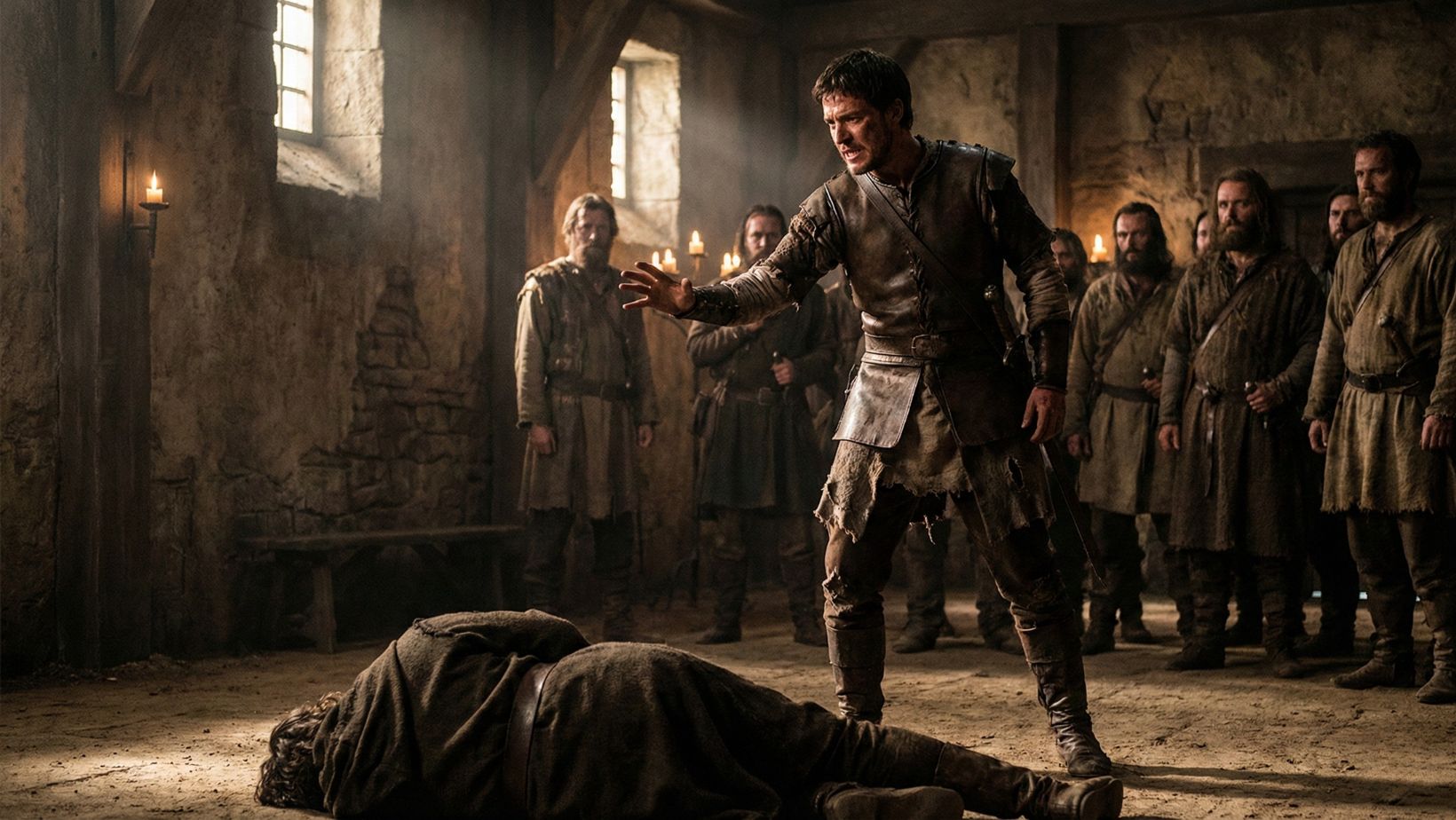
11 David and his men tore their clothes in sorrow when they heard the news. 12 They mourned and wept and fasted all day for Saul and his son Jonathan, and for the Lord’s army and the nation of Israel, because they had died by the sword. 13 Then David said to the young man who had brought the news, “Where are you from?” And he replied, “I am a foreigner, an Amalekite, who lives in your land.” 14 “Why were you not afraid to kill the Lord’s anointed one?” David asked. 15 Then David said to one of his men, “Kill him!” So the man thrust his sword into the Amalekite and killed him. 16 “You have condemned yourself,” David said, “for you yourself confessed that you killed the Lord’s anointed one.”
Commentary:
- Genuine Grief (v. 11–12): Instead of rejoicing at the death of the man who hunted him for years, David tears his clothes. His grief is tripartite:
- Fasting (v. 12): David leads a communal lament. This validates his innocence; he had no hand in Saul’s death and takes no pleasure in it.
- The Verdict (v. 13–14): David interrogates the messenger. The key issue is theological: “Why were you not afraid to kill the Lord’s anointed one?”
- David had two opportunities to kill Saul (1 Samuel 24, 26) but refused because he respected the office God established.
- The Amalekite, a foreigner (“sojourner”), failed to respect the sanctity of God’s anointed leader.
- Self-Condemnation (v. 16): David orders the execution based on the man’s own confession (“you yourself confessed”). Whether the man actually killed Saul or just lied about it, his claim to have laid hands on God’s anointed was a capital offense in David’s eyes.
- Political Wisdom: By executing Saul’s “killer,” David publicly distances himself from the regicide. This was crucial for winning the loyalty of the northern tribes (Saul’s supporters) later on.
Insight: David defends the dignity of the office of the King, even when the King was his enemy. He establishes a precedent: power is God-given, not something to be seized by violence or assassination.
3. The Song of the Bow: Lament for Saul and Jonathan (2 Samuel 1:17–27 NLT)
17 Then David composed a funeral song for Saul and his son Jonathan, 18 and he commanded that it be taught to the people of Judah. It is known as the Song of the Bow, and it is recorded in The Book of Jashar. 19 Your pride and joy, O Israel, lies dead on the hills! Oh, how the mighty heroes have fallen! 20 Don’t announce the news in Gath, don’t proclaim it in the streets of Ashkelon, or the daughters of the Philistines will rejoice and the pagans will laugh in triumph. 21 O mountains of Gilboa, let there be no dew or rain upon you, nor fruitful fields producing offerings of grain. For there the shield of the mighty heroes was defiled; the shield of Saul will no longer be anointed with oil. 22 The bow of Jonathan was powerful, and the sword of Saul did their mighty work. They shed the blood of their enemies and pierced the bodies of mighty heroes. 23 How beloved and gracious were Saul and Jonathan! They were together in life and in death. They were swifter than eagles, stronger than lions. 24 O women of Israel, weep for Saul, for he dressed you in luxurious scarlet clothing, in garments decorated with gold. 25 Oh, how the mighty heroes have fallen in battle! Jonathan lies dead on the hills. 26 How I weep for you, my brother Jonathan! Oh, how much I loved you! And your love for me was deep, deeper than the love of women! 27 Oh, how the mighty heroes have fallen! Stripped of their weapons, they lie dead.
Commentary:
- The Song of the Bow (v. 18): This elegy is titled, likely referencing Jonathan’s skill with the bow (v. 22) or the weapon that killed Saul (archers, 1 Samuel 31:3). It is cited from the “Book of Jashar,” a lost collection of Israelite war songs (also mentioned in Joshua 10:13).
- The Refrain (v. 19, 25, 27): The recurring phrase “How the mighty heroes have fallen!” structures the poem, emphasizing the magnitude of the loss.
- Public Shame (v. 20): David dreads the gloating of the Philistines in their five major cities (Gath and Ashkelon are mentioned). The defeat is not just a national loss but a theological embarrassment, as the “pagans” (uncircumcised) mock Yahweh’s people.
- Curse on Nature (v. 21): David curses Mount Gilboa. He asks for a cessation of dew and rain—the sources of life—because the king died there. The “shield… no longer anointed with oil” implies the shield was left to dry and crack, or that the king himself was no longer sustained by God’s anointing.
- Praise for the Warriors (v. 22–23):
- David graciously omits Saul’s madness and persecution. He focuses solely on Saul’s bravery, military success, and bond with Jonathan.
- “Swifter than eagles, stronger than lions” utilizes animal imagery to depict their prowess.
- “Together in life and in death” highlights the tragic irony that Jonathan, who supported David, died alongside his father who hated David.
- Economic Prosperity (v. 24): David reminds the women of Israel that Saul brought economic stability, symbolized by “luxurious scarlet clothing” and gold ornaments. Saul had transformed Israel from a loose tribal confederation into a kingdom with wealth.
- Personal Lament for Jonathan (v. 26): This is the emotional core of the song.
- “My brother Jonathan”: Indicates a covenantal, familial bond.
- “Deeper than the love of women”: This is not erotic; in the ancient Near East, romantic love (often arranged or political) was considered less stable and profound than the covenantal loyalty between warriors or “blood brothers.” David is extolling platonic, covenantal intimacy that survived political pressure.
- Finality (v. 27): The poem ends on a somber note. The “weapons of war” (referring to the men themselves or their literal arms) have perished.
Insight: This lament reveals David’s lack of bitterness. He chooses to remember Saul at his best, not his worst. It models how to honor leadership and grieve loss without harboring resentment for past wrongs.
Theological Significance of 2 Samuel 1
- Sanctity of the Lord’s Anointed: The central theological theme is the inviolability of God’s chosen leader. Even though Saul was rejected, David believed it was God’s prerogative to remove him, not man’s.
- Divine Justice: The Amalekite, representing the nation Saul was supposed to destroy, claims to destroy Saul. This reflects a theological irony where partial obedience (Saul sparing Amalekites) leads to ultimate downfall.
- Kingdom Ethics: David establishes that the Kingdom of God is not built on assassination or political opportunism. The ends do not justify the means.
- True Friendship: The relationship between David and Jonathan, memorialized here, stands as the biblical gold standard for loyalty, surpassing political ambition and family dysfunction.
Practical Applications
- Refusing Opportunism: When a rival falls or a “door opens” through someone else’s tragedy, we should not rush to capitalize on it. Integrity matters more than advancement.
- Honoring Difficult Leaders: David found things to praise in Saul, a man who tried to kill him. We can learn to respect the office or the past contributions of a leader even if their current behavior is flawed.
- Grieving Well: The “Song of the Bow” teaches us to articulate our grief. Lament is a healthy, biblical response to loss, allowing us to process pain before moving into the new season.
- Loyalty in Friendship: We are challenged to cultivate friendships like David and Jonathan’s—loyal, sacrificial, and enduring through adversity.
Sermon Titles
- The King Who Wept for His Enemy.
- How the Mighty Have Fallen.
- When Good News is Bad News.
- Touching the Lord’s Anointed.
- Honor in an Age of Opportunism.







Leave a Reply