
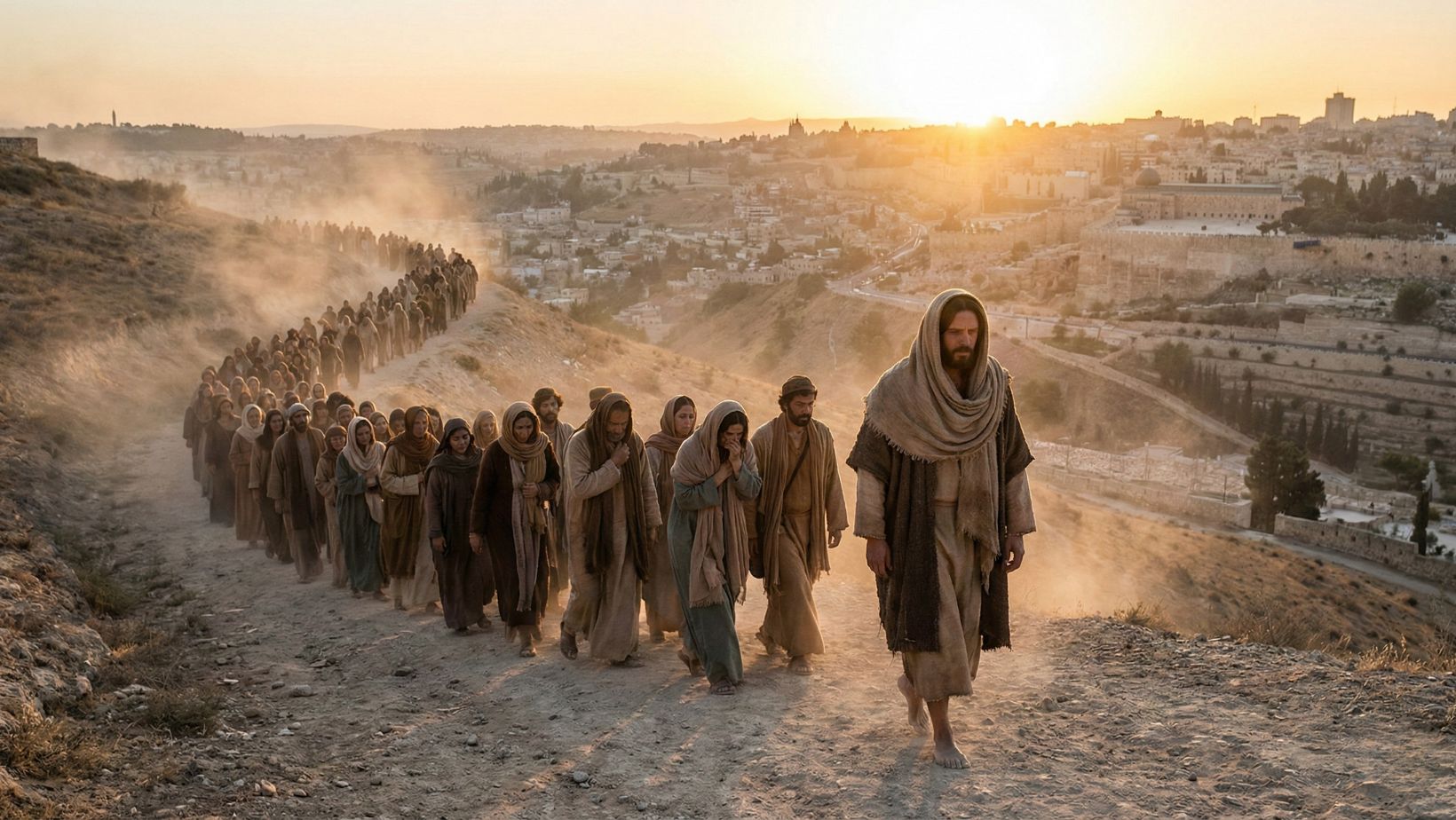
2 Samuel 15 records one of the darkest days in David’s life: the coup of his son Absalom. After years of meticulous political maneuvering, Absalom declares himself king in Hebron, stealing the loyalty of the nation. Faced with a sudden insurrection, David makes the agonizing decision to evacuate Jerusalem rather than turn the City of God into a battlefield. The chapter contrasts the treachery of a son (Absalom) and a trusted counselor (Ahithophel) with the surprising loyalty of foreigners (Ittai) and the steadfast faith of the aging King. It is a narrative of betrayal, brokenness, and strategic retreat.
1. Absalom Steals the Hearts (2 Samuel 15:1–12 NLT)
1 After this, Absalom bought a chariot and horses, and he hired fifty bodyguards to run ahead of him. 2 He got up early every morning and went out to the gate of the city. When people brought a case to the king for judgment, Absalom would ask where they were from, and they would tell him their tribe. 3 Then Absalom would say, “You’ve really got a strong case here! It’s too bad the king doesn’t have anyone to hear it. 4 I wish I were the judge. Then everyone could bring their cases to me for judgment, and I would give them justice!” 5 When people tried to bow before him, Absalom wouldn’t let them. Instead, he took them by the hand and kissed them. 6 Absalom did this with everyone who came to the king for judgment, and so he stole the hearts of all the people of Israel. 7 After four years, Absalom said to the king, “Let me go to Hebron to offer a sacrifice to the Lord… 10 But while he was there, he sent secret messengers to all the tribes of Israel to stir up a rebellion against the king. “As soon as you hear the ram’s horn,” his message read, “you are to say, ‘Absalom has been crowned king in Hebron!’” … 12 While Absalom was offering the sacrifices, he sent for Ahithophel, one of David’s counselors who lived in Giloh. Soon many others also joined Absalom, and the conspiracy gained momentum.
Commentary:
- The Campaign (v. 1): Absalom adopts the trappings of royalty (chariots and runners) similar to what Adonijah attempts later (1 Kings 1:5). He projects power and prestige.
- The Politics of Empathy (v. 2–6): Absalom utilizes a classic populist strategy:
- Access: He stands at the “gate” (the center of commerce and law), intercepting disgruntled citizens.
- Validation: He tells everyone, “Your case is good,” validating their grievances without hearing the other side.
- Blame: He claims the “king doesn’t have anyone to hear it,” painting David’s administration as negligent or out of touch.
- False Humility: He refuses bows and offers kisses/handshakes, appearing approachable (“man of the people”) compared to the distant King.
- “Stole the Hearts” (v. 6): This phrase indicates deception. He didn’t win their loyalty through service; he filched it through flattery.
- The Hebron Strategy (v. 7, 10):
- Timeline: The NLT says “four years” (following the Greek Septuagint and Syriac versions), correcting the Hebrew text’s likely scribal error of “forty years.”
- Location: Hebron was David’s first capital and his tribal center. By launching the revolt there, Absalom appeals to the southern tribe of Judah, suggesting they felt neglected after David moved the capital to Jerusalem.
- Ahithophel’s Defection (v. 12): This is the crushing blow. Ahithophel was considered the wisest man in Israel (his counsel was like the “oracle of God,” 2 Sam 16:23). As Bathsheba’s grandfather, his defection likely stemmed from simmering resentment over David’s treatment of his granddaughter and Uriah.
Insight: Absalom wanted the authority of the King without the heart of the King. He sought power to be “Judge” (v. 4) for his own glory, whereas David sought to shepherd the people for God’s glory.
2. David’s Evacuation and the Loyalty of Ittai (2 Samuel 15:13–23 NLT)
13 A messenger soon arrived in Jerusalem to tell David, “All Israel has joined Absalom in a conspiracy against you!” 14 “Then we must flee at once, or it will be too late!” David urged his men. “Hurry! If we get out of the city before Absalom arrives, both we and the city of Jerusalem will be spared from disaster.” … 18 David stood at the city gate… The king’s bodyguard, including the Cherethites, Pelethites, and six hundred Gittites from Gath, marched past the king. 19 Then the king turned and said to Ittai, a leader of the Gittites, “Why are you coming with us? Go back to King Absalom, for you are a guest in Israel, a foreigner in exile. 20 You arrived only recently, and should I force you to wander with us? … Go back and take your kinsmen with you, and may the Lord show you his unfailing love and faithfulness.” 21 But Ittai said to the king, “I vow by the Lord and by your own life that I will go wherever my lord the king goes, no matter what happens—whether it means life or death.” … 23 Everyone cried loudly as the king and his followers passed by. They crossed the Kidron Valley and then headed out toward the wilderness.
Commentary:
- The Decision to Flee (v. 14): David’s flight is often criticized as cowardice, but it was likely strategic and merciful.
- He had no standing army in the city (Absalom had the people).
- He refused to let Jerusalem (Zion) become a site of urban warfare and slaughter. He chose exile over destroying his own capital.
- The Foreign Loyalists (v. 18): While his own son (Absalom) and counselor (Ahithophel) betray him, his foreign mercenaries (Cherethites, Pelethites, Gittites) remain loyal.
- Ittai the Gittite (v. 19–21):
- Ittai is a Philistine from Gath (Goliath’s hometown!).
- David tries to release him from obligation, showing selfless leadership even in crisis (“Why should I force you to wander?”).
- Ittai’s vow (“Where the king is… there will your servant be”) echoes Ruth’s vow to Naomi. It is a stunning display of covenant loyalty from a Gentile.
Insight: In the hour of crisis, you find out who your true friends are. Often, those closest by blood betray, while those bound by spirit or honor remain closer than a brother.
3. The Ark and the Agony (2 Samuel 15:24–29 NLT)
24 Zadok and all the Levites also came along, carrying the Ark of the Covenant of God. … 25 Then the king instructed Zadok, “Take the Ark of God back into the city. If the Lord sees fit, he will bring me back to see the Ark and the Tabernacle again. 26 But if he says, ‘I am not pleased with you,’ then let him do to me whatever he thinks best.” 27 The king also told Zadok the priest, “Look, here is my plan. You and Abiathar should return quietly to the city with your son Ahimaaz and Abiathar’s son Jonathan. 28 I will stop at the shallows of the Jordan River and wait there for a report from you.” 29 So Zadok and Abiathar took the Ark of God back to the city and stayed there.
Commentary:
- The Theology of the Ark (v. 25): The priests assume the Ark should go with the King (as a talisman of victory). David corrects them.
- Total Resignation (v. 26): “Let him do to me whatever he thinks best.” This is the pinnacle of David’s spiritual maturity. He accepts that this rebellion might be God’s judgment (the “sword” promised in Ch. 12). He puts himself entirely in God’s hands, without demand or entitlement.
- Strategic Plant (v. 27–28): David combines faith with espionage. He sends the priests back to be his eyes and ears in the capital. He is trusting God, but he is also keeping his powder dry.
Insight: David does not manipulate God. He submits to God. He is willing to lose the throne if that is God’s will.
4. The Ascent of Olives and the Spy (2 Samuel 15:30–37 NLT)
30 David walked up the road to the Mount of Olives, weeping as he went. His head was covered and his feet were bare as a sign of mourning. And the people who were with him covered their heads and wept as they climbed the hill. 31 When someone told David that his adviser Ahithophel was now backing Absalom, David prayed, “O Lord, let Ahithophel give Absalom foolish counsel!” 32 When David reached the summit of the Mount of Olives where people worshiped God, Hushai the Archite was waiting there for him. His tunic was torn and he had put dirt on his head. 33 But David told him, “If you go with me, you will only be a burden. 34 Return to Jerusalem and tell Absalom, ‘I will now be your adviser, O King, just as I was your father’s adviser in the past.’ Then you can frustrate and counter Ahithophel’s advice. … 37 So David’s friend Hushai returned to Jerusalem, getting there just as Absalom arrived.
Commentary:
- The Procession of Weeping (v. 30):
- The Prayer against Ahithophel (v. 31): David fears Ahithophel’s advice more than Absalom’s army. He prays a specific, strategic prayer: “Turn the counsel of Ahithophel into foolishness.” (God answers this via Hushai in Ch. 17).
- Hushai the Archite (v. 32): God answers the prayer immediately. Hushai meets David at the “summit where people worshiped.”
- David sends Hushai on a dangerous double-agent mission. He is to infiltrate Absalom’s court and defeat Ahithophel’s counsel from the inside.
- “David’s Friend” (v. 37): This was an official title (like Chief of Staff), implying absolute trust.
Insight: In his deepest pain, David still prays. And his prayer is not just for comfort, but for the neutralization of the enemy’s strategy. He engages in spiritual warfare while walking barefoot in the dust.
Theological Significance of 2 Samuel 15
- Typology of Christ: The parallels between David and Jesus in this chapter are striking.
- Both are the Lord’s Anointed, rejected by their own people.
- Both cross the Kidron Valley (John 18:1).
- Both ascend the Mount of Olives weeping (Luke 19:41, 22:39).
- Both are betrayed by a close associate (Ahithophel/Judas) who later hangs himself.
- Sovereignty and Submission: David’s statement in v. 26 (“Let him do to me whatever he thinks best”) echoes Jesus’ prayer in Gethsemane (“Not my will, but yours be done”). It is the ultimate posture of the believer in suffering.
- The Anti-King: Absalom represents the anti-Christ figure—charismatic, deceptive, stealing hearts, and exalting himself. David represents the suffering King—humble, rejected, and trusting in God.
Practical Applications
- Leading When You Are Losing: David shows us how to lead during a collapse. He prioritized the safety of the city, released his friends from obligation, worshiped God, and made a plan. Panic is not a strategy.
- Beware of Flattery: Absalom “stole hearts” with kisses and empty promises. We must be discerning of leaders who promise to solve every problem and stroke our egos.
- Spiritualizing Our Crisis: When disaster strikes, do we cling to our “Arks” (symbols of security), or do we surrender to the God of the Ark? David let go of the symbol to hold onto the Savior.
- The Power of Specific Prayer: David didn’t just pray “Help me.” He prayed, “Turn Ahithophel’s counsel to foolishness.” Specific prayers get specific answers.
Sermon Titles
- The King Who Wept (The Mount of Olives).
- Stealing Hearts vs. Guarding Hearts.
- If the Lord is Pleased (v. 25-26).
- When Your Son Becomes Your Enemy.
- Barefoot in the Kidron: The Path of Humility.







Leave a Reply