
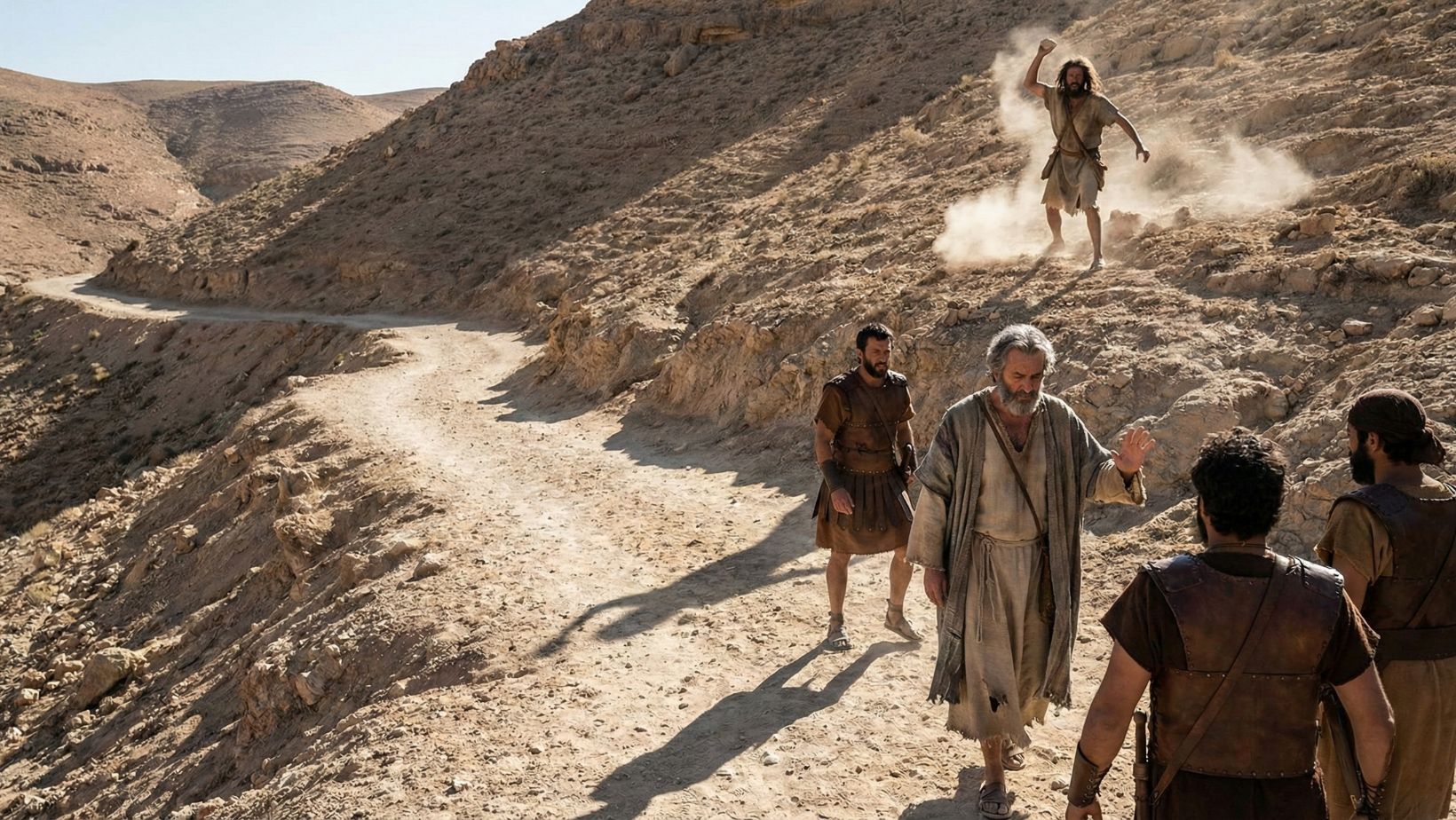
2 Samuel 16 chronicles the low point of David’s flight from Jerusalem. As the King descends into the wilderness, he encounters a series of characters who reveal their true colors in his moment of weakness. Ziba uses deceit to steal Mephibosheth’s inheritance; Shimei curses David, kicking him while he is down; and Ahithophel advises Absalom to burn his bridges by publicly violating his father’s concubines. The chapter is a study in opportunism, verbal abuse, and the fulfillment of divine judgment, all met by David with a stunning, broken humility.
1. Ziba’s Opportunism (2 Samuel 16:1–4 NLT)
1 When David had gone a little beyond the summit of the Mount of Olives, Ziba, the servant of Mephibosheth, was waiting there for him. He had a couple of donkeys loaded with two hundred loaves of bread, one hundred clusters of raisins, one hundred bunches of summer fruit, and a skin of wine. 2 “What are these for?” the king asked Ziba. Ziba replied, “The donkeys are for the king’s people to ride on, and the bread and summer fruit are for the young men to eat. The wine is for those who become exhausted in the wilderness.” 3 “And where is Mephibosheth, your master’s grandson?” the king asked. “He stayed in Jerusalem,” Ziba replied. “He said, ‘Today I will get back the kingdom of my grandfather Saul.’” 4 “In that case,” the king told Ziba, “I give you everything Mephibosheth owns.” “I bow before you,” Ziba replied. “May I always be pleasing to you, my lord the king.”
Commentary:
- The Gift (v. 1): Ziba brings essential supplies for a refugee army. The quantity (200 loaves, wine, fruit) is generous and strategically timed to indebt the King.
- The Lie (v. 3): When David asks about Mephibosheth, Ziba claims the crippled prince is plotting a comeback: “Today I will get back the kingdom.”
- Implausibility: It is highly unlikely a cripple thought he could seize power amidst a civil war between two powerful warriors (David and Absalom). Later, in Chapter 19, Mephibosheth reveals Ziba tricked him and left him behind.
- The Rash Judgment (v. 4): David, exhausted and feeling betrayed by his own son, readily believes that Saul’s grandson is also betraying him. He impulsively transfers all of Mephibosheth’s estate to Ziba.
- Insight: Grief and exhaustion make us vulnerable to manipulation. David makes a major legal decision without hearing the other side (Proverbs 18:17).
2. Shimei’s Curses (2 Samuel 16:5–14 NLT)
5 As King David came to Bahurim, a man came out of the village cursing them. It was Shimei son of Gera, from the same clan as Saul’s family. 6 He threw stones at the king and the king’s officers and all the mighty warriors who surrounded him. 7 “Get out of here, you murderer, you scoundrel!” he shouted at David. 8 “The Lord is paying you back for all the bloodshed in Saul’s clan. You stole his throne, and now the Lord has given it to your son Absalom. At last you will taste some of your own medicine, for you are a murderer!” 9 “Why should this dead dog curse my lord the king?” Abishai son of Zeruiah demanded. “Let me go over and cut off his head!” 10 “No!” the king said. “Who asked your opinion, you sons of Zeruiah! If the Lord has told him to curse me, who are you to stop him?” 11 Then David said to Abishai and to all his servants, “My own son is trying to kill me. Doesn’t this relative of Saul have even more reason to do so? Leave him alone and let him curse, for the Lord has told him to do it. 12 And perhaps the Lord will see that I am being wronged and will bless me because of these curses today.” … 13 So David and his men continued down the road, and Shimei kept pace with them on a nearby hillside, cursing and throwing stones and dirt at them.
Commentary:
- Shimei’s Grievance (v. 5–8): Shimei is a Benjaminite (Saul’s tribe). He has been harboring bitterness for years, believing David is a “man of blood” responsible for the death of Abner and Ishbosheth (though David was innocent of those specific crimes).
- The Stones (v. 6): Throwing stones and dirt was a grave insult, treating the King like a stray dog or a leper.
- Abishai’s Reaction (v. 9): Abishai (Joab’s brother) responds with predictable violence: “Let me cut off his head.” He sees only the insult to the crown.
- David’s Theology of Suffering (v. 10–12): David’s response is profound.
- Divine Sovereignty: “The Lord has told him to curse me.” David views Shimei not as a random nuisance, but as a rod in God’s hand. He accepts the humiliation as part of God’s discipline for his sin.
- Perspective: If his own son wants to kill him, why be surprised that a Saulite wants to curse him?
- Hope: “Perhaps the Lord will see…” David hopes that by bearing the curse quietly, God will eventually turn it into a blessing.
Insight: David refuses to vindicate himself. He knows he is guilty of Uriah’s blood, even if he is innocent of Saul’s. He leaves vengeance entirely to God.
3. Absalom and Ahithophel’s Counsel (2 Samuel 16:15–23 NLT)
15 Meanwhile, Absalom and all the army of Israel arrived at Jerusalem, accompanied by Ahithophel. 16 When David’s friend Hushai the Archite arrived, he went to Absalom and shouted, “Long live the king! Long live the king!” 17 “Is this the way you treat your friend David?” Absalom asked him. “Why aren’t you with him?” 18 “I’m here because I work for the man who is chosen by the Lord and by the people of Israel,” Hushai replied. … 20 Then Absalom said to Ahithophel, “Give us your advice. What should we do?” 21 Ahithophel told him, “Go and sleep with your father’s concubines, for he has left them here to look after the palace. Then all Israel will know that you have insulted your father beyond hope of reconciliation, and they will throw their support to you.” 22 So they set up a tent on the palace roof where everyone could see it, and Absalom went in and had sex with his father’s concubines. 23 Now in those days the advice of Ahithophel was like the word of God. Both David and Absalom honored it.
Commentary:
- Hushai the Spy (v. 16–19): Hushai infiltrates Absalom’s court. He uses flattery (“Long live the king!”) and ambiguous theology (“chosen by the Lord”) to deceive Absalom. Absalom, vain and eager for validation, accepts him.
- The Problem: Absalom’s rebellion is still tentative. Many people might fear that David and Absalom will reconcile (like they did in Ch. 14), leaving the rebels exposed to David’s wrath. They need a point of no return.
- Ahithophel’s Brutal Advice (v. 21): Ahithophel suggests a public, irrevocable act of treason. By sleeping with the King’s concubines, Absalom claims the royal harem (a symbol of succession) and creates a “stench” (utter hatred) between him and his father.
- The Fulfillment of Prophecy (v. 22): “They set up a tent on the palace roof.”
Insight: Ahithophel’s wisdom was “like the word of God” (v. 23) in its accuracy and effectiveness, but it was demonic in its morality. Intelligence without character is dangerous.
Theological Significance of 2 Samuel 16
- The Passive King vs. The Active Rebel: David is passive, accepting rocks and curses as from the Lord. Absalom is hyper-active, seizing power and women. Yet, David is the one “after God’s heart” because he submits to judgment.
- The Role of Shimei: Shimei represents the accuser. He speaks partial truths (David is a murderer) but misapplies them (David didn’t kill Saul). David shows us how to handle accusation: humble self-examination rather than defensive rage.
- The Poison of Bitterness: Shimei nursed a grudge for decades. When the opportunity came, he didn’t help the nation; he just vented his spleen. Bitterness makes us useless in the Kingdom.
Practical Applications
- Don’t Answer Every Critic: When people throw “stones” (insults/criticism) at you, you don’t always need to “cut off their heads” (attack back). Sometimes, you need to let them throw, trusting God to vindicate you.
- Beware of Rash Decisions: David gave away Mephibosheth’s land because he was tired and emotional. Never make major financial or relational decisions when you are H.A.L.T. (Hungry, Angry, Lonely, Tired).
- Burned Bridges: Ahithophel advised Absalom to make reconciliation impossible. Be careful of actions that permanently destroy relationships. God is a God of reconciliation; the enemy loves the “point of no return.”







Leave a Reply