
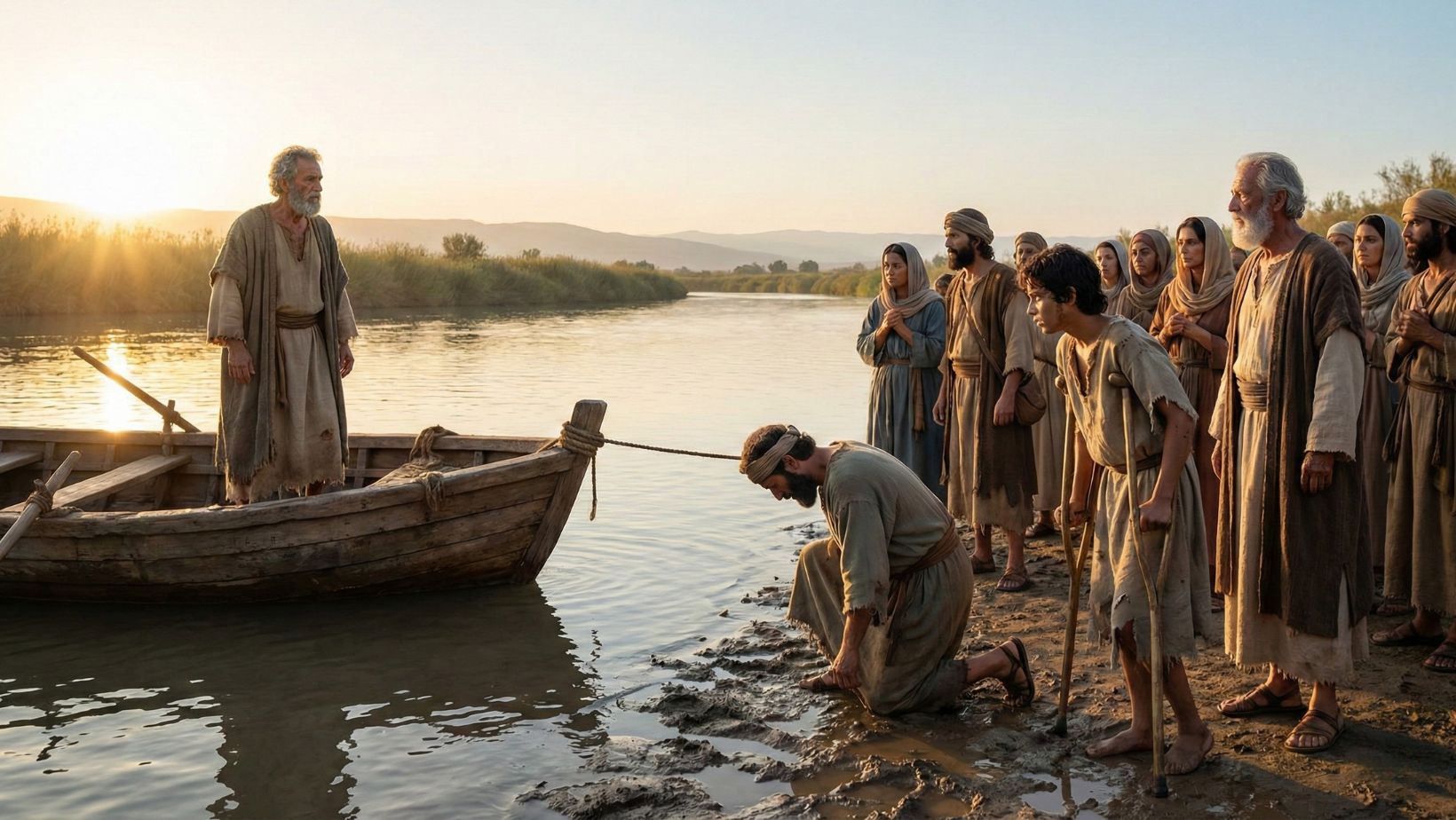
2 Samuel 19 details the complex and painful process of David’s restoration to the throne. Following the death of Absalom, the victory turns into mourning until Joab brutally confronts David, forcing him to choose between his grief as a father and his duty as a king. David rallies and begins the journey back to Jerusalem, but the road is paved with political landmines. He navigates encounters with former enemies (Shimei), wronged family members (Mephibosheth), and loyal friends (Barzillai). He also makes a controversial strategic move to replace Joab with Amasa (the rebel general) to unify the tribes. The chapter concludes with a heated argument between the tribes of Israel and Judah, foreshadowing the eventual division of the kingdom. It is a narrative about the difficulty of “winning the peace” after the war is over.
1. Joab’s Rebuke and the King’s Return (2 Samuel 19:1–8 NLT)
1 Word soon reached Joab that the king was weeping and mourning for Absalom. 2 As all the people heard of the king’s deep grief for his son, the joy of that day’s victory was turned into deep sadness. 3 They crept back into the town that day as though they were ashamed and had deserted in battle. 4 The king covered his face with his hands and kept crying out, “O my son Absalom! O Absalom, my son, my son!” 5 Then Joab went to the king’s room and said to him, “We saved your life today and the lives of your sons, your daughters, and your wives and concubines. Yet you act like this, making us feel ashamed of ourselves. 6 You seem to love those who hate you and hate those who love you. You have made it clear today that your commanders and troops mean nothing to you. It seems that if Absalom had lived and all of us had died, you would be pleased. 7 Now go out there and congratulate the troops, for I swear by the Lord that if you don’t go out, not a single one of them will remain here tonight. Then you will be worse off than you have ever been in your entire life.” 8 So the king went out and took his seat at the town gate, and the news spread throughout the town that he was sitting there. So all the troops came to see the king. Meanwhile, the Israelites who had supported Absalom fled to their homes.
Commentary:
- The Morale Crisis (v. 1–4): David’s grief, though understandable, is politically disastrous. By treating the victory as a tragedy, he inadvertently shames the soldiers who risked their lives for him. They sneak into the city like deserters rather than heroes.
- Joab’s Confrontation (v. 5–7): Joab is harsh, insolent, and borderline threatening, but he is absolutely correct.
- The accusation: “You love those who hate you and hate those who love you” (v. 6). David is prioritizing his dead enemy (Absalom) over his living loyalists.
- The threat: Joab swears by Yahweh that if David doesn’t pull himself together, the army will abandon him that very night. This would leave David alone and defenseless.
- The Gate (v. 8): David suppresses his personal pain for public duty. “Sitting in the gate” was the official act of resuming rule. It signaled to the troops that their King was back and their victory was valid.
Insight: Leadership often requires subordinating personal feelings to the needs of the community. Joab, though a violent man, understood that a leader cannot indulge in private grief at the expense of public morale.
2. Political Maneuvering and Amasa’s Appointment (2 Samuel 19:9–15 NLT)
9 Throughout all the tribes of Israel, there was much discussion and argument. The people were saying, “The king saved us from our enemies and delivered us from the Philistines, but Absalom chased him out of the country. 10 Now Absalom, whom we anointed to rule over us, is dead. Why not ask David to come back and be our king again?” 11 Then King David sent Zadok and Abiathar the priests to say to the elders of Judah, “Why are you the last ones to welcome the king back to his palace? For I have heard that all Israel is ready. 12 You are my relatives, my own flesh and blood. So why are you the last ones to welcome the king back?” 13 And David told them to tell Amasa, “Since you are my own flesh and blood, may God strike me and even kill me if I don’t appoint you as commander of my army in place of Joab.” 14 Then Amasa convinced all the men of Judah, and they responded unanimously. They sent word to the king, “Return to us, and bring back all who are with you.” 15 So the king started back to Jerusalem. And when he arrived at the Jordan River, the people of Judah came to Gilgal to meet him and escort him across the river.
Commentary:
- The Vacuum (v. 9–10): The northern tribes (Israel) are in chaos. They backed the loser (Absalom) and are now sheepishly debating inviting David back.
- Wooing Judah (v. 11–12): David notices his own tribe, Judah, is silent. Perhaps they fear retribution for supporting the revolt (which began in Hebron, Judah). David appeals to kinship (“my own flesh and blood”).
- The Appointment of Amasa (v. 13): This is a brilliant but dangerous political move.
- Who is Amasa? Ideally, he should be executed for leading the rebel army. He is David’s nephew (sister Abigail’s son).
- The Strategy: By making the rebel general the new commander of the royal army, David signals total amnesty to the rebels. It unifies the fractured military.
- The Personal Motive: It is also a punishment for Joab. David cannot execute Joab (who is too powerful), but he can fire him for killing Absalom against orders.
- Success (v. 14): The strategy works. Judah is “swayed” and invites David back.
Insight: David is “winning the peace.” He realizes that he cannot rule by force alone; he must rule by consensus. However, promoting Amasa plants a seed of bitterness in Joab that will lead to more bloodshed (2 Samuel 20).
3. Encounters at the River: Shimei, Ziba, and Mephibosheth (2 Samuel 19:16–30 NLT)
16 Then Shimei son of Gera, the man from Bahurim in Benjamin, hurried across with the men of Judah to welcome King David. 17 A thousand other men from the tribe of Benjamin were with him. And Ziba, the chief servant of the house of Saul, also came with his fifteen sons and twenty servants. They rushed down to the Jordan to meet the king. 18 They crossed the shallows of the Jordan to bring the king’s household across and to help him in every way they could. As the king was about to cross the river, Shimei fell down before him. 19 “My lord the king, please forgive me,” he pleaded. “Forget the terrible thing your servant did when you left Jerusalem. May the king put it out of his mind. 20 I know how much I sinned. That is why I have come here today, the very first person in all the house of Joseph to greet my lord the king.” 21 Then Abishai son of Zeruiah said, “Shimei should die, for he cursed the Lord’s anointed king!” 22 “Who asked your opinion, you sons of Zeruiah!” David exclaimed. “Why have you become my adversary today? This is not a day for execution, for today I am once again king of Israel!” 23 Then, turning to Shimei, David vowed, “Your life will be spared.” 24 Now Mephibosheth, Saul’s grandson, also came down to meet the king. He had not cared for his feet or trimmed his beard or washed his clothes since the day the king left until the day he returned safely. 25 When he came from Jerusalem to meet the king, the king asked him, “Why didn’t you come with me, Mephibosheth?” 26 Mephibosheth replied, “My lord the king, my servant Ziba deceived me. I told him, ‘Saddle my donkey so I can go with the king.’ For as you know I am crippled. 27 Ziba has slandered me by saying that I refused to come. But I know that my lord the king is like an angel of God, so do what you think is best. 28 All my relatives and I could expect only death from you, my lord, but instead you have honored me by allowing me to eat at your own table! What more can I ask?” 29 “You’ve said enough,” David replied. “I’ve decided that you and Ziba will divide your land equally between you.” 30 “Give him all of it,” Mephibosheth said. “I am content just to have you safely back again.”
Commentary:
- Shimei’s Panic (v. 16–20): Shimei, who cursed David in Ch. 16, sees the tide turning. He arrives with 1,000 men (a show of political strength) to beg for mercy.
- David’s Amnesty (v. 22–23): Abishai wants execution (again). David refuses, not because Shimei is innocent, but because the “day of coronation” should not be marred by death. It is a pragmatic mercy. (Note: On his deathbed, David will instruct Solomon to deal with Shimei, 1 Kings 2:8–9).
- Mephibosheth’s Appearance (v. 24): The text validates Mephibosheth. He is unwashed, unshaven, and unkempt. These are undeniable signs of mourning. He has been grieving while David was gone.
- The Defense (v. 26–27): Mephibosheth explains that Ziba tricked him. Because he was crippled, he couldn’t saddle his own donkey. When Ziba left him, he was stranded.
- The Verdict (v. 29): “Divide the land.”
- Why? This is a confusing ruling. If Mephibosheth is innocent, he should get everything (and Ziba punished). If he is guilty, he should die.
- Possibilities: David may be unsure who to believe; he may be too tired to litigate; or he may feel indebted to Ziba for the supplies in the wilderness. It is a compromise that satisfies neither fully.
- Mephibosheth’s Loyalty (v. 30): “Give him all of it.” Mephibosheth proves he is not after the money. He loves the King. This statement likely stung David’s conscience.
Insight: David is quick to forgive his enemy (Shimei) for political reasons, but somewhat cold to his friend (Mephibosheth). Leadership fatigue can lead to compromised justice.
4. Barzillai and Chimham (2 Samuel 19:31–40 NLT)
31 Barzillai of Gilead had also come down from Rogelim to escort the king across the Jordan River. 32 He was very old, eighty years of age, and very wealthy. He was the one who had provided food for the king during his stay in Mahanaim. 33 “Come across with me and live in Jerusalem,” the king said to Barzillai. “I will take care of you there.” 34 “No,” he replied, “I am far too old to go with the king to Jerusalem. 35 I am eighty years old today, and I can no longer enjoy anything. Food and wine are no longer tasty, and I cannot hear the musicians as they play. I would only be a burden to my lord the king. 36 Just let me go across the river with you. Why should the king reward me with this honor? 37 Please let me return so I can die in my own town and be buried by the graves of my father and mother. But here is your servant, my son Chimham. Let him go with my lord the king and receive whatever good things you want to give him.” 38 “Good,” the king agreed. “Chimham will go with me, and I will do for him whatever I would have done for you.” … 39 So all the people crossed the Jordan with the king. After the king had kissed Barzillai and blessed him, the man returned home. 40 The king then crossed over to Gilgal, taking Chimham with him. All the troops of Judah and half the troops of Israel escorted the king across.
Commentary:
- Barzillai (v. 32): The wealthy benefactor who fed David in exile. David wants to reward him with a life of luxury in the capital.
- Refusal of Court Life (v. 34–35): Barzillai is a realist. At 80, the pleasures of the palace (food, music, status) mean nothing to him. He prefers home and his ancestral grave. He serves the King for love, not reward.
- Chimham (v. 37): He offers his son, Chimham, in his place.
- Unity at the River (v. 40): The King crosses with “all Judah” but only “half of Israel.” The discrepancy in numbers highlights the enthusiasm gap.
Insight: Barzillai models finishing well. He recognizes his season has passed and uses his influence to launch the next generation (Chimham) rather than clinging to power or comfort for himself.
5. The Quarrel Between Israel and Judah (2 Samuel 19:41–43 NLT)
41 But then all the men of Israel complained to the king, “The men of Judah stole the king and didn’t give us the honor of helping take you, your household, and all your men across the Jordan.” 42 The men of Judah replied, “The king is one of our own kinsmen. Why should this make you angry? We haven’t eaten any of the king’s food or received any special favors!” 43 “But there are ten tribes in Israel,” the others replied. “So we have ten times as much right to the king as you do. What right do you have to treat us with such contempt? Weren’t we the first to speak of bringing him back?” But the men of Judah spoke even more harshly than the men of Israel.
Commentary:
- The Jealousy (v. 41): The northern tribes feel sidelined. They view David’s exclusive escort by Judah as “stealing the king.”
- Judah’s Defense (v. 42): “He is our kinsman.” They play the family card. They claim they did it for love, not “special favors” (though David did promise Amasa a job).
- Israel’s Math (v. 43): “We have ten tribes… ten times as much right.” This argument reveals the deep rift. They view the monarchy as a partnership, and they are the majority shareholders.
- Harsh Words: “Judah spoke even more harshly.” The chapter ends in a shouting match. The reconciliation is fragile. This verbal conflict sows the seeds for the rebellion of Sheba in the very next chapter.
Insight: In their eagerness to claim the King, the tribes fight each other. Unity built on jealousy and entitlement is destined to fracture.
Theological Significance of 2 Samuel 19
- Restoration involves Suffering: David is restored to his throne, but he carries the wounds of the rebellion (grief, compromised decisions, tribal division). Redemption is real, but scars remain.
- The “Day of Salvation”: David declares, “Today I am king,” and refuses to kill Shimei. This foreshadows the “Day of the Lord” which is a day of amnesty and grace, where former enemies are invited to make peace.
- Faithfulness in Obscurity: Mephibosheth and Barzillai show us that true loyalty isn’t about what you get from the King, but about your love for the King himself.
Practical Applications
- Putting Feelings Aside: Like David at the gate, sometimes we must show up and lead even when we are broken inside. Our people need our strength even when we feel weak.
- Winning the Peace: Defeating an enemy is easier than making them a friend. David’s attempt to integrate Amasa and pardon Shimei shows the messy, necessary work of reconciliation.
- Misunderstandings: Mephibosheth was slandered and lost half his land, yet he remained bitter-free. Sometimes we will be misunderstood by leadership. The test of character is: Do we love the “King” more than the “Land”?
- Generational Transfer: Barzillai promoted his son. We should look for opportunities to pass blessings to the next generation rather than hoarding them for our declining years.
Sermon Titles
- Sitting in the Gate: The Cost of Leadership.
- Unwashed Clothes and Slandered Names (Mephibosheth).
- Too Old for the Palace (Barzillai).
- Winning the War, Losing the Peace.
- The King Returns.







Leave a Reply