
2 Samuel 20 records the aftershocks of Absalom’s rebellion. The tribal jealousy that ignited at the end of Chapter 19 explodes into a new revolt led by Sheba, a Benjaminite who attempts to lead the northern tribes away from the house of David. This chapter is characterized by the ruthlessness of Joab. Although David replaced him with Amasa, Joab murders his rival in cold blood and seizes command of the army to crush the rebellion. The violence is halted not by a soldier, but by a “wise woman” in the far northern city of Abel Beth-maacah, who negotiates peace by delivering the head of the rebel leader. The chapter ends with a restored cabinet, but the peace is fragile, built on bloodshed and compromise.
1. The Rebellion of Sheba (2 Samuel 20:1–3 NLT)
1 There happened to be a troublemaker there named Sheba son of Bicri, a man from the tribe of Benjamin. He blew a ram’s horn and began to chant: “Down with the dynasty of David! We have no interest in the son of Jesse. Come on, you men of Israel, back to your homes!” 2 So all the men of Israel deserted David and followed Sheba son of Bicri. But the men of Judah stayed with their king and escorted him from the Jordan River to Jerusalem. 3 When the king arrived at his palace in Jerusalem, he took the ten concubines he had left to look after the palace and placed them in seclusion. Their needs were provided for, but he no longer slept with them. So each of them lived like a widow until she died.
Commentary:
- The Troublemaker (v. 1): Sheba is called a “worthless man” (ish belial). As a Benjaminite, he represents the lingering resentment of Saul’s tribe.
- The Slogan (v. 1): “We have no share in David.” This chant becomes the rallying cry for the ultimate division of the kingdom under Jeroboam in 1 Kings 12:16. Sheba is a precursor to the final split.
- The Desertion (v. 2): The fragile unity crumbles. “All the men of Israel” (the ten northern tribes) leave. David is left only with Judah. The “restoration” of Chapter 19 lasted only hours before fracturing.
- The Fate of the Concubines (v. 3): David puts away the ten women Absalom had violated (2 Sam 16:22).
- Living Widows: They are provided for (“needs provided”) but sequestered. They are victims of the political power struggle—first used by the son, now sidelined by the father.
- David’s Purity: David could not resume relations with them because they had been defiled by his son (Leviticus 18:8), but he treats them with as much dignity as the law/culture allowed.
Insight: Unity is hard to keep. The moment the external threat (Absalom) was gone, internal division (Sheba) emerged. A kingdom united only by a common enemy will fall apart in peace.
2. The Murder of Amasa (2 Samuel 20:4–13 NLT)
4 Then the king told Amasa, “Mobilize the army of Judah within three days, and report back to me.” 5 So Amasa went out to notify the troops, but it took him longer than the three days he had been given. 6 Then David said to Abishai, “Sheba son of Bicri is going to hurt us more than Absalom did. Quick, take my personal guard and chase after him before he gets into a fortified city…” 7 So Abishai and Joab… set out to pursue Sheba… 8 As they arrived at the great stone in Gibeon, Amasa met them. Joab was wearing his military tunic with a dagger strapped to his belt. As he stepped forward to greet Amasa, he slipped the dagger out of its sheath. 9 “How are you, my cousin?” Joab said and took him by the beard with his right hand as if to kiss him. 10 Amasa didn’t notice the dagger in his left hand, and Joab stabbed him in the stomach so that his insides spilled onto the ground. Joab did not need to strike again, and Amasa died. Joab and his brother Abishai left him lying there and continued the chase. … 12 Amasa lay wallowing in his blood in the middle of the road, and every soldier stopped to stare at him. When the man saw how the crowd was stopping, he dragged the body off the road into a field and threw a garment over it. 13 With the body out of the way, all the men followed Joab to capture Sheba son of Bicri.
Commentary:
- Amasa’s Incompetence (v. 4–5): Amasa, the former rebel general David promoted to replace Joab, proves slow. He fails the “three-day” deadline. He likely struggled to mobilize Judah because they didn’t trust him (their former enemy) or because he was simply unskilled.
- David turns to Abishai (v. 6): David deliberately bypasses Joab, giving the order to Abishai. He knows Sheba needs to be stopped before he fortifies himself in a city.
- Joab’s Treachery (v. 8–10):
- The “Accident”: Joab arranges for his sword to fall out, perhaps to look disarmed or clumsy, then picks it up (or has a second concealed dagger).
- The Kiss: He uses the greeting of a kinsman (“took him by the beard”) to distract him. This mirrors Judas’s kiss.
- The Strike: He stabs Amasa in the “fifth rib” (stomach), just as he did to Abner (2 Sam 3:27).
- The Motive: Pure jealousy and power. Joab refuses to be replaced. He eliminates the competition to regain his position as Commander.
- The Obstacle (v. 12): Amasa’s body stops the army. The soldiers are horrified to see their appointed general gutted. Once the body is hidden, they follow Joab. They fear him more than they loved Amasa.
Insight: Joab is efficient but cancerous. He wins battles for David but destroys the King’s moral authority. He establishes that in David’s kingdom, the sword (violence) rules, not the law.
3. The Wise Woman of Abel Beth-maacah (2 Samuel 20:14–22 NLT)
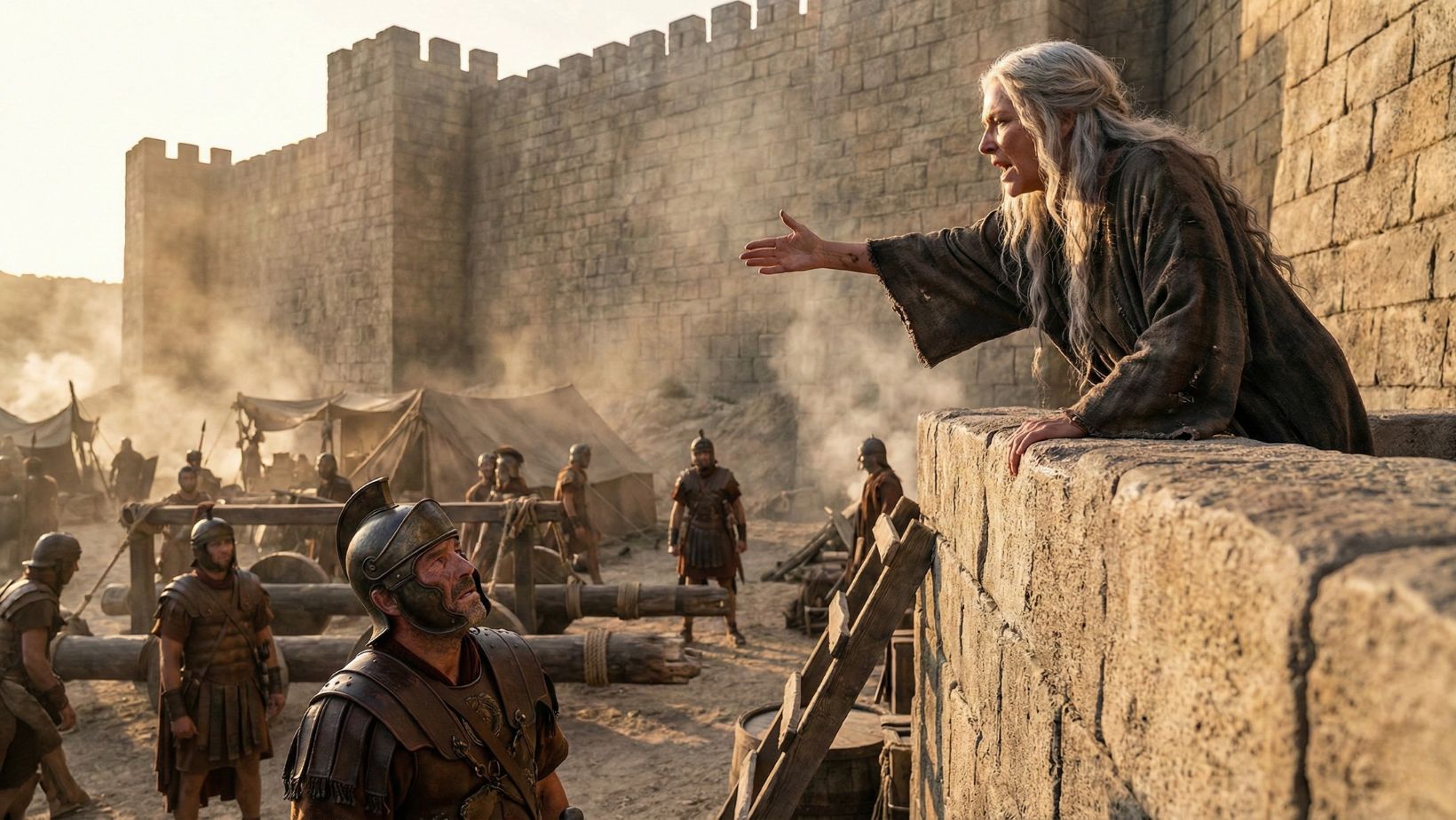
14 Meanwhile, Sheba traveled through all the tribes of Israel to Abel-beth-maacah… 15 When Joab’s forces arrived, they attacked Abel-beth-maacah. They built a siege ramp against the city’s outer wall and began battering down the wall. 16 But a wise woman in the city called out to Joab, “Listen to me, Joab. Come over here so I can talk to you.” … 18 Then she said, “There used to be a saying, ‘If you want to settle an argument, ask advice at the town of Abel.’ 19 I am one of those who are peace loving and faithful in Israel. But you are destroying an important city in Israel, a mother in Israel. Why do you want to devour what belongs to the Lord?” 20 “Far be it from me!” Joab replied. “I don’t want to devour or destroy it. 21 That’s not my purpose. We only want a man named Sheba… If you hand him over to us, we will leave the city alone.” “All right,” the woman replied. “We will throw his head over the wall to you.” 22 Then the woman went to the people with her wise advice, and they cut off Sheba’s head and threw it out to Joab. So he blew the ram’s horn and called his troops back from the attack… And Joab returned to the king at Jerusalem.
Commentary:
- Abel Beth-maacah (v. 14): A city in the far north (near Dan). Sheba retreats to the very edge of the map.
- The Siege (v. 15): Joab doesn’t negotiate; he builds a ramp to crush the wall. He is ready to massacre a whole city to get one man.
- The Wise Woman (v. 16): Another anonymous female heroine (like the woman of Tekoa in Ch. 14 or Abigail in 1 Sam 25).
- “Mother in Israel” (v. 19): She appeals to the city’s heritage. Abel was known for wisdom (“Ask at Abel”). Destroying it would be like killing a “mother” of the nation.
- The Negotiation (v. 20–21): Joab defends himself: “I don’t want to destroy.” He claims he is surgical, not genocidal. He agrees to lift the siege for the head of the traitor.
- Pragmatic Justice (v. 22): The woman convinces the citizens. It is better for one guilty man to die than for the whole innocent city to perish (a principle later echoed by Caiaphas in John 11:50, though wrongly applied there).
- The Head (v. 22): The rebellion ends not with a great battle, but with a severed head thrown over a wall.
Insight: Wisdom is better than weapons of war (Ecclesiastes 9:18). One woman saved an entire city by using her words when the general was ready to use battering rams.
4. David’s Administration Restored (2 Samuel 20:23–26 NLT)
23 Now Joab was the commander of the army of Israel. Benaiah son of Jehoiada was captain of the king’s bodyguard. 24 Adoniram was in charge of the forced labor. Jehoshaphat son of Ahilud was the royal historian. 25 Sheva was the court secretary. Zadok and Abiathar were the priests. 26 And Ira the Jairite was David’s personal priest.
Commentary:
- Joab Returns (v. 23): This is the shocking reality. Joab murdered Amasa, disobeyed the King, and yet he is listed as “commander of the army.” David is too weak or too pragmatic to fire him. Joab has won his power back through blood.
- Adoniram and Forced Labor (v. 24): A disturbing new addition to the cabinet list (compare to 2 Sam 8:16–18).
- “Forced Labor” (Mas): This indicates a shift toward a more oppressive, bureaucratic state. This institution will eventually cause the rebellion against Solomon’s son Rehoboam. The seeds of the future split are being planted now.
- Ira the Jairite (v. 26): Replaces David’s sons as “priestly leaders” (2 Sam 8:18). The loss of his sons (Amnon, Absalom) has changed the structure of his court.
Insight: The chapter ends with “order” restored, but it is a darker order. The innocent enthusiasm of David’s early reign (Ch. 8) is replaced by a government that includes forced labor and a general who is a murderer.
Theological Significance of 2 Samuel 20
- The “Mother in Israel”: This title (v. 19) highlights the role of wisdom in preserving the community of faith. While men like Sheba and Joab tear down (one with words, one with swords), the wisdom of the faithful builds up and protects.
- The Failure of Human Politics: The cycle of rebellions (Absalom, then Sheba) shows that the Davidic Kingdom cannot be maintained by human charisma or military force alone. It points to the need for a Prince of Peace who rules the heart, not just the territory.
- Guilt vs. Innocence: The story of the city being saved by the death of the one guilty man serves as a reverse-type of Christ. In the Gospel, the One Innocent Man dies so the guilty city (the world) can be saved.
Practical Applications
- Be a Peacemaker: In a world of “Joabs” (who escalate conflict) and “Shebas” (who incite division), be a “Wise Woman of Abel.” Speak words that de-escalate tension and save relationships.
- Integrity in Leadership: Joab regained his job, but he lost his soul. Success achieved through backstabbing (literally) is failure in God’s eyes.
- Cut off the Head: Sometimes, for the sake of the whole (a church, a family, a company), a toxic influence (“Sheba”) must be removed decisively. Tolerating a cancer endangers the whole body.
- The Danger of Resentment: Sheba’s revolt started because the northern tribes felt slighted. Unaddressed offenses in a community often mutate into open rebellion.







Leave a Reply