
2 Samuel 21 begins an epilogue section (Chapters 21–24) that disrupts the chronological narrative to focus on thematic issues. This chapter deals with two main threats to the kingdom: a spiritual threat caused by past sin (the Gibeonite bloodguilt) and a physical threat caused by present enemies (Philistine giants). It opens with a famine caused by Saul’s broken treaty with the Gibeonites, which is only resolved through a grim act of execution and the touching vigil of a mother named Rizpah. The second half of the chapter highlights the aging vulnerability of King David, who nearly dies in battle, and the rise of his “Mighty Men” who defeat four giants, securing the future of the nation.
1. The Famine and the Gibeonite Revenge (2 Samuel 21:1–9 NLT)
1 There was a famine during David’s reign that lasted for three years, so David asked the Lord about it. And the Lord said, “The famine has come because Saul and his family are guilty of murdering the Gibeonites.” 2 So the king summoned the Gibeonites. They were not part of Israel but were all that was left of the nation of the Amorites. The people of Israel had sworn not to kill them, but Saul, in his zeal for Israel and Judah, had tried to wipe them out. 3 David asked them, “What can I do for you? How can I make amends so that you will bless the Lord’s people again?” 4 “Well, money won’t do it,” the Gibeonites replied. “And we don’t want to see any Israelites executed in revenge.” “What can I do then?” David asked. “Just tell me and I will do it for you.” 5 Then they replied, “It was Saul who planned to destroy us, to keep us from having any place at all in the territory of Israel. 6 So let seven of Saul’s sons be handed over to us, and we will execute them before the Lord at Gibeon, on the mountain of the Lord.” “All right,” the king said, “I will do it.” 7 The king spared Jonathan’s son Mephibosheth, who was Saul’s grandson, because of the oath David and Jonathan had sworn before the Lord. 8 But he gave them Saul’s two sons, Armoni and Mephibosheth, whose mother was Rizpah daughter of Aiah. He also gave them the five sons of Saul’s daughter Merab, the wife of Adriel the Meholathite. 9 The men of Gibeon executed them on the mountain before the Lord. So all seven of them died together at the beginning of the barley harvest.
Commentary:
- The Cause (v. 1): A three-year famine prompts David to seek God. The answer is “bloodguilt.” Saul had violated the ancient treaty Joshua made with the Gibeonites (Joshua 9), attempting genocide in a misguided nationalist “zeal” (v. 2).
- Principle: God does not forget broken covenants, even if they were made centuries ago or by previous administrations. Sin has a long shelf life.
- The Demand (v. 4–6): The Gibeonites refuse “silver or gold.” They demand “blood for blood” (Numbers 35:31).
- They ask for seven male descendants (seven being the number of completion) to be executed/impaled.
- This brutal request was legally permissible under ancient Near Eastern codes for broken treaties, though it sits uncomfortably with Deuteronomy 24:16 (fathers not put to death for children). However, this seems to be a special case of divine justice regarding national oaths.
- Covenant Fidelity (v. 7): David faces a conflict of covenants. He must satisfy the Gibeonite covenant, but he is also bound by his covenant to Jonathan.
- He spares Mephibosheth (Jonathan’s son) to honor his word.
- He hands over the other sons (including another man named Mephibosheth, Saul’s son by Rizpah).
- The Execution (v. 9): The execution happens at the “beginning of the barley harvest” (Passover season). It is a public act of propitiation to lift the curse from the land.
Insight: David cleans up Saul’s mess. Leaders often have to deal with the “unexploded bombs” (sins, debts, broken promises) left by their predecessors.
2. Rizpah’s Vigil and the Burial of Bones (2 Samuel 21:10–14 NLT)
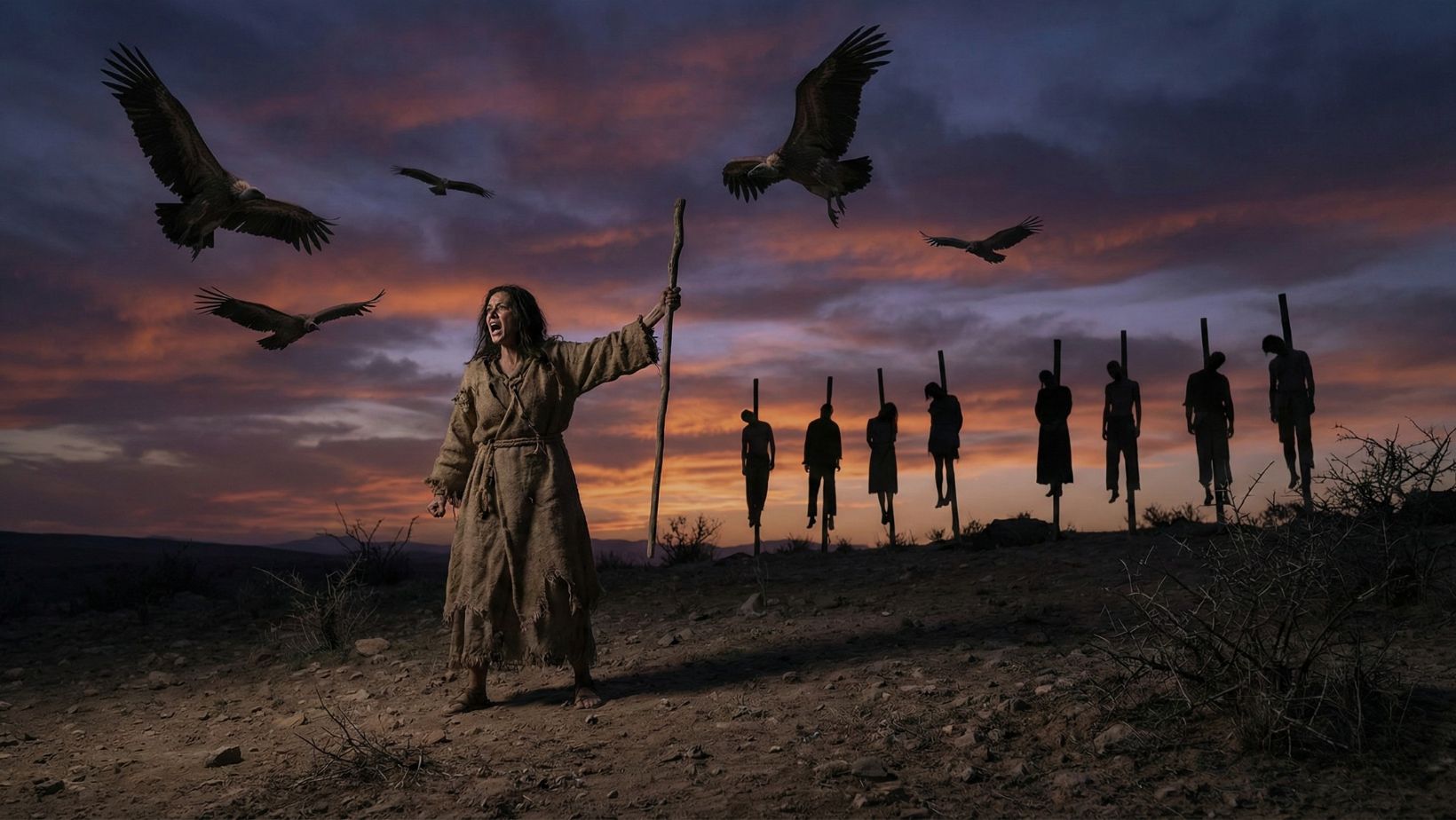
10 Then Rizpah daughter of Aiah, the mother of two of the men, spread sackcloth on a rock and stayed there the entire harvest season. She prevented the scavenger birds from tearing at their bodies during the day and stopped wild animals from eating them at night. 11 When David learned what Rizpah, Saul’s concubine, had done, 12 he went to the people of Jabesh-gilead and retrieved the bones of Saul and his son Jonathan… 13 So David collected the bones of Saul and his son Jonathan, as well as the bones of the men the Gibeonites had executed. 14 Then the king ordered that they be buried in the tomb of Kish, Saul’s father, at the town of Zela in the land of Benjamin. After that, God ended the famine in the land.
Commentary:
- Rizpah’s Devotion (v. 10): Rizpah’s sons are dead, their bodies left exposed to the elements (a supreme curse). She cannot save their lives, but she fights to save their dignity.
- She camps on the rock from April (barley harvest) until October (early rains).
- She fights off vultures and jackals day and night for months. It is a harrowing picture of maternal grief and endurance.
- David’s Response (v. 11–12): David is moved by Rizpah’s act. He realizes that while justice has been served, dignity has not.
- He retrieves the bones of Saul and Jonathan (buried in Jabesh-gilead since 1 Samuel 31).
- He gathers the bones of the seven executed men.
- Closure (v. 14): David gives them all a royal burial in the ancestral tomb.
Insight: Rizpah is the silent hero of the chapter. Her refusal to let the bodies be desecrated shamed the King into doing the right thing, turning a gruesome execution into a moment of national healing.
3. The Exhaustion of David and the Rise of Giants (2 Samuel 21:15–22 NLT)
15 Once again the Philistines were at war with Israel. And when David and his men were in the thick of battle, David became weak and exhausted. 16 Ishbi-benob was a descendant of the giants; his bronze spearhead weighed more than seven pounds, and he was armed with a new sword. He had cornered David and was about to kill him. 17 But Abishai son of Zeruiah came to David’s rescue and killed the Philistine. Then David’s men declared, “You are not going out to battle with us again! Why should you risk snuffing out the light of Israel?” 18 After this, there was another battle against the Philistines at Gob. As they fought, Sibbechai from Hushah killed Saph, another descendant of the giants. 19 During another battle at Gob, Elhanan son of Jair from Bethlehem killed the brother of Goliath of Gath. The handle of his spear was as thick as a weaver’s beam! 20 In another battle at Gath, there was a huge man with six fingers on each hand and six toes on each foot—twenty-four in all. He was also a descendant of the giants. 21 But when he defied and taunted Israel, he was killed by Jonathan, the son of David’s brother Shimea. 22 These four Philistines were descendants of the giants of Gath, but they were killed by David and his warriors.
Commentary:
- David Faints (v. 15): This is a startling admission. The slayer of Goliath is now an old man. He becomes “weak and exhausted” in battle.
- Ishbi-benob (v. 16): A giant (likely of the Rafa/Rephaim clan). He spots David’s weakness and targets him with “new armor.”
- Abishai Saves the Day (v. 17): Abishai intervenes and kills the giant.
- The Giant Slayers (v. 18–22): The narrative lists four giants killed by David’s men.
- Sibbechai kills Saph.
- Elhanan kills Goliath’s brother: (The NLT clarifies “brother of Goliath” to harmonize with 1 Chronicles 20:5. The Hebrew text of 2 Samuel says “Elhanan killed Goliath,” which is likely a scribal omission of “brother of” or refers to a title, as David clearly killed the original Goliath).
- Jonathan (David’s Nephew) kills the Six-Fingered Man.
- The Legacy (v. 22): “They were killed by David and his warriors.” Even though David didn’t kill them personally, his spirit inspired the men who did. He reproduced himself.
Insight: There comes a time when the hero must hang up his sword. David’s greatness is shown not in fighting forever, but in raising up a generation of “Giant Killers” (Abishai, Sibbechai, Elhanan) who can finish the job.
Theological Significance of 2 Samuel 21
- Corporate Guilt: The famine shows that nations can suffer for the sins of their leaders (Saul). Justice must be satisfied for healing to occur.
- The Integrity of God: God defends the Gibeonites (Gentiles) against Israel. He is no respecter of persons; He expects His people to keep their word even to “lesser” nations.
- Atonement: The execution of the seven sons functions as a grim form of propitiation—turning away God’s wrath. It underscores the severity of sin and the necessity of a blood price (foreshadowing the ultimate price paid by Christ).
- Suffering Servant: Rizpah illustrates the power of lament and intercession. She stood between the dead and the living (the birds/beasts) until the King took notice.
Practical Applications
- Clean Up the Past: Is there “bloodguilt” or broken promises in your family or organization’s past? You cannot move forward until you address the unpaid debts of yesterday.
- Protect the Lamp: We must protect our leaders. When they are exhausted, we shouldn’t criticize them; we should step in like Abishai and strike the giant threatening them.
- Rizpah’s Endurance: When you can’t change the outcome, you can still honor the loss. Sometimes love looks like scaring away the vultures from what remains.
- Passing the Baton: Leaders must accept their limits. There is a time to fight and a time to let others fight for you. Don’t risk the “Lamp of Israel” trying to prove you are still young.
Sermon Titles
- The Unbroken Oath.
- Rizpah on the Rock: The Power of a Mother’s Vigil.
- When the Giant Killer Faints.
- Cleaning Up Saul’s Mess.
- The Lamp of Israel.







Leave a Reply