
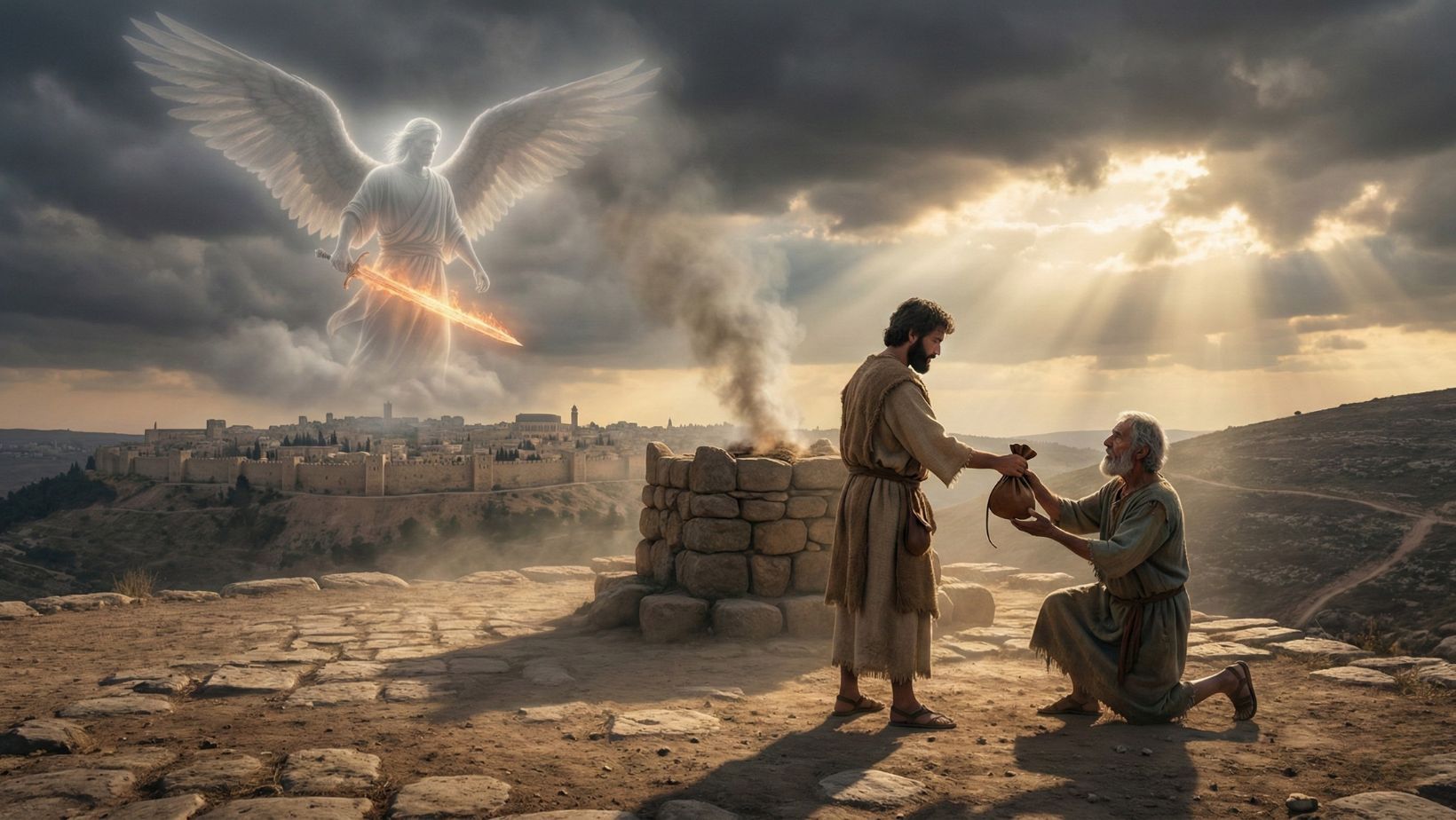
2 Samuel 24 serves as the epilogue to the entire book, grounding the future of Israel’s worship in a moment of royal repentance. The chapter narrates David’s final recorded sin: taking a military census of the people. This act of pride or lack of trust prompts divine judgment in the form of a pestilence. However, the plague is halted at a specific location—the threshing floor of Araunah the Jebusite. David purchases this site to build an altar, and it is here that the plague stops. This location is significant because it is Mount Moriah, the future site of Solomon’s Temple. The book concludes not with a battle, but with a sacrifice, pointing toward the need for atonement at the heart of the kingdom.
1. The Sinful Census (2 Samuel 24:1–9 NLT)
1 Once again the anger of the Lord burned against Israel, and he caused David to harm them by taking a census. “Go and count the people of Israel and Judah,” the Lord told him. 2 So the king said to Joab and the commanders of the army, “Take a census of all the tribes of Israel—from Dan in the north to Beersheba in the south—so I may know how many people there are.” 3 But Joab replied to the king, “May the Lord your God let you live to see a hundred times as many people as there are now! But why does my lord the king want to do this?” 4 But the king insisted that they take the census, so Joab and the commanders of the army went out to count the people of Israel. … 9 Joab reported the number of people to the king. There were 800,000 capable warriors in Israel who could handle a sword, and 500,000 men in Judah.
Commentary:
- The Incitement (v. 1): The text says the Lord “caused David” to take the census because His anger burned against Israel. However, 1 Chronicles 21:1 states, “Satan rose up against Israel and caused David to take a census.”
- Why was it a Sin? (v. 2): Counting people wasn’t inherently evil (Moses did it). The sin lay in the motive.
- Pride: David wanted to “know” the strength of his power. He was shifting from trusting God’s promise (which makes people innumerable, Gen 15:5) to trusting human statistics.
- Military Reliance: He counted “warriors who could handle a sword” (v. 9). It was a draft registration.
- Neglect of Ransom: Exodus 30:12 required a “ransom money” tax for every person counted to prevent a plague. There is no mention of David collecting this.
- Joab’s Conscience (v. 3): Even Joab, a man with blood on his hands, recognizes this is spiritually dangerous. When a morally compromised man tells a man of God, “Don’t do this,” the leader should listen.
- The Numbers (v. 9): The total military strength is 1.3 million. This represents a massive force, fueling David’s ego.
Insight: We often want to “count” our resources (money, followers, achievements) to feel secure. But when we measure our strength, we stop relying on God’s strength.
2. The Judgment and David’s Choice (2 Samuel 24:10–17 NLT)
10 But after he had taken the census, David’s conscience began to bother him. And he said to the Lord, “I have sinned greatly by this census. I beg you, Lord, take away the guilt of your servant, for I have done a very foolish thing.” 11 The next morning… the word of the Lord came to the prophet Gad, who was David’s seer. 12 “Go and say to David… I will give you three choices. Choose one of these punishments, and I will inflict it on you.” … 13 “Shall there be three years of famine throughout your land? Shall there be three months of fleeing from your enemies while they pursue you? Or shall there be three days of a plague throughout your land?” … 14 “I am in a desperate situation!” David replied to Gad. “But let us fall into the hands of the Lord, for his mercy is great. Do not let me fall into human hands.” 15 So the Lord sent a plague upon Israel that morning, and it lasted for three days. A total of 70,000 people died… 16 But as the angel was preparing to destroy Jerusalem, the Lord relented and said to the death angel, “Stop! That is enough!” At that moment the angel of the Lord was by the threshing floor of Araunah the Jebusite. 17 When David saw the angel, he said to the Lord, “I am the one who has sinned and done wrong! But these people are as innocent as sheep—what have they done? Let your anger fall against me and my family.”
Commentary:
- Conscience (v. 10): David’s heart “smote him” (KJV). This is the mark of a true believer—he doesn’t need a prophet to tell him he sinned this time; his internal alarm goes off.
- The Three Options (v. 13):
- Famine (3 years): Economic disaster.
- Sword (3 months): Military defeat (fleeing from enemies).
- Plague (3 days): Direct divine judgment.
- David’s Choice (v. 14): David chooses the plague.
- Reasoning: “Let us fall into the hands of the Lord.” He knows human enemies are cruel, but God is merciful even in judgment.
- The Angel of the Lord (v. 16): The plague is executed by a specific angelic agent.
- The Halt (v. 16): The destruction stops at Jerusalem, specifically at the “threshing floor of Araunah.” This is a pivotal geographical detail.
- The Shepherd’s Heart (v. 17): David sees the Angel and intercedes. He takes full responsibility: “I am the one who sinned… these are sheep.” He offers himself as a substitute for the people.
Insight: True leadership involves taking the blame. David asks God to shift the judgment from the innocent “sheep” to himself, the guilty shepherd.
3. The Purchase of the Altar (2 Samuel 24:18–25 NLT)
18 That day Gad came to David and said to him, “Go up and build an altar to the Lord on the threshing floor of Araunah the Jebusite.” 19 So David went up to do what the Lord had commanded him. 20 When Araunah saw the king and his men coming toward him, he came and bowed before the king… 21 “Why have you come, my lord the king?” Araunah asked. David replied, “I have come to buy your threshing floor and to build an altar to the Lord there, so that the plague may be stopped.” 22 “Take it, my lord the king, and use it as you wish,” Araunah said to David. “Here are oxen for the burnt offering, and you can use the threshing boards and ox yokes for wood to build a fire on the altar. 23 I will give it all to you, Your Majesty…” 24 But the king replied to Araunah, “No, I insist on buying it, for I will not present burnt offerings to the Lord my God that have cost me nothing.” So David paid him fifty pieces of silver for the threshing floor and the oxen. 25 David built an altar there to the Lord and sacrificed burnt offerings and peace offerings. And the Lord answered his prayer for the land, and the plague on Israel was stopped.
Commentary:
- Araunah the Jebusite: Likely the former King of Jebus (Jerusalem) before David conquered it. He still owns land just outside the city walls.
- The Offer (v. 22–23): Araunah tries to give the land, the oxen, and the wood for free. It is a noble gesture (or perhaps fear of the King).
- The Principle of Cost (v. 24): This is one of the most important verses on worship in the Bible.
- “I will not present burnt offerings… that have cost me nothing.”
- Worship requires sacrifice. If it is convenient or cheap, it is not worship; it is patronage. David understands that the value of the offering is in the cost to the giver.
- The Site: 2 Chronicles 3:1 identifies this threshing floor as Mount Moriah, the place where Abraham offered Isaac.
- The End of the Book: The book ends not with David sitting on a throne, but David kneeling at an altar. The solution to Israel’s sin is not a better King, but a perfect Sacrifice.
Insight: David buys the site for the future Temple. He cannot build it (because he is a man of war), but he secures the land through an act of repentance. The Temple is founded on the ground of mercy.
Theological Significance of 2 Samuel 24
- The Danger of Self-Reliance: The census reminds us that trusting in numbers rather than God brings disaster.
- Mercy in Judgment: Even when judging, God “relented” (v. 16). His nature is to show mercy.
- Atonement: The plague is stopped only when the altar is built and blood is shed. This reinforces the biblical theme that sin requires a blood sacrifice for atonement.
- Costly Worship: True devotion costs us something—time, money, pride, or comfort.
Practical Applications
- Don’t Count Your Troops: Stop obsessing over your “numbers” (bank account, social media likes, church attendance). Do the work and trust God with the results.
- Listen to Conscience: When your heart smites you, repent immediately. Don’t wait for the consequences to pile up.
- Worship that Costs: Ask yourself: Does my walk with God cost me anything? If my giving, serving, or worship is only done when it’s comfortable, is it truly a sacrifice?
- Intercede for the Sheep: Leaders must cover their people. When things go wrong, don’t blame the people; take responsibility and go to God on their behalf.
Sermon Titles
- I Will Not Offer What Costs Me Nothing.
- Falling into the Hands of God.
- When the Shepherd Sins.
- The Threshing Floor: Where Mercy Meets Judgment.
- Stop Counting, Start Trusting.







Leave a Reply