
2 Samuel 3 details the gradual strengthening of David’s house and the simultaneous collapse of Saul’s house. The long war continues, but the momentum is decisively with David. The chapter is dominated by political intrigue: Abner, insulted by Ishbosheth, defects to David and negotiates to hand over the entire kingdom of Israel. David accepts the offer on the condition that his first wife, Michal (Saul’s daughter), is returned to him—a move that strengthens his legal claim to Saul’s throne. Just as peace seems imminent, Joab (David’s general) murders Abner in cold blood to avenge his brother Asahel. David publicly mourns Abner to prove his innocence to the people, navigating a political crisis that could have alienated the northern tribes.
1. The Growth of David’s House (2 Samuel 3:1–5 NLT)
1 That was the beginning of a long war between those who were loyal to Saul and those loyal to David. As time passed, David became stronger and stronger, while Saul’s dynasty became weaker and weaker. 2 These are the sons who were born to David in Hebron: The oldest was Amnon, whose mother was Ahinoam from Jezreel. 3 The second was Kileab, whose mother was Abigail, the widow of Nabal from Carmel. The third was Absalom, whose mother was Maacah, the daughter of Talmai, king of Geshur. 4 The fourth was Adonijah, whose mother was Haggith. The fifth was Shephatiah, whose mother was Abital. 5 The sixth was Ithream, whose mother was Eglah, David’s wife. These sons were all born to David in Hebron.
Commentary:
- The Trajectory (v. 1): The narrator summarizes the era: David is waxing (growing stronger), and the house of Saul is waning (growing weaker). This confirms God’s blessing is on David.
- Political Marriages (v. 2–5): The list of sons born in Hebron reflects David’s political alliances:
- Amnon (Ahinoam): Represents a connection to the Jezreel Valley.
- Kileab/Daniel (Abigail): Represents wealth and influence in southern Judah.
- Absalom (Maacah): His mother was a princess of Geshur (a kingdom northeast of the Sea of Galilee). This was a strategic international alliance.
- Adonijah: Will later try to usurp the throne (1 Kings 1).
- The Shadow of Polygamy: While these marriages expanded David’s influence, the sons born from them (Amnon, Absalom, Adonijah) would later cause David immense grief, rape, murder, and treason. The seeds of future family chaos are planted here.
Insight: David’s political strength is growing, but his domestic life is becoming complicated. Success in the public square does not always equal success at home.
2. Abner’s Defection (2 Samuel 3:6–11 NLT)
6 As the war between the house of Saul and the house of David went on, Abner became a powerful leader among the loyalists of Saul. 7 One day Ishbosheth, Saul’s son, accused Abner, “Why have you been sleeping with my father’s concubine, Rizpah?” 8 Abner was furious. “Am I some Judean dog to be kicked around like this?” he shouted. “After all I have done for your father, Saul, and his family and friends by not handing you over to David, is this my reward—that you find fault with me about this woman? 9 May God strike me and even kill me if I don’t do everything I can to help David get what the Lord has promised him! 10 I’m going to take the kingdom away from Saul’s house and give it to David. I will establish the throne of David over Israel as well as Judah, all the way from Dan in the north to Beersheba in the south.” 11 Ishbosheth didn’t dare say another word because he was afraid of what Abner might do.
Commentary:
- The Harem Incident (v. 7): In the ancient Near East, taking a king’s concubine was a claim to the throne (see Absalom later in 2 Sam 16:21). Ishbosheth asks Abner about Rizpah.
- Abner’s Reaction (v. 8): Abner explodes in rage. He feels his loyalty is being insulted over a “trivial” matter (“fault with me about this woman”). He calls himself a “Judean dog” (an expression of utter contempt).
- The Power Shift (v. 9–10): Abner acknowledges he knew God’s will all along (“what the Lord has promised him”). He admits he has been fighting against God’s plan and now decides to switch sides—not out of piety, but out of spite against Ishbosheth.
- The Puppet King (v. 11): Ishbosheth is paralyzed by fear. He realizes he is king in name only.
Insight: Abner is a “kingmaker.” He uses God’s will as a tool for his own convenience. He fights God’s will when it suits him and aligns with it when he gets angry.
3. The Covenant with David (2 Samuel 3:12–21 NLT)
12 Then Abner sent messengers to David, saying, “Doesn’t the entire land belong to you? Make a solemn pact with me, and I will help turn over all of Israel to you.” 13 “All right,” David replied, “but I will not negotiate with you unless you bring back my wife Michal, Saul’s daughter, when you come.” … 17 Meanwhile, Abner had consulted with the elders of Israel. “For some time now,” he told them, “you have wanted to make David your king. 18 Now is the time! For the Lord has said, ‘I have chosen David to save my people Israel from the hands of the Philistines and from all their other enemies.’” … 20 When Abner arrived at Hebron with twenty of his men, David entertained them with a great feast. 21 Then Abner said to David, “Let me go and call an assembly of all Israel to support my lord the king. They will make a covenant with you to make you their king, and you will rule over everything your heart desires.” So David sent Abner safely on his way.
Commentary:
- The Demand for Michal (v. 13): David agrees to the alliance but demands the return of Michal, his first wife (1 Samuel 18:27), whom Saul had given to another man (Paltiel).
- Abner’s Persuasion (v. 17–18): Abner convinces the elders of Israel (especially the tribe of Benjamin) to switch allegiance. He uses religious language (“The Lord has said”) to validate the political flip.
- The Feast (v. 20): David receives Abner with a feast, signifying a covenant of peace. He accepts the defector.
Insight: David is pragmatic. He is willing to work with Abner, his former enemy, to unify the kingdom and stop the shedding of Israelite blood.
4. Joab’s Revenge and Murder of Abner (2 Samuel 3:22–30 NLT)
22 But just after David had sent Abner away in safety, Joab and some of David’s troops returned from a raid… 23 When Joab arrived, he was told that Abner had just been there visiting the king… 24 Joab rushed to the king and demanded, “What have you done? What do you mean by letting him get away? 25 You know Abner son of Ner. He came here to deceive you and spy on your movements and find out everything you’re doing!” 26 Joab then left David and sent messengers to catch up with Abner… 27 When Abner arrived back at Hebron, Joab took him aside at the gateway as if to speak with him privately. But then he stabbed Abner in the stomach and killed him in revenge for killing his brother Asahel. 28 When David heard about it, he declared, “I vow by the Lord that I and my kingdom are forever innocent of this crime against Abner son of Ner. 29 May Joab and his family be cursed! Let the family of Joab never be without someone who has a running sore or leprosy or who walks with crutches or who dies by the sword or who begs for food!”
Commentary:
- Joab’s Fury (v. 24–25): Joab returns and is incensed. He frames his objection as security (“he came to spy”), but his motive is personal vengeance. He also likely fears Abner replacing him as supreme commander.
- The Murder (v. 27):
- Deceit: Joab tricks Abner just as Abner had warned Asahel not to trick him.
- Location: He kills him in the “gateway” of Hebron. Since Hebron was a City of Refuge (Joshua 20), this was a sacrilege. Blood revenge was forbidden inside the city limits.
- Motive: “In revenge for killing his brother Asahel” (2 Sam 2:23).
- David’s Curse (v. 28–29): David immediately distances himself from the act. If the northern tribes think David ordered the hit, the civil war will never end. He pronounces a severe, multi-generational curse on Joab’s house (leprosy, disability, poverty).
Insight: Joab represents “machiavellian” politics—power protected by violence. David cannot control Joab yet, but he refuses to be complicit in his treachery.
5. David’s Lament and Public Exoneration (2 Samuel 3:31–39 NLT)
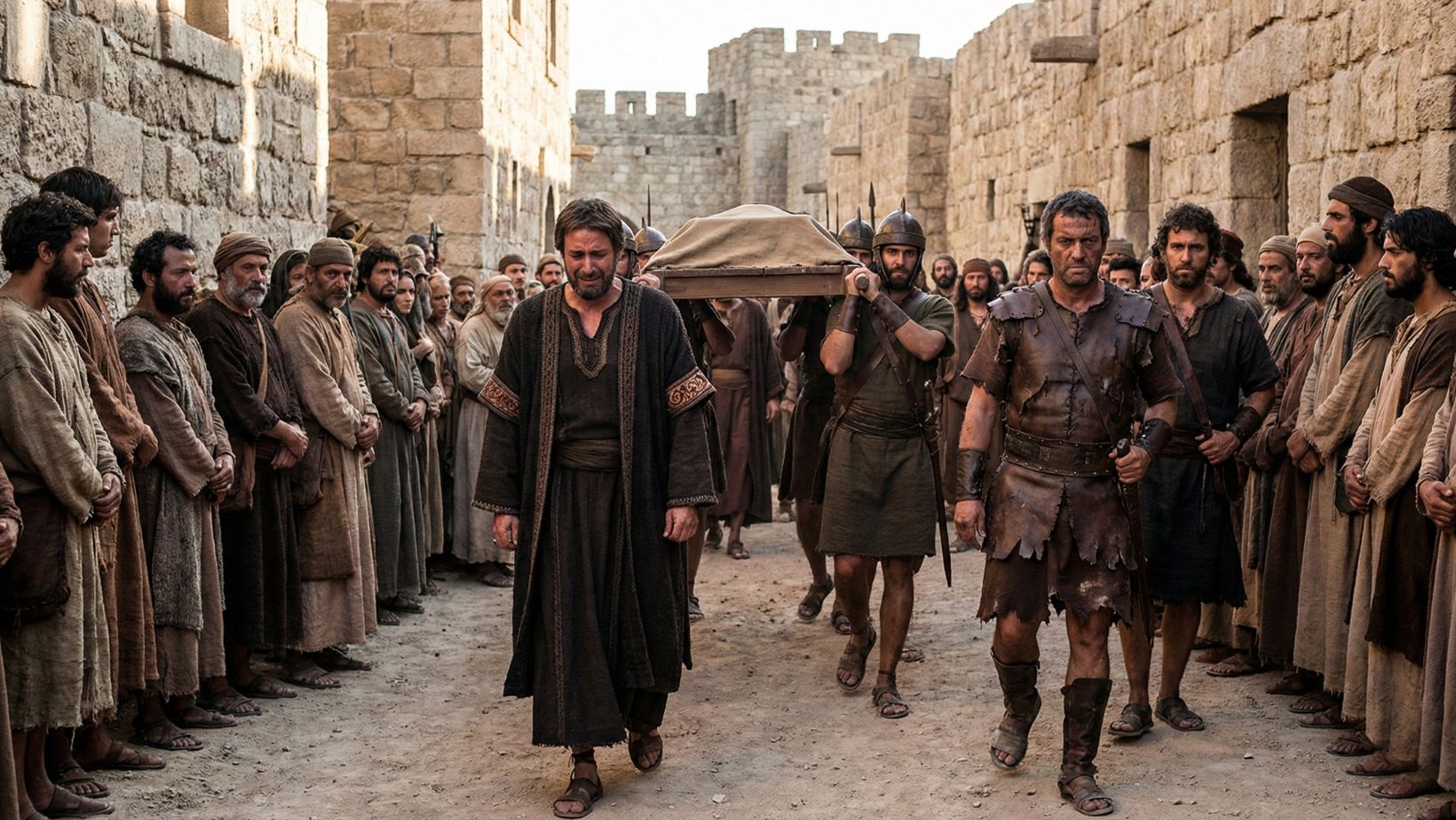
31 Then David said to Joab and all those who were with him, “Tear your clothes and put on burlap. Mourn for Abner.” And King David himself walked behind the procession to the grave. 32 They buried Abner in Hebron, and the king wept aloud at his grave, and all the people wept. 33 Then the king sang this funeral song for Abner: “Should Abner have died as a fool dies? 34 Your hands were not bound; your feet were not chained. No, you were murdered—the victim of a wicked plot.” All the people wept again for him. 35 David refused to eat anything on the day of the funeral… 36 This pleased the people very much. In fact, everything the king did pleased them. 37 So everyone in Judah and all Israel understood that David was not responsible for Abner’s murder. 38 Then King David said to his officials, “Don’t you realize that a great commander has fallen in Israel today? 39 And even though I am the anointed king, these two sons of Zeruiah—Joab and Abishai—are too strong for me to control. So may the Lord repay these evil men for their evil deeds.”
Commentary:
- Forced Mourning (v. 31): David commands Joab to tear his clothes and mourn the man he just murdered. This is a public humiliation for Joab and a political necessity for David.
- The King Weeps (v. 32): In the ancient world, kings usually did not weep for subjects. David’s public display of emotion convinces the people of his sincerity.
- The Lament (v. 33–34): David sings that Abner did not die like a “fool” (criminal) or a prisoner of war, but as a victim of treachery (“wicked plot”). He validates Abner’s honor.
- Political Success (v. 36–37): The strategy works. The people are “pleased.” They recognize David is a man of justice, distinct from his violent general.
- David’s Vulnerability (v. 39): David admits a shocking truth to his inner circle: “I am weak… these sons of Zeruiah are too strong for me.” He is king, but he is held hostage by the military power of his nephews.
Insight: David wins the hearts of the people not by force, but by empathy and justice. However, the chapter ends on a tension: David is on the throne, but he cannot yet fully enforce justice in his own cabinet.
Theological Significance of 2 Samuel 3
- God’s Providence in Politics: God uses the sinful anger of Abner (over a concubine) to fulfill His promise to David. God often bends the crooked lines of human history to draw His straight path.
- The Guilt of Blood: The chapter emphasizes that leadership must be free of treacherous bloodshed. David knows that a kingdom built on murder cannot stand (unlike Joab, who relies on it).
- Weakness in Strength: David is “waxing strong” (v. 1), yet admits he is “weak” (v. 39) against Joab. This highlights the complexity of leadership—having authority does not always mean having full control.
Practical Applications
- Beware of “Joabs”: In life and leadership, be wary of people who claim to be “on your side” but use unethical means to “help” you. Their loyalty is often self-serving and destructive.
- Public Integrity: David knew that appearing innocent was as important as being innocent. He took public steps to clarify his stance. Sometimes we must make our values visible to avoid misunderstanding.
- Conflict Resolution: David was willing to make peace with Abner, a man who had hunted him. We should be open to alliances with former adversaries if they are willing to seek peace.
- The Danger of Unchecked Anger: Abner’s pride (over the concubine) and Joab’s vengeance (over Asahel) both led to destruction. Unchecked emotion is a terrible master.
Sermon Titles
- The King Who Wept.
- Sleeping with the Enemy: Abner’s Defection.
- Sons of Zeruiah: When Your Helpers Are Your Hindrance.
- Murder at the City of Refuge.
- Growing Stronger, Growing Weaker.







Leave a Reply