
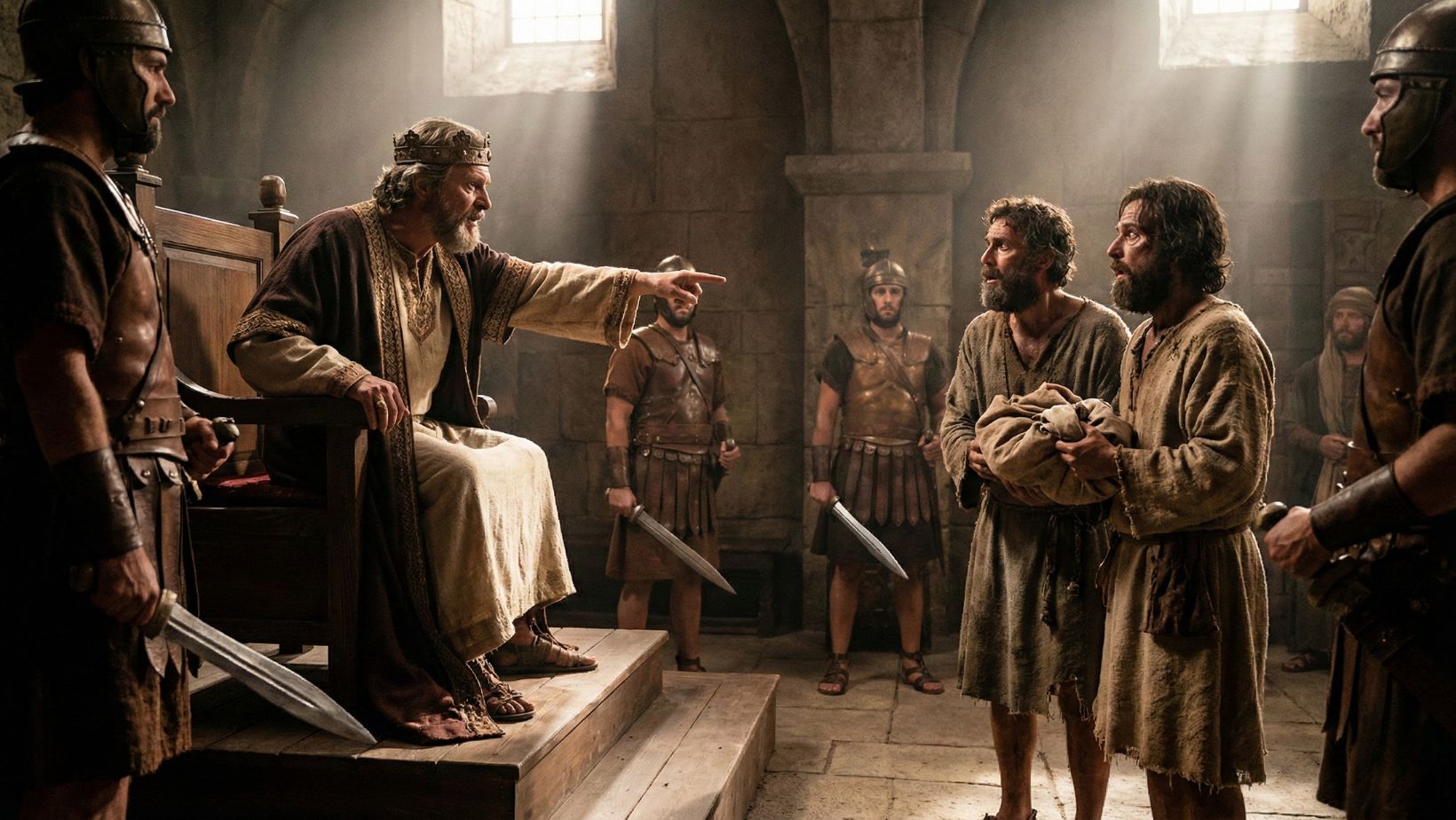
2 Samuel 4 narrates the final collapse of Saul’s dynasty. With Abner dead, Ishbosheth loses his courage and his grip on the northern kingdom. Two of his own captains, Baanah and Recab, sensing the shifting political winds, assassinate Ishbosheth in his bed and bring his head to David, expecting a reward. Once again, David demonstrates his commitment to justice over opportunism. Instead of rewarding the assassins, he executes them for murdering an innocent man in his own home. The chapter removes the last barrier to David’s kingship over all Israel, but it happens through tragedy rather than David’s aggression.
1. The Assassination of Ishbosheth (2 Samuel 4:1–8 NLT)
1 When Ishbosheth, Saul’s son, heard that Abner had died in Hebron, he lost all courage, and all Israel became paralyzed with fear. 2 Now there were two brothers, Baanah and Recab, who were captains of Ishbosheth’s raiding parties. They were sons of Rimmon, a member of the tribe of Benjamin who lived in Beeroth. The town of Beeroth is now part of Benjamin… 4 (Saul’s son Jonathan had a son named Mephibosheth, who was crippled as a child. He was five years old when the report came from Jezreel that Saul and Jonathan had been killed in battle. When the child’s nurse heard the news, she picked him up and fled. But as she hurried away, she dropped him, and he became crippled.) 5 One day Recab and Baanah, the sons of Rimmon, went to Ishbosheth’s house around noon as he was taking his midday rest. 6 The doorkeeper, who had been sifting wheat, became drowsy and fell asleep. So Recab and Baanah slipped past her. 7 They went into the house and found Ishbosheth sleeping on his bed in his bedroom. They struck and killed him and cut off his head. Then, taking his head with them, they fled across the Jordan Valley through the night. 8 When they arrived at Hebron, they presented Ishbosheth’s head to the king. “Look!” they said to the king. “Here is the head of Ishbosheth, the son of your enemy Saul who tried to kill you. Today the Lord has given my lord the king revenge on Saul and his entire family.”
Commentary:
- The Vacuum of Power (v. 1): Ishbosheth’s authority was entirely dependent on Abner. With Abner dead, Ishbosheth “lost all courage” (literally: “his hands dropped”). The nation is paralyzed, knowing their king is weak.
- The Assassins (v. 2): Baanah and Recab are Benjaminites—from Saul’s own tribe. This signifies the total disintegration of loyalty within Saul’s house. Even his kinsmen are turning on him.
- The Parenthesis on Mephibosheth (v. 4): The narrator interrupts the murder plot to introduce Mephibosheth (Jonathan’s son).
- Reason: It clarifies why the assassins targeted Ishbosheth. Mephibosheth was crippled and only 12 years old at this time (5 years old at Saul’s death + 7.5 years of David’s reign in Hebron). He was not a viable candidate for king in a time of war. Ishbosheth was the only obstacle left.
- Tragedy: His disability was caused by the panic following his grandfather’s death. He represents the innocent collateral damage of the family’s fall.
- The Crime (v. 5–7): The murder is depicted as cowardly.
- It happens at “midday” (siesta time).
- The victim is “sleeping on his bed.”
- They bypass a sleeping doorkeeper.
- They decapitate the corpse to prove the deed.
- The Theology of the Wicked (v. 8): Like the Amalekite in chapter 1, these men use theological language to justify their crime. They claim, “The Lord has given… revenge.” They assume David hates Saul’s family as much as they love money.
Insight: The assassins mistake God’s sovereignty (God allowing Saul’s house to fall) for God’s sanction (God approving of murder). They try to spiritualize their ambition.
2. David’s Judgment (2 Samuel 4:9–12 NLT)
9 But David said to Recab and Baanah, “The Lord, who saves me from all my enemies, is my witness. 10 Someone once told me, ‘Saul is dead,’ thinking he was bringing me good news. But I seized him and killed him at Ziklag. That’s the reward I gave him for his news! 11 How much more should I reward wicked men who have killed an innocent man in his own house and on his own bed? Shouldn’t I hold you responsible for shedding his blood and rid the earth of you?” 12 So David ordered his young men to kill them, and they did. They cut off their hands and feet and hung their bodies beside the pool in Hebron. Then they took Ishbosheth’s head and buried it in Abner’s tomb in Hebron.
Commentary:
- David’s Oath (v. 9): David begins with a testimony: “The Lord, who saves me…” This is crucial. David does not need assassins to save him or advance him. God is his redeemer; therefore, he does not need to use dirty tactics.
- The Precedent (v. 10): David reminds them of the Amalekite in Chapter 1. If he executed a man for claiming to kill a guilty king (Saul) on a battlefield, how much more will he execute men for actually killing an innocent man (Ishbosheth) in his bed?
- “Innocent Man” (v. 11): David calls Ishbosheth “righteous” or “innocent” (tsaddiq). Politically, he was a rival; legally and morally, he had done no wrong worthy of death.
- The Punishment (v. 12):
- Honorable Burial (v. 12): David buries Ishbosheth’s head in the tomb of Abner, treating him with the dignity of a royal family member.
Insight: David creates a culture of justice. By punishing those who “helped” him through illegal means, he establishes that his kingdom will be based on law, not the “law of the jungle.”
Theological Significance of 2 Samuel 4
- God as the Sole Redeemer: David’s statement in verse 9 (“The Lord who redeemed my life”) is the theological anchor. Because God redeems, we don’t have to manipulate, cheat, or kill to get ahead.
- The Sanctity of Life: David defends the life of his rival. Even in war and politics, there are lines that cannot be crossed. Murdering a defenseless man is “wicked” (v. 11), regardless of the political advantage it offers.
- Providence vs. Pragmatism: The assassins were pragmatists—they did what “worked” to get ahead. David trusted in Providence—waiting for God to move.
Practical Applications
- Don’t Help God with Sin: We often feel tempted to cut corners or hurt others to achieve a “good” result (like a promotion or resolving a conflict). David teaches us that the method matters as much as the outcome.
- Integrity When No One is Watching: Ishbosheth was killed when he was most vulnerable. The assassins had no integrity. Character is defined by what we do when we have the power to hurt someone and get away with it.
- Trusting God’s Timing: David could have rejoiced that his rival was gone. Instead, he mourned the way it happened. We should never rejoice in injustice, even if it benefits us.
Sermon Titles
- Assassins in the Bedroom.
- How Not to Please a King.
- The Lord Who Redeems (v. 9).
- When “Good News” is Bad News.
- Collateral Damage: The Tragedy of Mephibosheth.







Leave a Reply