
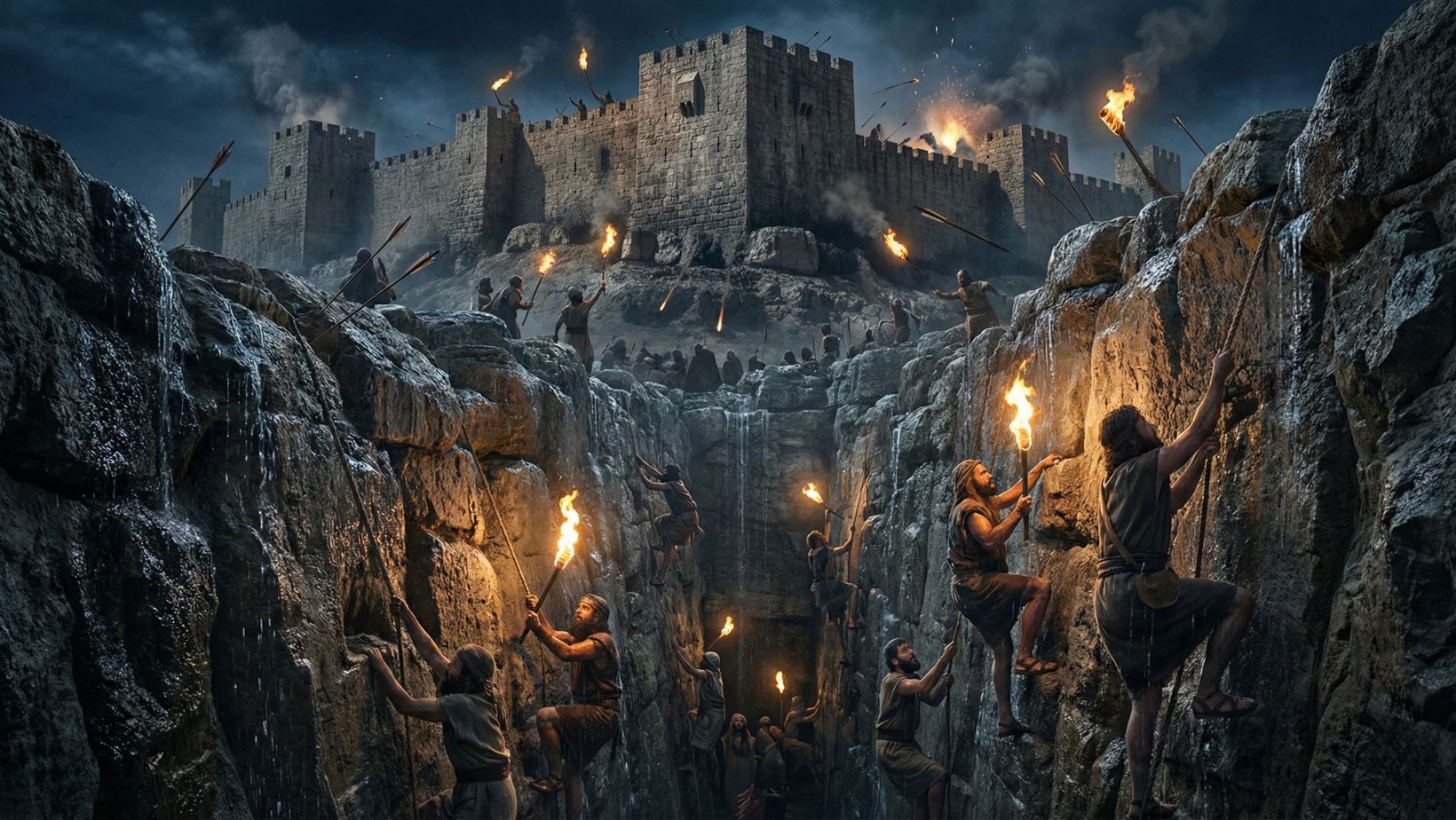
2 Samuel 5 is one of the high points of the Old Testament narrative. After years of running from Saul and seven years of ruling only Judah, God’s promise is finally fully realized: David is anointed king over all twelve tribes of Israel. To unify the fractured nation, David conquers the neutral Jebusite fortress of Jerusalem, establishing it as the political and spiritual capital—Zion. The chapter also records international recognition from the King of Tyre and two decisive military victories against the Philistines, who try to crush the new kingdom before it solidifies. This chapter marks the transition from a tribal confederacy to a centralized monarchy under God’s chosen king.
1. The Coronation: King Over All Israel (2 Samuel 5:1–5 NLT)
1 Then all the tribes of Israel went to David at Hebron and told him, “We are your own flesh and blood. 2 In the past, when Saul was our king, you were the one who really led the forces of Israel. And the Lord told you, ‘You will be the shepherd of my people Israel. You will be Israel’s leader.’” 3 So there at Hebron, King David made a covenant before the Lord with all the elders of Israel. And they anointed him king of Israel. 4 David was thirty years old when he began to reign, and he reigned forty years in all. 5 He reigned over Judah from Hebron for seven years and six months, and from Jerusalem he reigned over all Israel and Judah for thirty-three years.
Commentary:
- The Assembly (v. 1): “All the tribes” come to Hebron. This is a moment of massive national reconciliation.
- Three Reasons for Kingship (v. 1–2): The elders cite three qualifications for David’s rule:
- Kinship: “We are your own flesh and blood” (Deut 17:15 required the king to be an Israelite).
- Military Merit: “You were the one who really led the forces” (even under Saul, David was the effective leader).
- Divine Election: “The Lord told you…” They finally submit to the prophecy given to Samuel years ago.
- The Shepherd King (v. 2): This is the first time in the Bible a ruler is explicitly called a “shepherd.” It redefines kingship from “privilege” to “care and protection.”
- The Covenant (v. 3): This wasn’t a dictatorship; it was a constitutional monarchy based on a “covenant” (treaty) between the king, the people, and Yahweh.
- The Third Anointing (v. 3):
- Chronology (v. 4–5): David takes the throne at 30 (the age of maturity/priestly service) and reigns 40 years. This parallels Jesus’ ministry starting at roughly 30.
Insight: Unity requires humility. The northern tribes had to admit they were wrong to follow Ishbosheth, and David had to welcome them without “I told you so.”
2. The Conquest of Jerusalem (2 Samuel 5:6–10 NLT)
6 David then led his men to Jerusalem to fight against the Jebusites, the original inhabitants of the land, who were living there. The Jebusites taunted David, saying, “You’ll never get in here! Even the blind and lame could keep you out!” For the Jebusites thought they were safe. 7 But David captured the fortress of Zion, which is now called the City of David. 8 On the day of the attack, David said to his troops, “I hate those ‘lame’ and ‘blind’ Jebusites. Whoever attacks them should use the water shaft to get into the city.” That is why people say, “The blind and the lame must not enter the house.” 9 So David made the fortress his home, and he called it the City of David. He extended the city, starting at the supporting terraces and working inward. 10 And David became more and more powerful, because the Lord God of Heaven’s Armies was with him.
Commentary:
- Strategic Genius (v. 6): Jerusalem (Jebus) was a neutral enclave between Judah (South) and Benjamin (North). By taking it, David created a capital that belonged to no single tribe, unifying the nation politically.
- The Jebusite Taunt (v. 6): The city was naturally fortified by steep valleys on three sides. The Jebusites were so confident that they claimed “the blind and lame” could defend it—implying they didn’t even need healthy soldiers to stop David.
- The Water Shaft (v. 8): David discovers the city’s one weakness: the tsinnor (water shaft/gutter) connecting the Gihon Spring outside the walls to the city inside. (1 Chronicles 11:6 tells us Joab led this commandos raid).
- David’s Retort (v. 8): David sarcastically refers to the Jebusite soldiers as “the lame and blind,” turning their taunt back on them. The saying “The blind and lame must not enter” likely became a proverb about barring the incompetent or hostile from the temple/palace.
- Zion (v. 7): This is the first biblical mention of “Zion.” Originally the name of the Jebusite citadel, it became the theological name for God’s dwelling place.
- The Millo (v. 9): “Supporting terraces.” David expanded the city by filling in the steep slopes with stone structures to support buildings (terracing).
Insight: David tackles the “impossible” stronghold. What had intimidated Israel for 400 years (since Joshua) was conquered by David because he found the vulnerability and acted in faith.
3. Establishment and International Recognition (2 Samuel 5:11–16 NLT)
11 Then King Hiram of Tyre sent messengers to David, along with cedar timber and carpenters and stonemasons, and they built David a palace. 12 And David realized that the Lord had confirmed him as king over Israel and had blessed his kingdom for the sake of his people Israel. 13 After moving from Hebron to Jerusalem, David married more concubines and wives, and they had more sons and daughters. 14 These are the names of the children born to him there: Shammua, Shobab, Nathan, Solomon, 15 Ibhar, Elishua, Nepheg, Japhia, 16 Elishama, Eliada, and Eliphelet.
Commentary:
- Hiram of Tyre (v. 11): Tyre was a wealthy Phoenician maritime power (modern Lebanon). This alliance provided Israel with technology (architecture) and materials (cedar) they lacked. It marks Israel’s entry onto the world stage as a respected power.
- The Theology of Power (v. 12): This is a critical verse. David realizes God did not exalt him for David’s glory, but “for the sake of his people Israel.”
- Principle: Leadership is stewardship. God blesses the leader to bless the people.
- The Harem Expands (v. 13): While politically customary, David’s accumulation of wives and concubines violated Deuteronomy 17:17 (“The king must not take many wives”).
- Notable Sons (v. 14):
Insight: David passes the test of adversity (running from Saul), and here he passes the test of prosperity (recognizing God as the source). However, the seed of his future moral failure is watered by his growing harem.
4. Defeating the Philistines (2 Samuel 5:17–25 NLT)
17 When the Philistines heard that David had been anointed king over Israel, they mobilized all their forces to capture him. But David was told they were coming, so he went into the stronghold. 18 The Philistines arrived and spread out across the valley of Rephaim. 19 So David asked the Lord, “Should I go out to fight the Philistines? Will you hand them over to me?” The Lord replied to David, “Yes, go ahead. I will certainly hand them over to you.” 20 So David went to Baal-perazim and defeated the Philistines there. “The Lord did it!” David exclaimed. “He burst through my enemies like a raging flood!” So he named that place Baal-perazim (which means “The Lord who bursts through”). 21 The Philistines abandoned their idols there, and David and his men confiscated them. 22 But after a while the Philistines returned and again spread out across the valley of Rephaim. 23 And again David asked the Lord what to do. “Do not attack them straight on,” the Lord replied. “Instead, circle around behind and attack them near the poplar trees. 24 When you hear a sound like marching feet in the tops of the poplar trees, be on the alert! That will be the signal that the Lord is moving ahead of you to strike down the Philistine army.” 25 So David did what the Lord commanded, and he struck down the Philistines all the way from Gibeon to Gezer.
Commentary:
- The Philistine Reaction (v. 17): The Philistines tolerated David when he was a vassal in Ziklag or a regional king in Judah. A united Israel, however, was an existential threat. They attack immediately.
- The Stronghold (v. 17): David does not let success make him reckless. He retreats to a defensible position to plan.
- Battle 1: Baal-perazim (v. 19–21):
- Inquiry: David asks God before fighting.
- Outcome: A frontal assault. David compares God’s power to a “raging flood” or “breakthrough.”
- Idols: In a reversal of history (where Philistines captured the Ark), the Philistines flee so fast they leave their gods behind. 1 Chronicles 14:12 adds that David burned them.
- Battle 2: The Valley of Rephaim (v. 22–25):
- New Strategy: The Philistines return to the same spot. David asks God again.
- Divine Adjustment: God says “No” to a frontal assault. He orders an ambush near the “poplar/balsam trees.”
- The Sound: David is to wait for “a sound like marching feet in the tops of the trees.” This poetic image suggests the host of Heaven (angelic armies) or the Spirit of God moving across the canopy.
- Timing: David had to wait for God to move before he moved.
Insight: David did not rely on past victories. Just because God worked one way yesterday (frontal assault) didn’t mean He would work the same way today (ambush). David remained dependent on fresh guidance.
Theological Significance of 2 Samuel 5
- Jerusalem (Zion) Theology: The capture of Jerusalem is not just political; it begins the theology of Zion—the city of the Great King, the place where God chooses to dwell, prefiguring the New Jerusalem.
- The Servant Leader: Verse 12 is the definition of biblical leadership. The King exists for the Kingdom, not the Kingdom for the King.
- God the Warrior: The “sound in the trees” reminds Israel that their battles are actually spiritual conflicts fought by God’s invisible army.
- Unity of God’s People: The chapter opens with a picture of perfect unity (“bone of bone”). When God’s people are united, they can conquer strongholds (Jerusalem) and defeat enemies (Philistines).
Practical Applications
- Conquering “Jebusites”: We all have spiritual strongholds that have been there for years (“The Jebusites… original inhabitants”). Through God’s strength, even the oldest, most stubborn sins or problems can be conquered.
- Don’t Assume: David asked God for guidance for the second battle even after winning the first. We must not rely on “formulas” but on a living relationship with God for every new challenge.
- Wait for the Wind: In the second battle, David had to wait for the “sound.” Sometimes we must wait for the clear indication of the Spirit before we act.
- Give God the Glory: When David won, he named the place “The Lord Bursts Through.” He encoded God’s faithfulness into the geography of his life.
Sermon Titles
- The Lord of the Breakthrough (Baal-perazim).
- The Sound in the Trees.
- Taking the Stronghold.
- Bone of My Bone: The Power of Unity.
- For the Sake of the People (Leadership 101).







Leave a Reply