
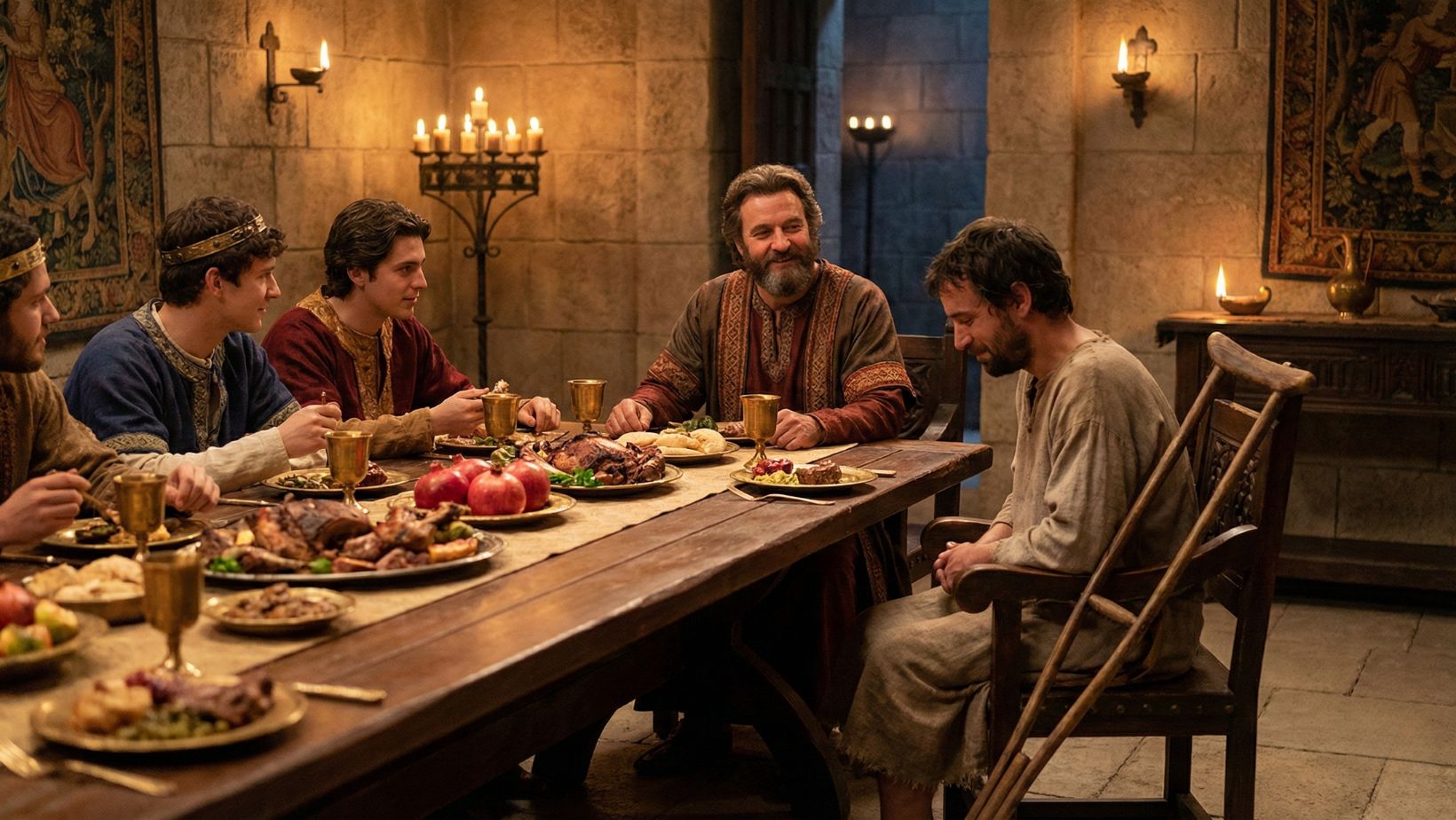
2 Samuel 9 serves as a beautiful interlude of grace amidst the political and military narratives of David’s reign. Having secured his borders and established his administration (Chapter 8), David turns his heart toward his covenant with his deceased friend, Jonathan. He seeks out a survivor from the house of Saul—not to destroy a potential rival, as was customary for new kings, but to show “God’s kindness” (hesed). He finds Mephibosheth, Jonathan’s crippled son, living in obscurity in Lo-debar. David restores his grandfather Saul’s land to him and adopts him into the royal court, granting him a permanent seat at the king’s table. The chapter is one of the clearest Old Testament illustrations of the Gospel: the King seeking out the broken to lavish grace upon them for the sake of another.
1. The Search for an Heir (2 Samuel 9:1–4 NLT)
1 One day David asked, “Is anyone in Saul’s family still alive—anyone to whom I can show kindness for Jonathan’s sake?” 2 He summoned a man named Ziba, who had been one of Saul’s servants. “Are you Ziba?” the king asked. “Yes sir, I am,” Ziba replied. 3 The king then asked him, “Is anyone still alive from Saul’s family? If so, I want to show God’s kindness to them.” Ziba replied, “Yes, one of Jonathan’s sons is still alive. He is crippled in both feet.” 4 “Where is he?” the king asked. “In Lo-debar,” Ziba told him, “at the home of Makir son of Ammiel.”
Commentary:
- The Motive (v. 1): David’s question is driven by two things:
- Memory: He remembers his covenant with Jonathan (1 Samuel 20:14–15, where Jonathan asked David not to cut off kindness from his house).
- Hesed: David uses the word hesed (“kindness”), referring to covenant loyalty or loyal love. He wants to show this kindness “for Jonathan’s sake,” not because the recipient earns it.
- Ziba (v. 2): Ziba is a former steward of Saul. He is influential (as seen later, he has 15 sons and 20 servants). He likely has been managing (and profiting from) Saul’s confiscated estates.
- God’s Kindness (v. 3): David elevates the concept. He doesn’t just want to show royal kindness, but “God’s kindness” (hesed elohim). He wants to treat Saul’s survivor the way God has treated him.
- The Disclosure (v. 3): Ziba mentions the son but immediately highlights his defect: “He is crippled in both feet.”
- Subtext: Ziba might be implying, “He is not a threat to your throne,” or perhaps, “He is not worth your time.” In the ancient world, physical deformity often led to social exclusion.
- Lo-debar (v. 4):
- Makir (v. 4): Makir is a wealthy benefactor who harbored Mephibosheth. Interestingly, this same Makir later supports David when Absalom rebels (2 Samuel 17:27), showing he is a man of loyalty.
Insight: Grace initiates. Mephibosheth did not seek David; David sought Mephibosheth. The King took the initiative to find the one who was hiding in “No Pasture.”
2. The Meeting: From Fear to Favor (2 Samuel 9:5–8 NLT)
5 So King David sent for him and brought him from Makir’s home in Lo-debar. 6 His name was Mephibosheth; he was Jonathan’s son and Saul’s grandson. When he came to David, he bowed low to the ground in deep respect. David said, “Greetings, Mephibosheth.” Mephibosheth replied, “I am your servant.” 7 “Don’t be afraid!” David said. “I intend to show kindness to you because of my promise to your father, Jonathan. I will give you all the property that once belonged to your grandfather Saul, and you will eat here with me at the king’s table!” 8 Mephibosheth bowed respectfully and exclaimed, “Who is your servant, that you should show such kindness to a dead dog like me?”
Commentary:
- The Summons (v. 5): Being summoned by the King was terrifying for a member of the rival dynasty. Usually, when a new king secured power, he executed all relatives of the former king to prevent insurrection.
- Mephibosheth’s Posture (v. 6): He bows low. He refers to himself as “your servant.” He is likely trembling, expecting execution.
- “Don’t Be Afraid” (v. 7): David’s first words address his fear. This is the language of theophany (God speaking to man) and grace.
- The Threefold Promise (v. 7):
- Restoration of Relationship: “Show kindness (hesed).”
- Restoration of Fortune: “Give you all the property.” This made Mephibosheth instantly wealthy, returning the private estates of Saul (Gibeah) to him.
- Restoration of Status: “Eat here with me at the king’s table.” This is the highest honor—adoption into the royal household. He is treated as one of David’s own sons.
- “Dead Dog” (v. 8): Mephibosheth’s self-perception is shattered. He calls himself a “dead dog”—a Hebrew idiom for something worthless, contemptible, and dangerous to touch (1 Samuel 24:14). He feels he has nothing to offer the King.
Insight: This is a picture of salvation. We are spiritually “crippled” by the fall, hiding in a desolate place, enemies of the King. Yet, the King calls us, not to judge us, but to adopt us “for the sake” of His Son (Jonathan/Jesus).
3. The Arrangement with Ziba (2 Samuel 9:9–13 NLT)
9 Then the king summoned Saul’s servant Ziba and said, “I have given your master’s grandson everything that belonged to Saul and his family. 10 You and your sons and servants are to farm the land for him to produce food for your master’s household. But Mephibosheth, your master’s grandson, will eat here at my table.” (Ziba had fifteen sons and twenty servants.) 11 Ziba replied, “Yes, my lord the king; I am your servant, and I will do all that you have commanded.” And from that time on, Mephibosheth ate regularly at David’s table, like one of the king’s own sons. 12 Mephibosheth had a young son named Mica. From then on, all the members of Ziba’s household were Mephibosheth’s servants. 13 And Mephibosheth, who was crippled in both feet, lived in Jerusalem and ate regularly at the king’s table.
Commentary:
- Ziba’s Demotion (v. 9–10): Ziba had likely been acting as the de facto owner of Saul’s estate. David now clarifies that Ziba is the servant and Mephibosheth is the master. Ziba must work the land, but the profits belong to Mephibosheth.
- Ziba’s Response (v. 11): Ziba agrees, but his later betrayal of Mephibosheth (2 Samuel 16) suggests he may have harbored resentment over losing his independence and becoming a servant to a cripple.
- “Like One of the King’s Sons” (v. 11): This phrase is key. Mephibosheth is not treated as a guest, but as family. He likely sat alongside Amnon, Absalom, and Solomon.
- The Line Continues (v. 12): The mention of “Mica” is crucial. It means Jonathan’s line did not end. Through Mephibosheth’s restoration, the genealogy of Saul continues (recorded in 1 Chronicles 8:34–40).
- The Final Contrast (v. 13): The narrator ends with a juxtaposition: “Ate regularly at the king’s table” vs. “Crippled in both feet.”
- The tablecloth covered his feet. At the table, his disability was hidden by the King’s provision. He was equal with the princes.
Insight: David provides Mephibosheth with “grace upon grace.” He gives him the provision of the land (income) and the presence of the table (fellowship).
Theological Significance of 2 Samuel 9
- The Gospel in Miniature:
- David represents God the Father.
- Jonathan represents Christ (the covenant maker).
- Mephibosheth represents the believer (fallen, hiding, unable to walk/save himself).
- Grace: David seeks Mephibosheth before Mephibosheth seeks him.
- Imputation: Mephibosheth receives blessings not for his own merit, but for “Jonathan’s sake” (just as we receive blessings for Jesus’ sake).
- The Nature of Hesed: This chapter defines biblical love. It is not an emotion; it is a commitment to keep a promise (covenant) even when the other party can offer nothing in return.
- Inclusion: In a culture that marginalized the disabled (levitical law even restricted some access to the temple for the deformed), David brings a crippled man into the heart of the palace. This foreshadows Jesus’ ministry to the lame and the Kingdom banquet (Luke 14:13).
Practical Applications
- Honoring Covenants: David kept a promise made years ago to a dead friend. Integrity means keeping your word even when no one is watching and when the person you promised is gone.
- Seeking the Marginalized: Is there a “Mephibosheth” in your life? Someone who is hiding, ashamed, or “crippled” by life’s circumstances? Be the one to go to Lo-debar and bring them out.
- Overcoming “Dead Dog” Syndrome: Many believers struggle with shame, feeling like “dead dogs” even after God has called them sons and daughters. We must accept our seat at the table and stop defining ourselves by our past or our weaknesses.
- Grace Covers: Just as the table hid Mephibosheth’s feet, God’s grace covers our infirmities. We are perfect in His sight because of where we sit, not because of how we walk.
Sermon Titles
- From Lo-debar to the King’s Table.
- Kindness for the Sake of Another.
- The Dog Who Became a Prince.
- When the King Calls Your Name.
- The Tablecloth of Grace.







Leave a Reply