
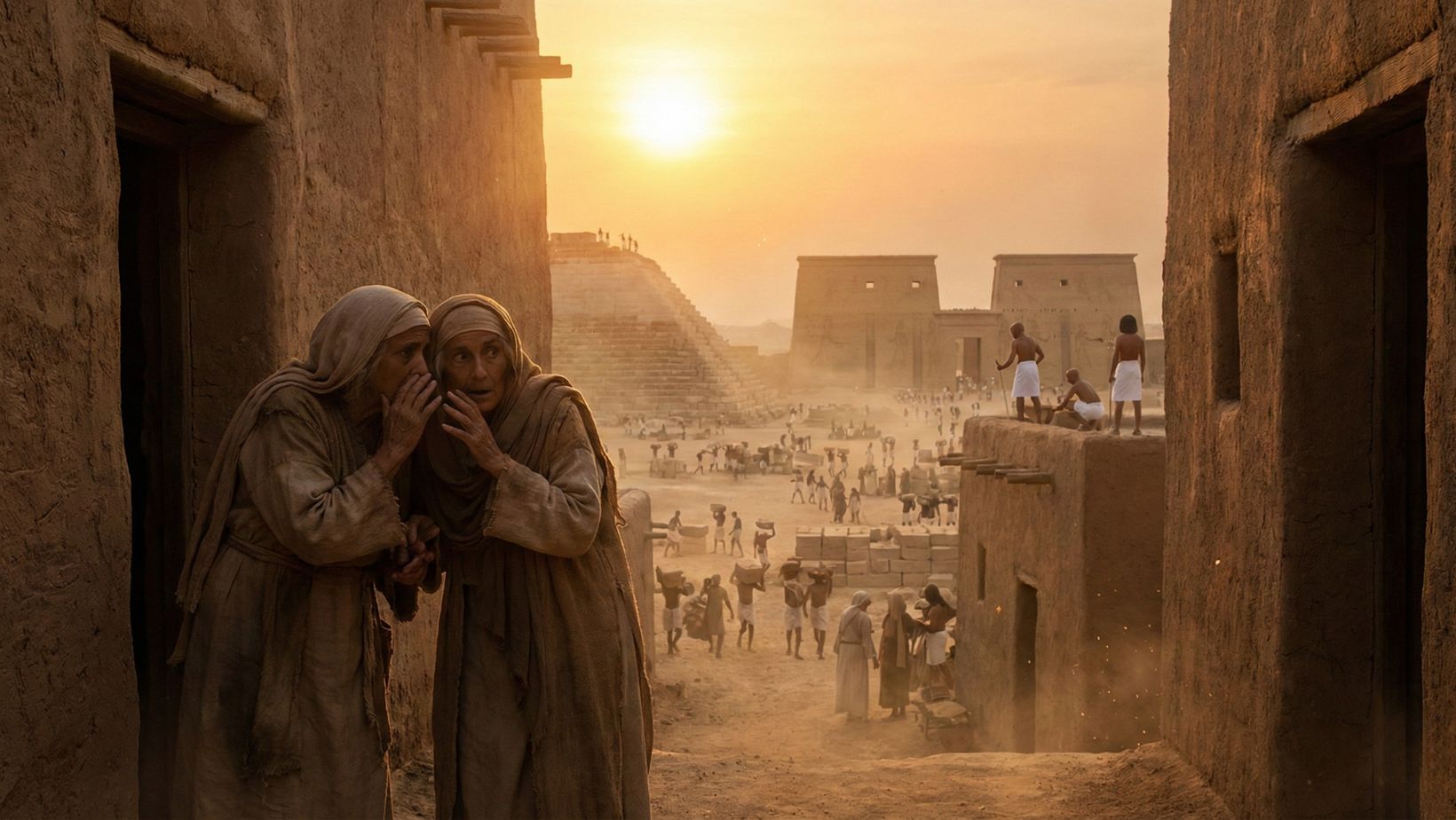
Exodus 1 serves as the bridge between the patriarchal narratives of Genesis and the national deliverance of Exodus. It documents the transition of Jacob’s descendants from a favored family of seventy individuals into a populous nation within Egypt. The narrative tension arises when a new Pharaoh, threatened by the Israelites’ rapid demographic growth, institutes a systematic program of oppression. This begins with harsh slavery aimed at crushing their spirits and curbing their numbers, but when this fails, it escalates to state-sanctioned genocide through infanticide. The chapter highlights the courageous civil disobedience of two Hebrew midwives, Shiphrah and Puah, who fear God more than the king. The chapter concludes with a horrific decree to cast all newborn Hebrew boys into the Nile, setting the stage for the birth of Moses.
1. The Proliferation of Israel (Exodus 1:1–7 NLT)
1 These are the names of the sons of Israel (that is, Jacob) who moved to Egypt with their father, each with his family: 2 Reuben, Simeon, Levi, and Judah; 3 Issachar, Zebulun, and Benjamin; 4 Dan and Naphtali; Gad and Asher. 5 In all, Jacob had seventy descendants in Egypt, including Joseph, who was already there. 6 In time, Joseph and all of his brothers died, ending that entire generation. 7 But their descendants, the Israelites, had many children and grandchildren. In fact, they multiplied so greatly that they became extremely powerful and filled the land.
Commentary:
- The Connection to Genesis (v. 1-4): The book begins with the Hebrew word We’elleh (“And these…”), signaling that Exodus is a direct continuation of the Genesis narrative. The listing of the names re-establishes the identity of the covenant people.
- The Number Seventy (v. 5): The text emphasizes that they started as a small group—”seventy descendants.” This number represents totality or completeness in Hebrew numerology. It contrasts sharply with the “multitude” they become in verse 7.
- The Death of a Generation (v. 6): The death of Joseph and his brothers marks the end of the era of favor and protection. It leaves the Israelites without a high-ranking advocate in the Egyptian court.
- Creation Mandate Language (v. 7): The description of their growth uses five distinct verbs of increase:
- “Had many children” (fruitful)
- “Multiplied” (increased abundantly)
- “Became extremely powerful” (waxed mighty)
- “Filled the land”
- This language deliberately echoes the Creation Mandate in Genesis 1:28 (“Be fruitful and multiply”). It signifies that God’s blessing on Abraham (Genesis 12:2) is active and unstoppable, even outside the Promised Land.
- Goshen: While not named here, previous context (Genesis 47) places them in Goshen, the fertile Nile Delta region, ideal for grazing and agriculture, facilitating this population boom.
Insight: God’s promises are not limited by geography or the death of human leaders. The explosion of the Israelite population occurred in a foreign land, demonstrating that God was preparing a nation before He gave them a land.
2. The Oppression Begins (Exodus 1:8–14 NLT)
8 Eventually, a new king came to power in Egypt who knew nothing about Joseph or what he had done. 9 He said to his people, “Look, the people of Israel now outnumber us and are stronger than we are. 10 We must make a plan to keep them from growing even more. If we don’t, and if war breaks out, they will join our enemies and fight against us. Then they will escape from the country.” 11 So the Egyptians made the Israelites their slaves. They appointed brutal slave drivers over them, hoping to wear them down with crushing labor. They forced them to build the cities of Pithom and Rameses as supply centers for the king. 12 But the more they were oppressed, the more they multiplied and spread, and the alarm of the Egyptians grew. 13 So the Egyptians worked the people of Israel without mercy. 14 They made their lives bitter, forcing them to mix mortar and make bricks and do all the work in the fields. They were ruthless in all their demands.
Commentary:
- The “New King” (v. 8): This Pharaoh “knew nothing about Joseph.” This likely signifies a willful ignorance or a change in dynasty. Historically, this could refer to the expulsion of the Hyksos (Semitic rulers) and the rise of the native Egyptian 18th or 19th Dynasty (possibly Ahmose I or later, Seti I/Rameses II). To a nationalist Egyptian Pharaoh, the Semitic Israelites were a reminder of the hated Hyksos occupiers.
- Political Propaganda (v. 9): The King uses fear-mongering. He claims the Israelites “outnumber us.” While they were numerous, it is unlikely they outnumbered the entire native Egyptian population; this is hyperbolic rhetoric used to justify oppression.
- The “Fifth Column” Fear (v. 10): Pharaoh’s fear was strategic. Egypt was often threatened by enemies from the East (Hittites, Canaanites). He feared the Israelites, living in the eastern delta, would side with invaders and “escape from the country” (depriving Egypt of its labor force).
- State Slavery (v. 11): The strategy shifts from hospitality to state-imposed slavery (mas). The goal was psychological breaking and population control through exhaustion.
- Supply Cities (v. 11): Pithom (“House of Atum”) and Rameses were store cities built to house grain and military supplies for campaigns into the Levant.
- The Irony of Oppression (v. 12): There is a divine paradox here: “The more they were oppressed, the more they multiplied.” Persecution acted as a catalyst for growth rather than a curb.
- Ruthlessness (v. 13-14): The NLT uses “without mercy” and “ruthless” to translate the Hebrew word parek, which implies breaking apart or crushing severity. The labor involved:
- Construction: Mixing mortar and making bricks (mud and straw).
- Agriculture: “Work in the fields” likely involved the arduous task of irrigation, moving water by foot or shaduf.
Insight: Pharaoh’s wisdom was foolishness to God. He intended to weaken Israel to keep them from leaving; instead, he hardened them into a distinct people who would eventually have no choice but to leave.
3. The Midwives’ Defiance (Exodus 1:15–21 NLT)
15 Then Pharaoh, the king of Egypt, gave this order to the Hebrew midwives, Shiphrah and Puah: 16 “When you help the Hebrew women as they give birth, watch as they deliver. If the baby is a boy, kill him; if it is a girl, let her live.” 17 But because the midwives feared God, they refused to obey the king’s orders. They allowed the boys to live, too. 18 So the king of Egypt called for the midwives. “Why have you done this?” he demanded. “Why have you allowed the boys to live?” 19 “The Hebrew women are not like the Egyptian women,” the midwives replied. “They are more vigorous and have their babies so quickly that we cannot get there in time.” 20 So God was good to the midwives, and the Israelites continued to multiply, growing more and more powerful. 21 And because the midwives feared God, he gave them families of their own.
Commentary:
- Shiphrah and Puah (v. 15): It is significant that the Bible records the names of two lowly midwives while the “King of Egypt” remains nameless.
- Shiphrah: “Beautiful” or “Fair.”
- Puah: “Splendid” or “Fragrant.”
- These two likely oversaw a guild of midwives, as two individuals could not birth an entire nation’s children.
- The First Stage of Genocide (v. 16): Pharaoh orders selective infanticide. Killing the males eliminates the military threat and the patrilineal identity; sparing the females allows them to be absorbed into the Egyptian population as slaves or wives, effectively erasing Israel as a distinct ethnic group.
- Civil Disobedience (v. 17): This is one of the earliest recorded instances of civil disobedience. Their “fear of God” (reverence for moral law) superseded their fear of the tyrant.
- The Explanation (v. 19): The midwives claim Hebrew women are “vigorous” (Hebrew hayot, meaning lively or animal-like strength).
- Interpretation: This may have been a lie to protect the babies, or it may have been partially true—hard labor kept the Hebrew women physically fit, leading to faster deliveries than the sedentary Egyptian nobility. Most commentators view this as a “justified deception” in the face of evil.
- Divine Reward (v. 20-21): God does not rebuke them for deceiving Pharaoh; He rewards them for saving lives.
Insight: The fear of God is the antidote to the fear of man. Two women, armed only with their conscience, successfully defied the most powerful monarch on earth.
4. The Decree of Death (Exodus 1:22 NLT)
22 Then Pharaoh gave this order to all his people: “Throw every newborn Hebrew boy into the Nile River. But you may let the girls live.”
Commentary:
- Escalation (v. 22): Secret infanticide failed, so Pharaoh institutes a public, national policy. He deputizes “all his people” to become murderers.
- The Nile River: The Nile was worshipped as a god (Hapi), the source of life in Egypt. Pharaoh turns the source of life into an instrument of death.
- Irony of the Decree: By commanding the babies be thrown into the Nile, Pharaoh unwittingly prepares the specific method—a basket on the water—that will save the deliverer, Moses.
Insight: Evil, when unchecked, inevitably escalates. What started as forced labor turned into secret murder, and finally into public genocide.
Theological Significance of Exodus 1
- The War on the Seed: This chapter is a continuation of the conflict predicted in Genesis 3:15. The serpent (working through Pharaoh) attempts to destroy the “seed of the woman” (Israel) to prevent the eventual birth of the Messiah.
- God’s Sovereignty in Suffering: The text does not say God stopped the suffering immediately. Instead, it shows God’s blessing within the suffering. The more they were oppressed, the more they grew.
- The Sanctity of Life: The midwives’ refusal to kill infants highlights the biblical view that human life is sacred and distinct from political expediency.
- God vs. Idols: The chapter sets up a confrontation between the God of Israel and the gods of Egypt (Pharaoh and the Nile).
Practical Applications
- Growth Under Pressure: Like the Israelites, the church and individual believers often grow most during times of difficulty, not ease. Comfort can lead to complacency; pressure leads to reliance on God.
- Civil Disobedience: There is a time to say “no” to authority when that authority commands what God forbids. Loyalty to God is the highest allegiance.
- The Impact of “Small” People: You do not need a title to change history. Shiphrah and Puah are remembered for their courage, while the Pharaoh is remembered only for his cruelty.
- The Futility of Opposing God: Human schemes to thwart God’s plan are destined to fail. Pharaoh’s attempts to reduce Israel only resulted in their multiplication.
Final Insight
Exodus 1 presents a stark contrast between the power of death and the power of life. Pharaoh represents the culture of death—enslaving, crushing, and killing to maintain control. The midwives and the people of Israel represent the power of life—multiplying, protecting, and fearing God. The chapter ends in darkness with the decree to kill, but the very existence of the “vigorous” people proves that God is working in the shadows.




Leave a Reply