
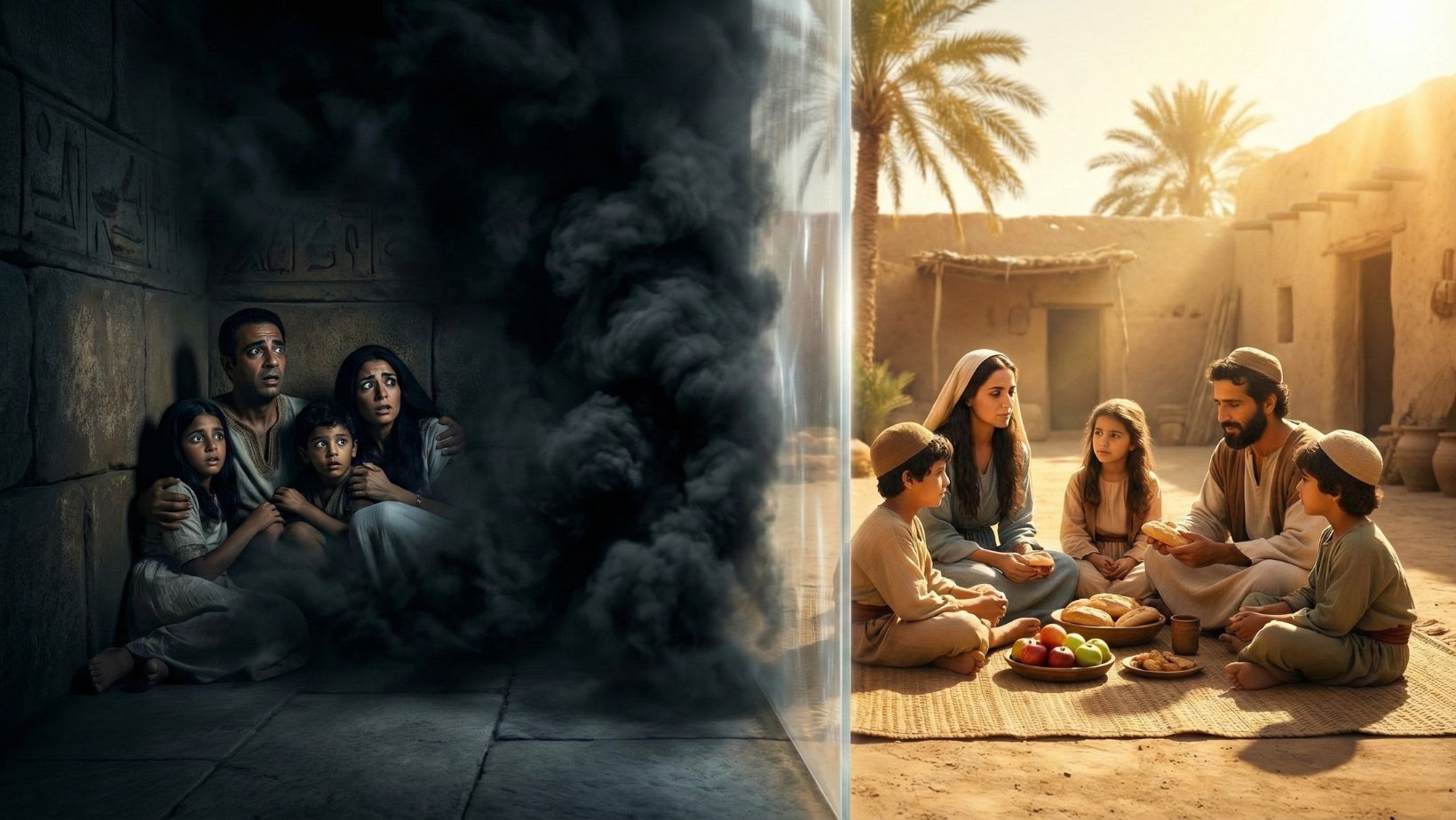
Exodus 10 details the eighth and ninth plagues: Locusts and Darkness. As the narrative progresses, the devastation of Egypt reaches near-total collapse. The chapter highlights a significant shift in the Egyptian court; Pharaoh’s own officials turn against him, realizing that their king’s stubbornness is destroying the nation. The theological battle peaks with the plague of Darkness, a direct assault on Ra, the supreme sun god of Egypt. We also see Pharaoh attempting to negotiate the terms of Israel’s release, trying to keep hostages (children) or collateral (livestock) to ensure their return. Moses, however, remains unyielding, declaring that “not a hoof will be left behind.” The chapter ends with the final rupture between Moses and Pharaoh, setting the stage for the Passover.
1. The Eighth Plague: Locusts (Exodus 10:1–20 NLT)
1 Then the Lord said to Moses, “Return to Pharaoh and make your demands again. I have made him and his officials stubborn so I can display my miraculous signs among them. 2 I’ve also done it so you can tell your children and grandchildren how I made a mockery of the Egyptians and about the signs I displayed among them—and so you will know that I am the Lord.” 3 So Moses and Aaron went to Pharaoh and said, “This is what the Lord, the God of the Hebrews, says: How long will you refuse to submit to me? Let my people go, so they can worship me. 4 If you refuse, watch out! For tomorrow I will bring a swarm of locusts on your country. 5 They will cover the land so that you won’t be able to see the ground. They will devour what little is left of your crops after the hailstorm, including all the trees growing in the fields. 6 They will overrun your palaces and the homes of your officials and all the houses in Egypt. Never in the history of Egypt have your ancestors seen a plague like this one!” And with that, Moses turned and left Pharaoh. 7 Pharaoh’s officials went to him. “How long will you let this man hold us hostage? Let the men go to worship the Lord their God! Don’t you realize that Egypt lies in ruins?” 8 So Moses and Aaron were brought back to Pharaoh. “All right,” he told them, “go and worship the Lord your God. But who exactly will be going with you?” 9 Moses replied, “We will go with our young and old, our sons and daughters, and our flocks and herds. We must all join together in celebrating a festival to the Lord.” 10 Pharaoh retorted, “The Lord will certainly need to be with you if I let you take your little ones! I can see through your evil plan. 11 Never! Only the men may go and worship the Lord, since that is what you requested.” And Pharaoh threw them out of the palace. 12 Then the Lord said to Moses, “Raise your hand over the land of Egypt to bring on the locusts. Let them cover the land and devour every plant that survived the hailstorm.” 13 So Moses raised his staff over Egypt, and the Lord caused an east wind to blow over the land all that day and through the night. When morning arrived, the east wind had brought the locusts. 14 And the locusts swarmed over the whole land of Egypt, settling in dense swarms from one end of the country to the other. It was the worst locust plague in Egyptian history, and there will never be another one like it. 15 For the locusts covered the whole country and darkened the land. They devoured every plant in the fields and all the fruit on the trees that had survived the hailstorm. Not a single leaf was left on the trees and plants throughout the land of Egypt. 16 Pharaoh quickly summoned Moses and Aaron. “I have sinned against the Lord your God and against you,” he confessed. 17 “Forgive my sin, just this once, and plead with the Lord your God to take away this death from me.” 18 So Moses left Pharaoh’s court and pleaded with the Lord. 19 The Lord responded by shifting the wind, and the strong west wind blew the locusts into the Red Sea. Not a single locust remained in all the land of Egypt. 20 But the Lord hardened Pharaoh’s heart again, so he refused to let the people of Israel go.
Commentary:
- The Educational Purpose (v. 2): God reveals a long-term goal for the plagues: storytelling. The signs are not just for Pharaoh’s defeat but for Israel’s discipleship. They are to be recounted to “children and grandchildren” (a foundation for the Passover Seder narration, or Haggadah).
- The Officials’ Revolt (v. 7): This is a crucial turning point. Pharaoh stands alone. His own cabinet, who previously supported him, now sees reality: “Egypt lies in ruins.” They view Moses as a “snare” or trap.
- Negotiation #3: Men Only (v. 11): Pharaoh offers a compromise: let the men (the workforce/worshippers) go, but keep the children. This is a strategic hostage situation. He knows that if the children stay, the men will return.
- East Wind (v. 13): God uses natural means (wind) to execute supernatural judgment. The east wind brings the locusts from the Arabian desert; later, a west wind (v. 19) drives them into the Red Sea.
- Ecological Wipeout (v. 15): The hail (Ch. 9) destroyed the flax and barley; the locusts now eat the wheat and emmer that were spared, plus every tree leaf. Egypt is stripped naked—no green thing remains. This reverses creation (Genesis 1:11-12).
- Pharaoh’s “Repentance” (v. 16): “I have sinned… just this once.” Pharaoh admits guilt to Moses and God, but the phrase “take away this death” shows he is focused on the consequence, not the relationship.
2. The Ninth Plague: Darkness (Exodus 10:21–29 NLT)
21 Then the Lord said to Moses, “Lift your hand toward heaven, and the land of Egypt will be covered with a darkness so thick you can feel it.” 22 So Moses lifted his hand to the sky, and a deep darkness covered the entire land of Egypt for three days. 23 During all that time the people could not see each other, and no one moved. But there was light as usual where the people of Israel lived. 24 Then Pharaoh summoned Moses. “Go and worship the Lord,” he said. “But leave your flocks and herds here. You may even take your little ones with you.” 25 “No,” Moses said, “you must provide us with animals for sacrifices and burnt offerings to the Lord our God. 26 All our livestock must go with us, too; not a hoof can be left behind. We must choose our sacrifices for the Lord our God from among these animals. And we won’t know how we are to worship the Lord until we get there.” 27 But the Lord hardened Pharaoh’s heart once more, and he would not let them go. 28 “Get out of here!” Pharaoh shouted at Moses. “I’m warning you. Never see my face again! If you do, you will die!” 29 “Very well,” Moses replied. “I will never see your face again.”
Commentary:
- Attack on Ra (v. 21): The sun god, Ra (or Amon-Ra), was the chief deity of Egypt. Pharaoh was considered the “son of Ra.” By blotting out the sun for three days, Yahweh demonstrates that the chief god of Egypt is powerless before Him.
- Palpable Darkness (v. 21): The text describes a darkness “so thick you can feel it.” This suggests a supernatural heaviness, perhaps a spiritual oppression or a physical suspension of light particles. It was not just an eclipse (which lasts minutes) or a sandstorm (which allows some light).
- Social Paralysis (v. 23): “No one moved.” The darkness froze Egyptian society. It was a psychological terror. Meanwhile, “there was light as usual” in Goshen. The distinction between God’s people and the world is now starkly visible.
- Negotiation #4: Livestock (v. 24): Pharaoh concedes the children but tries to keep the wealth (flocks/herds). If they leave their assets, they will return.
- “Not a Hoof Left Behind” (v. 26): Moses’ response is absolute. He refuses to compromise on even the smallest detail of God’s command. The livestock are needed for worship, and since they don’t know what God will ask for, they must take everything.
- The Final Rupture (v. 28-29): The dialogue ends with a death threat. Pharaoh banishes the only man who could save him. Moses accepts this: the time for negotiation is over; the time for the final judgment (Passover) has arrived.
Theological Significance of Exodus 10
- Total Surrender: The negotiations highlight a key spiritual principle: God demands total surrender. Pharaoh wanted to keep a foothold—first the location, then the children, then the wealth. Moses teaches us that we cannot serve God while leaving “hostages” (attachments) in Egypt (the world).
- The God of History: Verse 2 explicitly states that our current trials are often designed to become future testimonies. Faith is generational; we endure today so we can teach tomorrow.
- Light and Darkness: The separation of light (Goshen) and darkness (Egypt) foreshadows the ultimate separation of humanity. Jesus later claims, “I am the light of the world” (John 8:12), implying that life outside of Him is a “darkness that can be felt.”
- The Hardening: God’s hardening of Pharaoh is now dominant. It serves to “multiply signs” (v. 1). This teaches that human rebellion, no matter how stubborn, cannot thwart God’s plan—it only serves to make the final victory more glorious.
Practical Applications
- No Compromise: When the world (or our sin nature) offers a compromise—”You can be a Christian, just don’t take your kids seriously,” or “You can worship, just don’t give your money”—we must respond like Moses: “Not a hoof left behind.” All that we are and have belongs to God.
- Tell the Story: We have a responsibility to tell the next generation about “how God made a mockery” of the powers of darkness. Our testimony is their textbook.
- The Danger of Delayed Repentance: Pharaoh repented only when the pain was unbearable and stopped immediately when relief came. We must ensure our repentance is a change of heart, not just a cry for pain relief.
Possible Sermon Titles
- Not a Hoof Left Behind: The Call to Total Commitment.
- A Darkness You Can Feel.
- The God Who Mocked the Gods.
- Negotiating with the Devil: Why Compromise is Impossible.
- Stories for the Grandchildren.




Leave a Reply