
Exodus 15 marks a pivotal transition in the history of Israel, shifting from the dramatic liberation at the Red Sea to the beginning of the wilderness wanderings. The chapter is divided into two distinct sections: high praise and deep grumbling. It opens with the “Song of Moses” (and Miriam), the oldest recorded song in the Bible, celebrating Yahweh as a Divine Warrior who shattered the Egyptian army. This hymn establishes God’s sovereignty, holiness, and intent to plant His people in the Promised Land. However, the narrative quickly shifts from the mountaintop of victory to the valley of testing. Just three days later, the Israelites face dehydration and bitter water at Marah. This incident introduces the recurring theme of Israel’s murmuring and God’s provision, culminating in the revelation of a new name for God: Yahweh Rapha, “The Lord who heals you.”
1. The Song of Moses: Praise for Victory (Exodus 15:1–12 NLT)
1 Then Moses and the people of Israel sang this song to the Lord: “I will sing to the Lord, for he has triumphed gloriously; he has hurled both horse and rider into the sea. 2 The Lord is my strength and my song; he has given me victory. This is my God, and I will praise him— my father’s God, and I will exalt him. 3 The Lord is a warrior; Yahweh is his name! 4 Pharaoh’s chariots and army he has hurled into the sea. The finest of Pharaoh’s officers are drowned in the Red Sea. 5 The deep waters gushed over them; they sank to the bottom like a stone. 6 “Your right hand, O Lord, is glorious in power. Your right hand, O Lord, smashes the enemy. 7 In the greatness of your majesty, you overthrow those who rise against you. You unleash your blazing anger; it consumes them like straw. 8 At the blast of your breath, the waters piled up! The surging waters stood straight like a wall; in the heart of the sea the deep waters became hard. 9 “The enemy boasted, ‘I will chase them and catch them. I will plunder them. I will consume them. I will draw my sword; my powerful hand will destroy them.’ 10 But you blew with your breath, and the sea covered them. They sank like lead in the mighty waters. 11 “Who is like you among the gods, O Lord— glorious in holiness, awesome in splendor, performing great wonders? 12 You raised your right hand, and the earth swallowed our enemies.
Commentary:
- The First Hymn (v. 1): This is the first recorded corporate worship song in Scripture. It sets a precedent that redemption should always result in praise. The phrase “triumphed gloriously” (lit. highly exalted) acknowledges that this victory was not a joint effort; it was entirely God’s work.
- Personal Appropriation (v. 2): Notice the shift to singular pronouns (“my strength,” “my song,” “my God”). The national salvation has become a personal reality for every Israelite.
- The Divine Warrior (v. 3): The statement “The Lord is a warrior” is theologically significant. In a world where nations believed their gods fought for them, Yahweh proves He is the ultimate combatant who fights on behalf of the oppressed without needing a human army.
- The Physics of Judgment (vv. 4–5, 10): The imagery emphasizes the weight of sin and judgment. The Egyptians sank like “stones” and “lead.” This contrasts with the Israelites who walked on dry ground. The “finest officers” were powerless against the laws of nature when commanded by the Creator.
- Anthropomorphism (vv. 6–8): Moses uses human characteristics to describe God’s power:
- Right hand: A symbol of strength and authority.
- Blast of your breath: A poetic reference to the strong east wind (Exodus 14:21) that parted the sea. Spiritually, it recalls the creation narrative where God’s breath/spirit brings order or destruction.
- The Enemy’s Arrogance (v. 9): This verse utilizes a staccato rhythm in Hebrew to mimic the hasty, panting breath of the pursuers: “I will chase… catch… plunder… consume… destroy.” It highlights the futility of human ego against Divine will.
- Monotheistic Declaration (v. 11): “Who is like you among the gods?” This is a rhetorical question expecting the answer “No one.” It is a polemic against the Egyptian pantheon, asserting that their gods were powerless to save Pharaoh.
- Holiness: This is the first time in Scripture God is praised specifically for His “holiness” (qodesh), marking Him as distinct, separate, and morally pure.
2. Prophetic Confidence and God’s Reign (Exodus 15:13–18 NLT)
13 “With your unfailing love you lead the people you have redeemed. In your might, you guide them to your sacred home. 14 The peoples hear and tremble; anguish grips those who live in Philistia. 15 The leaders of Edom are terrified; the nobles of Moab tremble. All who live in Canaan melt away; 16 terror and dread fall upon them. The power of your arm makes them lifeless as stone until your people pass by, O Lord, until the people you purchased pass by. 17 You will bring them in and plant them on your own mountain— the place, O Lord, reserved for your own dwelling, the sanctuary, O Lord, that your hands have established. 18 The Lord will reign forever and ever!”
Commentary:
- Unfailing Love (v. 13): The Hebrew word used here is hesed (loyal love/covenant faithfulness). The motivation for the Exodus was not just judgment on Egypt, but covenant loyalty to Israel.
- Prophetic Perfect Tense (vv. 13–17): Moses speaks of future events (entering Canaan, the temple) as if they have already happened (“You lead,” “You guide,” “You will bring”). The deliverance at the Red Sea was such a guarantee of God’s power that the future conquest of the Promised Land was considered a done deal.
- Psychological Warfare (vv. 14–16): The song predicts the reaction of surrounding nations (Philistia, Edom, Moab, Canaan). Rahab later confirms to the spies in Joshua 2:9-11 that this dread did indeed fall upon Canaan because of the Red Sea event.
- Planting on the Mountain (v. 17): The language shifts from “wandering” to “planting.” God intends to establish Israel permanently. “Your own mountain” likely refers prophetically to Mount Zion (Jerusalem) where the Temple (“sanctuary”) would eventually stand.
- Eternal Kingship (v. 18): The song concludes by declaring Yahweh as the eternal King, contrasting Him with the temporal, mortal Pharaoh who had just been defeated.
3. Miriam’s Response (Exodus 15:19–21 NLT)
19 When Pharaoh’s horses, chariots, and charioteers rushed into the sea, the Lord brought the water crashing down on them. But the people of Israel had walked through the middle of the sea on dry ground! 20 Then Miriam the prophet, Aaron’s sister, took a tambourine and led all the women as they played their tambourines and danced. 21 And Miriam sang this song: “Sing to the Lord, for he has triumphed gloriously; he has hurled both horse and rider into the sea.”
Commentary:
- Narrative Recap (v. 19): The text reiterates the cause of the celebration to frame Miriam’s action.
- Miriam the Prophet (v. 20): Miriam is explicitly identified as a “prophet” (nebiah). She is the first woman in the Bible to bear this title. She holds a significant leadership role alongside Moses and Aaron (later confirmed in Micah 6:4).
- Liturgical Dance (v. 20): Worship involved the whole body. The use of tambourines and dancing indicates a highly spirited, organized communal celebration.
- Antiphonal Singing (v. 21): Miriam likely led a “call and response,” singing the chorus while the men or other women sang the verses. Her song is a condensed refrain of Moses’ opening verse, keeping the focus on the core message: The Lord has triumphed.
4. Bitter Water at Marah (Exodus 15:22–26 NLT)
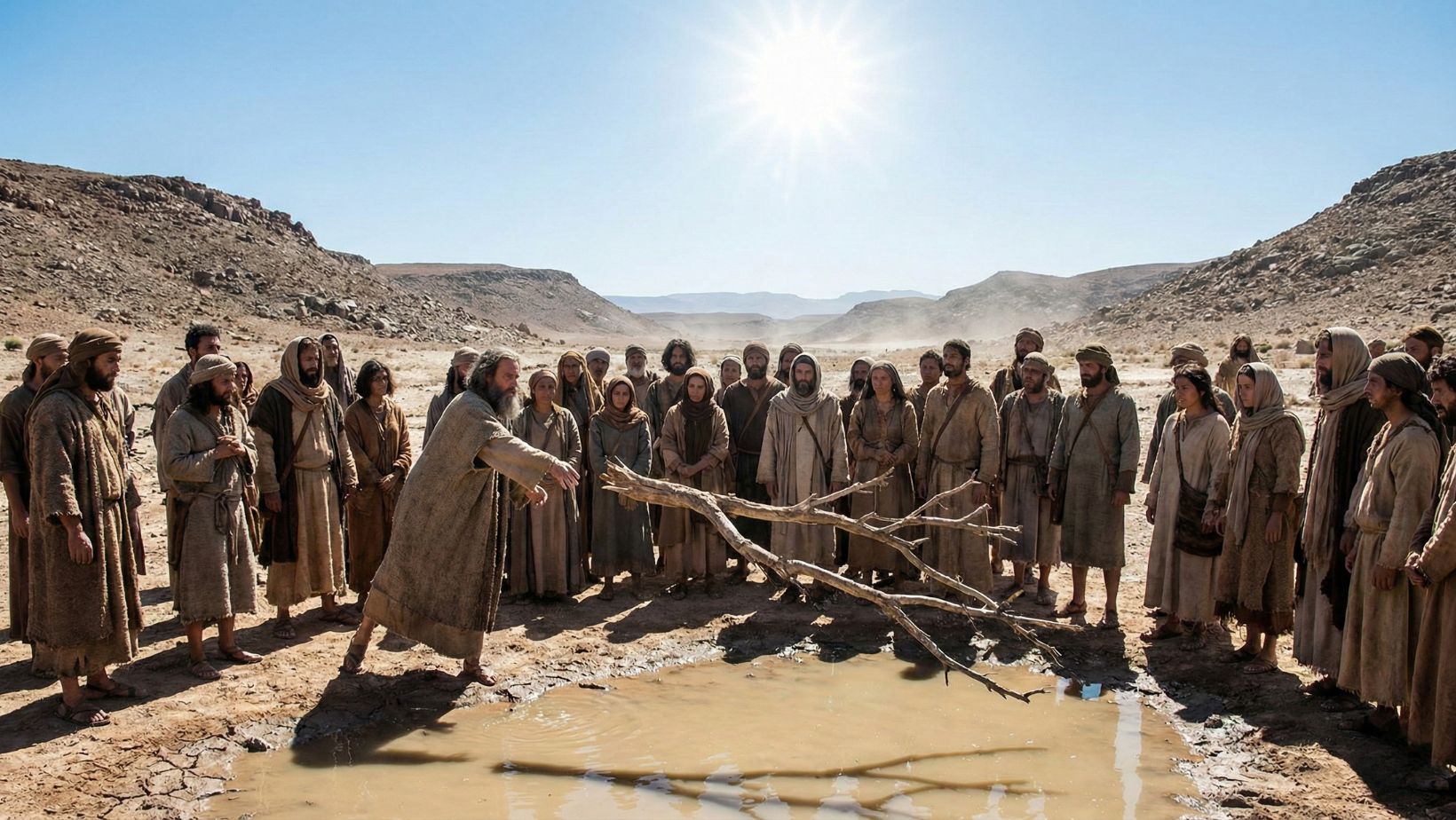
22 Then Moses led the people of Israel away from the Red Sea, and they moved out into the wilderness of Shur. They traveled in this wilderness for three days without finding any water. 23 When they came to the oasis of Marah, the water was too bitter to drink. So they called the place Marah (which means “bitter”). 24 Then the people complained and turned against Moses. “What are we going to drink?” they demanded. 25 So Moses cried out to the Lord for help, and the Lord showed him a piece of wood. Moses threw it into the water, and this made the water good to drink. It was there at Marah that the Lord set before them the following decree as a standard to test their faithfulness. 26 He said, “If you will listen carefully to the voice of the Lord your God and do what is right in his sight, obeying his commands and keeping all his decrees, then I will not make you suffer any of the diseases I sent on the Egyptians; for I am the Lord who heals you.”
Commentary:
- The Test of Thirst (v. 22): The “three days” journey is significant. After the spiritual high of the crossing, they face a physical crisis. It is often noted that spiritual breakthroughs are frequently followed by immediate testing.
- Marah (v. 23): The name means “Bitter.” The disappointment was acute—finding water, only to discover it was undrinkable (likely brackish/salty).
- The Grumbling Begins (v. 24): This is the first instance of the “murmuring” (loony) motif that characterizes the wilderness generation. They turn against their leader (Moses) rather than turning to their God.
- The Wood/Tree (v. 25): God instructs Moses to use a tangible object.
- Natural or Supernatural? Some suggest the wood had natural filtering properties (like certain berries used by Bedouins), but the text presents it as a divine provision.
- Typology: Christian theology often views this “wood” (or tree) as a type of the Cross, which turns the bitterness of sin and death into life.
- Yahweh Rapha (v. 26): Here God reveals a new name/attribute: Yahweh Rapha (The Lord Who Heals).
- The Context: The healing is preventative (“I will not make you suffer…”).
- The Condition: The promise is tied strictly to obedience (“If you will listen…”).
- The Connection: God links physical health and well-being to spiritual alignment with His will.
5. Refreshment at Elim (Exodus 15:27 NLT)
27 After leaving Marah, the Israelites traveled on to the oasis of Elim, where they found twelve springs and seventy palm trees. They camped there beside the water.
Commentary:
- Divine Balance: God does not keep His people in a state of testing forever. Marah (bitterness) is followed by Elim (strength/trees).
- Symbolism of Numbers:
- Twelve Springs: Corresponds to the twelve tribes of Israel (abundant supply for each).
- Seventy Palm Trees: Represents the seventy elders (leadership) or the seventy nations (fullness/completeness).
- Provision: Elim represents God’s gracious provision of rest and abundance after a period of trial.
Theological Significance of Exodus 15
- The Sovereignty of God: The chapter emphasizes that God is supreme over nature (water, wind), nations (Egypt, Canaan), and human circumstances (thirst, health).
- Worship as Memory: The Song of Moses serves as a historical record. Israel was commanded to sing to remember. Forgetting God’s past deeds leads to present grumbling.
- The Pattern of Salvation: The chapter outlines the believer’s journey: Deliverance (Red Sea) -> Worship (Song) -> Testing (Marah) -> Restoration (Elim).
- Holiness and Healing: God reveals that He is distinct from pagan gods (Holiness) and is the source of life and health (Healing).
Practical Applications
- Singing in the Storm: We should cultivate a habit of praise. Worship changes our perspective on our problems by magnifying our God.
- Short Memories: The Israelites complained only three days after a miracle. We must guard against spiritual amnesia, where we forget years of God’s faithfulness in a moment of panic.
- Turning Bitterness to Sweetness: When we face “bitter waters” (disappointment, grief, failure), we should follow Moses’ example: cry out to the Lord. God can transform bitter circumstances into sources of life.
- Obedience as Preventive Medicine: While not all sickness is a result of sin, verse 26 suggests that a lifestyle aligned with God’s design (statutes/decrees) spares us from many “diseases” of the world (both physical and spiritual consequences of sin).





Leave a Reply