
Exodus 17 presents two distinct crises that test Israel’s faith and define their relationship with God: an internal crisis of lack (thirst) and an external crisis of war (Amalek). The chapter begins at Rephidim, where the people, facing a severe water shortage, quarrel violently with Moses and test the Lord. God responds with grace, commanding Moses to strike the rock at Horeb, which yields water—a powerful type of Christ. The scene then shifts to Israel’s first military battle against the Amalekites. Victory is secured not merely by the sword of Joshua, but by the intercession of Moses on the hilltop, supported by Aaron and Hur. The chapter concludes with the construction of an altar named Jehovah Nissi (“The Lord Is My Banner”) and a divine declaration of eternal war against Amalek.
1. Water from the Rock at Rephidim (Exodus 17:1–7 NLT)
1 At the Lord’s command, the whole community of Israel left the wilderness of Sin and moved from place to place. Eventually they camped at Rephidim, but there was no water there for the people to drink. 2 So once more the people complained against Moses. “Give us water to drink!” they demanded. “Quiet!” Moses replied. “Why are you complaining against me? And why are you testing the Lord?” 3 But tormented by thirst, they continued to argue with Moses. “Why did you bring us out of Egypt? Are you trying to kill us, our children, and our livestock with thirst?” 4 Then Moses cried out to the Lord for help. “What should I do with these people?” he asked. “They are ready to stone me!” 5 The Lord said to Moses, “Walk out in front of the people. Take your staff, the one you used to strike the water of the Nile, and call some of the elders of Israel to join you. 6 I will stand before you on the rock at Mount Sinai. Strike the rock, and water will come gushing out. Then the people will be able to drink.” So Moses struck the rock as he was told, and the elders looked on. 7 Moses named the place Massah (which means “test”) and Meribah (which means “arguing”) because the people of Israel argued with Moses and tested the Lord by saying, “Is the Lord here with us or not?”
Commentary:
- Directed by God (v. 1): The text explicitly states they moved “At the Lord’s command.” This is crucial: being in the center of God’s will does not exempt one from trials. They were exactly where God wanted them, yet they had no water.
- The Nature of the Complaint (v. 2): The Hebrew word for “complained” (rib) is a legal term meaning to bring a lawsuit or contend. They were essentially putting Moses (and God) on trial.
- Testing the Lord (v. 2, 7): To “test” God is to demand He prove Himself on human terms. It is an expression of unbelief. They were not asking out of dependence but demanding out of entitlement.
- The Threat of Violence (v. 4): The situation had escalated beyond grumbling to potential mutiny. Moses feels his life is in danger (“ready to stone me”), highlighting the burden of leadership over a rebellious people.
- The Rod of Judgment (v. 5): God tells Moses to take the staff “used to strike the water of the Nile.” This connects the current miracle to the plagues of Egypt. The staff that brought judgment on Egypt now brings life to Israel.
- God on the Rock (v. 6): This is a startling image. God says, “I will stand before you on the rock.” In the ancient Near East, the accused stood before the judge. Here, God remarkably places Himself in the position of the accused to provide for the accusers.
- Striking the Rock (v. 6): Moses strikes the rock, and water flows.
- Naming the Place (v. 7):
- Massah: Means “Testing.”
- Meribah: Means “Quarreling” or “Arguing.”
- These names served as a permanent geographical reminder of their failure to trust. Psalm 95 later warns Israel not to harden their hearts “as at Meribah, as in the day of Massah.”
- The Core Question (v. 7): The root of their sin was the question, “Is the Lord here with us or not?” They interpreted their difficulty as God’s absence, rather than an opportunity for His provision.
2. The War with Amalek (Exodus 17:8–16 NLT)
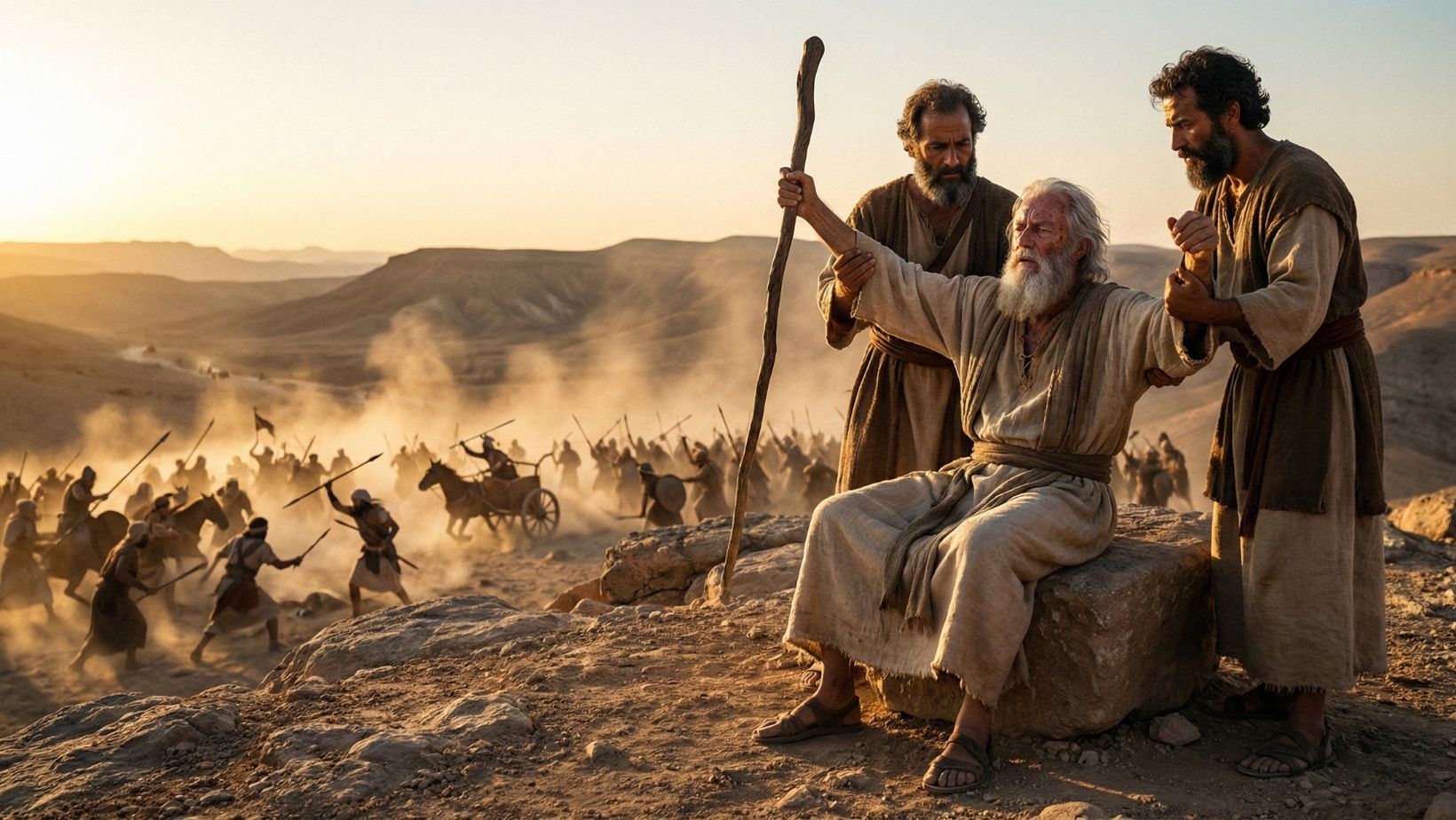
8 While the people of Israel were still at Rephidim, the warriors of Amalek attacked them. 9 Moses commanded Joshua, “Choose some men to go out and fight the army of Amalek for us. Tomorrow, I will stand at the top of the hill, holding the staff of God in my hand.” 10 So Joshua did what Moses had commanded and fought the army of Amalek. Meanwhile, Moses, Aaron, and Hur climbed to the top of a nearby hill. 11 As long as Moses held up the staff in his hand, the Israelites had the advantage. But whenever he dropped his hand, the Amalekites gained the advantage. 12 Moses’ arms soon became so tired he could no longer hold them up. So Aaron and Hur found a stone for him to sit on. Then they stood on each side of Moses, holding up his hands. So his hands held steady until sunset. 13 As a result, Joshua overwhelmed the army of Amalek in battle. 14 After the victory, the Lord instructed Moses, “Write this down on a scroll as a permanent reminder, and read it aloud to Joshua: I will erase the memory of Amalek from under heaven.” 15 Moses built an altar there and named it Yahweh-Nissi (which means “the Lord is my banner”). 16 He said, “They have raised their fist against the Lord’s throne, so now the Lord will be at war with Amalek generation after generation.”
Commentary:
- The Aggressor (v. 8): The Amalekites were descendants of Esau (Genesis 36:12), making them distant cousins of Israel. Deuteronomy 25:17-18 reveals that they attacked the stragglers—the weak, weary, and elderly at the rear of the column—showing their cowardly and predatory nature.
- Introduction of Joshua (v. 9): This is the first mention of Joshua (originally Hoshea). He appears as a military commander, a role that foreshadows his future task of leading the conquest of Canaan.
- The Strategy (v. 9-10): The battle is fought on two fronts:
- The Rod of God (v. 9): The same staff used to strike the Nile and the Rock is now used as a banner of authority and dependence on God.
- Intercession and Victory (v. 11): The lifting of hands was a universal posture of prayer (Psalm 28:2, 1 Timothy 2:8). The text establishes a direct cause-and-effect relationship: spiritual intercession determines physical outcomes. When prayer (dependence) wavered, the enemy advanced.
- Corporate Support (v. 12): Even Moses, the great prophet, had physical limitations (“arms became so tired”).
- Writing the Scroll (v. 14): This is the first explicit command in the Bible to write something down. It emphasizes the importance of recording God’s acts for future generations.
- Divine Judgment on Amalek (v. 14, 16): God takes this attack personally. Because Amalek attacked God’s people, they attacked God’s throne. This enmity would last until the time of Saul and David, where the Amalekites were finally defeated. Haman, the villain in the book of Esther, is identified as an Agagite (descendant of the Amalekite kings), showing the long-lasting nature of this feud.
- Yahweh-Nissi (v. 15): “The Lord is My Banner.” In ancient warfare, a banner (standard) was a rallying point for troops. It signaled where the leader was and gave direction. Moses acknowledges that the true rallying point and source of victory was not his leadership or Joshua’s sword, but Yahweh Himself.
Theological Significance of Exodus 17
- God as Provider and Protector: The chapter balances God’s provision of life (water) with His protection from death (war).
- The Rock as Christ: The striking of the rock is a central typological event. It points to the gospel truth that the living water of salvation flows from the stricken Savior.
- The Necessity of Intercession: The battle with Amalek teaches that physical effort (Joshua) is necessary but insufficient without spiritual power (Moses). Prayer is not just a support to the work; it is the work.
- Community in Ministry: The image of Aaron and Hur holding up Moses’ hands illustrates that spiritual leadership is not a solo endeavor. Burdens must be shared to sustain victory.
Practical Applications
- Responding to Lack: When we face “no water” situations (financial, emotional, spiritual drought), our reaction reveals our maturity. Do we quarrel with leadership and question God, or do we trust His track record?
- Supporting Leaders: Leaders grow weary. The “Aarons and Hurs” in the church are just as vital to the victory as the “Moses” on the hill or the “Joshua” in the field. We must look for ways to “hold up the hands” of those on the front lines.
- The Reality of Spiritual Warfare: The Christian life involves conflict. We have an enemy (represented by Amalek) who attacks when we are weak. Victory requires persistent prayer and the use of the “sword of the Spirit” (Word of God).
- Memorializing Victory: Moses built an altar and wrote in a book. We should keep records (journals, testimonies) of God’s faithfulness so that when the next trial comes, we remember Jehovah Nissi.
Possible Sermon Titles
- Striking the Rock: Grace from Judgment.
- The Battle is Won on the Hill.
- Holding Up the Hands of the Leader.
- Is the Lord Among Us or Not?
- Jehovah Nissi: The Lord Our Banner.
- Water for the Thirsty, War for the Weary.




Leave a Reply