
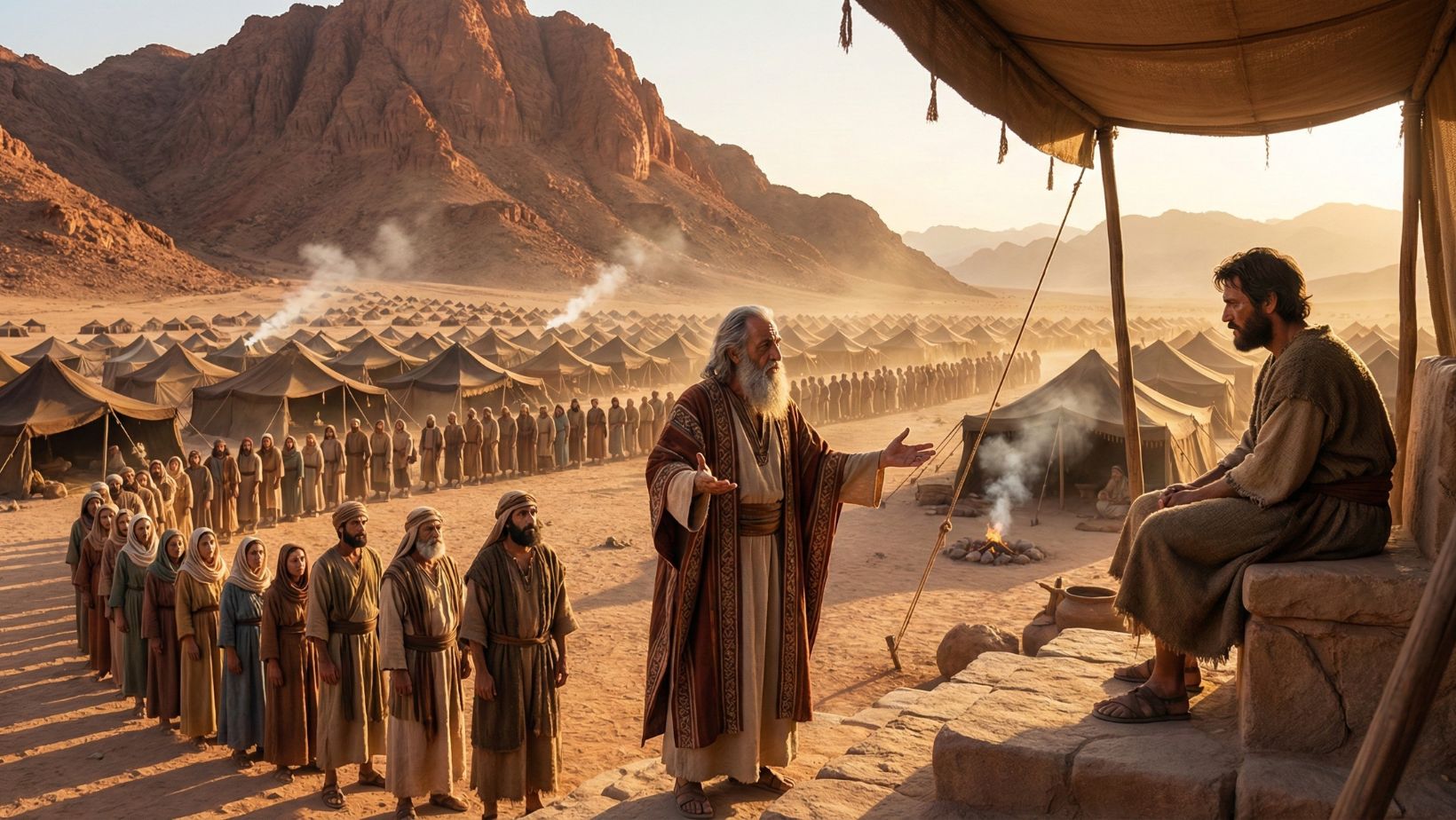
Exodus 18 serves as a crucial interlude between the battles of the wilderness (Exodus 17) and the giving of the Law at Sinai (Exodus 19). It focuses on organization, governance, and the reunion of Moses’ family. Jethro, the priest of Midian and Moses’ father-in-law, arrives bringing Moses’ wife, Zipporah, and their two sons. After hearing of Yahweh’s mighty acts, Jethro blesses the Lord and offers sacrifices. The narrative then shifts to a crisis of leadership: Moses is burning out trying to judge every dispute for the entire nation single-handedly. Jethro offers wise counsel on delegation and administration, establishing a judicial hierarchy that would sustain Israel. It is a chapter about humility, wisdom, and the necessity of shared leadership.
1. The Reunion and Jethro’s Praise (Exodus 18:1–12 NLT)
1 Jethro, the priest of Midian and Moses’ father-in-law, heard about everything God had done for Moses and his people, the Israelites. He heard especially about how the Lord had rescued them from Egypt. 2 Earlier, Moses had sent his wife, Zipporah, and his two sons back to Jethro, who had taken them in. 3 (Moses’ first son was named Gershom, for Moses had said when the boy was born, “I have been a foreigner in a foreign land.” 4 His second son was named Eliezer, for he had said, “The God of my ancestors was my helper; he rescued me from the sword of Pharaoh.”) 5 Jethro, Moses’ sons, and his wife came to Moses in the wilderness, where he was camped near the mountain of God. 6 Jethro had sent a message to him, saying, “I, your father-in-law Jethro, am coming to see you with your wife and your two sons.” 7 So Moses went out to meet his father-in-law. He bowed low and kissed him. They asked about each other’s welfare and then went into Moses’ tent. 8 Moses told his father-in-law everything the Lord had done to Pharaoh and Egypt on behalf of Israel. He also told about all the hardships they had experienced along the way and how the Lord had rescued them. 9 Jethro was delighted when he heard about all the good things the Lord had done for Israel as he rescued them from the hand of the Egyptians. 10 “Praise the Lord,” Jethro said, “for he has rescued you from the Egyptians and from Pharaoh. Yes, he has rescued Israel from the powerful hand of Egypt! 11 I know now that the Lord is greater than all other gods, because he rescued his people from the oppression of the proud Egyptians.” 12 Then Jethro, Moses’ father-in-law, brought a burnt offering and sacrifices to God. Aaron and all the elders of Israel came out and ate a sacred meal with Moses’ father-in-law in the presence of God.
Commentary:
- Context of Separation (v. 2): We learn here that Moses had sent Zipporah and the boys back to her father at some point, likely for their safety during the confrontation with Pharaoh. This reunion marks the restoration of his domestic life.
- Significance of Names (v. 3-4): The sons’ names serve as a theological memoir for Moses:
- Gershom: “A stranger there.” Represents Moses’ isolation and exile.
- Eliezer: “My God is help.” Represents Moses’ deliverance. It is a testimony that the God of the patriarchs (ancestors) is still active.
- The Mountain of God (v. 5): This is Horeb (Sinai), the place where Moses first met God at the burning bush. The prophecy of Exodus 3:12 (“you will worship God at this mountain”) is being fulfilled.
- Respect and Affection (v. 7): Moses, though the leader of a nation, shows profound respect to Jethro by bowing and kissing him. This reflects the Eastern custom of honoring elders and maintaining family bonds.
- Evangelism and Testimony (v. 8-9): Moses recounts the narrative of salvation. Jethro’s reaction is “delight” (Hebrew chadah, meaning to rejoice).
- Jethro’s Confession (v. 10-11): Jethro, a Midianite priest, makes a significant theological confession: “I know now that the Lord (Yahweh) is greater than all other gods.” This is a high point of the chapter—a Gentile priest acknowledging the supremacy of Yahweh over the Egyptian pantheon.
- Covenant Meal (v. 12): The burnt offering and the meal “in the presence of God” signify communion. It is a proto-fellowship between Gentiles and Israelites, united by sacrifice.
Insight: Testimony is powerful. Moses simply shared what God had done, and it led a pagan priest to praise Yahweh. We don’t need to argue people into faith; often, we just need to tell them our story.
2. The Leadership Crisis (Exodus 18:13–16 NLT)
13 The next day, Moses took his seat to hear the people’s disputes against each other. They waited before him from morning till evening. 14 When Moses’ father-in-law saw all that Moses was doing for the people, he asked, “What are you really accomplishing here? Why are you trying to do all this alone while everyone stands around you from morning till evening?” 15 Moses replied, “Because the people come to me to get a ruling from God. 16 When a dispute arises, they come to me, and I am the one who settles the case between the quarreling parties. I inform the people of God’s decrees and give them his instructions.”
Commentary:
- The Problem (v. 13): Moses is functioning as the sole Supreme Court, civil judge, and spiritual arbiter for presumably two million people.
- “Morning till evening”: This indicates an unsustainable workload and incredible inefficiency. The people are frustrated by long waits, and Moses is physically trapped.
- Jethro’s Observation (v. 14): Jethro brings an outsider’s perspective. Sometimes those closest to the work (Moses) are too busy working to see that the method of work is broken. He asks, “What are you really accomplishing?”
- Moses’ Defense (v. 15-16): Moses defends his actions with good intentions.
- The Need: People need God’s will (“ruling”).
- The Method: Moses personally adjudicates and teaches the statutes.
- Note: This shows that laws and statutes existed in some form before the formal giving of the Ten Commandments in Exodus 20, likely as case law or oral instruction.
Insight: Good intentions can lead to bad management. Moses wanted to help everyone, but by trying to do it all himself, he was actually hindering the people from getting justice in a timely manner.
3. Jethro’s Wise Counsel (Exodus 18:17–23 NLT)
17 “This is not good!” Moses’ father-in-law exclaimed. 18 “You’re going to wear yourself out—and the people, too. This job is too heavy a burden for you to handle all by yourself. 19 Now listen to me, and let me give you a word of advice, and may God be with you. You should continue to be the people’s representative before God, bringing their disputes to him. 20 Teach them God’s decrees, and give them his instructions. Show them how to conduct their lives. 21 But select from all the people some capable, honest men who fear God and hate bribes. Appoint them as leaders over groups of one thousand, one hundred, fifty, and ten. 22 They should always be available to solve the people’s common disputes, but have them bring the major cases to you. Let the leaders decide the smaller matters themselves. They will help you carry the load, making the task easier for you. 23 If you follow this advice, and if God commands you to do so, then you will be able to endure the pressures, and all these people will go home in peace.”
Commentary:
- The Diagnosis (v. 17-18): “This is not good.” This echoes the creation narrative where God said, “It is not good for man to be alone” (Gen 2:18). Leadership is not meant to be a solitary burden.
- Consequences: “Wear yourself out” (literally: to wither or fade like a leaf). Burnout is the inevitable result of solitary leadership.
- The Strategy (v. 19-20): Jethro divides Moses’ role into three distinct functions:
- Intercessor: Represent the people before God (v. 19).
- Educator: Teach the decrees and instructions (v. 20).
- Example: Show them “how to conduct their lives” (v. 20).
- The Structure (v. 21): This is the “Jethro Principle” of management.
- Qualifications: The leaders must be:
- Capable: Competent and able.
- God-fearing: Moral authority rooted in reverence for God.
- Trustworthy: Men of truth.
- Incorruptible: “Hating bribes.”
- Hierarchy: Leaders of thousands, hundreds, fifties, and tens. This decimal system allows for appellate courts where difficult cases move up the chain.
- Qualifications: The leaders must be:
- The Benefit (v. 22-23):
Insight: Spiritual leadership requires practical administration. Being “spiritual” does not mean being disorganized. Jethro taught Moses that sharing the load is not a sign of weakness, but a requirement for long-term survival.
4. Implementation and Departure (Exodus 18:24–27 NLT)
24 Moses listened to his father-in-law’s advice and followed his suggestions. 25 He chose capable men from all over Israel and appointed them as leaders over the people. He put them in charge of groups of one thousand, one hundred, fifty, and ten. 26 These men were always available to solve the people’s common disputes. They brought the major cases to Moses, but they took care of the smaller matters themselves. 27 Soon after this, Moses said good-bye to his father-in-law, who returned to his own land.
Commentary:
- Humility of Moses (v. 24): This is remarkable. Moses, the man who spoke with God face-to-face, accepted correction and advice from a Midianite. He did not let pride preventing him from changing his methods.
- Execution (v. 25-26): Moses implements the plan immediately. This structure likely formed the basis of Israel’s civil society and military organization for generations.
- Departure (v. 27): Jethro returns to Midian, his mission of family reunion and administrative counsel complete.
Insight: The greatest leaders are also the best listeners. Moses’ willingness to pivot based on wise counsel saved his ministry from collapse.
Theological Significance of Exodus 18
- The Priesthood of Believers (Foreshadowed): Jethro’s system moves away from a single mediator (Moses) to a community of elders who share the burden of judgment and guidance. This foreshadows the New Testament structure of church elders and the distribution of spiritual gifts.
- Common Grace: God uses Jethro, a non-Israelite, to provide essential wisdom to His people. This shows that God’s truth and wisdom can be found even outside the immediate covenant community (Common Grace).
- Justice: The text emphasizes that justice must be accessible (not long waits) and pure (leaders who hate bribes). God cares about the administration of justice as much as the theology of worship.
Practical Applications
- Avoiding Burnout: If you feel like you are “withering,” check your workload. Are you trying to do what others could do?
- The Art of Delegation: Effective leadership involves identifying capable people and trusting them. Holding onto power creates a bottleneck that hurts everyone.
- Character Over Charisma: When choosing leaders (v. 21), look for character (fears God, hates bribes) rather than just skill or popularity.
- Listen to Outsiders: Sometimes we are too close to our own problems to see the solution. Be open to advice from “Jethros” in your life—mentors, in-laws, or consultants who see things clearly.






Leave a Reply