
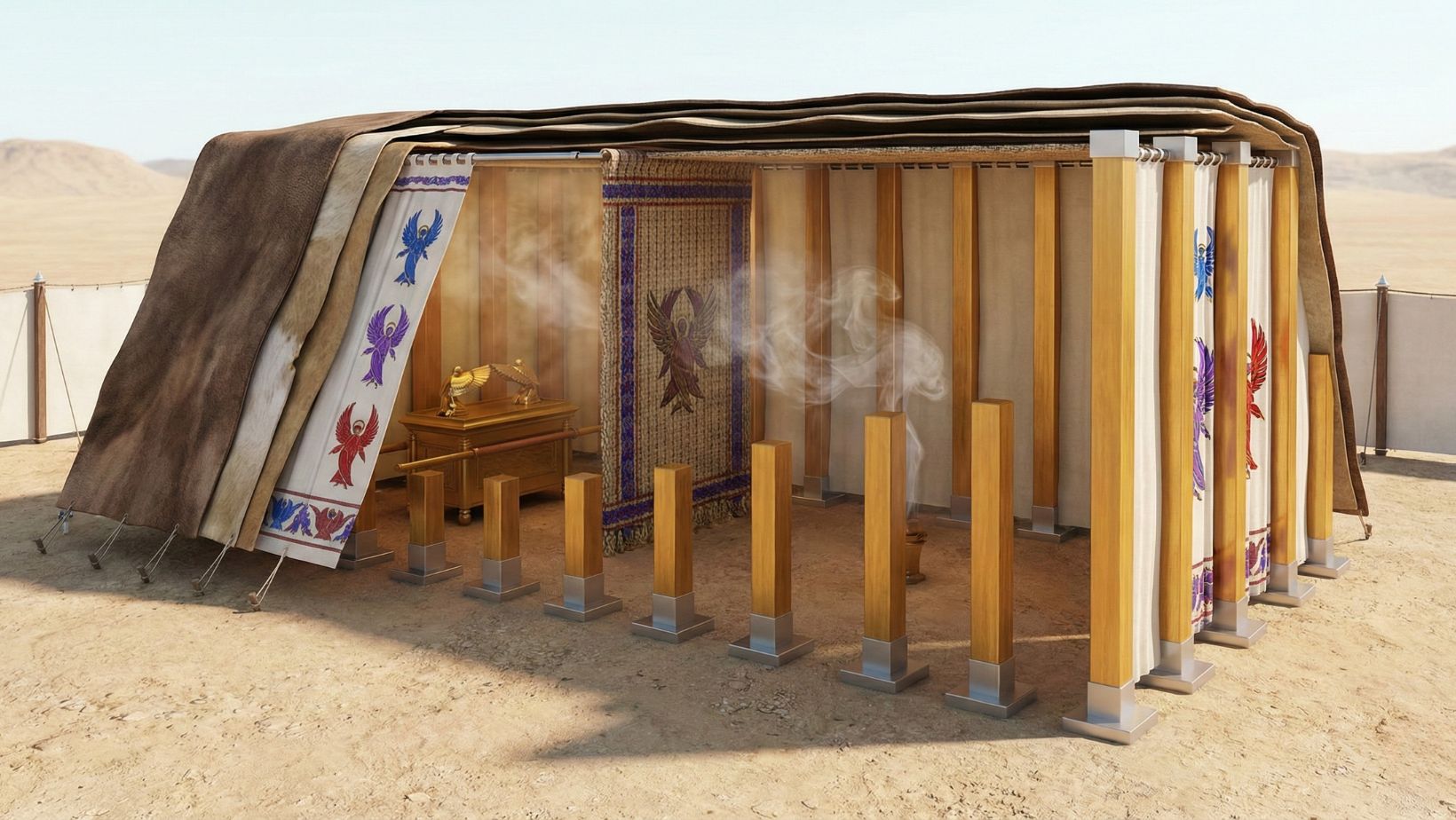
Exodus 26 provides the architectural blueprints for the Tabernacle’s structure—its curtains, coverings, frames, and internal divisions. While Chapter 25 focused on the “furniture” (the spiritual heart), Chapter 26 focuses on the “tent” (the protective shell). The design is a paradox: it is a portable, rugged tent suited for the wilderness, yet its interior is a portable palace of exquisite beauty, mirroring the Garden of Eden. The most critical element is the “Veil,” which separated the Holy Place from the Most Holy Place, emphasizing both God’s proximity and His terrifying holiness.
1. The Inner Curtains of Fine Linen (Exodus 26:1–6 NLT)
1 “Make the Tabernacle from ten curtains of finely woven linen. Decorate the curtains with blue, purple, and scarlet thread and with skillfully embroidered cherubim. 2 These ten curtains must all be exactly the same size—42 feet long and 6 feet wide. 3 Join five of these curtains together to make one long curtain, then join the other five into a second long curtain. 4 Put loops of blue yarn along the edge of the last curtain in each set. 5 The fifty loops along the edge of one set of curtains must match the fifty loops along the edge of the other set. 6 Then make fifty gold clasps and fasten the long curtains together with the clasps. In this way, the Tabernacle will be made of one continuous piece.
- The Tapestry of Heaven (v. 1): The innermost layer was seen only from the inside. The blue, purple, and scarlet threads on white linen represented royalty, divinity, and sacrifice.
- Embroidered Cherubim (v. 1): As the priests looked up, they saw angels. This created the atmosphere of the heavenly throne room, where God is surrounded by celestial beings.
- Unity in Design (v. 6): The curtains were joined by “gold clasps” to become “one continuous piece.” This reflects the unity of the people of God and the seamless nature of His redemptive plan.
2. The Protective Outer Coverings (Exodus 26:7–14 NLT)
7 “Make eleven curtains of goat-hair cloth to serve as a tent covering for the Tabernacle. 8 These eleven curtains must all be exactly the same size—45 feet long and 6 feet wide. 9 Join five of these curtains together to make one long curtain, and join the other six into a second long curtain. Allow the sixth curtain to hang over the front of the Sacred Tent. 10 Make fifty loops for the edge of each large curtain. 11 Then make fifty bronze clasps, and fasten the loops of the long curtains with the clasps. In this way, the covering will be made of one continuous piece. 12 The remaining 3 feet of this covering will hang over the back of the Tabernacle. 13 Allow 18 inches of remaining material to hang down over each side, so the Tabernacle is completely covered. 14 Complete the tent covering with a protective layer of tanned ram skins and a layer of fine goatskin leather.
- Goat-Hair (v. 7): This second layer was larger and more durable. In the ancient Near East, black goat-hair tents were the standard for nomadic life.
- Bronze vs. Gold (v. 11): While the inner curtains used gold clasps, the outer tent used bronze. As one moves outward from the presence of God, the materials become more functional and less “heavenly.”
- Tanned Ram Skins and Goatskin (v. 14): The final two layers were weatherproof. Some translations suggest the outermost layer was “sea cow” or “badger” skin. From the outside, the Tabernacle looked plain, dark, and humble—much like Christ, who had “no beauty or majesty to attract us” (Isaiah 53:2).
3. The Framework of Acacia Wood (Exodus 26:15–30 NLT)
15 “For the framework of the Tabernacle, make upright frames of acacia wood. 16 Each frame must be 15 feet high and 27 inches wide, 17 with two pegs under each frame to leave them together. All the frames must be made this way. 18 Make twenty frames for the south side of the Tabernacle. 19 With them make forty silver bases—two bases under each frame, with the pegs fitting securely into the bases. 20 For the north side of the Tabernacle, make another twenty frames, 21 with their forty silver bases, two bases under each frame. 22 Make six frames for the rear—the west side of the Tabernacle— 23 along with two additional frames to reinforce the rear corners. 24 These corner frames will be matched at the bottom and firmly attached at the top with a single ring, forming a single unit. Both of these corner frames will be made the same way. 25 So there will be eight frames at the rear of the Tabernacle, set in sixteen silver bases—two bases under each frame. 26 “Make crossbars of acacia wood to link the frames, five crossbars for the north side of the Tabernacle 27 and five for the south side. Also make five crossbars for the rear, which faces west. 28 The middle crossbar, halfway up the frames, will run all the way from one end of the Tabernacle to the other. 29 Overlay the frames with gold, and make gold rings to hold the crossbars. Also overlay the crossbars with gold. 30 “Set up this Tabernacle according to the pattern you were shown on the mountain.
- The Silver Bases (v. 19): These “sockets” were made of silver, which in the Bible often symbolizes “redemption” (the silver used was the half-shekel atonement price paid by every Israelite). The entire structure literally stood on a foundation of redemption.
- Gold-Overlaid Wood (v. 29): Acacia wood is dense and resistant to decay (representing humanity), but it is covered in gold (representing divinity).
- The Support System (vv. 26-28): The crossbars held the upright frames together, ensuring the structure could withstand the desert winds.
4. The Inner Veil and the Most Holy Place (Exodus 26:31–37 NLT)
31 “For the inside of the Tabernacle, make a special curtain of finely woven linen. Decorate it with blue, purple, and scarlet thread and with skillfully embroidered cherubim. 32 Hang this curtain on gold hooks attached to four posts of acacia wood. Overlay the posts with gold, and set them in four silver bases. 33 Hang the inner curtain from the clasps, and put the Ark of the Covenant in the room behind it. This curtain will separate the Holy Place from the Most Holy Place. 34 “Then put the Ark’s cover—the place of atonement—on top of the Ark of the Covenant inside the Most Holy Place. 35 Place the table outside the inner curtain on the north side of the Holy Place, and place the lampstand across the room on the south side. 36 “Make another curtain for the entrance to the Sacred Tent. Make it of finely woven linen and embroider it with exquisite designs using blue, purple, and scarlet thread. 37 Craft five posts from acacia wood. Overlay them with gold, and hang the curtain from them with gold hooks. Cast five bronze bases for the posts.
- The Veil (v. 31): This was a thick, heavy barrier. It functioned as a “Keep Out” sign for everyone except the High Priest once a year. It reminded Israel that God is approachable only through a mediator and a sacrifice.
- The Two Rooms (v. 33): The veil created two distinct zones:
- The Entrance (v. 36): A second screen or curtain was made for the entrance to the tent. While the inner veil sat on silver bases, this outer entrance sat on bronze bases—showing a progression of holiness as one moved closer to the center.
Theological Significance of Exodus 26
- God’s Dwelling is Beautiful and Strong: The Tabernacle was not a flimsy tent; it was a reinforced structure of gold and silver, yet covered in humble skins. It represents the “Hidden Glory” of God’s presence.
- The Torn Veil: In the New Testament, at the moment of Jesus’ death, this very veil (in the later Temple) was torn from top to bottom (Matthew 27:51). This signified that Christ’s flesh was the true veil, and through His death, the way into the “Most Holy Place” is now open to all believers (Hebrews 10:19–20).
- The Foundation of Redemption: The fact that the sanctuary stood on silver sockets (redemption money) teaches that we can only stand before God on the basis of His having purchased us.
Practical Applications
- Inner Beauty vs. Outer Appearance: The Tabernacle looked like a dark tent on the outside but was gold and angelic on the inside. We should focus more on our “inner man” which is being renewed, rather than our outward shell.
- Boundaries and Respect: The veil reminds us that God is not our “buddy” in a casual sense; He is holy. We must approach Him with reverence and awe, thankful that Jesus has made a way for us.
- The Strength of Unity: Just as the frames and crossbars worked together to support the weight of the gold and curtains, the Church works together to “house” the Spirit of God on earth today.




Leave a Reply