
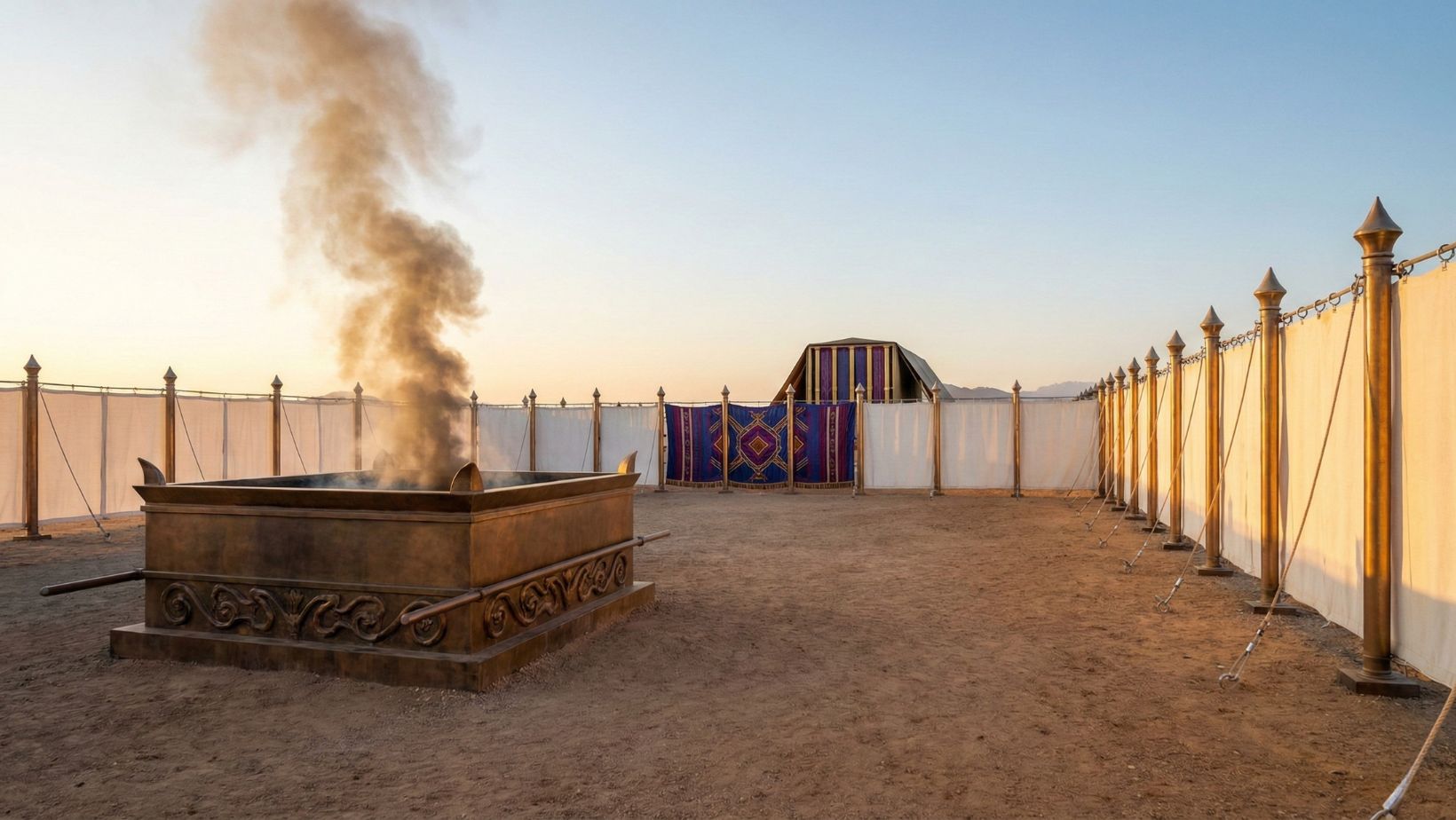
Exodus 27 provides the blueprints for the external components of the Tabernacle: the Bronze Altar and the Outer Courtyard. While the previous chapters focused on the gold-covered furniture inside the tent, this chapter moves outside to the courtyard where the public aspects of sacrifice and approach began. The Bronze Altar was the place of substitutionary sacrifice—the only way for a sinful person to begin their journey toward God. The courtyard, defined by fine linen curtains, established a clear boundary between the common world and the sacred presence of Yahweh. The chapter ends with a command for the “eternal flame” of the golden lampstand, ensuring that God’s light never goes out.
1. The Bronze Altar (Exodus 27:1–8 NLT)
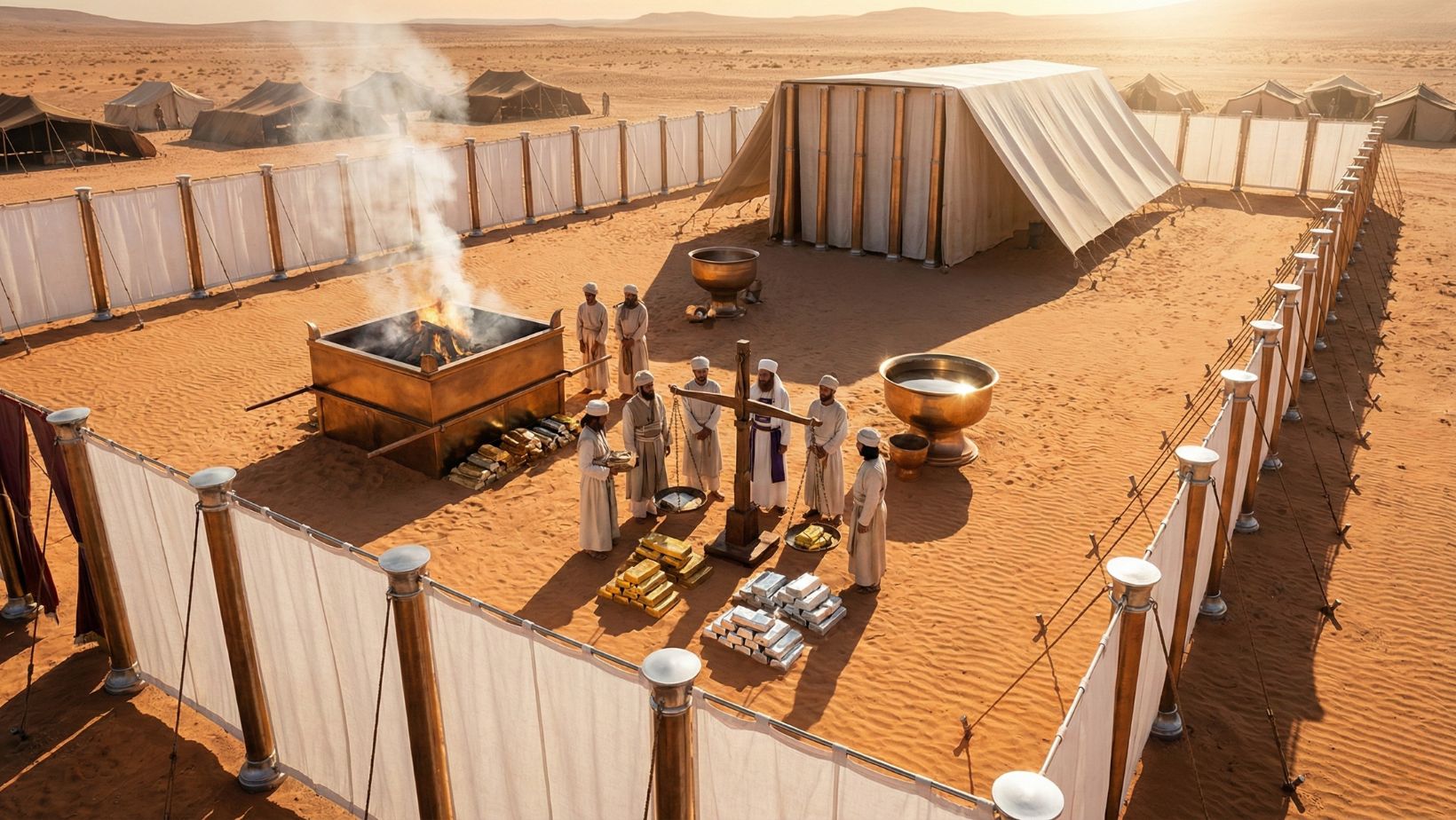
1 “Using acacia wood, construct a square altar 7 1/2 feet wide, 7 1/2 feet long, and 4 1/2 feet high. 2 Make horns for the altar at each of the four corners so that the horns and altar are all one piece. Overlay the altar with bronze. 3 Make ash buckets, shovels, basins, meat forks, and firepans, all of bronze. 4 Make a bronze grating for it, and attach four bronze rings at its four corners. 5 Install the grating half way down the side of the altar, under the ledge. 6 For moving the altar, make poles from acacia wood and overlay them with bronze. 7 Insert the poles through the rings on the sides of the altar. 8 The altar must be hollow, made from planks. Build it just as you were shown on the mountain.”
Commentary:
- The Place of Sacrifice (v. 1): The altar was the first object encountered upon entering the Tabernacle gate. It teaches that there is no access to God except through the blood of a sacrifice. It was significantly larger than the gold Altar of Incense, measuring approximately 7.5 feet square.
- The Horns of the Altar (v. 2): The “horns” symbolized power and strength. In biblical tradition, a person seeking mercy could cling to the horns of the altar (1 Kings 1:50). They were also the place where the blood of the sacrifice was applied.
- Bronze Construction (v. 2-3): While the interior furniture was gold (symbolizing deity), the exterior furniture was bronze. In Scripture, bronze often symbolizes judgment (as it can withstand the heat of fire). This was the place where sin was judged so the sinner could be spared.
- The Grating (v. 4-5): A bronze mesh or grate was placed inside to allow ashes to fall through and air to circulate, ensuring the fire remained hot enough to consume the sacrifices completely.
2. The Outer Courtyard (Exodus 27:9–19 NLT)
9 “Then make the courtyard for the Tabernacle. The south side must have curtains made of finely woven linen. These curtains must be 150 feet long, 10 supported by twenty posts set into twenty bronze bases. Hang the curtains with silver hooks and rings. 11 Make the north side the same—150 feet of curtains held up by twenty posts set into twenty bronze bases, with silver hooks and rings. 12 The west side of the courtyard will be 75 feet wide, supported by ten posts set into ten bases. 13 The east end of the courtyard, the front, will also be 75 feet wide. 14 On one side of the entrance, there will be 22 1/2 feet of curtains, supported by three posts set into three bases. 15 On the other side of the entrance, there will also be 22 1/2 feet of curtains, supported by three posts set into three bases. 16 “For the entrance to the courtyard, make a curtain 30 feet long. Fashion it from finely woven linen, and decorate it with blue, purple, and scarlet thread and with skillful embroidery. Support this curtain with four posts, each set into its own base. 17 All the posts around the courtyard must have silver rings and hooks and bronze bases. 18 So the entire courtyard will be 150 feet long and 75 feet wide, with curtain walls 7 1/2 feet high, made of finely woven linen. The bases for the posts must be made of bronze. 19 All the articles used in the rituals of the Tabernacle, including all the tent pegs used to support the Tabernacle and the courtyard curtains, must be made of bronze.”
Commentary:
- The Separation of the Holy (v. 9-11): The white linen curtains formed a barrier. To the outside world, the Tabernacle looked like a wall of white. This symbolizes the righteousness and purity required to approach God.
- The Single Gate (v. 16): There was only one entrance into the courtyard, located on the East side. It was decorated with the same colors as the Tabernacle veil (blue, purple, scarlet). This singular gate foreshadows Jesus’ claim: “I am the way… no one comes to the Father except through me” (John 14:6).
- Dimensions (v. 18): The courtyard was 150 feet by 75 feet. It provided a large space for the people to bring their animals and for the priests to perform the heavy labor of the sacrificial system.
- Silver and Bronze (v. 17): The “silver hooks” are significant. In Exodus 30, silver is the metal of redemption. The curtains of righteousness (linen) are held up by the hooks of redemption (silver).
3. The Oil for the Lampstand (Exodus 27:20–21 NLT)
20 “Command the people of Israel to bring you pure oil of pressed olives for the light, to keep the lamps burning continually. 21 The lampstand will stand in the Tabernacle, in the Holy Place of the Lord, outside the inner curtain that shields the Ark of the Covenant. Aaron and his sons must keep the lamps burning in the Lord’s presence from evening until morning. This is a permanent law for the people of Israel, and it must be observed from generation to generation.”
Commentary:
- Pure Pressed Oil (v. 20): The oil had to be “pure,” beaten or pressed rather than heated. This produced a clearer light with less smoke. Oil is a consistent biblical symbol for the Holy Spirit.
- Burning Continually (v. 20): The light was never to go out. In a dark world, the Tabernacle was a source of constant divine illumination.
- The Priestly Duty (v. 21): This introduces the responsibility of Aaron and his sons. They were to be the “keepers of the light.” This signifies that the spiritual leaders’ primary job is to ensure that God’s truth and Spirit are clearly visible to the people.
Theological Significance of Exodus 27
- The Necessity of Blood: The Bronze Altar dominates the courtyard, proving that “without the shedding of blood, there is no forgiveness” (Hebrews 9:22).
- The Barrier of Sin: The linen curtains remind us that God is “separate from sinners.” We cannot simply wander into His presence; we must enter through the designated gate and the prescribed sacrifice.
- Christ our Altar: Hebrews 13:10 says, “We have an altar.” Jesus is both the sacrifice and the altar. He bore the fire of God’s judgment so that we might enjoy the light of His presence.
Practical Applications
- The Daily Sacrifice: While we no longer sacrifice animals, we are called to present our bodies as “living sacrifices” (Romans 12:1). Our “altar” is our daily surrender to God.
- One Way to God: The single gate of the courtyard reminds us to be grateful for the clear path God has provided through Christ, rather than seeking “alternate” routes to spirituality.
- Keep the Flame: Like the priests tending the lamps, we are responsible for “tending” the light of the Spirit in our lives through prayer and the Word, ensuring our witness does not grow dim.




Leave a Reply