
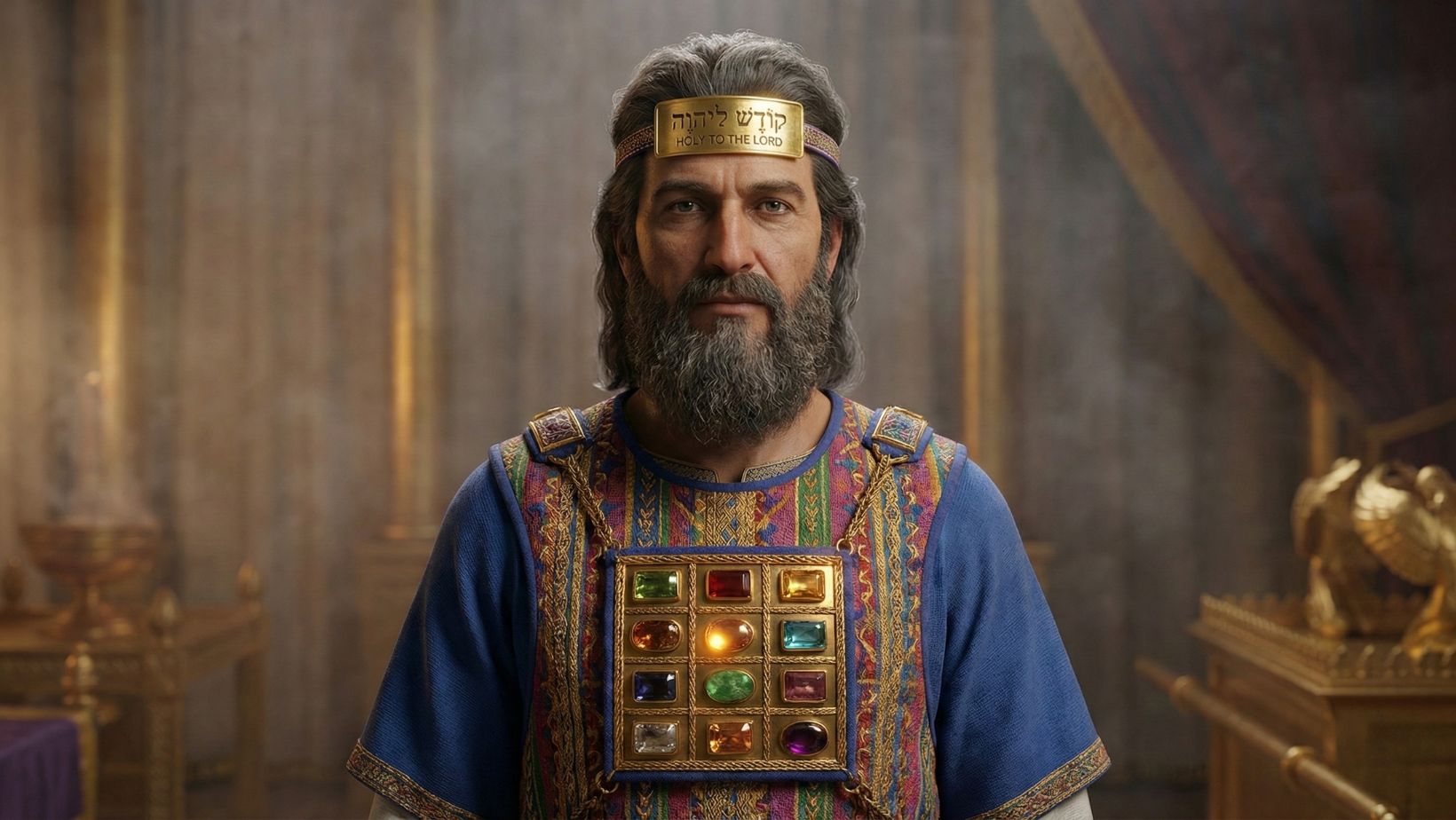
Exodus 28 shifts the focus from the Tabernacle’s structure to the people who would serve within it. God calls Aaron and his sons to the priesthood, commanding the creation of “sacred garments” that would provide them with “glory and beauty.” These vestments were not merely decorative; they were functional, symbolic, and essential for the safety of the priest. The garments—the breastpiece, ephod, robe, tunic, turban, and sash—served as a visual representation of the High Priest’s role as a mediator. He literally carried the names of the twelve tribes of Israel on his shoulders and over his heart, acting as their representative before the Holy God.
1. The Call to the Priesthood (Exodus 28:1–5 NLT)
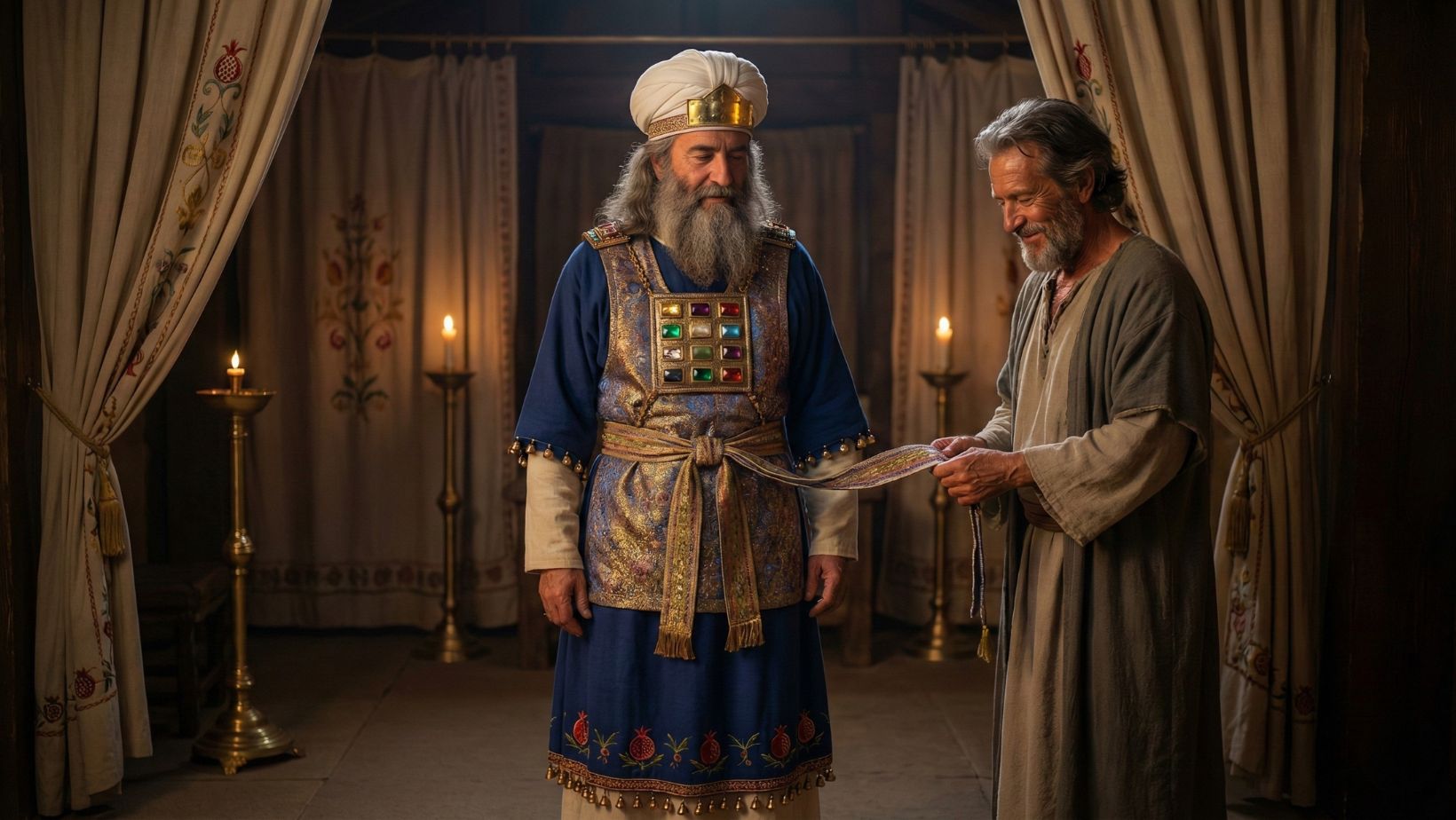
1 “Call for your brother, Aaron, and his sons, Nadab, Abihu, Eleazar, and Ithamar. Set them apart from the rest of the people of Israel to serve me as my priests. 2 Make sacred garments for Aaron that are worthy of his splendor and beauty. 3 Instruct all the skilled craftsmen whom I have filled with the spirit of wisdom. Have them make garments for Aaron that will distinguish him as a priest set apart for my service. 4 These are the garments they are to make: a chestpiece, an ephod, a robe, a design-woven tunic, a turban, and a sash. They must make these sacred garments for your brother, Aaron, and his sons to wear when they serve me as priests. 5 So give them fine linen cloth, gold thread, and blue, purple, and scarlet thread.”
Commentary:
- Divine Selection (v. 1): The priesthood was not a career choice but a divine appointment. Aaron did not volunteer; he was “set apart” by God.
- Glory and Beauty (v. 2): The Hebrew words kabod (glory) and tipharah (beauty/splendor) are used. These garments were intended to reflect the majesty of the God they served, shifting the focus from the man’s personality to his holy office.
- Spirit-Filled Craftsmanship (v. 3): God imparts “the spirit of wisdom” to the tailors. This shows that artistic and manual labor, when dedicated to God, is a spiritual gift.
- The Colors (v. 5): The gold, blue, purple, and scarlet threads match the materials used for the Tabernacle curtains, signaling that the High Priest was a human extension of the sanctuary itself.
2. The Ephod and the Shoulder Stones (Exodus 28:6–14 NLT)
6 “The craftsmen must make the ephod of finely woven linen and skillfully embroider it with gold and with blue, purple, and scarlet thread. 7 It will consist of two pieces, front and back, joined at the shoulders with two shoulder-pieces. 8 The decorative sash will be made of the same materials: finely woven linen embroidered with gold and with blue, purple, and scarlet thread. 9 “Take two onyx stones and engrave on them the names of the tribes of Israel. 10 Six names will be on each stone, arranged in the order of the births of the sons of Israel. 11 Engrave these names on the two stones in the same way a jeweler engraves a seal. Then mount the stones in settings of gold filigree. 12 Fasten the two stones on the shoulder-pieces of the ephod as a reminder that Aaron represents the people of Israel. Aaron will carry these names on his shoulders as a constant reminder whenever he goes before the Lord. 13 Make the settings of gold filigree, 14 and make two cords of pure gold, twisted like cords of rope; then attach them to the filigree settings.”
Commentary:
- The Ephod (v. 6-8): This was an apron-like garment worn over the robe. It was the most intricate part of the attire, containing the same gold thread used in the Most Holy Place.
- The Burden of Representation (v. 12): The two onyx stones on the shoulders carried the names of the twelve tribes. This symbolized that the High Priest carried the weight and responsibility of the nation before God. The shoulders are the place of strength; the people were supported by his strength of office.
- Engraved Like a Seal (v. 11): A seal (signet) implies permanent ownership and authenticity. Israel was not just “written” on the stones but “engraved,” signifying God’s permanent commitment to His people.
3. The Breastpiece of Decision (Exodus 28:15–30 NLT)
15 “Then, with great skill, make a chestpiece to be used for making decisions. Make it of the same materials as the ephod—with gold thread and blue, purple, and scarlet thread on finely woven linen. 16 It must be nine inches square and folded into a pocket. 17 Mount four rows of gemstones on it. The first row will contain a red carnelian, a pale-green peridot, and an emerald. 18 The second row will contain a turquoise, a blue lapis lazuli, and a white moonstone. 19 The third row will contain a orange jacinth, an agate, and a purple amethyst. 20 The fourth row will contain a blue-green beryl, an onyx, and a green jasper. All these stones will be set in gold filigree. 21 Each stone will represent one of the twelve sons of Israel, and the name of that tribe will be engraved on it like a seal. 22 “To attach the chestpiece to the ephod, make braided cords of pure gold thread. 23 Then make two gold rings and attach them to the upper corners of the chestpiece. 24 Tie the two gold cords to the two rings on the chestpiece. 25 Tie the other ends of the cords to the gold settings on the shoulder-pieces of the ephod. 26 Then make two more gold rings and attach them to the inside edges of the chestpiece next to the ephod. 27 And make two more gold rings and attach them to the front of the ephod, below the shoulder-pieces, just above the knot where the decorative sash is fastened to the ephod. 28 Then tie the rings of the chestpiece to the rings of the ephod with blue cords. This will hold the chestpiece securely to the ephod, above the decorative sash. 29 “In this way, Aaron will carry the names of the tribes of Israel on the sacred chestpiece over his heart when he enters the Holy Place. This will be a continual reminder that he represents the people when he comes before the Lord. 30 Insert the Urim and Thummim into the sacred chestpiece, to be worn over Aaron’s heart when he goes into the Lord’s presence. In this way, Aaron will always carry the objects used to determine the Lord’s will for his people when he goes in before the Lord.”
Commentary:
- Over the Heart (v. 29): While the shoulders (stones) represent strength, the breastpiece represents affection. The High Priest carried the people not just as a duty, but as a matter of the heart.
- Unity in Diversity (v. 21): Each stone was different—different colors, different values—yet all were set in the same gold and worn by the same priest. This illustrates that while the tribes were diverse, they were one in their standing before God.
- The Urim and Thummim (v. 30): These were likely two stones or lots kept in the “pocket” of the breastpiece. Their names mean “Lights” and “Perfections.” They were used to discern God’s “yes” or “no” on specific national matters.
4. The Robe, Turban, and Undergarments (Exodus 28:31–43 NLT)
31 “Make the robe that is worn with the ephod from a single piece of blue cloth, 32 with an opening for Aaron’s head in the middle of it. Reinforce the opening with a woven collar so it will not tear. 33 Make pomegranates of blue, purple, and scarlet yarn, and attach them to the hem of the robe, with gold bells between them. 34 The gold bells and pomegranates should alternate all around the hem. 35 Aaron will wear this robe whenever he ministers before the Lord, and the bells will tinkle as he goes in and out of the Lord’s presence. If he wears it, he will not die. 36 “Next make a medallion of pure gold, and engrave it like a seal with these words: HOLY TO THE LORD. 37 Attach it to the front of the turban with a blue cord. 38 Aaron must wear it on his forehead so he may take on himself any guilt of the people of Israel when they consecrate their sacred offerings. He must always wear it on his forehead so the Lord will accept the people. 39 “Weave Aaron’s patterned tunic from fine linen cloth. Fashion the turban from this same cloth, and make him an embroidered sash. 40 “For Aaron’s sons, make tunics, sashes, and special head coverings that are worthy of splendor and beauty. 41 Clothe Aaron and his sons with these garments, and then anoint and ordain them. Consecrate them so they can serve me as priests. 42 Also make linen undergarments for them, to be worn next to their bodies, reaching from their hips to their thighs. 43 Aaron and his sons must wear them whenever they enter the Tabernacle or approach the altar to minister in the Holy Place, or they will be guilty and die. This is a permanent law for Aaron and all his descendants.”
Commentary:
- Bells and Pomegranates (v. 33-35): The bells announced the priest’s survival and activity in the Holy Place, while the pomegranates (a fruit with many seeds) symbolized fruitfulness and the sweetness of God’s Word.
- Holy to the Lord (v. 36-38): The gold plate on the forehead was the most critical label. It declared that the priest’s mind and very being were consecrated. It also allowed him to “bear the guilt” of the people’s holy things—meaning he covered the imperfections in the people’s worship so God would accept them.
- Linen Undergarments (v. 42-43): Even the hidden parts of the priest had to be covered. This was a direct contrast to pagan religions of the time, which often involved ritual nudity. God’s service required modesty and the “covering of the flesh.”
Theological Significance of Exodus 28
- Christ our High Priest: This chapter is a “shadow” of Jesus Christ. Hebrews 4:14-16 describes Jesus as our Great High Priest. He does not wear literal gemstones, but He carries our names in His heart and intercedes for us with the “strength” of His finished work.
- Mediation: The priest stands between a Holy God and a sinful people. He bears their names (on shoulders and heart) and their guilt (on his forehead).
- Access Requires Covering: One cannot approach God “as they are” in their sin. Just as the priest needed “sacred garments,” we need to be “clothed with Christ” (Galatians 3:27) to stand before God.
Practical Applications
- Representing Others: Like the priest with names on his heart, we should carry the needs of our families and communities before God in prayer.
- Holiness in the Mind: The “Holy to the Lord” medallion on the forehead challenges us to consecrate our thoughts and motives to God.
- Attention to Detail: God’s specific instructions for the hem and the undergarments remind us that God cares about the “small things” in our walk of obedience.




Leave a Reply