
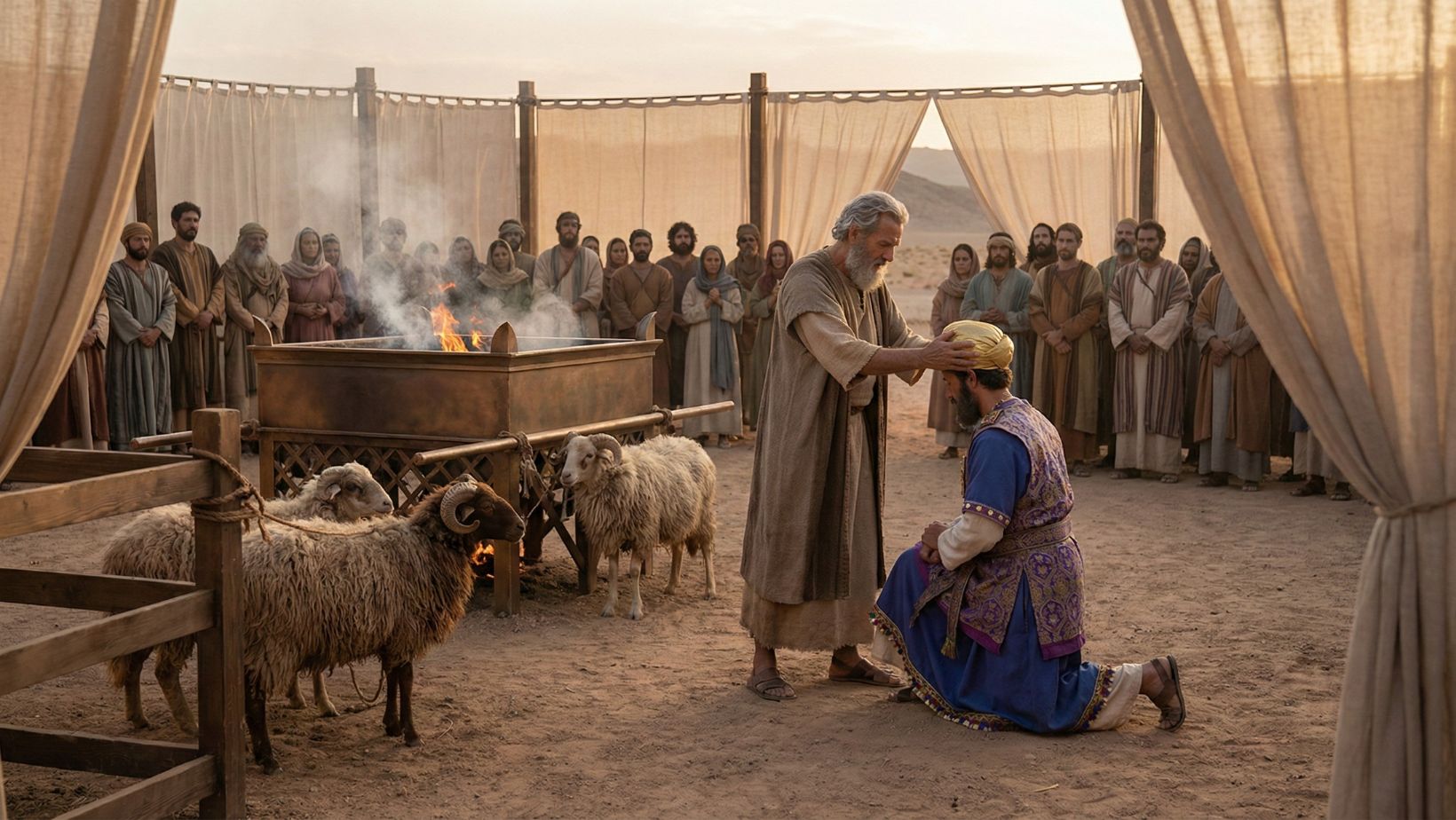
Exodus 29 details the elaborate seven-day consecration ceremony for Aaron and his sons, officially setting them apart as priests for the nation of Israel. This chapter serves as the operational manual for the garments described in chapter 28. It outlines the necessary purifications, vestments, anointing, and specific sacrifices required to transition sinful men into holy mediators. The rituals involve washing with water, clothing in holy garments, anointing with oil, and a three-part sacrificial system (sin offering, burnt offering, and peace/ordination offering). The chapter concludes with instructions for the daily morning and evening sacrifices, anchoring the promise that God will dwell among His people.
1. Preparation: Washing and Clothing (Exodus 29:1–9 NLT)
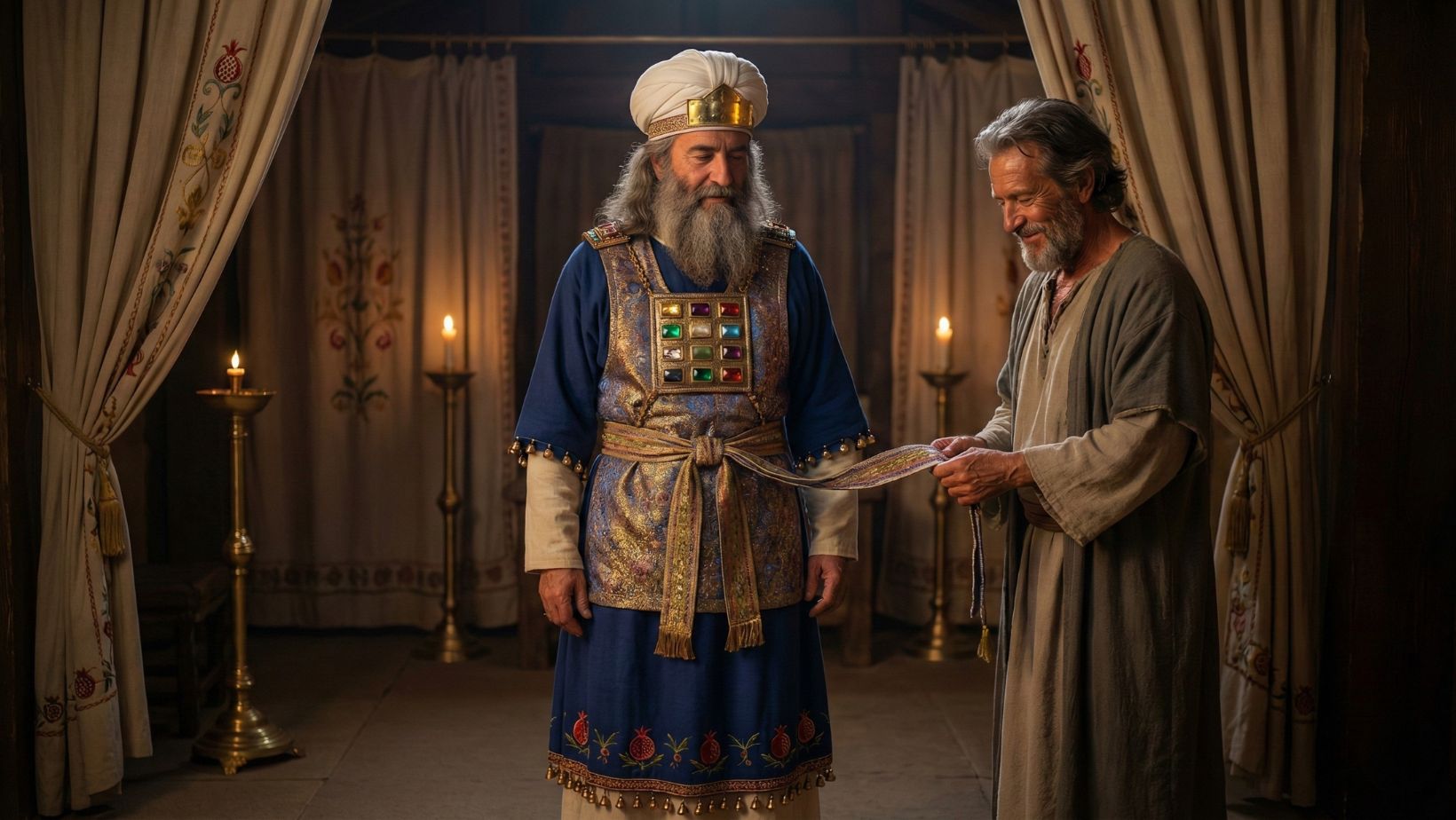
1 “This is the ceremony you must follow when you consecrate Aaron and his sons to serve me as priests: Take a young bull and two rams with no defects. 2 Then, using choice wheat flour and no yeast, make loaves of bread, thin cakes mixed with olive oil, and wafers spread with oil. 3 Place them all in a single basket, and present them at the entrance of the Tabernacle, along with the young bull and the two rams. 4 “Present Aaron and his sons at the entrance of the Tabernacle, and wash them with water. 5 Then put Aaron’s special garments on him—the tunic, the robe worn with the ephod, the ephod itself, and the chestpiece. Wrap the decorative sash of the ephod around him. 6 Place the turban on his head, and fasten the sacred medallion to the turban. 7 Then take the anointing oil and pour it over his head to consecrate him. 8 “Next present his sons, and dress them in their tunics. 9 Wrap the sashes around the waists of Aaron and his sons, and put their special head coverings on them. Then the right to the priesthood will be theirs by a perpetual law. In this way, you will ordain Aaron and his sons.
Commentary:
- The Materials (v. 1-3): The ceremony requires specific biological and agricultural elements: a bull (strength/service), rams (leadership/vigor), and unleavened bread (purity/sinlessness). The absence of yeast symbolizes the removal of corruption.
- Washing (v. 4): This was a full-body bath, not just hand-washing. It symbolizes spiritual regeneration and cleansing from the pollution of the world before entering sacred service. In the New Testament, this foreshadows the “washing of regeneration” (Titus 3:5).
- Investiture (v. 5-6, 8-9): Aaron is clothed in the “glory and beauty” garments described in Exodus 28. He does not dress himself; he is dressed by Moses (acting as God’s agent). This signifies that spiritual authority and righteousness are endowed by God, not manufactured by man.
- The Anointing (v. 7): Oil is poured over Aaron’s head. In Scripture, oil represents the Holy Spirit. This anointing sets Aaron apart as the High Priest. Psalms 133:2 describes this oil running down his beard, symbolizing an overflow of grace and the Spirit’s empowerment for service.
- Perpetual Law (v. 9): The priesthood was not a temporary office but a permanent institution for Israel, eventually fulfilled in the eternal priesthood of Jesus Christ (Hebrews 7:23-25).
2. The Sin Offering: Atonement (Exodus 29:10–14 NLT)
10 “Bring the bull to the entrance of the Tabernacle, and lay their hands on its head. 11 Then slaughter the bull in the Lord’s presence at the entrance of the Tabernacle. 12 Dip your finger in the bull’s blood and put it on the horns of the altar. Pour out the rest of the blood at the base of the altar. 13 Take all the fat around the internal organs, the long lobe of the liver, and the two kidneys and the fat around them, and burn it all on the altar. 14 But burn the bull’s meat, its skin, and its dung outside the camp. It is an offering for sin.
Commentary:
- Identification (v. 10): Aaron and his sons lay their hands on the bull. This is a vital theological gesture of imputation or transfer. They are visually confessing, “This animal represents me; my guilt is transferred to it.”
- The First Sacrifice (v. 11-12): Before they can serve others, the priests must deal with their own sin. The bull serves as a “Sin Offering” (Chattat).
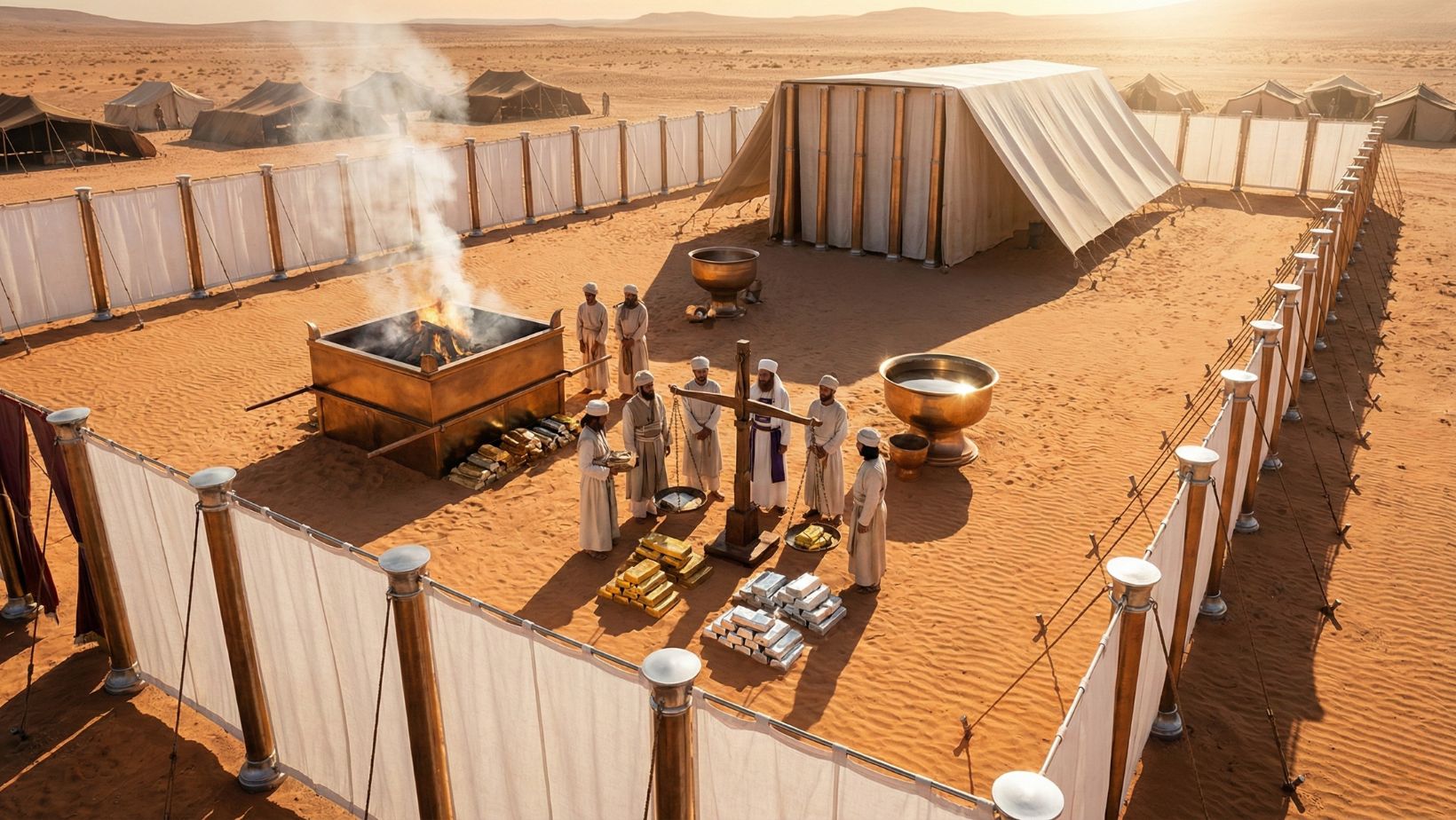
- The Horns of the Altar (v. 12): The horns symbolized the power and refuge of the altar. Daubing blood here signifies that the power of the sacrifice has been applied to the place of mediation.
- Burning Outside the Camp (v. 14): Unlike other offerings where the meat might be eaten, the sin offering for the priests had to be destroyed outside the camp. It was considered “unclean” because it bore their sin. Hebrews 13:11-13 explicitly connects this to Jesus suffering “outside the gate” to make the people holy.
3. The Burnt Offering: Total Dedication (Exodus 29:15–18 NLT)
15 “Take one of the rams, and have Aaron and his sons lay their hands on its head. 16 Then slaughter the ram, and splatter its blood against all sides of the altar. 17 Cut the ram into pieces, and wash the internal organs and the legs. Set them alongside the head and the other pieces of the body. 18 Then burn the entire ram on the altar. It is a burnt offering to the Lord, a pleasing aroma, a special gift presented to the Lord.
Commentary:
- Distinct Purpose: While the bull was for sin (expiation), this first ram is a burnt offering (Olah). The defining characteristic of a burnt offering is that the entire animal is consumed by fire (v. 18).
- Total Surrender (v. 18): This symbolizes the complete dedication of the priest to God. Nothing is held back. The priest’s life is to be wholly consumed by the service of Yahweh.
- Pleasing Aroma (v. 18): This anthropomorphism indicates God’s acceptance and pleasure in the total devotion of His servants.
4. The Ordination Offering: Consecration (Exodus 29:19–28 NLT)
19 “Now take the other ram, and have Aaron and his sons lay their hands on its head. 20 Then slaughter it, and apply some of its blood to the right earlobes of Aaron and his sons. Also put it on the thumbs of their right hands and the big toes of their right feet. Splatter the rest of the blood against all sides of the altar. 21 Then take some of the blood from the altar and some of the anointing oil, and sprinkle it on Aaron and his sons and on their garments. In this way, they and their garments will be set apart as holy. 22 “Since this is the ram for the ordination of Aaron and his sons, take the fat of the ram, including the fat of the broad tail, the fat around the internal organs, the long lobe of the liver, and the two kidneys and the fat around them, along with the right thigh. 23 Then take one round loaf of bread, one thin cake mixed with olive oil, and one wafer from the basket of bread without yeast that was placed in the Lord’s presence. 24 Put all these in the hands of Aaron and his sons to be lifted up as a special offering to the Lord. 25 Afterward take the various breads from their hands, and burn them on the altar along with the burnt offering. It is a pleasing aroma to the Lord, a special gift for him. 26 Then take the breast of Aaron’s ordination ram, and lift it up in the Lord’s presence as a special offering to him. Then keep it as your own portion. 27 “Set aside the portions of the ordination ram that belong to Aaron and his sons. This includes the breast and the thigh that were lifted up before the Lord as a special offering. 28 In the future, whenever the people of Israel offer up peace offerings or thanksgiving offerings to the Lord, these portions will be lifted up before the Lord and these pieces will belong to Aaron and his descendants. This is their permanent right.
Commentary:
- The Ram of Ordination (v. 22): This second ram is unique to this ceremony. The Hebrew word for ordination literally means “filling the hand” (implied in v. 24), suggesting they are being given the tools and authority for their task.
- Ear, Thumb, Toe (v. 20): This specific application of blood is highly symbolic:
- Right Ear: Their hearing is sanctified to listen to God’s word.
- Right Thumb: Their hands are sanctified to do God’s work.
- Right Big Toe: Their walk is sanctified to follow God’s ways.
- Note: The “right” side was considered the side of strength and honor.
- Mixture of Blood and Oil (v. 21): Sprinkling the mixture of atoning blood and anointing oil on the garments symbolizes that their holiness is a result of both the sacrifice (redemption) and the Spirit (empowerment).
- The Wave Offering (v. 24-26): Placing the fat and bread in the priests’ hands to “wave” before the Lord indicates that they are presenting these things to God, who then symbolically gives a portion back to them for their sustenance.
5. Succession and Sanctification (Exodus 29:29–37 NLT)
29 “Aaron’s sacred garments must be preserved for his descendants who succeed him, and they will wear them when they are anointed and ordained. 30 The descendant who succeeds him as high priest and enters the Tabernacle to minister in the Holy Place must wear these garments for seven days. 31 “Take the ram used in the ordination ceremony, and boil its meat in a sacred place. 32 Then Aaron and his sons will eat this meat, along with the bread in the basket, at the Tabernacle entrance. 33 They alone may eat the meat and bread used for their purification in the ordination ceremony. No one else may eat them, for these things are holy. 34 If any of the ordination meat or bread remains until the morning, it must be burned. It may not be eaten, for it is holy. 35 “This is how you will ordain Aaron and his sons to their offices, just as I have commanded you. The ordination ceremony will go on for seven days. 36 Each day you must sacrifice a young bull as a sin offering to purify them, making them right with the Lord. Afterward, cleanse the altar by purifying it; make it holy by anointing it with oil. 37 Purify the altar every day for seven days, and make it holy. Then the altar will be most holy, and whatever touches it will become holy.
Commentary:
- Seven Days (v. 35): The process of becoming holy wasn’t instant. It took seven days—a number representing completion and perfection in Hebrew thought. They repeated these sacrifices daily for a week.
- Communion Meal (v. 32-33): Eating the sacrifice signifies fellowship and peace with God. Only the priests could eat this; it was a “closed communion,” emphasizing the specific covenant role they held.
- Holiness of the Altar (v. 37): Not only the men but the physical altar had to be atoned for. The statement “whatever touches it will become holy” suggests a contagious holiness, warning that common things should not come into contact with it casually.
6. The Daily Offerings (Exodus 29:38–46 NLT)
38 “This is what you are to offer on the altar. Offer two one-year-old lambs each day, forever. 39 Offer one in the morning and the other in the evening. 40 With one of them, offer two quarts of choice flour mixed with one quart of pure oil of pressed olives; also, offer one quart of wine as a liquid offering. 41 Offer the other lamb in the evening, along with the same offerings of flour and wine as in the morning. It will be a pleasing aroma, a special gift presented to the Lord. 42 “These burnt offerings are to be made each day from generation to generation. Offer them in the Lord’s presence at the Tabernacle entrance; there I will meet with you and speak with you. 43 I will meet the people of Israel there, in the place made holy by my glory. 44 Yes, I will consecrate the Tabernacle and the altar, and I will consecrate Aaron and his sons to serve me as priests. 45 Then I will live among the people of Israel and be their God, 46 and they will know that I am the Lord their God. I am the one who brought them out of the land of Egypt so that I could live among them. I am the Lord their God.
Commentary:
- The Tamid (v. 38): The “continual” (Hebrew: Tamid) offering. Every single morning and evening, a lamb was sacrificed. This ensured there was always a fresh blood sacrifice on the altar, maintaining the covenant relationship 24/7.
- Rhythm of Grace (v. 39): This established a liturgical rhythm for Israel—beginning and ending the day with sacrifice and prayer.
- The Goal of Exodus (v. 45-46): This is the climax of the chapter and arguably the book. God states the purpose of the Exodus was not just liberation from slavery, but “so that I could live among them.” The complex rituals, the blood, and the priesthood all serve one end: Immanuel (God with us).
Theological Significance of Exodus 29
- The Cost of Holiness: The sheer volume of blood shed (bulls, rams, lambs daily) underscores that holiness is dangerous and costly. Sin cannot merely be overlooked; it must be atoned for.
- Mediation: The people could not approach God directly; they needed a consecrated mediator. This points to Jesus, who is the “one mediator between God and mankind” (1 Timothy 2:5).
- Sanctification of the Senses: The blood on the ear, thumb, and toe teaches that a servant of God must hear differently, work differently, and walk differently than the world.
Practical Applications
- Morning and Evening: The daily offerings (v. 38) encourage believers to establish a rhythm of devotion, meeting with God at the start and end of the day.
- Priesthood of Believers: In the New Testament, all believers are “a royal priesthood” (1 Peter 2:9). We don’t offer animals, but we offer our bodies as “living sacrifices” (Romans 12:1) and the “sacrifice of praise” (Hebrews 13:15).
- God’s Desire to Dwell: The text reminds us that God desires intimacy. He went to great lengths—ultimately the cross—to ensure He could dwell within us safely.




Leave a Reply