
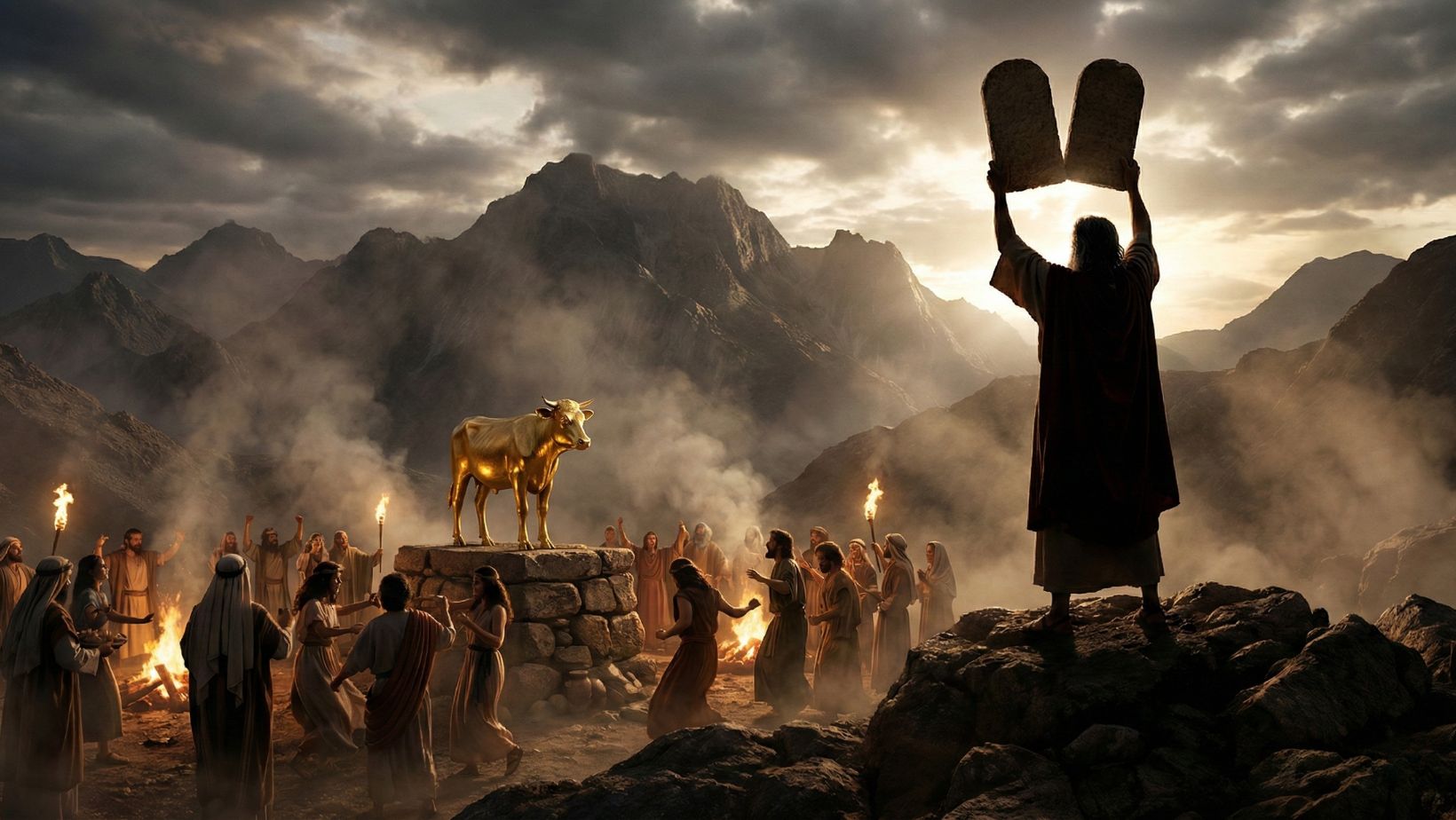
Exodus 32 presents one of the most tragic and pivotal turning points in Israel’s history: the Golden Calf incident. While Moses is on Mount Sinai receiving the stone tablets of the Covenant directly from God, the people below grow impatient and succumb to idolatry. They coerce Aaron into fashioning a physical representation of deity, leading to a breakdown of the newly formed covenant. This chapter highlights the depth of human depravity, the necessity of intercession, and the tension between God’s righteous justice and His steadfast mercy. It concludes with a severe reckoning and Moses’ selfless plea for the people’s lives, setting the stage for the renewal of the covenant.
1. The Apostasy: The Golden Calf (Exodus 32:1–6 NLT)
1 When the people saw how long it was taking Moses to come back down the mountain, they gathered around Aaron. “Come on,” they said, “make us some gods who can lead us. We don’t know what happened to this fellow Moses, who brought us here from the land of Egypt.” 2 So Aaron said, “Take the gold rings from the ears of your wives and sons and daughters, and bring them to me.” 3 All the people took the gold rings from their ears and brought them to Aaron. 4 Then Aaron took the gold, melted it down, and molded it into the shape of a calf. When the people saw it, they exclaimed, “O Israel, these are the gods who brought you out of Egypt!” 5 Aaron saw how excited the people were, so he built an altar in front of the calf. Then he announced, “Tomorrow will be a festival to the Lord!” 6 The people got up early the next morning to sacrifice burnt offerings and peace offerings. After this, they celebrated with feasting and drinking, and they indulged in pagan revelry.
Commentary:
- Impatience and Unbelief (v. 1): The catalyst for the sin was Moses’ delay. The people’s faith was tethered to a visible leader rather than the invisible God. Their dismissive reference to “this fellow Moses” shows a rapid erosion of respect for God’s appointed mediator.
- The Failure of Leadership (v. 2–4): Aaron, tasked with the spiritual oversight of the camp, capitulates immediately to the mob. Instead of rebuking them, he facilitates the idolatry by collecting their jewelry—ironically, the very gold God had provided them as they left Egypt.
- Syncretism (v. 4–5): The “calf” (likely a young bull) was a common symbol of power and fertility in Egypt (the Apis bull) and Canaan. Notice that they didn’t necessarily think they were abandoning Yahweh; they were trying to worship Him through a forbidden image. Aaron calls it a “festival to the Lord (Yahweh),” attempting to blend holy worship with pagan methods.
- Pagan Revelry (v. 6): The Hebrew word for “indulged in pagan revelry” (tsachaq) implies not just dancing, but drunken, sexual immorality. The breakdown of theological boundaries led immediately to the breakdown of moral boundaries.
Insight: Idolatry often begins when we try to force God into a timeframe or a form that we can control. When we lose sight of God’s mediator (Moses/Jesus), we inevitably create “gods” that reflect our own desires.
2. Divine Wrath and Moses’ Intercession (Exodus 32:7–14 NLT)
7 The Lord told Moses, “Quick! Go down the mountain! Your people whom you brought from the land of Egypt have corrupted themselves. 8 How quickly they have abandoned the way I commanded them to live! They have melted down gold and made a calf, and they have bowed down and sacrificed to it. They are saying, ‘These are your gods, O Israel, who brought you out of Egypt.’” 9 Then the Lord said, “I have seen how stubborn and rebellious these people are. 10 Now leave me alone so my fierce anger may blaze against them, and I will destroy them. Then I will make you, Moses, into a great nation.” 11 But Moses tried to pacify the Lord his God. “O Lord!” he exclaimed. “Why are you so angry with your own people whom you brought from the land of Egypt with such great power and a strong hand? 12 Why let the Egyptians say, ‘Their God rescued them with the evil intention of slaughtering them in the mountains and wiping them from the face of the earth’? Turn away from your fierce anger. Change your mind about this terrible disaster you have threatened against your people! 13 Remember your servants Abraham, Isaac, and Jacob. You bound yourself with an oath to them, saying, ‘I will make your descendants as numerous as the stars of heaven. And I will give them all of this land that I have promised to your descendants, and they will possess it forever.’” 14 So the Lord changed his mind about the terrible disaster he had threatened to punish his people with.
Commentary:
- Disowned by God (v. 7): God refers to Israel as “your people” (Moses’) rather than “My people.” This language signifies a legal breach of the covenant; by their actions, Israel had effectively filed for “divorce” from God.
- The Divine Test (v. 10): God’s statement “leave me alone” is an invitation for Moses to intercede. God offers to fulfill the Abrahamic promise through Moses alone (“I will make you… into a great nation”), testing Moses’ humility and love for the people.
- The Basis of Intercession (v. 11–13): Moses does not defend Israel’s behavior; he appeals to three things:
- God’s Reputation: What will the Egyptians think of God’s character?
- God’s Relationship: They are still Your people, redeemed by Your hand.
- God’s Rembrace (Covenant): He reminds God of the unconditional oath made to the Patriarchs.
- God “Changed His Mind” (v. 14): In Hebrew, the word nacham indicates a change in the direction of God’s action based on a change in the human situation (in this case, the presence of a mediator). It does not imply that God is fickle, but that He is responsive to prayer within His sovereign plan.
Insight: Moses functions here as a “type” of Christ. He stands in the gap, refusing to benefit from the people’s destruction and appealing solely to God’s glory and previous promises.
3. The Broken Tablets and the Golden Grinding (Exodus 32:15–24 NLT)
15 Then Moses turned and went down the mountain. He held in his hands the two stone tablets inscribed with the terms of the covenant. They were inscribed on both sides, front and back. 16 These tablets were God’s work; the words on them were written by God himself. 17 When Joshua heard the noise of the people shouting below them, he exclaimed to Moses, “It sounds like war in the camp!” 18 But Moses replied, “No, it’s not a shout of victory nor the cry of defeat. It’s the sound of a celebration, and I hear singing.” 19 When they came near the camp, Moses saw the calf and the dancing, and he burned with anger. He threw the stone tablets to the ground, smashing them at the foot of the mountain. 20 He took the calf they had made and burned it. Then he ground it into powder, threw it into the water, and forced the people to drink it. 21 Finally, he turned to Aaron and demanded, “What did these people do to you to make you bring such terrible sin upon them?” 22 “Don’t get so upset, my lord,” Aaron replied. “You know how evil these people are. 23 They said to me, ‘Make us gods who can lead us. We don’t know what happened to this fellow Moses, who brought us here from the land of Egypt.’ 24 So I told them, ‘Whoever has gold jewelry, take it off.’ When they brought it to me, I simply threw it into the fire—and out came this calf!”
Commentary:
- Symbolic Breaking (v. 19): Moses smashing the tablets was not just a fit of rage; it was a legal demonstration. The covenant had been broken by Israel; the physical tablets were now a dead letter.
- The Bitter Drink (v. 20): By grinding the gold and making them drink it, Moses forces the people to literally consume their sin. It proves the “god” they made is powerless—it is now part of their waste.
- Aaron’s Absurd Excuse (v. 21–24): Aaron’s response is a classic example of shifting blame. He blames the people (“you know how evil they are”) and then suggests the calf was a miracle (“out came this calf!”). He denies his own craftsmanship (v. 4).
Insight: True leadership takes responsibility. Aaron’s attempt to minimize his role in the sin only highlights his failure to stand for the truth.
4. The Levites and the Execution of Judgment (Exodus 32:25–29 NLT)
25 Moses saw that Aaron had let the people get completely out of control, making them a laughingstock to their enemies. 26 So he stood at the entrance to the camp and shouted, “All of you who are on the Lord’s side, come here and join me.” And all the Levites gathered around him. 27 Moses told them, “This is what the Lord, the God of Israel, says: Each of you, take your swords and go back and forth from one end of the camp to the other. Kill everyone—even your brothers, friends, and neighbors.” 28 The Levites obeyed Moses’ command, and about 3,000 people died that day. 29 Then Moses told the Levites, “Today you have ordained yourselves for the service of the Lord, for you obeyed him even though it meant killing your own sons and brothers. Today you have earned a blessing.”
Commentary:
- A Call to Decision (v. 26): Moses forces a moment of choice. The “Lord’s side” is defined by those who are willing to separate from the idolatry.
- The Cost of Holiness (v. 27–28): The execution of 3,000 people seems harsh to modern readers, but in the context of a theocracy, this was the excision of a “cancer” that threatened the entire nation’s survival.
- The Levites’ Ordination (v. 29): The Levites were not originally the priestly tribe (that was to be all Israel), but because of their loyalty to God over family ties during this crisis, they were set apart for sacred service.
Insight: Devotion to God often requires difficult choices that put His will above our most intimate human relationships.
5. Moses’ Final Plea (Exodus 32:30–35 NLT)
30 The next day Moses said to the people, “You have committed a terrible sin, but I will go back up to the Lord on the mountain. Perhaps I can make atonement for your sin.” 31 So Moses returned to the Lord and said, “Alas, these people have committed a terrible sin. They have made gods of gold for themselves. 32 But now, if you will only forgive their sin—but if not, erase my name from the record you have written!” 33 But the Lord replied to Moses, “No, I will erase the name of everyone who sins against me. 34 Now go, lead the people to the place I told you about. Look! My angel will lead the way before you. And when I come to settle accounts, I will certainly hold them accountable for their sins.” 35 Then the Lord sent a great plague upon the people because they had worshiped the calf Aaron had made.
Commentary:
- Sacrificial Love (v. 32): Moses offers his own eternal soul for the sake of the people (“erase my name”). This is the pinnacle of intercession. He would rather be damned with them than saved without them.
- Individual Responsibility (v. 33): God rejects Moses’ offer to be a substitute. At this stage in redemptive history, God establishes that the soul who sins is the one who dies (Ezekiel 18:20). A sinful man cannot die for the sins of another.
- Delayed Judgment (v. 34): God allows the journey to continue, but the relationship is changed. The intimate presence of God is replaced by a representative “angel” (further explored in Chapter 33).
- The Plague (v. 35): The chapter ends with a reminder that sin has physical and spiritual consequences. The 3,000 killed by the sword were followed by those who suffered under God’s direct judgment.
Insight: While Moses’ offer to be a substitute was rejected, it points directly to Jesus Christ, the only mediator who could and did have His name “erased” (stricken) so that ours could be written in the Book of Life.
Theological Significance of Exodus 32
- The Nature of Idolatry: Idolatry is not just worshipping “other” gods; it is often trying to worship the true God in our own way, on our own terms, and through our own images.
- The Role of the Mediator: This chapter establishes the absolute necessity of a mediator between a holy God and a sinful people. Without Moses’ intervention, Israel would have ceased to exist.
- The Severity of Sin: The golden calf incident shows that even after experiencing the Red Sea and the Ten Commandments, the human heart is prone to wander. Grace is not a license for license.
- Justice and Mercy: God’s “fierce anger” is balanced by His willingness to listen to the intercessor. He punishes the sin but preserves the remnant for the sake of His promise.
Practical Applications
- Watch the “Wait”: Many spiritual failures happen in the “waiting rooms” of life. When God seems silent or delayed, remain faithful to what He has already spoken.
- The Danger of “People Pleasing”: Aaron’s failure reminds us that leaders who try to please everyone usually end up leading them into sin.
- Intercession Matters: Our prayers for others are not a mere formality; they are a means by which God works His mercy in the world.
- Total Allegiance: Like the Levites, there are times when we must choose God’s side even when it is unpopular or personally painful.
Possible Sermon Titles from the Chapter
- The Gods We Make When God is Silent.
- The Man in the Gap: The Power of Intercession.
- Grinding Your Idols to Dust.
- The Cost of a Second Chance.
- Aaron’s Excuse and the Leader’s Responsibility.




Leave a Reply