
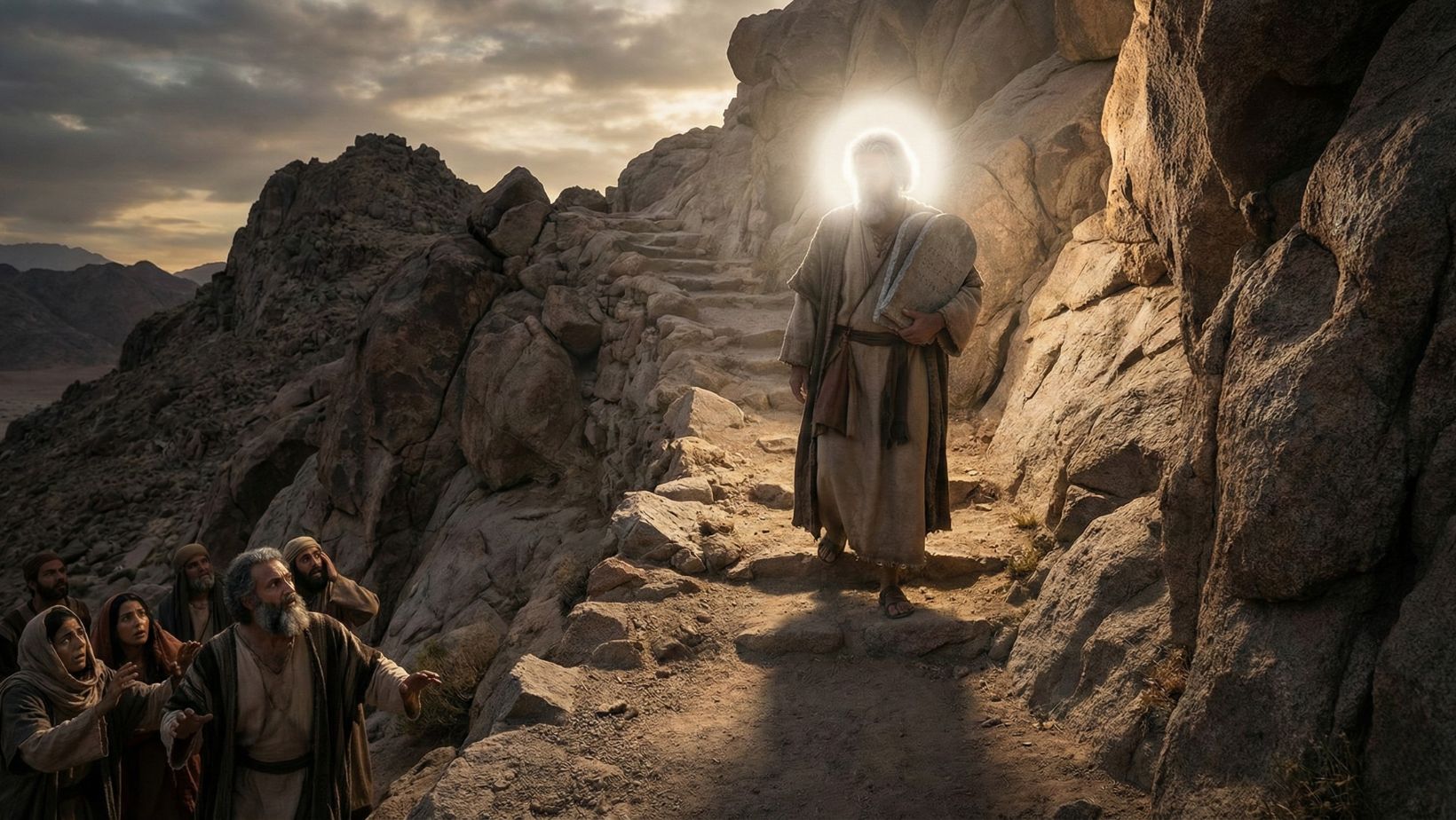
Exodus 34 marks the formal restoration of the covenant between Yahweh and Israel following the catastrophic Golden Calf incident. This chapter is a beautiful display of God’s grace—He does not merely “patch up” the relationship but chooses to start anew. Moses returns to Mount Sinai with two new stone tablets he has prepared, and there God reveals His character in what is arguably the most important self-description in the Old Testament. The chapter details the rewriting of the Law, the warning against future idolatry (especially with the inhabitants of Canaan), and concludes with the striking physical transformation of Moses, whose face shines with the reflected glory of God.
1. New Tablets and the Revelation of God’s Name (Exodus 34:1–9 NLT)
1 The Lord said to Moses, “Prepare two stone tablets like the first ones. I will write on them the same words that were on the tablets you smashed. 2 Be ready early tomorrow morning to come up Mount Sinai and present yourself to me on the top of the mountain. 3 No one else may come with you. In fact, no one is to be seen anywhere on the mountain. Do not even let the flocks or herds graze near the mountain.” 4 So Moses chipped out two tablets of stone like the first ones. Early the next morning he climbed Mount Sinai as the Lord had commanded him, and he carried the two stone tablets in his hands. 5 Then the Lord came down in a cloud and stood there with him; and he called out his own name, Yahweh. 6 The Lord passed in front of Moses, calling out, “Yahweh! The Lord! The God of compassion and mercy! I am slow to anger and filled with unfailing love and faithfulness. 7 I lavish unfailing love to a thousand generations. I forgive iniquity, rebellion, and sin. But I do not excuse the guilt. I lay the sins of the parents upon their children and grandchildren; the entire family is affected—even children in the third and fourth generations.” 8 Moses immediately threw himself to the ground and worshiped. 9 And he said, “O Lord, if it is true that I have found favor with you, then please travel with us. Yes, this is a stubborn and rebellious people, but please forgive our iniquity and our sins, and claim us as your own special possession.”
Commentary:
- Human Preparation, Divine Inscription (v. 1–4): In the first instance (Exodus 31), God provided the tablets. Here, Moses must “chip out” the stone. This cooperation symbolizes a restored but sobered partnership. God still provides the authoritative Word (“I will write”), but man must prepare the heart to receive it.
- The Character of God (v. 6–7): These verses are often called the “Thirteen Attributes of Mercy.” God defines Himself not by His power or creative might, but by His ethical character:
- Compassion/Mercy: He feels for the weak.
- Slow to Anger: He is patient with the failing.
- Unfailing Love (Hesed): Covenant loyalty that never quits.
- Faithfulness (Emet): Truth and reliability.
- The Tension of Justice (v. 7): While God is overwhelmingly merciful, He is also just. The reference to “sins of the parents” isn’t about God punishing innocent children for a father’s crime (see Deut 24:16), but rather the tragic reality that consequences of sin often ripple through generations, creating cycles of brokenness.
- Claiming the “Stubborn” (v. 9): Moses uses the people’s “stiff-necked” nature as an argument for God’s presence rather than against it. He realizes that precisely because they are prone to wander, they desperately need a Shepherd to claim them as His “special possession.”
Insight: God’s glory is most visible in His mercy. When we ask to see God’s “face,” He shows us His “heart.”
2. The Covenant Renewed and the Warning Against Idolatry (Exodus 34:10–17 NLT)
10 The Lord replied, “Listen, I am making a covenant with you in the presence of all your people. I will perform miracles that have never been performed anywhere in all the earth or in any nation. And all the people around you will see the power of the Lord—the awesome power I will display for you. 11 But listen carefully to everything I command you today. Then I will go ahead of you and drive out the Amorites, Canaanites, Hittites, Perizzites, Hivites, and Jebusites. 12 Be very careful never to make a treaty with the people who live in the land where you are going. If you do, you will follow their evil ways and be trapped. 13 Instead, you must break down their pagan altars, smash their sacred pillars, and cut down their Asherah poles. 14 You must worship no other gods, for the Lord, whose very name is Jealous, is a God who is jealous about his relationship with you. 15 Be very careful not to make a treaty with the people of the land. They lust after their gods and offer sacrifices to them. They will invite you to join them in their sacrificial meals, and you will go with them. 16 Then you will accept their daughters, who sacrifice to other gods, as wives for your sons. And they will seduce your sons to commit adultery against me by worshipping other gods. 17 You must not make any gods of molten metal.”
Commentary:
- Miraculous Distinction (v. 10): God promises to do “awesome” things for Israel. The purpose of these miracles is to distinguish them and testify to His power among the surrounding nations.
- The Danger of Compromise (v. 12–16): Having just fallen into idolatry with the Golden Calf, the warning against the gods of Canaan is intensified. God commands a “scorched earth” policy regarding pagan worship—altars, pillars, and poles must be destroyed.
- The Jealousy of God (v. 14): This is one of the most striking descriptions of God. His name is “Jealous.” This is not the petty jealousy of a human, but the protective, passionate love of a husband for his wife. He refuses to share Israel’s heart with worthless idols.
- The Trap of Integration (v. 15–16): God identifies a progression: Treaties lead to social invitations, which lead to intermarriage, which ultimately leads to spiritual apostasy. Compromise is a slow leak, not a sudden burst.
Insight: God’s intolerance of other gods is an expression of His commitment to us. He loves us too much to let us be destroyed by things that aren’t God.
3. Religious Observances and the Three Festivals (Exodus 34:18–28 NLT)
18 You must celebrate the Festival of Unleavened Bread. For seven days you must eat bread made without yeast, just as I commanded you. Celebrate this festival annually at the appointed time in early spring, in the month of Abib, for that is the anniversary of your departure from Egypt. 19 The firstborn of every animal belongs to me, including the firstborn males from your herds of cattle and your flocks of sheep and goats. 20 A firstborn donkey may be redeemed from the Lord by presenting a lamb in its place. But if you do not redeem it, you must break its neck. However, you must redeem every one of your firstborn sons. No one may appear before me without an offering. 21 You have six days each week for your ordinary work, but on the seventh day you must stop working, even during the seasons of plowing and harvest. 22 You must celebrate the Festival of Harvest with the firstcrops of the wheat harvest, and celebrate the Festival of the Final Harvest at the end of the harvest year. 23 Three times a year every man in Israel must appear before the Sovereign, the Lord, the God of Israel. 24 I will drive out the nations in your way and expel them in order to enlarge your territory. For no one will even desire to conquer your land while you are appearing before the Lord your God three times a year. 25 You must not offer the blood of my sacrificial offerings together with anything containing yeast. And none of the meat of the Passover sacrifice may be kept over until the next morning. 26 As you harvest your crops, bring the very best of the firstfruits of your entire harvest to the house of the Lord your God. You must not cook a young goat in its mother’s milk. 27 Then the Lord said to Moses, “Write down all these instructions, for they represent the terms of the covenant I am making with you and with Israel.” 28 Moses remained there on the mountain with the Lord forty days and forty nights. In all that time he ate no bread and drank no water. And the Lord wrote the terms of the covenant—the Ten Commandments—on the stone tablets.
Commentary:
- Rhythms of Remembrance (v. 18–23): God reiterates the festivals (Unleavened Bread, Harvest/Pentecost, and Final Harvest/Tabernacles). These were designed to keep Israel’s history and dependence on God at the center of their national life.
- Sabbath in the Busy Seasons (v. 21): The command to rest even during “plowing and harvest” is a profound test of faith. It asks: “Do you trust Me to provide when you aren’t working, even when the work is most urgent?”
- Divine Protection (v. 24): God makes a supernatural promise: when the men leave their homes to worship Him, God will protect their land. No enemy will even “desire” it. Obedience to God provides security that human military might cannot.
- The Second 40 Days (v. 28): Like the first time, Moses fasts for forty days. This miraculous preservation emphasizes that man does not live by bread alone but by the word of God.
Insight: Worship is a discipline of trust. By giving God the firstfruits and the Sabbath, we acknowledge that He is the true Provider of the harvest.
4. The Radiant Face of Moses (Exodus 34:29–35 NLT)
29 When Moses came down Mount Sinai carrying the two stone tablets inscribed with the terms of the covenant, he wasn’t aware that his face glowed because he had spoken to the Lord. 30 When Aaron and the people of Israel saw the radiance of Moses’ face, they were afraid to come near him. 31 But Moses called out to them and asked Aaron and the community leaders to come over and talk with him. 32 Then all the people of Israel approached him, and Moses gave them all the instructions the Lord had given him on Mount Sinai. 33 When Moses finished speaking with them, he covered his face with a veil. 34 But whenever he went into the Tent of Meeting to speak with the Lord, he would remove the veil until he came out again. Then he would give the people whatever instructions the Lord had given him, 35 and the people of Israel would see the radiant glow of his face. So he would put the veil over his face until he returned to speak with the Lord.
Commentary:
- Reflected Glory (v. 29): Moses’ face “glowed” (Hebrew qaran, meaning to send out rays). He was not the source of the light; he was a mirror reflecting the glory he had witnessed.
- The People’s Fear (v. 30): The radiance was so intense it terrified the people. It was a physical reminder of the holiness of God and the seriousness of the covenant they had just re-entered.
- The Veil (v. 33–35): Moses used a veil not just because of their fear, but—as Paul explains in 2 Corinthians 3:13—because the glory was temporary and would eventually fade. The veil hid the fact that the radiance was not permanent.
Insight: Spending time with God changes us. We may not have glowing skin, but a life of intimacy with Christ should result in a “radiance” of character that others notice.
Theological Significance of Exodus 34
- The God of the Second Chance: This chapter is the ultimate proof that failure is not final with God. He is willing to rewrite the Law and renew the relationship.
- Revelation of Character: Verse 6-7 is the “creed” of the Old Testament, quoted repeatedly by later prophets and psalmists (e.g., Psalm 86:15, Joel 2:13, Jonah 4:2). It balances God’s absolute holiness with His infinite love.
- The Jealousy of Love: God’s jealousy is presented as a virtue—it is His commitment to the exclusivity of the covenant relationship.
- Transformation through Presence: Moses’ radiant face shows the effect of God’s presence on a human being. It foreshadows the Transfiguration of Jesus and the eventual transformation of all believers (2 Cor 3:18).
Practical Applications
- Prepare the Tablets: God wants to work in your life, but He often asks you to “chip out the stone”—to do the hard work of preparation and repentance so He can write His will on your heart.
- Trust the Character of God: When you fail, don’t run from God; run to Him. Remember His name: “Compassionate, Merciful, Slow to Anger.”
- Guard Against “Treaties”: Be careful of the small compromises in your life. What “pagan altars” have you allowed to stand? True renewal requires a clean break from idols.
- Reflect the Light: The best way to lead others is to spend so much time with God that His character begins to “glow” through your actions.




Leave a Reply