
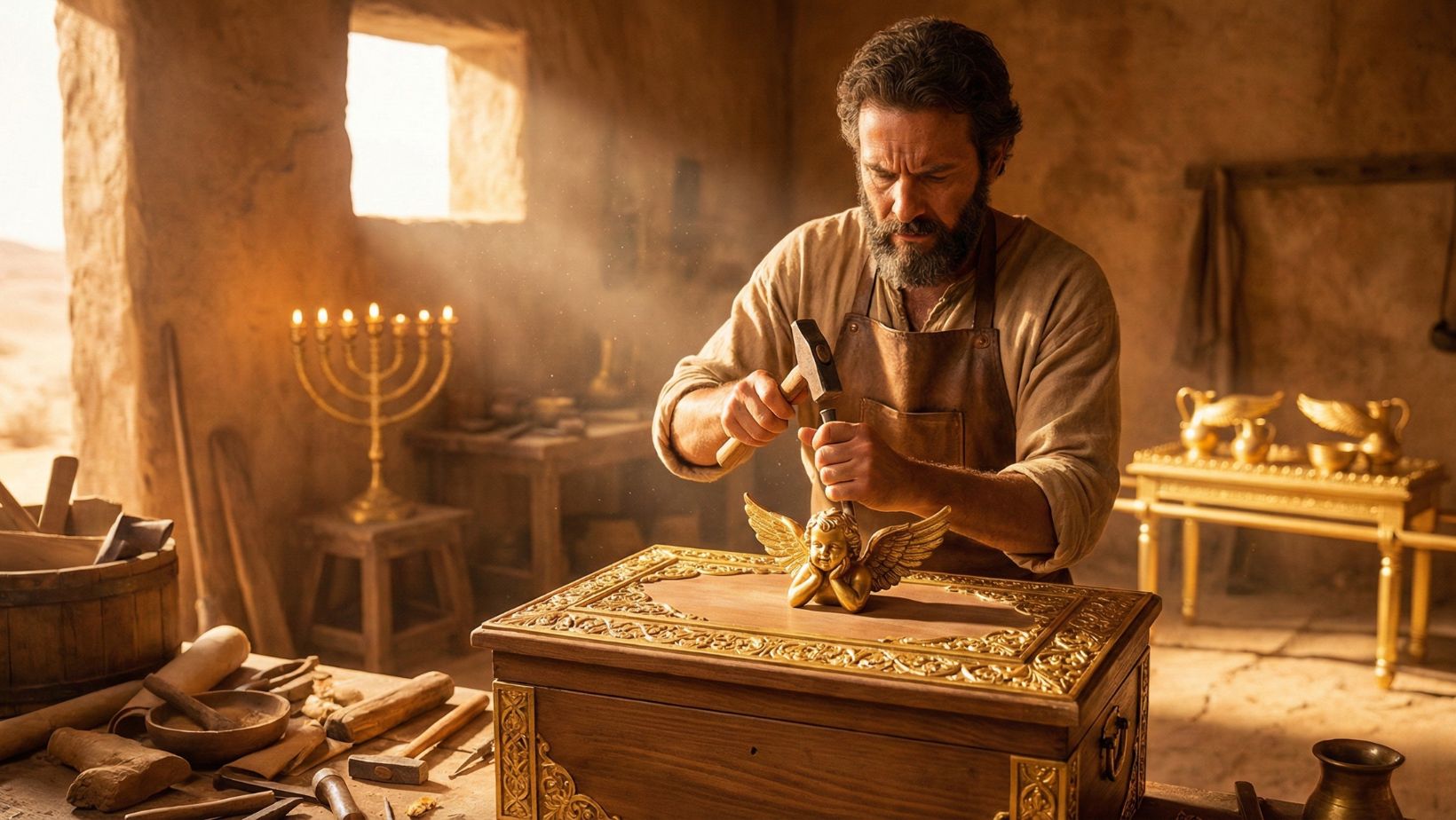
Exodus 37 shifts the focus to the “inner sanctum” of the Tabernacle. While the previous chapter dealt with the structure (the shell), this chapter chronicles the creation of the sacred furniture that would occupy the Holy Place and the Most Holy Place. Bezalel, the master craftsman filled with the Spirit, personally fashions the Ark of the Covenant, the Table of Showbread, the Golden Lampstand, and the Altar of Incense. Every item is crafted with precise detail and expensive materials—primarily acacia wood overlaid with pure gold. These items were not merely artistic; they were functional symbols of God’s presence, provision, light, and the prayers of His people.
1. The Ark of the Covenant and the Mercy Seat (Exodus 37:1–9 NLT)
1 Next Bezalel made the Ark of acacia wood. It was 3¾ feet long, 2¼ feet wide, and 2¼ feet high. 2 He overlaid it inside and out with pure gold, and he ran a molding of gold all around it. 3 He cast four gold rings and attached them to its four feet, two rings on each side. 4 Then he made poles of acacia wood and overlaid them with gold. 5 He inserted the poles into the rings at the sides of the Ark to carry it. 6 Then he made the Ark’s cover—the place of atonement—of pure gold. It was 3¾ feet long and 2¼ feet wide. 7 He fashioned two cherubim from hammered gold and placed them on the two ends of the atonement cover. 8 He made them so that they were actually part of the atonement cover—it was all one piece. There was a cherub at each end. 9 The cherubim faced each other and looked down at the atonement cover. With their wings spread above it, they protected it.
Commentary:
- The Chest of the Covenant (v. 1-2): The Ark was a wooden chest containing the Law. The acacia wood (humanity/durability) overlaid with pure gold (divinity/purity) symbolizes the intersection of God and man.
- The Atonement Cover (v. 6): Often called the “Mercy Seat,” this was a solid gold lid. It was the most important spot on earth in the Old Testament—the place where the blood was sprinkled on the Day of Atonement to cover the sins of the nation.
- Hammered Cherubim (v. 7-9): These were not separate statues but were “hammered” out of the same piece of gold as the cover. Their posture is significant: they face each other but look down at the blood-stained cover, symbolizing that even the angels marvel at God’s redemptive work.
Insight: The Law (inside the Ark) condemned the people, but the Mercy Seat (on top) covered the Law. Between the holy Law and the holy God stood the blood of atonement.
2. The Table of Showbread (Exodus 37:10–16 NLT)
10 Then Bezalel made the table of acacia wood, 3 feet long, 1½ feet wide, and 2¼ feet high. 11 He overlaid it with pure gold and ran a gold molding around the edge. 12 He made a rim about 3 inches wide around it and put a gold molding on the rim. 13 He cast four gold rings for the table and attached them to the four corners, next to the four legs. 14 The rings were placed near the rim to hold the poles used to carry the table. 15 He made the poles of acacia wood and overlaid them with gold. 16 Then he made the utensils of pure gold for the table—the bowls, ladles, pitchers, and jars to be used in pouring out liquid offerings.
Commentary:
- Bread of the Presence (v. 10): This table held twelve loaves of bread, representing the twelve tribes of Israel. It symbolized God’s constant provision and His desire for fellowship—eating a meal together was a sign of peace and friendship in the ancient Near East.
- The Molding (v. 11-12): The “rim” and “molding” served the practical purpose of keeping the bread and utensils from sliding off during transport through the rugged desert.
Insight: God is not only our Judge; He is our Provider. The Table reminds us that God invites His people to a perpetual feast in His presence.
3. The Golden Lampstand (Exodus 37:17–24 NLT)
17 Then Bezalel made the lampstand of pure, hammered gold. He made the entire lampstand and its decorations of one piece—the base, center stem, lamp cups, buds, and petals. 18 The lampstand had six branches going out from the center stem, three on each side. 19 Each of the six branches had three lamp cups shaped like almond blossoms, complete with buds and petals. 20 The center stem of the lampstand was also decorated with four lamp cups shaped like almond blossoms, complete with buds and petals. 21 One bud was placed on the stem under each pair of branches where they sprouted from the center stem—all six branches. 22 The cups, buds, and branches were all of one piece with the center stem, and they were hammered from pure gold. 23 He also made seven lamps for the lampstand, along with its lamp snuffers and trays, all of pure gold. 24 The entire lampstand, along with its utensils, was made from 75 pounds of pure gold.
Commentary:
- The Menorah (v. 17): This was the only source of light in the Holy Place. It was made of 75 pounds (one talent) of pure gold.
- Almond Blossoms (v. 19-20): The almond tree is the first to bloom in spring in Israel, symbolizing “watchfulness” or “awakening.” The lampstand looked like a golden tree, reminiscent of the Tree of Life in Eden.
- One Piece (v. 22): Like the Mercy Seat, the Lampstand was hammered from a single block of gold. This required immense skill and symbolized the organic unity of God’s light.
Insight: In a world of darkness, God provides the light. The Lampstand points to Jesus, who is the “Light of the World” and the true “Tree of Life.”
4. The Altar of Incense and the Anointing Oil (Exodus 37:25–29 NLT)
25 Then Bezalel made the incense altar of acacia wood. It was 18 inches square and 3 feet high, with horns at the corners carved from the same piece of wood as the altar itself. 26 He overlaid the top, sides, and horns of the altar with pure gold, and he ran a gold molding around the entire altar. 27 He made two gold rings and attached them on opposite sides of the altar below the gold molding to hold the poles used to carry it. 28 He made the poles of acacia wood and overlaid them with gold. 29 Then he made the holy anointing oil and the fragrant incense, using the techniques of a skilled incense maker.
Commentary:
- The Altar of Incense (v. 25-28): This was located directly in front of the veil. The smoke of the incense rising from this altar represented the prayers of the people ascending to God.
- Horns of the Altar (v. 25): Horns were symbols of power and authority. In times of desperation, individuals would flee to the Tabernacle and “grab the horns of the altar” for mercy.
- Specialized Chemistry (v. 29): The oil and incense were not standard items; they were “holy,” made with specific formulas that were not to be replicated for common use.
Insight: Our prayers are a “sweet-smelling aroma” to God. Just as the incense was burned daily, our communication with God should be a constant, fragrant part of our lives.
Theological Significance of Exodus 37
- The Supremacy of the Ark: The chapter begins with the Ark, signifying that everything in the Tabernacle flows from the presence of God and His Word (the Law).
- Materials and Meaning: The consistent use of gold reflects the worth, beauty, and “weight” (glory) of God. The acacia wood reminds us that God uses the ordinary and makes it extraordinary.
- The Way to God: To reach the Ark, one had to pass the Altar of Incense (Prayer), the Table (Fellowship), and the Lampstand (Light).
- Christ in the Furniture:
- Ark: Christ, the fulfiller of the Law.
- Table: Christ, the Bread of Life.
- Lampstand: Christ, the Light of the World.
- Altar of Incense: Christ, our Intercessor who always lives to pray for us.
Practical Applications
- Build Your Life on the “Ark”: Let the Word of God be the center of your “inner sanctuary.” Everything else should be built around His truth.
- Fellowship at the Table: Don’t just serve God; eat with Him. Spend time in “communion”—quiet fellowship that nourishes your soul.
- Keep the Lamps Burning: In a dark culture, your light must be fueled by the “pure gold” of God’s Spirit. Don’t let your lamp go out.
- The Fragrance of Prayer: Let your life be marked by the “smoke” of constant prayer. Your petitions are not lost; they are a sweet perfume to the King.
Possible Sermon Titles from the Chapter
- The Furniture of a Faithful Life.
- Mercy on Top of the Law.
- A Table Set in the Desert.
- Hammered into Unity.
- The Scent of a Praying Soul.




Leave a Reply