
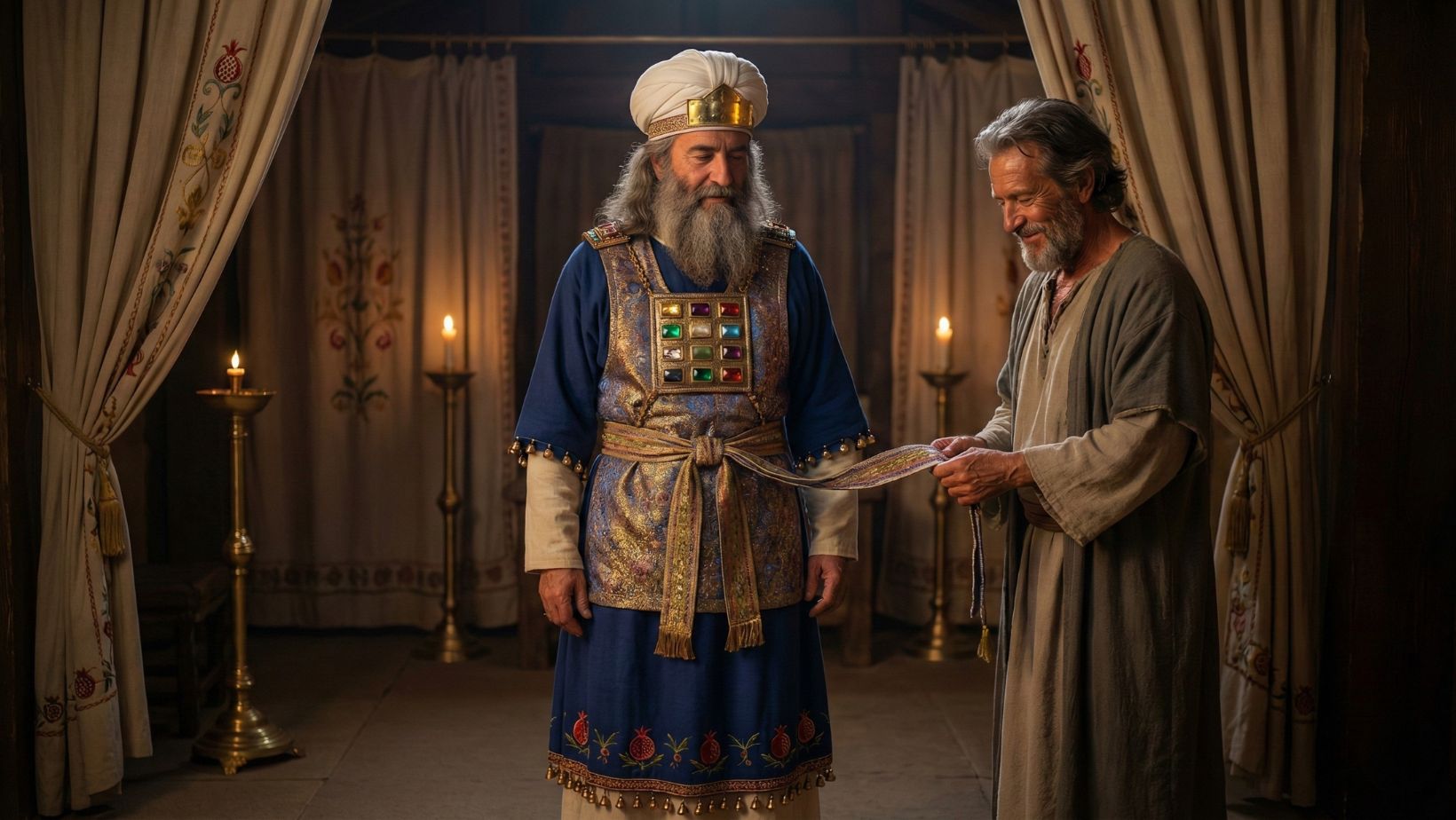
Exodus 39 details the final stage of the Tabernacle project: the creation of the priestly garments. These were not mere clothes but “holy garments” designed for “glory and beauty.” The chapter meticulously describes the Ephod, the Breastpiece, the Robe, and the remaining vestments for Aaron and his sons. A recurring phrase in this chapter is “just as the Lord had commanded Moses,” appearing seven times to emphasize the Israelites’ absolute obedience. The chapter—and the labor—concludes with a formal inspection by Moses. Seeing that every detail perfectly matched the divine pattern, Moses pronounces a blessing over the people, marking the successful completion of the work.
1. The Ephod: The Shoulder-Pieces of Authority (Exodus 39:1–7 NLT)
1 The craftsmen made beautiful sacred garments of blue, purple, and scarlet cloth—clothing for priests to wear while ministering in the Holy Place—just as the Lord had commanded Moses. 2 Bezalel made the ephod of finely woven linen and embroidered it with gold and with blue, purple, and scarlet thread. 3 They hammered gold into thin sheets and cut it into slender threads to weave into the fine linen, the blue, purple, and scarlet cloth. It was a masterpiece of design. 4 The ephod consisted of two pieces, front and back, joined at the shoulders with two shoulder-pieces. 5 The decorative sash was made of the same materials: finely woven linen embroidered with gold and with blue, purple, and scarlet thread, just as the Lord had commanded Moses. 6 They mounted the two onyx stones in settings of gold filigree. The stones were engraved with the names of the tribes of Israel, just as a seal is engraved. 7 He fastened these stones on the shoulder-pieces of the ephod as a reminder that the priest represents the people of Israel. All this was done just as the Lord had commanded Moses.
Commentary:
- Golden Threads (v. 3): This is the only place in the Bible that describes the process of making gold thread. They hammered gold into thin sheets and cut them into wires to be woven directly into the fabric. This made the priest’s garment literally shine with the glory of God.
- The Weight on the Shoulders (v. 6-7): Two onyx stones were placed on the shoulders, each engraved with six names of the tribes of Israel. This symbolized that the High Priest carried the “weight” and responsibility of the entire nation before God.
Insight: Just as Aaron carried the names of Israel on his shoulders, Jesus, our Great High Priest, carries us by His power. We are not just in His mind; we are supported by His strength.
2. The Breastpiece: The Heart of Judgment (Exodus 39:8–21 NLT)
8 Bezalel made the breastpiece with the same skilled craftsmanship. He made it of finely woven linen embroidered with gold and with blue, purple, and scarlet thread, just like the ephod. 9 It was made of a single piece of cloth folded to form a pouch nine inches square. 10 They mounted four rows of gemstones on it. The first row contained a red carnelian, a pale-green peridot, and an emerald. 11 The second row contained a turquoise, a blue lapis lazuli, and a white moonstone. 12 The third row contained a orange jacinth, an agate, and a purple amethyst. 13 The fourth row contained a blue-green beryl, an onyx, and a green jasper. All these stones were set in gold filigree. 14 Each stone represented one of the twelve sons of Israel, and the name of that tribe was engraved on it like a seal. 15 To attach the breastpiece to the ephod, they made braided cords of pure gold thread. 16 They also made two settings of gold filigree and two gold rings and attached them to the top corners of the breastpiece. 17 They tied the two gold cords to the rings on the corners of the breastpiece. 18 They tied the other ends of the cords to the gold settings on the shoulder-pieces of the ephod. 19 Then they made two more gold rings and attached them to the inside edges of the breastpiece next to the ephod. 20 Then they made two more gold rings and attached them to the front of the ephod, below the shoulder-pieces, just above the knot where the decorative sash was fastened. 21 They coupled the rings of the breastpiece to the rings of the ephod with blue cords. This tied the breastpiece securely to the ephod just above the sash. All this was done just as the Lord had commanded Moses.
Commentary:
- Twelve Unique Stones (v. 10-14): Each tribe was represented by a different gemstone. This teaches that while Israel was one nation, God valued the unique identity and “color” of each tribe.
- Close to the Heart (v. 19-21): The breastpiece was physically tied to the priest’s chest. Aaron didn’t just carry the people on his shoulders (strength); he carried them on his heart (affection).
Insight: You are a “precious stone” to God. He does not just deal with “humanity” as a mass; He knows your “name” and keeps you close to His heart.
3. The Robe and Other Vestments (Exodus 39:22–31 NLT)
22 Bezalel made the robe that is worn with the ephod from a single piece of blue woven cloth, 23 with an opening for Aaron’s head in the middle of it. The opening was reinforced with a woven collar so it would not tear. 24 They made pomegranates of blue, purple, and scarlet yarn and finely woven linen and attached them to the hem of the robe. 25 They also made bells of pure gold and placed them between the pomegranates along the entire hem of the robe, 26 with a bell between each pomegranate. This robe was to be worn whenever the priest ministered before the Lord, just as the Lord had commanded Moses. 27 They made tunics of finely woven linen for Aaron and his sons. 28 They also made the turban of fine linen, the ornamental headbands of fine linen, and the undergarments of finely woven linen. 29 The sash was made of finely woven linen and embroidered with blue, purple, and scarlet thread, just as the Lord had commanded Moses. 30 Finally, they made the sacred medallion—the badge of holiness—of pure gold. They engraved it like a seal with these words: HOLY TO THE LORD. 31 They attached the medallion with a blue cord to the front of Aaron’s turban, just as the Lord had commanded Moses.
Commentary:
- Bells and Pomegranates (v. 24-26): The bells allowed the people outside to hear the priest’s movement, confirming he was still alive and ministering. The pomegranates symbolized fruitfulness.
- Holy to the Lord (v. 30): The gold plate on the forehead was the most visible part of the outfit. It reminded everyone that the primary requirement for approaching God is holiness.
4. The Final Inspection and Blessing (Exodus 39:32–43 NLT)
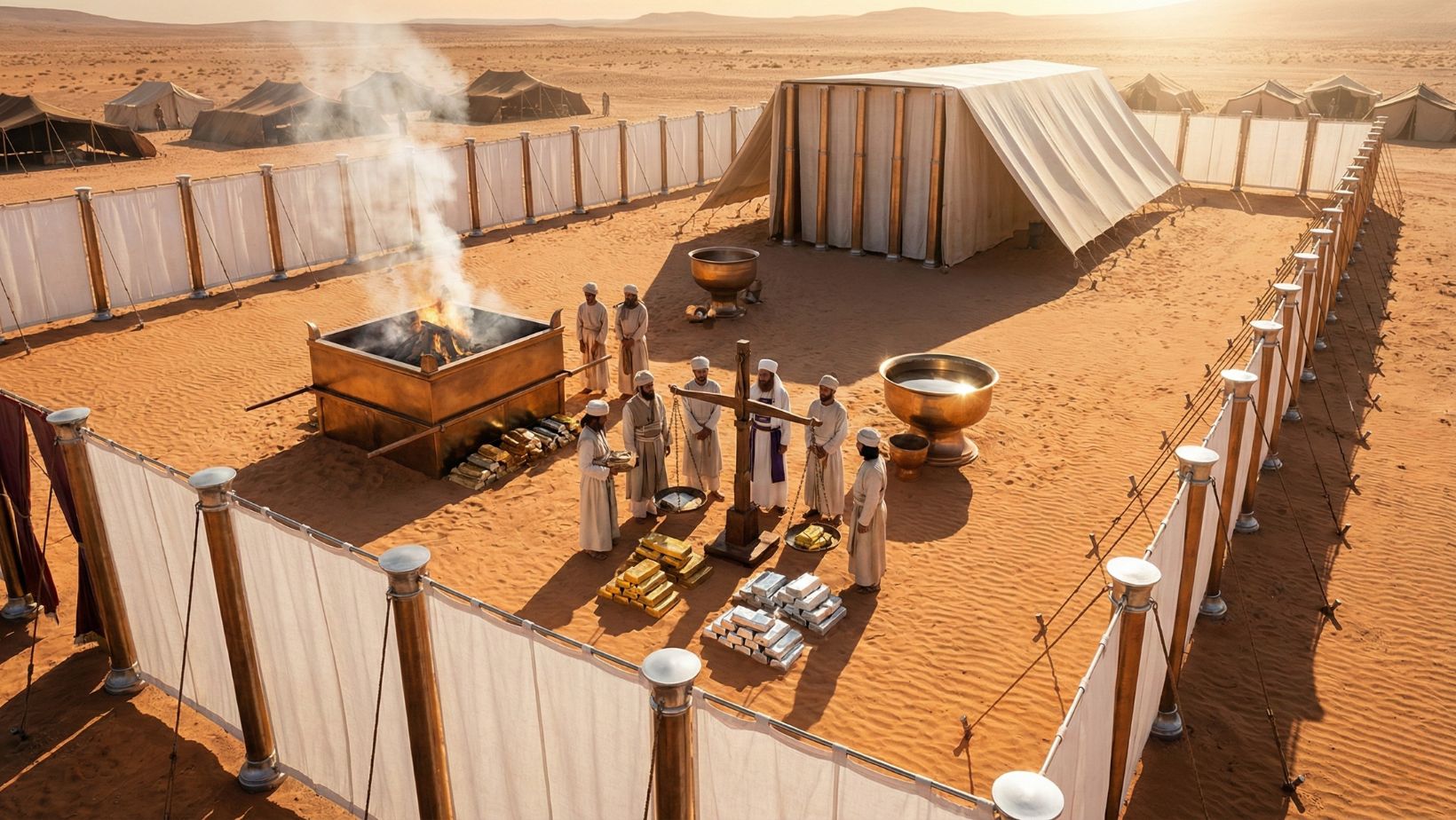
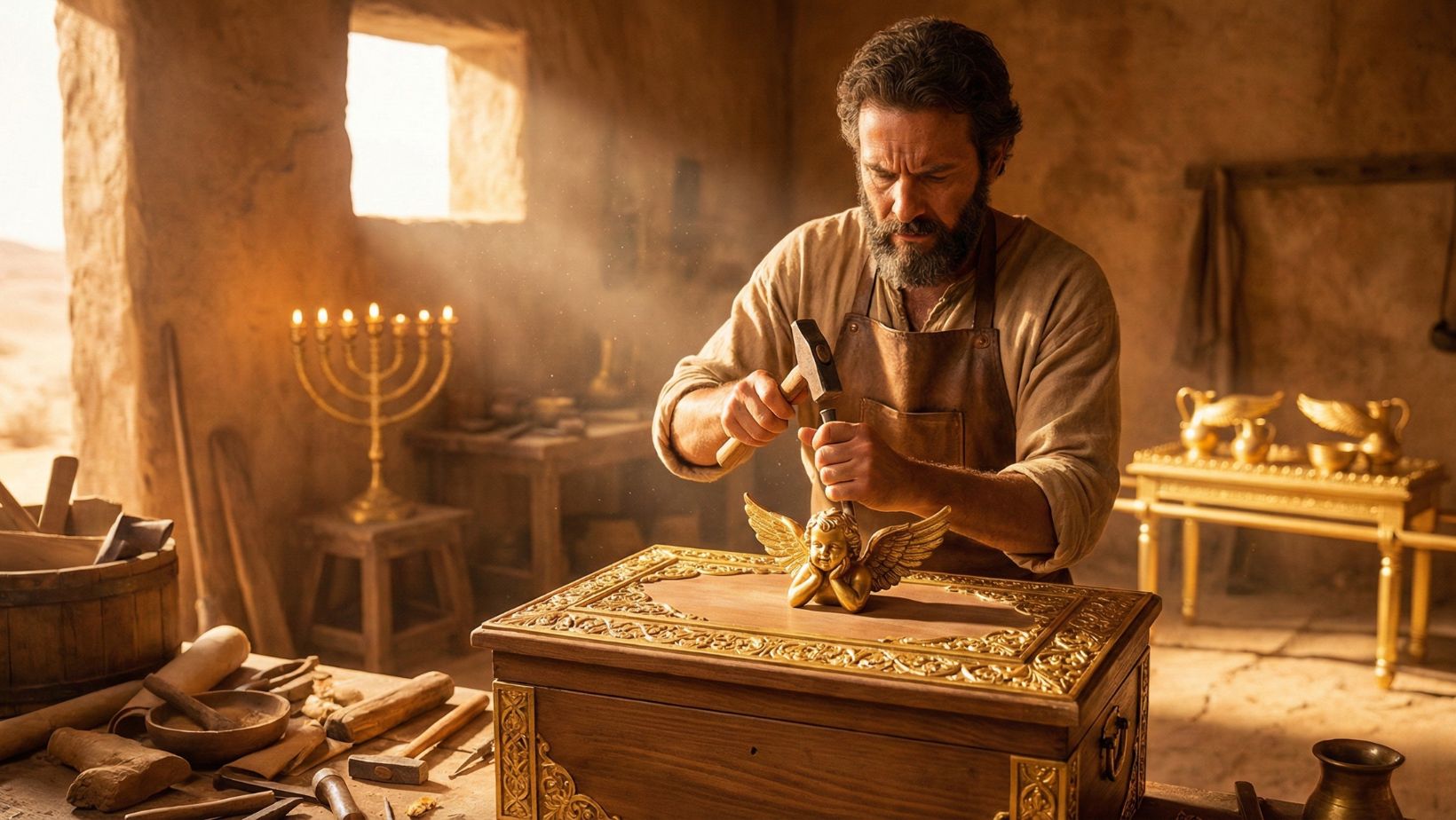
32 And so at last the Tabernacle was finished. The Israelites had done everything just as the Lord had commanded Moses. 33 Then they brought the entire Tabernacle to Moses: the sacred tent with all its furnishings, clasps, frames, crossbars, posts, and bases; 34 the tent coverings of tanned ram skins and fine goat-skin leather; the inner curtain to shield the Ark; 35 the Ark of the Covenant and its carrying poles; the Ark’s cover—the place of atonement; 36 the table and all its utensils; the Bread of the Presence; 37 the pure gold lampstand with its symmetrical lamp cups, its accessories, and the olive oil for lighting; 38 the gold altar; the anointing oil and fragrant incense; the curtain for the entrance of the sacred tent; 39 the bronze altar; the bronze grating and its carrying poles and utensils; the washbasin with its stand; 40 the curtains for the walls of the courtyard; the posts and their bases; the curtain for the entrance to the courtyard; the ropes and tent pegs; all the furnishings to be used in worship at the Tabernacle; 41 the beautifully stitched garments for the priests to wear while ministering in the Holy Place—the sacred garments for Aaron the priest, and the garments for his sons to use as they minister as priests. 42 So the people of Israel followed all of the Lord’s instructions to Moses. 43 Then Moses inspected all their work. When he found it had been done just as the Lord had commanded him, he blessed them.
Commentary:
- The Finished Work (v. 32): This verse mirrors Genesis 2:1 (“So the heavens and the earth and everything in them were finished”). The Tabernacle is a “New Creation” where God will dwell with His people.
- The Inspection (v. 43): Moses acts as the overseer. His blessing is the “well done, good and faithful servant” moment for the nation.
Theological Significance of Exodus 39
- The Beauty of Holiness: God is not only concerned with truth; He is concerned with beauty. The “glory and beauty” of the garments reflect the splendor of God’s character.
- The Perfection of Obedience: The repetitive mention of “as the Lord commanded” shows that partial obedience is not enough for a holy God.
- Christ our High Priest: Every element of Aaron’s outfit points to Jesus. He is our strength (shoulders), He loves us (heart), He is fruitful (pomegranates), and He is perfectly “Holy to the Lord.”
Practical Applications
- Weave Gold into Your Day: Just as gold was woven into the linen, let your spiritual life be woven into your “ordinary” work.
- Check Your “Hem”: Are you making “noise” (bells/testimony) but lacking “fruit” (pomegranates/character)? God desires both.
- Seek the Blessing: The blessing came after the work was inspected and found faithful. Don’t look for God’s “well done” until you have followed His instructions.
Possible Sermon Titles
- Dressed for Glory.
- On the Shoulders and Over the Heart.
- HOLY TO THE LORD: The Badge of the Believer.
- The Inspection of the Master.




Leave a Reply