
Exodus 4 continues the dialogue between God and Moses at the burning bush. Despite the profound revelation of God’s name (“I AM”) in the previous chapter, Moses remains hesitant, offering objections based on his lack of credibility and eloquence. God responds with three miraculous signs—a staff turning into a snake, a hand becoming leprous, and water turning to blood—to authenticate Moses’ mission. When Moses still pleads inadequacy regarding his speech, God appoints his brother Aaron as his mouthpiece. The narrative then shifts to Moses’ return to Egypt, interrupted by a bizarre and terrifying encounter where God seeks to kill him due to his failure to circumcise his son. The chapter concludes with the reunion of Moses and Aaron and the successful gathering of the elders of Israel, who believe the signs and worship God.
1. The Three Miraculous Signs (Exodus 4:1–9 NLT)
1 But Moses protested again, “What if they won’t believe me or listen to me? What if they say, ‘The Lord never appeared to you’?” 2 Then the Lord asked him, “What is that in your hand?” “A shepherd’s staff,” Moses replied. 3 “Throw it down on the ground,” the Lord told him. So Moses threw down the staff, and it turned into a snake! Moses jumped back. 4 Then the Lord told him, “Reach out and grab its tail.” So Moses reached out and grabbed it, and it turned back into a shepherd’s staff in his hand. 5 “Perform this sign,” the Lord told him. “Then they will believe that the Lord, the God of their ancestors—the God of Abraham, the God of Isaac, and the God of Jacob—really has appeared to you.” 6 Then the Lord said to Moses, “Now put your hand inside your cloak.” So Moses put his hand inside his cloak, and when he took it out again, his hand was white as snow with a severe skin disease. 7 “Now put your hand back into your cloak,” the Lord said. So Moses put his hand back in, and when he took it out again, it was as healthy as the rest of his body. 8 The Lord said to Moses, “If they do not believe you and are not convinced by the first miraculous sign, they will be convinced by the second sign. 9 And if they don’t believe you or listen to you even after these two signs, then take some water from the Nile River and pour it out on the dry ground. When you do, the water from the Nile will turn to blood on the ground.”
Commentary:
- Moses’ Doubt (v. 1): Moses shifts from “Who am I?” (Ex 3:11) to “They won’t believe me.” He fears a lack of credentials.
- “What is in your hand?” (v. 2): God starts with the ordinary. A shepherd’s staff (matteh) was a tool of support, guidance, and defense. It represented Moses’ current identity and livelihood. God transforms what Moses has into a tool for what God will do.
- Sign 1: The Snake (v. 3-4):
- Sign 2: Leprosy (v. 6-7):
- Life and Death: Leprosy (specifically a skin disease turning the skin white) was feared as a living death, incurable by man.
- Power: This sign showed God’s power over the human body—to inflict and to heal instantly. It proved Moses carried the power of life and death.
- Sign 3: Water to Blood (v. 9):
Insight: Miracles in Exodus are not just magic tricks; they are polemics. Each sign targets an Egyptian fear or deity, asserting Yahweh’s supremacy.
2. The Excuse of Speech and Aaron’s Appointment (Exodus 4:10–17 NLT)
10 But Moses pleaded with the Lord, “O Lord, I’m not very good with words. I never have been, and I’m not now, even though you have spoken to me. I get tongue-tied, and my words get tangled.” 11 Then the Lord asked Moses, “Who makes a person’s mouth? Who decides whether people speak or do not speak, hear or do not hear, see or do not see? Is it not I, the Lord? 12 Now go! I will be with you as you speak, and I will instruct you in what to say.” 13 But Moses again pleaded, “Lord, please! Send anyone else.” 14 Then the Lord became angry with Moses. “All right,” he said. “What about your brother, Aaron the Levite? I know he speaks well. And look! He is on his way to meet you now. He will be delighted to see you. 15 Talk to him, and put the words in his mouth. I will be with both of you as you speak, and I will instruct you both in what to do. 16 Aaron will be your spokesman to the people. He will be your mouthpiece, and you will stand in the place of God for him, telling him what to say. 17 And take your shepherd’s staff with you, and use it to perform the miraculous signs I have shown you.”
Commentary:
- The Final Excuse (v. 10): Moses claims a speech impediment (“heavy of mouth/tongue”).
- Interpretation: Some scholars suggest a literal stutter; others suggest he had forgotten the Egyptian language after 40 years, or simply lacked rhetorical skill.
- The Creator Argument (v. 11): God responds with a rhetorical question asserting His sovereignty over human faculties. The God who made the mouth can surely enable the mouth.
- The Refusal (v. 13): “Send anyone else” (literally: “Send by the hand of whom You will send”). This is not humility; it is disobedience. Moses is resigning before he begins.
- God’s Anger (v. 14): This is the first time God gets angry with Moses. Yet, in His anger, He provides a solution rather than a punishment.
- Aaron the Levite (v. 14): God had already prepared Aaron (“He is on his way”). God’s providence works ahead of our obedience.
- The Partnership (v. 15-16):
Insight: Our perceived weaknesses are not valid excuses to the Creator. God does not call the qualified; He qualifies the called.
3. Return to Egypt and the Forewarning (Exodus 4:18–23 NLT)
18 So Moses went back home to Jethro, his father-in-law. “Please let me return to my relatives in Egypt,” Moses said. “I don’t even know if they are still alive.” “Go in peace,” Jethro replied. 19 Before Moses left Midian, the Lord said to him, “Return to Egypt, for all those who wanted to kill you are dead.” 20 So Moses took his wife and sons, put them on a donkey, and started back to Egypt. And he held the staff of God in his hand. 21 And the Lord told Moses, “When you arrive back in Egypt, go to Pharaoh and perform all the miracles I have empowered you to do. But I will harden his heart so he will refuse to let the people go. 22 Then you will tell him, ‘This is what the Lord says: Israel is my firstborn son. 23 I commanded you, “Let my son go, so he can worship me.” But since you have refused, I will now kill your firstborn son!’”
Commentary:
- Asking Permission (v. 18): Moses shows respect to Jethro, his employer and father-in-law. He doesn’t reveal the full divine encounter, perhaps to avoid sounding insane.
- Safety (v. 19): God confirms the political coast is clear (Thutmose III is likely dead).
- The Staff of God (v. 20): Notice the change. In v. 2 it was “a shepherd’s staff”; now it is “the staff of God.” Surrendering our resources to God changes their nature.
- Hardening of the Heart (v. 21): A major theological theme.
- Sonship Theology (v. 22-23): This is the core reason for the Exodus.
- Israel as Son: Not just a servant, but a “firstborn son.” This implies inheritance, status, and unique love.
- The Ultimatum: The logic is “Let My son go, or I will take your son.” The 10th plague (Death of the Firstborn) is announced here at the very beginning.
Insight: The battle is defined from the start: Yahweh’s Son (Israel) vs. Pharaoh’s Son.
4. The Bridegroom of Blood (Exodus 4:24–26 NLT)
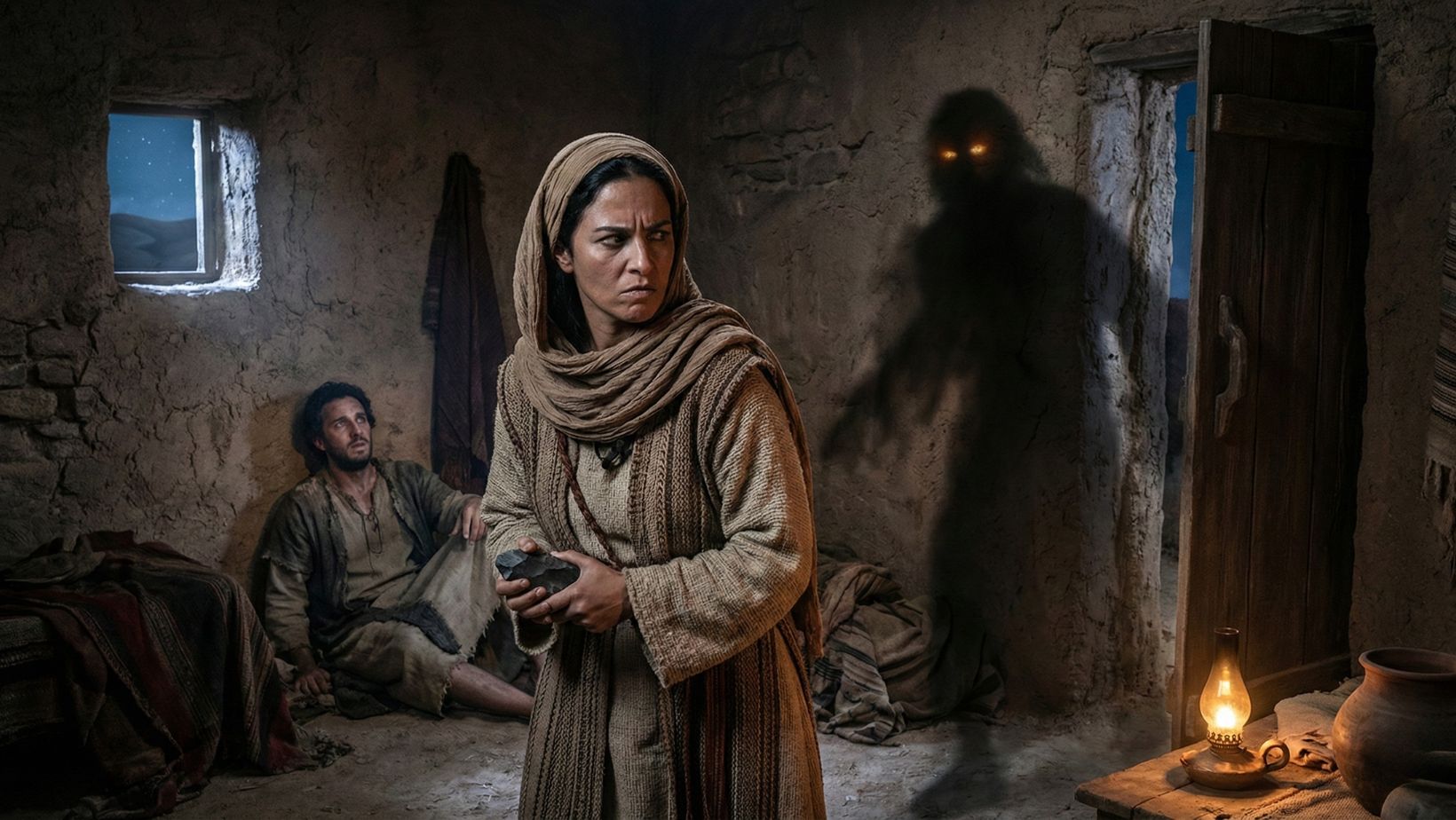
24 On the way to Egypt, at a place where Moses and his family had stopped for the night, the Lord confronted him and was about to kill him. 25 But Moses’ wife, Zipporah, took a flint knife and circumcised her son. She touched his feet with the foreskin and said, “Now you are a bridegroom of blood to me.” 26 (When she said “a bridegroom of blood,” she was referring to the circumcision.) After that, the Lord left him alone.
Commentary:
- The Crisis (v. 24): This is one of the most enigmatic passages in Scripture. Immediately after commissioning Moses, God seeks to kill him.
- The Cause: It is implied that Moses had failed to circumcise his son (likely Gershom or Eliezer), breaking the Covenant of Abraham (Gen 17:14).
- Negligence: Moses is going to be the mediator of the Covenant; he cannot lead the people if his own house is not in order. He cannot confront Pharaoh for “God’s son” (Israel) while neglecting the sign of the covenant on his own son.
- Zipporah’s Intervention (v. 25): Zipporah, a Midianite, acts quickly to save her husband. She performs the rite herself using a sharp stone (flint).
- “Feet”: A euphemism for the genitals in ancient Hebrew.
- Bridegroom of Blood (v. 26): Zipporah likely means that she has “bought back” her husband from death through the blood of her son’s circumcision. The blood appeased the wrath of God.
Insight: Holiness is dangerous. Before public ministry, private obedience is non-negotiable. God will not overlook disobedience in His leaders just because they are “needed.”
5. Reunion and Belief (Exodus 4:27–31 NLT)
27 Now the Lord had said to Aaron, “Go out into the wilderness to meet Moses.” So Aaron traveled to the mountain of God, where he met Moses and embraced him. 28 Moses told Aaron everything the Lord had commanded him to say. And he told him about the miraculous signs the Lord had commanded him to perform. 29 Then Moses and Aaron returned to Egypt and called all the elders of Israel together. 30 Aaron told them everything the Lord had told Moses, and Moses performed the miraculous signs as they watched. 31 Then the people of Israel were convinced that the Lord had sent them. When they heard that the Lord was concerned about them and had seen their misery, they bowed down and worshiped.
Commentary:
- Brotherly Reunion (v. 27): They meet at the “Mountain of God” (Sinai). This fulfills the sign that Aaron would be “glad to see him” (v. 14).
- Communication (v. 28): Moses shares the burden of the revelation with Aaron.
- The Assembly (v. 29): They respect the tribal structure, gathering the “elders” (leaders).
- Success (v. 31): Moses’ fears (v. 1) were unfounded. The people believed immediately.
- Worship (v. 31): The response to the news that God “was concerned” (visited) and “seen” is not a riot or a celebration, but reverent worship.
Theological Significance of Exodus 4
- The Nature of Signs: Miracles are “signs” (oth)—they point to a greater reality. They are credentials of the messenger and demonstrations of God’s dominion over nature.
- Divine Sovereignty and Human Weakness: God is not limited by human disability (speech impediment) or human hesitation. He uses the weak to shame the strong (1 Cor 1:27).
- Covenant Fidelity: The incident at the inn highlights that the Covenant is not a light matter. Participation in God’s plan requires adherence to God’s signs.
- Hardening of Hearts: The chapter introduces the mystery of divine sovereignty in judgment. God uses even the resistance of the wicked to further His glory.
Practical Applications
- Stop Making Excuses: Like Moses, we often plead lack of ability (“I can’t speak,” “They won’t listen”). God’s answer is always His presence (“I will be with you”).
- Use What is in Your Hand: You don’t need new resources to serve God; you need to yield what you already have (a staff, a talent, a home) to Him.
- Family Ministry: Before you can lead a nation (or a church/business), you must lead your family. Neglecting spiritual discipline at home disqualifies us from public leadership.
- The Value of Partners: Moses needed Aaron. We should not attempt to carry the burden of ministry alone. God provides partners to complement our weaknesses.
Final Insight
Exodus 4 is a chapter of transition. It moves Moses from the burning bush to the border of Egypt, and from a solitary shepherd to the leader of a nation. It teaches us that God’s call is accompanied by God’s power, but it also demands our complete personal obedience. The “staff of Moses” is now the “staff of God,” ready to strike the Nile.




Leave a Reply