
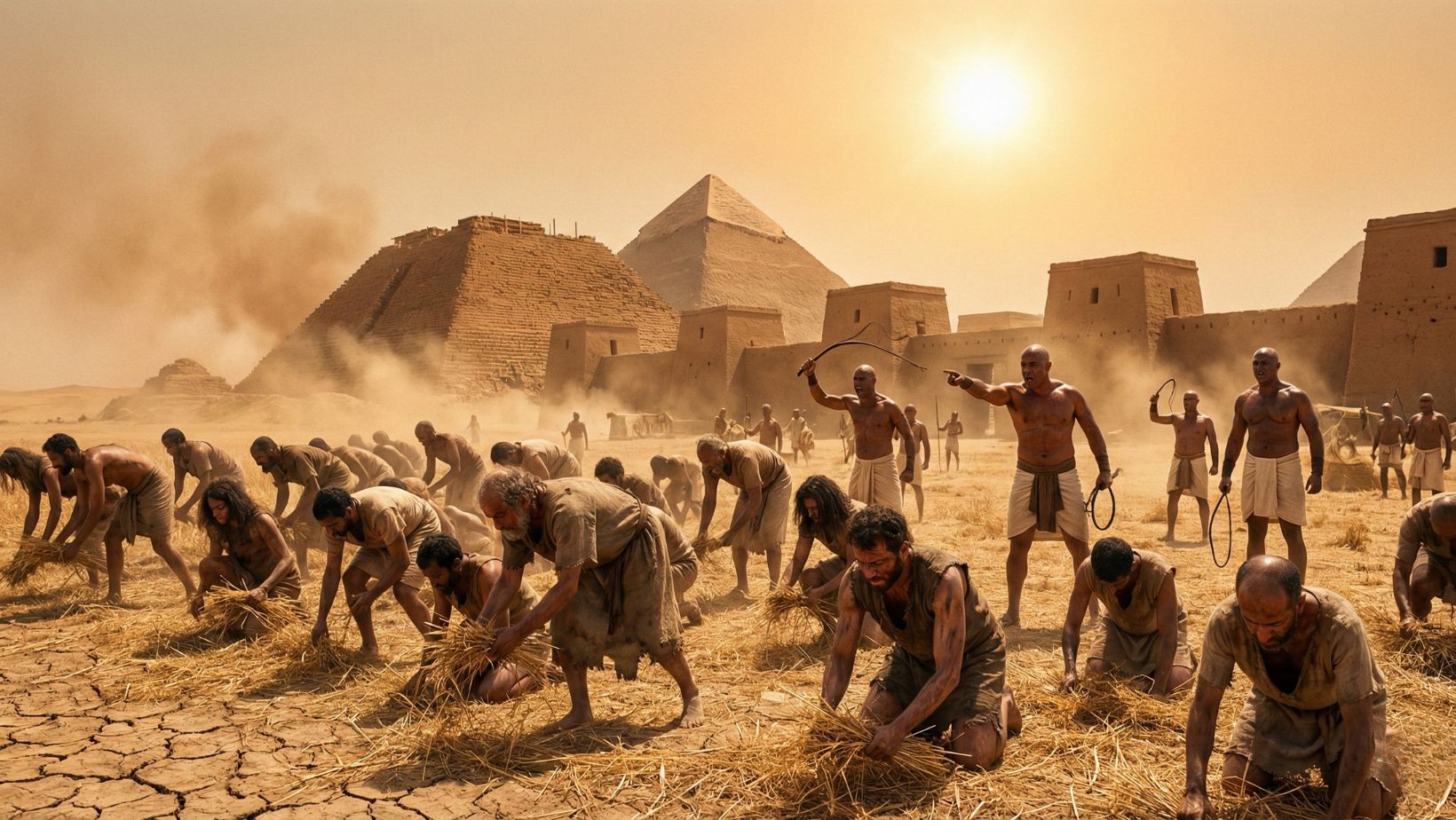
Exodus 5 marks the beginning of the great confrontation between Yahweh and Pharaoh. Moses and Aaron enter the royal court with God’s command, “Let my people go,” only to be met with scorn and total rejection. Pharaoh, regarding Yahweh as irrelevant, accuses the Israelites of laziness and retaliates by increasing their labor. He commands that they must now gather their own straw for brick-making while maintaining the same production quota. The chapter chronicles the crushing disappointment of the people, who turn against Moses and Aaron, and ends with Moses returning to God in anguish, questioning why he was sent at all, as the situation has only worsened.
1. The First Confrontation (Exodus 5:1–5 NLT)
1 After this presentation to the leaders of Israel, Moses and Aaron went and spoke to Pharaoh. They told him, “This is what the Lord, the God of Israel, says: Let my people go so they may hold a festival in my honor in the wilderness.” 2 “Is that so?” retorted Pharaoh. “And who is the Lord? Why should I listen to him and let Israel go? I don’t know the Lord, and I will not let Israel go.” 3 But Aaron and Moses persisted. “The God of the Hebrews has met with us,” they declared. “So please, let us take a three-day journey into the wilderness so we can offer sacrifices to the Lord our God. If we don’t, he will kill us with a plague or with the sword.” 4 Pharaoh replied, “Moses and Aaron, why are you distracting the people from their tasks? Get back to work! 5 Look, there are many of your people in the land, and you are stopping them from their work.”
Commentary:
- The Demand (v. 1): The message is direct: “Let my people go.” It establishes that Israel belongs to Yahweh (“My people”), not Pharaoh.
- The Festival (v. 1): The purpose of freedom is worship (“hold a festival”). Liberty is not an end in itself but a means to serve God.
- Pharaoh’s Question (v. 2): “Who is the Lord?” (Hebrew: Mi Yahweh?).
- This is not just ignorance; it is contempt. In a pantheon of hundreds of Egyptian gods, Pharaoh had never heard of this desert deity.
- Theological Theme: The entire book of Exodus is God’s answer to this question. By the end, Pharaoh will know who the Lord is.
- The Warning (v. 3): Moses clarifies that obedience is a matter of life and death. If they do not sacrifice, they face divine wrath (“plague or sword”).
- Economic Threat (v. 4-5): Pharaoh views this purely through an economic lens. A three-day holiday for a workforce of millions represents a massive loss of productivity. He accuses Moses of “distracting” (literally: letting loose) the people.
Insight: To the world, spiritual devotion often looks like laziness or wasted time. Pharaoh sees worship as a threat to his bottom line.
2. Bricks Without Straw (Exodus 5:6–14 NLT)
6 That same day Pharaoh sent this order to the Egyptian slave drivers and the Israelite foremen: 7 “Do not supply any more straw for making bricks. Make the people get it themselves! 8 But still require them to make the same number of bricks as before. Don’t reduce the quota. They are lazy. That’s why they are crying out, ‘Let us go and offer sacrifices to our God.’ 9 Load them down with more work. Make them sweat! That will teach them to listen to lies!” 10 So the slave drivers and foremen went out and told the people: “This is what Pharaoh says: I will not provide any more straw for you. 11 Go and get it yourselves. Find it wherever you can. But you must produce just as many bricks as before!” 12 So the people scattered throughout the land of Egypt in search of stubble to use as straw. 13 Meanwhile, the Egyptian slave drivers continued to push them. “Hurry up!” they yelled. “Complete your daily quota just as when we provided you with straw!” 14 The Israelite foremen, who had been appointed by Pharaoh’s slave drivers, were beaten. They were asked, “Why haven’t you met your quota of bricks yesterday or today, as you did before?”
Commentary:
- The Retaliation (v. 6-7): Pharaoh’s strategy is psychological warfare. By making their lives miserable, he hopes to break their will to leave and turn them against their leaders.
- The Role of Straw (v. 7): In ancient brick-making, chopped straw was mixed with Nile mud.
- Function: The acid in the decaying straw released a chemical that made the clay more plastic and prevented the bricks from shrinking or cracking as they dried in the sun.
- Difficulty: Gathering straw required roaming the fields, effectively doubling the workload.
- “Lazy” (v. 8): Pharaoh labels their spiritual awakening as idleness. This is a common tactic of oppressors: dehumanize the oppressed to justify cruelty.
- The Chain of Command (v. 10, 14):
- Slave Drivers (Taskmasters): Egyptians.
- Foremen (Officers): Israelites appointed to police their own people. This created internal division, as the foremen were beaten for the failures of the workers.
- Scattered (v. 12): Instead of gathering to worship, they are “scattered” to scavenge. The enemy disrupts unity by creating busyness and desperation.
Insight: Sometimes, obeying God makes life harder before it gets better. The initial result of Moses’ mission was not deliverance, but increased burden.
3. The Foremen’s Complaint (Exodus 5:15–21 NLT)
15 Then the Israelite foremen went and appealed to Pharaoh: “Why are you treating your servants like this? 16 We are given no straw, but the slave drivers still demand, ‘Make bricks!’ We are being beaten, but it isn’t our fault! It’s the fault of your own people!” 17 But Pharaoh shouted, “You’re just lazy! Lazy! That’s why you’re saying, ‘Let us go and offer sacrifices to the Lord.’ 18 Now get back to work! No straw will be given to you, but you must still deliver the full quota of bricks.” 19 The Israelite foremen saw that they were in serious trouble when they were told, “You must not reduce the daily quota of bricks.” 20 As they left Pharaoh’s court, they confronted Moses and Aaron, who were waiting outside for them. 21 The foremen said to them, “May the Lord judge and punish you for making us stink before Pharaoh and his officials. You have put a sword into their hands to kill us!”
Commentary:
- Appealing to Pharaoh (v. 15): The foremen still think this is a misunderstanding or a managerial error. They appeal to Pharaoh’s sense of fairness (“It isn’t our fault”). They do not yet realize that the cruelty is the point.
- Pharaoh’s Hardness (v. 17): Pharaoh repeats the charge: “Lazy! Lazy!” He refuses to acknowledge their grievance.
- Blaming the Messenger (v. 20-21): The foremen turn their anger onto Moses and Aaron.
Insight: Leadership is lonely. Moses is rejected by the King he confronted and by the people he came to save. He is squeezed between the oppression of the world and the unbelief of the church.
4. Moses’ Complaint to God (Exodus 5:22–23 NLT)
22 Then Moses went back to the Lord and protested, “Why have you brought all this trouble on your own people, Lord? Why did you send me? 23 Ever since I came to Pharaoh as your spokesman, he has been even more brutal to your people. And you have done nothing to rescue them!”
Commentary:
- “Went back to the Lord” (v. 22): This is Moses’ saving grace. He doesn’t quit; he doesn’t argue with the foremen; he takes his pain directly to God.
- Honest Lament (v. 22): Moses asks the hard questions:
- Why the trouble? (The Problem of Evil/Suffering).
- Why send me? (The Crisis of Calling).
- Accusation (v. 23): “You have done nothing to rescue them!” (Literally: Delivering, You have not delivered).
Insight: Prayer is the place to pour out our confusion. God is not offended by our honest “Why?” He prefers a passionate complaint to a silent withdrawal.
Theological Significance of Exodus 5
- The War of the Gods: This is not just a labor dispute; it is cosmic warfare. Pharaoh claims to be the supreme authority (“Who is the Lord?”). The suffering of Israel is the collateral damage of this spiritual collision.
- The Suffering Servant: The chapter highlights that redemption is often preceded by an intensification of suffering. The darkness is deepest just before the dawn.
- Human Power vs. Divine Power: Pharaoh uses power to crush and exploit; Yahweh uses power to liberate and redeem.
- The Test of Faith: Israel’s faith was easy when they heard the good news (Ex 4:31), but it crumbled the moment persecution started. True faith is forged in the furnace of affliction, not the festival.
Practical Applications
- Expect Resistance: When you decide to follow God or step out in ministry, pushback is inevitable. The enemy does not surrender territory without a fight.
- Don’t Measure Success by Comfort: Just because things get harder doesn’t mean you are out of God’s will. The storm often indicates you are heading in the right direction.
- Handling Criticism: Leaders will be blamed for problems they didn’t cause. Like Moses, we must learn to take those complaints to God rather than retaliating against hurting people.
- The Danger of “Bricks without Straw”: In leadership or management, demanding results without providing the necessary resources is an act of tyranny, not leadership.
Final Insight
Exodus 5 ends on a cliffhanger. The people are broken, the leaders are rejected, and God seems silent. It is the low point of the narrative. But this despair is necessary. It strips Israel of any hope in Pharaoh’s mercy or their own ability to negotiate. They are now ready to see that salvation belongs to the Lord alone.
Possible Sermon Titles from the Chapter
- When Obedience Makes Things Worse.
- Who is the Lord? (Pharaoh’s Famous Last Words).
- Bricks Without Straw: The Tactics of the Enemy.
- The Stench of Faithfulness.
- Dealing with Disappointed Expectations.
- Why, Lord? The Prayer of the Frustrated Leader.






Leave a Reply