
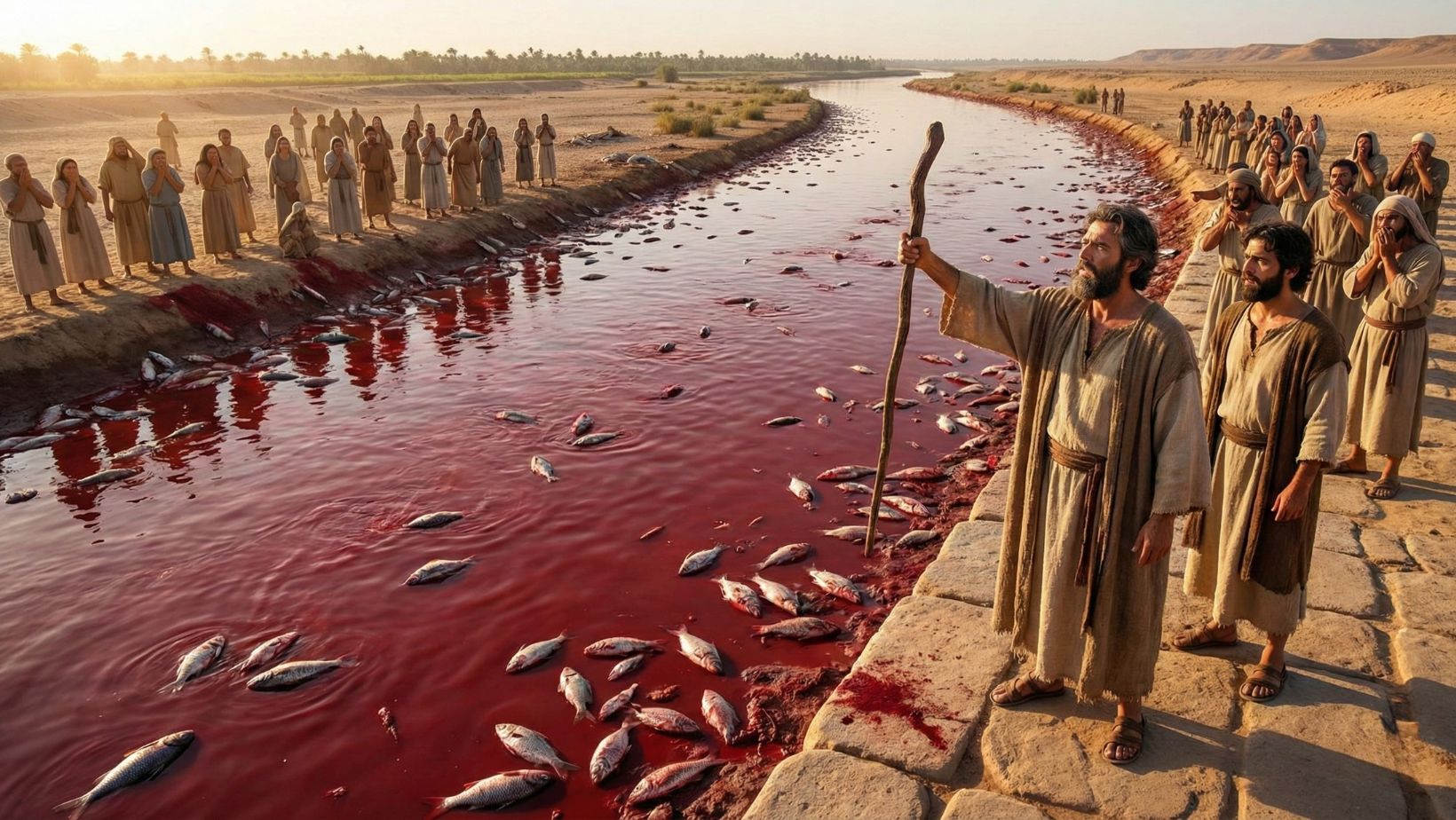
Exodus 7 marks the transition from negotiation to divine confrontation. The time for polite requests is over; the “Battle of the Gods” begins. God re-commissions Moses and Aaron, explicitly stating that Moses will function “like God” to Pharaoh, with Aaron as his prophet. The chapter details the first miraculous sign (the staff turning into a serpent) which the Egyptian magicians counterfeit, though Aaron’s staff swallows theirs. This is followed by the first of the ten plagues: the turning of the Nile River into blood. This strike is not random; it is a direct theological assault on the Egyptian pantheon, specifically Hapi, the god of the Nile. Despite the undeniable supernatural power displayed, Pharaoh’s heart remains hard, setting the stage for further judgment.
1. The Divine Commission and Strategy (Exodus 7:1–7 NLT)
1 Then the Lord said to Moses, “Pay close attention to this. I will make you seem like God to Pharaoh, and your brother, Aaron, will be your prophet. 2 Tell Aaron everything I command you, and Aaron is to tell Pharaoh to let the people of Israel leave his country. 3 But I will make Pharaoh’s heart stubborn so I can multiply my miraculous signs and wonders in the land of Egypt. 4 Even then Pharaoh will not listen to you. Then I will crush Egypt with a hard blow and bring my people, the Israelites, out of the land of Egypt like an army. 5 When I raise my powerful hand and bring out the Israelites, the Egyptians will know that I am the Lord.” 6 So Moses and Aaron did just as the Lord had commanded them. 7 Moses was eighty years old, and Aaron was eighty-three when they made their demands to Pharaoh.
Commentary:
- “Like God to Pharaoh” (v. 1): This is a profound shift in power dynamics. Moses is no longer a trembling shepherd but the representative of Divine Authority. To Pharaoh, who considered himself a god, Moses is now the superior spiritual power.
- The Role of Aaron (v. 1–2): Aaron is designated as the “prophet” (spokesperson). Just as a prophet speaks for God, Aaron speaks for Moses. This accommodates Moses’ earlier insecurity about his speech.
- The Hardening of the Heart (v. 3): God predicts Pharaoh’s stubbornness. This introduces the theological tension between human free will and divine sovereignty. God uses Pharaoh’s natural resistance to display His glory on a grander scale.
- Israel as an Army (v. 4): Though they are currently a disorganized group of slaves, God calls them “my armies” (or hosts). God defines them by their future destiny, not their current condition.
- The Purpose of the Signs (v. 5): The ultimate goal is evangelistic and theological: “The Egyptians will know that I am the Lord.” The plagues are a revelation of Yahweh’s supremacy over Egyptian deities.
- Age of the Leaders (v. 7): The text highlights that Moses (80) and Aaron (83) are elderly men. In a culture that valued youth and vigor for war, God uses two octogenarians to defeat a superpower.
2. The Sign of the Staff and Serpent (Exodus 7:8–13 NLT)
8 Then the Lord said to Moses and Aaron, 9 “Pharaoh will demand, ‘Show me a miracle to prove that God has sent you.’ When he does this, say to Aaron, ‘Take your staff and throw it down in front of Pharaoh, and it will become a serpent.’” 10 So Moses and Aaron went to Pharaoh and did what the Lord had commanded them. Aaron threw down his staff in front of Pharaoh and his officials, and it became a serpent! 11 Then Pharaoh called in his own wise men and sorcerers, and these Egyptian magicians did the same thing with their magic. 12 They threw down their staffs, which also became serpents! But then Aaron’s staff swallowed up their staffs. 13 Pharaoh’s heart, however, remained hard. He still refused to listen, just as the Lord had predicted.
Commentary:
- The Initial Credential (v. 9): Before the plagues begin, God offers a credential miracle. It serves as a warning shot.
- The Serpent (v. 10): The Hebrew word used here is tannin, which can mean snake, dragon, or crocodile. Given the Egyptian context, it likely refers to a cobra (symbol of Pharaoh’s power) or a crocodile (associated with the Nile god Sobek).
- Counterfeit Miracles (v. 11): The Egyptian magicians (identified in Jewish tradition and 2 Timothy 3:8 as Jannes and Jambres) replicate the sign. This suggests that dark spiritual powers or sleight of hand can mimic divine power to a certain extent.
- “Swallowed Up” (v. 12): The key detail is not the transformation, but the domination. Aaron’s staff consuming the others symbolizes that Yahweh’s power will consume Egypt’s pantheon.
- Pharaoh’s Hardness (v. 13): Because the magicians could replicate the sign, Pharaoh found a reason to rationalize his disbelief. He ignored the superior power (the swallowing) and focused on the copy.
3. The First Plague: Water Turned to Blood (Exodus 7:14–25 NLT)
14 Then the Lord said to Moses, “Pharaoh’s heart is stubborn, and he still refuses to let the people go. 15 So go to Pharaoh in the morning as he goes down to the river. Stand on the bank of the Nile and meet him there. Be sure to take along the staff that turned into a snake. 16 Then announce to him, ‘The Lord, the God of the Hebrews, has sent me to tell you, “Let my people go, so they can worship me in the wilderness.” But up to now, you have refused to listen. 17 So this is what the Lord says: “I will show you that I am the Lord.” Look! I will strike the water of the Nile with this staff in my hand, and the river will turn to blood. 18 The fish in it will die, and the river will stink. The Egyptians will not be able to drink any water from the Nile.”’” 19 Then the Lord said to Moses: “Tell Aaron, ‘Take your staff and raise your hand over the waters of Egypt—all its rivers, canals, ponds, and all the reservoirs. Turn all the water to blood. Everywhere in Egypt the water will turn to blood, even the water stored in wooden bowls and stone pots.’” 20 So Moses and Aaron did just as the Lord commanded them. As Pharaoh and all of his officials watched, Aaron raised his staff and struck the water of the Nile. Suddenly, the whole river turned to blood! 21 The fish in the river died, and the water became so foul that the Egyptians couldn’t drink it. There was blood everywhere throughout the land of Egypt. 22 But again the magicians of Egypt used their magic, and they, too, turned water into blood. So Pharaoh’s heart remained hard. He refused to listen to Moses and Aaron, just as the Lord had predicted. 23 Pharaoh returned to his palace and put the whole matter out of his mind. 24 Then all the Egyptians dug along the riverbank to find drinking water, for they couldn’t drink the water from the Nile. 25 Seven days passed from the time the Lord struck the Nile.
Commentary:
- Strategic Timing (v. 15): Moses is told to meet Pharaoh in the morning at the water. This was likely a time of religious ritual where Pharaoh worshipped the Nile. Moses intercepts him to challenge that very worship.
- Attack on the Nile (v. 17): The Nile was the bloodstream of Egypt. It provided water, irrigation, and transport. Hapi was the spirit of the Nile, and Osiris was believed to have the Nile as his bloodstream. Turning it to blood was a death blow to these deities.
- Total Contamination (v. 19): The plague affected not just the main river but canals, ponds, and even water stored in “wooden bowls and stone pots” (domestic vessels). No one was exempt.
- Magicians’ Failure (v. 22): The magicians again replicate the plague, likely using digging techniques or sleight of hand on small amounts of water. Crucially, they demonstrate power to destroy (make more blood) but lack the power to redeem (clean the water).
- Pharaoh’s Apathy (v. 23): “Pharaoh… put the whole matter out of his mind.” Despite the ecological disaster and the suffering of his people, his heart is callous. He retreats to the comfort of his palace while his people suffer.
- Desperation (v. 24): The people are forced to dig wells (filtration) to survive. The burden of the leader’s stubbornness falls on the common people.
Theological Significance of Exodus 7
- The Supremacy of Yahweh: The chapter establishes that this is not a political dispute but a theological war. Yahweh targets the gods of Egypt (Serpent/Cobra, Nile/Hapi) to prove they are powerless before Him.
- The Nature of Hardness: Pharaoh’s heart is hardened both by God (judicially) and by himself (obstinately). This warns us that repeated rejection of God’s truth leads to an inability to perceive it.
- Counterfeit Power: The existence of the magicians’ power reminds us that not all supernatural displays are from God. The test of true power is not just the miraculous, but the redemptive (swallowing the serpents, eventually healing the land).
Practical Applications
- Confronting our “Niles”: We all have sources of security—wealth, career, relationships—that we rely on like Egypt relied on the Nile. God sometimes disrupts these sources to show us that He alone is the Sustainer.
- Faithfulness over Success: Moses obeyed God perfectly, yet Pharaoh said “No.” We are called to be faithful to the message, regardless of the immediate reception.
- The Danger of Indifference: Pharaoh saw the blood and “went into his house.” We must guard against becoming desensitized to God’s warnings or the suffering of others around us.
Possible Sermon Titles
- The Battle of the Gods Begins.
- When the River Runs Red.
- Counterfeit Miracles and Hardened Hearts.
- God of the Impossible: Using the Old to Defeat the Mighty.
- Swallowed Up: The Victory of Divine Authority.




Leave a Reply