
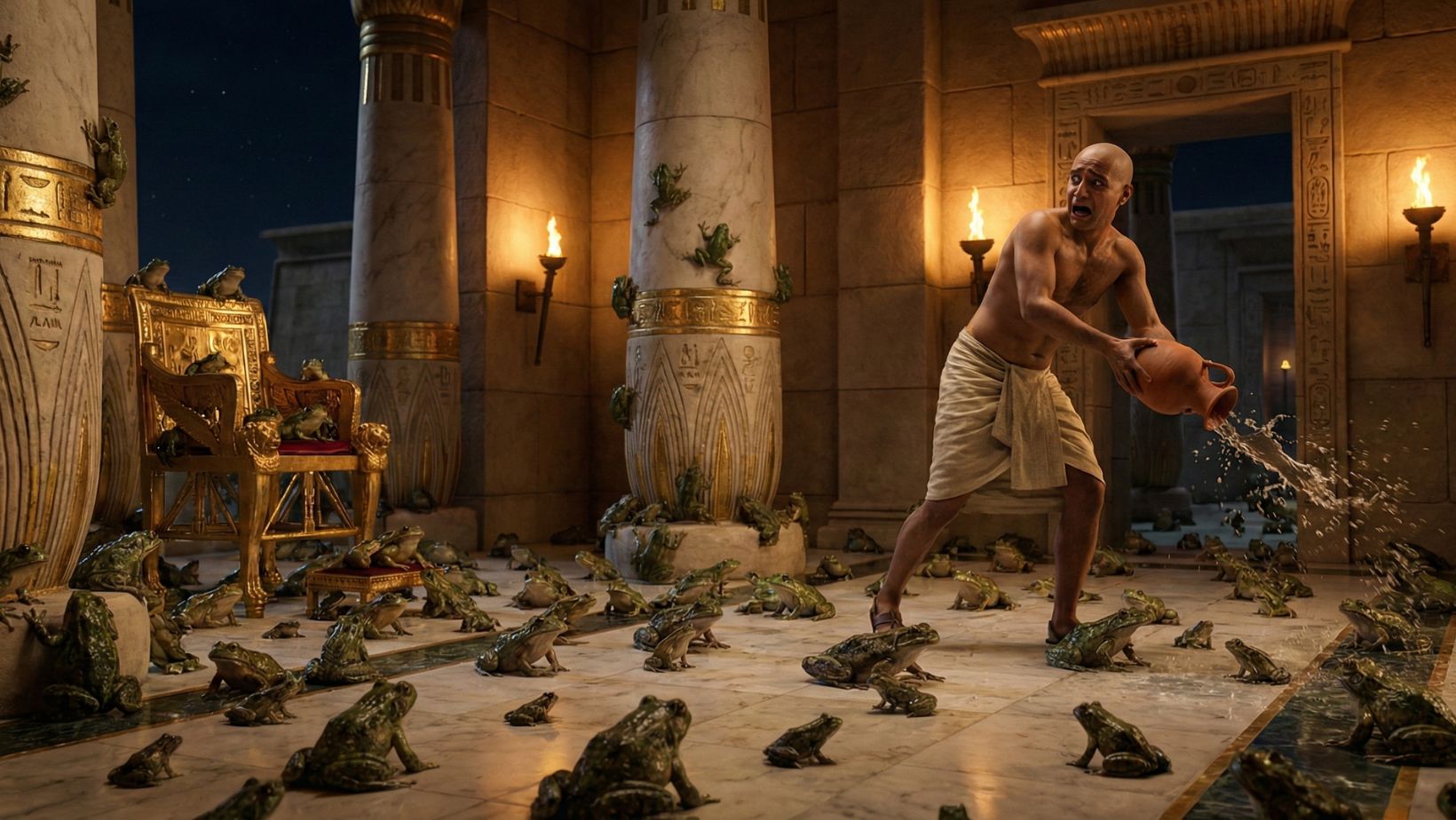
Exodus 8 escalates the divine assault on Egypt with the second, third, and fourth plagues: Frogs, Gnats (or Lice), and Flies. The chapter showcases a critical progression in the narrative. First, the Egyptian magicians, who previously matched Moses’ signs, finally reach their limit with the plague of gnats, confessing, “This is the finger of God.” Second, God introduces a new dynamic with the plague of flies: the distinction between the Egyptians and the Israelites living in Goshen. God demonstrates that His judgment is precise, striking the oppressor while shielding His people. Despite momentary lapses where Pharaoh begs for relief and offers compromises, his heart remains hardened the moment the pressure is lifted.
1. The Second Plague: Frogs (Exodus 8:1–15 NLT)
1 Then the Lord said to Moses, “Go back to Pharaoh and announce to him, ‘This is what the Lord says: Let my people go, so they can worship me. 2 If you refuse to let them go, I will send a plague of frogs across your entire land. 3 The Nile River will swarm with frogs. They will come up out of the river and into your palace, even into your bedroom and onto your bed! They will enter the houses of your officials and your people. They will even jump into your ovens and your kneading bowls. 4 Frogs will jump on you, your people, and all your officials.’” 5 Then the Lord said to Moses, “Tell Aaron, ‘Raise the staff in your hand over all the rivers, canals, and ponds of Egypt, and bring up frogs over all the land.’” 6 So Aaron raised his hand over the waters of Egypt, and frogs came up and covered the whole land! 7 But the magicians were able to do the same thing with their magic. They, too, caused frogs to come up on the land of Egypt. 8 Then Pharaoh summoned Moses and Aaron and begged, “Plead with the Lord to take the frogs away from me and my people. I will let your people go, so they can offer sacrifices to the Lord.” 9 “You set the time!” Moses told Pharaoh. “Tell me when you want me to pray for you, your officials, and your people. Then you and your houses will be rid of the frogs. They will remain only in the Nile River.” 10 “Do it tomorrow,” Pharaoh said. “All right,” Moses replied, “it will be as you have said. Then you will know that there is no one like the Lord our God. 11 The frogs will leave you and your houses, your officials, and your people. They will remain only in the Nile River.” 12 So Moses and Aaron left Pharaoh’s palace, and Moses cried out to the Lord about the frogs he had inflicted on Pharaoh. 13 And the Lord did just what Moses had predicted. The frogs in the houses, the courtyards, and the fields all died. 14 The Egyptians piled them into great heaps, and a terrible stench filled the land. 15 But when Pharaoh saw that relief had come, he became stubborn. He refused to listen to Moses and Aaron, just as the Lord had predicted.
Commentary:
- Targeting Heqet (v. 2): This plague targeted Heqet, the Egyptian goddess of fertility, water, and renewal, who was depicted with the head of a frog. To kill a frog was often a crime punishable by death. God made their “sacred” symbol a loathsome curse.
- Invasive Presence (v. 3): The frogs invaded the most private spaces: bedrooms, beds, ovens, and kneading bowls. This signifies that there is no sanctuary from God’s judgment; it penetrates domestic and personal life.
- Magicians’ Limits (v. 7): The magicians replicated the plague, bringing more frogs. This highlights the absurdity of evil: they could increase the suffering but lacked the power to remove it. Real power would have been banishing the frogs.
- Pharaoh’s Prayer Request (v. 8): For the first time, Pharaoh asks Moses to “Plead with Yahweh.” He acknowledges Yahweh’s existence and power over the plague, a significant theological concession.
- “Tomorrow” (v. 10): Why wait? Perhaps Pharaoh hoped the frogs would leave naturally overnight, attributing it to chance rather than God. Moses accepts the timeline to prove precise divine control.
- The Stench (v. 14): The death of the frogs wasn’t a clean “poof” disappearance. They died where they were, requiring physical cleanup. The “terrible stench” served as a lingering sensory reminder of the judgment.
2. The Third Plague: Gnats/Lice (Exodus 8:16–19 NLT)
16 So the Lord said to Moses, “Tell Aaron, ‘Raise your staff and strike the ground. The dust will turn into swarms of gnats throughout the land of Egypt.’” 17 So Moses and Aaron did just as the Lord had commanded them. When Aaron raised his hand and struck the ground with his staff, gnats infested the entire land, covering the Egyptians and their animals. All the dust in the land of Egypt turned into gnats. 18 Pharaoh’s magicians tried to do the same thing with their secret arts, but this time they failed. And the gnats covered everyone, people and animals alike. 19 “This is the finger of God!” the magicians exclaimed to Pharaoh. But Pharaoh’s heart remained hard. He wouldn’t listen to them, just as the Lord had predicted.
Commentary:
- No Warning (v. 16): Unlike the first two plagues, this one comes without a prelude or warning to Pharaoh. It is a sudden strike.
- Nature of the Plague (v. 17): The Hebrew word kinnim is difficult to translate precisely. It can mean gnats, lice, or mosquitoes. The connection to “dust” suggests something small and irritating that arises from the earth itself.
- Targeting Geb (v. 16): By striking the dust of the earth, God challenges Geb, the Egyptian god of the earth. The very soil of Egypt, usually the source of crops and wealth, turns against them.
- The Magicians’ Defeat (v. 18): This is the turning point. The magicians try to bring forth life from dust but fail. Only God can create life from dust (Genesis 2:7).
- “The Finger of God” (v. 19): This phrase indicates supreme power exercised with minimal effort. To God, crushing Egypt requires only a finger, not an arm. The magicians recognize a power beyond their occult capabilities, but Pharaoh ignores even his own experts.
3. The Fourth Plague: Flies (Exodus 8:20–32 NLT)
20 Then the Lord told Moses, “Get up early in the morning and stand before Pharaoh as he goes down to the river. Say to him, ‘This is what the Lord says: Let my people go, so they can worship me. 21 If you refuse to let them go, I will send swarms of flies on you, your officials, your people, and all the houses. The Egyptian homes will be filled with flies, and the ground will be covered with them. 22 But this time I will make a distinction between my people in the land of Goshen and your people. No flies will be found where my people live. In this way you will know that I am the Lord in the heart of the land. 23 I will make a clear distinction between my people and your people. This miraculous sign will happen tomorrow.’” 24 And the Lord did just as he had said. A thick swarm of flies filled Pharaoh’s palace and the houses of his officials. The whole land of Egypt was thrown into chaos by the flies. 25 Pharaoh called for Moses and Aaron. “All right! Go ahead and offer sacrifices to your God,” he said. “But do it here in this land.” 26 But Moses replied, “That wouldn’t be right. The sacrifices we offer the Lord our God would be detestable to the Egyptians. If we offer sacrifices to the Lord our God right before their eyes, they will stone us to death. 27 We must go a three-day journey into the wilderness to offer sacrifices to the Lord our God, just as he has commanded us.” 28 “All right, go ahead,” Pharaoh replied. “I will let you go into the wilderness to offer sacrifices to the Lord your God. But don’t go too far away. Now hurry and pray for me.” 29 Moses answered, “As soon as I leave you, I will pray to the Lord, and tomorrow the swarms of flies will disappear from you and your officials and all your people. But I am warning you, Pharaoh, don’t lie to us again and refuse to let the people go to sacrifice to the Lord.” 30 So Moses left Pharaoh’s palace and prayed to the Lord. 31 And the Lord did as Moses asked and caused the swarms of flies to disappear from Pharaoh, his officials, and his people. Not a single fly remained. 32 But Pharaoh hardened his heart again and refused to let the people go.
Commentary:
- Targeting Khepri (v. 21): The specific type of fly is debated, often thought to be the dog fly or ichneumon fly, which bites painfully. This attacks the realm of Khepri, the god of insects/beetles and resurrection.
- The Distinction of Goshen (v. 22): This is the first time God explicitly separates the Israelites from the judgment. Goshen, where Israel lived, is a “safe zone.” This demonstrates God’s sovereignty (control over geography and insects) and His covenant love (protecting His own).
- Pharaoh’s Compromise #1 (v. 25): “Sacrifice… in this land.” Pharaoh tries to keep Israel within his borders. He wants to integrate their worship into the Egyptian system.
- Moses’ Rejection (v. 26): Moses refuses. Egyptian animal worship (bulls, rams) meant that Israel’s sacrifice would be an “abomination” (killing a god). It would incite a riot (“they will stone us”). True worship requires separation from the world’s system.
- Pharaoh’s Compromise #2 (v. 28): “Don’t go too far.” Pharaoh wants to keep them on a short leash. He fears losing his labor force entirely.
- The Relapse (v. 32): Once the flies are gone (“not a single fly remained”), the urgency vanishes. Pharaoh’s repentance is proven to be shallow—born of pain, not conviction.
Theological Significance of Exodus 8
- The Finger of God: This chapter establishes that God’s power is qualitatively different from magic. Magic manipulates nature; God commands it. Even the enemies of God eventually have to admit His supremacy.
- Divine Discrimination: The separation of Goshen introduces the doctrine that God knows those who are His. While believers may suffer general hardships (like the first two plagues), they are spared from God’s specific wrath (the subsequent plagues).
- The Nature of False Repentance: Pharaoh illustrates the difference between attrition (regret because of punishment) and contrition (sorrow for the sin itself). He wants the consequence removed, not the relationship restored.
Practical Applications
- The Danger of Compromise: Pharaoh offered “worship in the land” or “don’t go far.” The world often tells us we can be Christians as long as we don’t take it “too far” or leave the cultural “Egypt.” Moses teaches us that true worship requires a clean break from sin.
- God’s Protection: Just as God put a wall of protection around Goshen, believers can trust in God’s specific care even when the world around them is in chaos.
- Don’t Waste the Relief: When God answers prayer and removes a “plague” from our lives (illness, debt, conflict), we must not return to our old ways like Pharaoh did. We should use the relief to serve Him more fully.
Possible Sermon Titles
- The Finger of God vs. The Hand of Man.
- Goshen: The Safe Zone of Grace.
- Don’t Go Too Far: The Trap of Half-Hearted Christianity.
- Frogs in the Bedroom: When Sin Comes Home.
- The Stench of Stubbornness.





Leave a Reply