
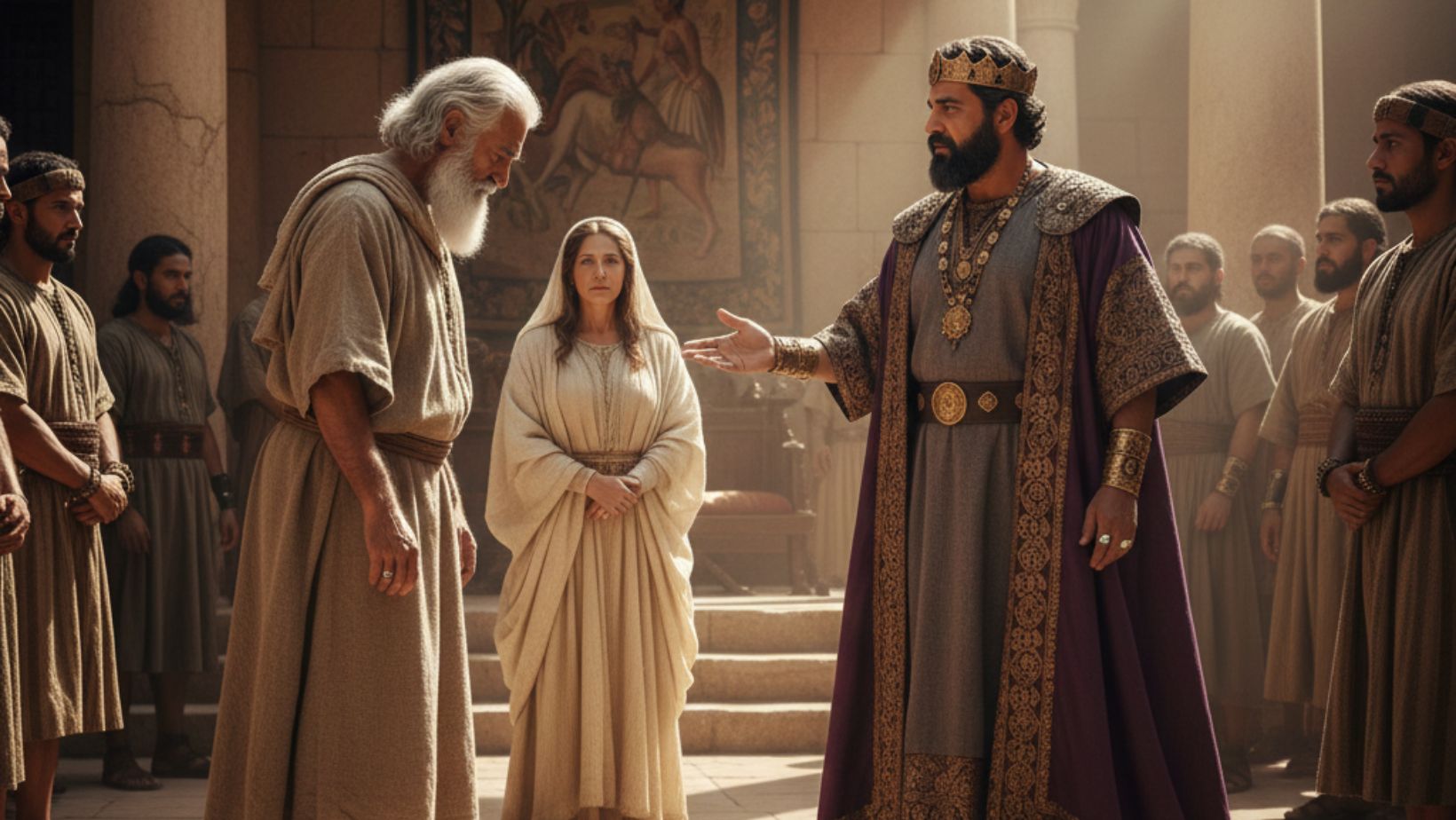
Genesis 20 records a relapse in Abraham’s faith immediately following the destruction of Sodom. Abraham moves his camp to Gerar, a Philistine territory. Prompted by fear, he repeats the same deception he used in Egypt (Genesis 12), telling the local king, Abimelech, that Sarah is his sister. Abimelech takes Sarah into his harem, threatening the promised line of Isaac. God intervenes supernaturally, appearing to Abimelech in a dream to stop him from touching Sarah. The chapter highlights God’s sovereign protection of His covenant promises despite human failure. It concludes with Abraham’s restoration as a prophet who intercedes for the healing of Abimelech’s household.
1. The Deception at Gerar (Genesis 20:1–2 NIV)
1 Now Abraham moved on from there into the region of the Negev and lived between Kadesh and Shur. For a while he stayed in Gerar, 2 and there Abraham said of his wife Sarah, “She is my sister.” Then Abimelech king of Gerar sent for Sarah and took her.
Commentary:
- The Move (v. 1):
- Abraham moves “from there” (Mamre/Hebron), likely because the destruction of Sodom and the smoke over the plain (Gen 19:28) made the region unbearable or traumatic.
- Gerar: A city in the Negev (south), ruled by the Philistines.
- The Repetition of Sin (v. 2):
- Fear over Faith: Despite just witnessing God’s power in Sodom and receiving the promise of a son “by this time next year” (Gen 18:10), Abraham succumbs to the fear of man.
- “She is my sister”: This is the second time Abraham uses this lie (first in Genesis 12 in Egypt). It indicates a deep-seated character flaw—a tendency to rely on manipulation rather than divine protection when he feels threatened.
- Abimelech: A title (like “Pharaoh”) meaning “My Father is King.” He acts innocently here, relying on Abraham’s word.
Insight: Spiritual highs (Chapter 18) are often followed by carnal lows. Abraham, the “Friend of God,” acts like an atheist here, assuming God cannot protect him without a lie.
2. God Confronts Abimelech (Genesis 20:3–7 NIV)
3 But God came to Abimelech in a dream one night and said to him, “You are as good as dead because of the woman you have taken; she is a married woman.” 4 Now Abimelech had not gone near her, so he said, “Lord, will you destroy an innocent nation? 5 Did he not say to me, ‘She is my sister,’ and didn’t she also say, ‘He is my brother’? I have done this with a clear conscience and clean hands.” 6 Then God said to him in the dream, “Yes, I know you did this with a clear conscience, and so I have kept you from sinning against me. That is why I did not let you touch her. 7 Now return the man’s wife, for he is a prophet, and he will pray for you and you will live. But if you do not return her, you may be sure that you and all who belong to you will die.”
Commentary:
- Divine Intervention (v. 3):
- God bypasses Abraham (the believer who is sinning) and speaks to Abimelech (the pagan king who is innocent in this matter).
- “You are as good as dead”: The threat is immediate and severe because the seed of the promise (Isaac) is at risk. If Abimelech sleeps with Sarah, the paternity of the coming child would be in doubt.
- Abimelech’s Defense (v. 4-5):
- God’s Restraint (v. 6):
- Abraham as Prophet (v. 7):
Insight: God protects His promises even when His people endanger them. The sanctity of Sarah’s womb was guarded by God because Abraham failed to guard it.
3. The Confrontation and Explanation (Genesis 20:8–13 NIV)
8 Early the next morning Abimelech summoned all his officials, and when he told them all that had happened, they were very much afraid. 9 Then Abimelech called Abraham in and said, “What have you done to us? How have I wronged you that you have brought such great guilt upon me and my kingdom? You have done things to me that should not be done.” 10 And Abimelech asked Abraham, “What was your reason for doing this?” 11 Abraham replied, “I said to myself, ‘There is surely no fear of God in this place, and they will kill me because of my wife.’ 12 Besides, she really is my sister, the daughter of my father though not of my mother; and she became my wife. 13 And when God had me wander from my father’s household, I said to her, ‘This is how you can show your love to me: Everywhere we go, say of me, “He is my brother.”’”
Commentary:
- The Rebuke (v. 9):
- Abraham’s Excuse (v. 11):
- The Half-Truth (v. 12):
- Abraham rationalizes his lie. Sarah was indeed his half-sister (same father, Terah, different mothers). However, a half-truth intended to deceive is a whole lie.
- Premeditated Sin (v. 13): Abraham reveals this wasn’t a spur-of-the-moment decision but a standing policy (“Everywhere we go…”). He had a “safety net” of deceit planned from the beginning of his journey.
Insight: We often rationalize our sins (“it’s technically true”) and misjudge others (“they have no morals”) to justify our own lack of integrity.
4. Restoration and Healing (Genesis 20:14–18 NIV)
14 Then Abimelech brought sheep and cattle and male and female slaves and gave them to Abraham, and he returned Sarah his wife to him. 15 And Abimelech said, “My land is before you; live wherever you like.” 16 To Sarah he said, “I am giving your brother a thousand shekels of silver. This is to cover the offense against you before all who are with you; you are completely vindicated.” 17 Then Abraham prayed to God, and God healed Abimelech, his wife and his female slaves so they could have children again, 18 for the Lord had kept all the women in Abimelech’s household from conceiving because of Abraham’s wife Sarah.
Commentary:
- Abimelech’s Generosity (v. 14-16):
- Instead of punishing Abraham, Abimelech heaps gifts on him (similar to Pharaoh in Gen 12, but this time voluntarily).
- “Your Brother”: In v. 16, Abimelech sarcastically refers to Abraham as “your brother” when speaking to Sarah, a subtle jab at their deception.
- Vindication: The “thousand shekels” (a massive sum) was a “covering of the eyes”—a legal settlement proving Sarah’s chastity had not been violated. This was crucial for the legitimacy of Isaac, who would be born in the next chapter.
- The Power of Prayer (v. 17-18):
Insight: The chapter ends with Abraham back in his rightful place—interceding for the nations. Despite his failure, God uses him to bring blessing (healing) to the Gentiles.
Theological Significance of Genesis 20
- The Preservation of the Seed: This chapter is the final hurdle before the birth of Isaac (Gen 21). Satan often attacks right before a divine breakthrough. God ensures the purity of the lineage of the Messiah.
- Common Grace: The chapter acknowledges that non-believers (Abimelech) can possess moral integrity and conscience, sometimes shaming believers.
- God’s Sovereignty over Sin: God is able to restrain sin and navigate human failures to keep His covenant on track. “I kept you from sinning against me” (v. 6).
- The Definition of a Prophet: A prophet is not just one who predicts the future, but one who has an audience with God and intercedes for others (v. 7).
Practical Applications
- Stop Recurring Sins: Abraham repeated a sin he committed years prior. We must identify our “default” sins—the ones we run to when we are afraid—and repent of them, or we will repeat them.
- Don’t Judge by Appearance: Abraham assumed no one in Gerar feared God. He was wrong. We should not assume that those outside the church are devoid of conscience or decency.
- The Danger of Half-Truths: Relying on technicalities to deceive others undermines our witness.
- God protects us from ourselves: Sometimes God mercifully blocks our path or intervenes to stop us from destroying our own lives (or the lives of others) through our foolishness.
Final Insight
Genesis 20 is a humbling interlude. Just before the greatest miracle of his life (Isaac), Abraham proves he is still a flawed man made of dust. It reminds us that the hero of the Bible is never the human instrument, but always the faithful God who keeps His promises despite them.
Possible Sermon Titles
- The Danger of Old Habits.
- When the World Rebukes the Church.
- The Myth of the “White Lie.”
- Restraining Grace: How God Stops Us from Sinning.
- Fear vs. Faith: The Battle for the Mind.







Leave a Reply