
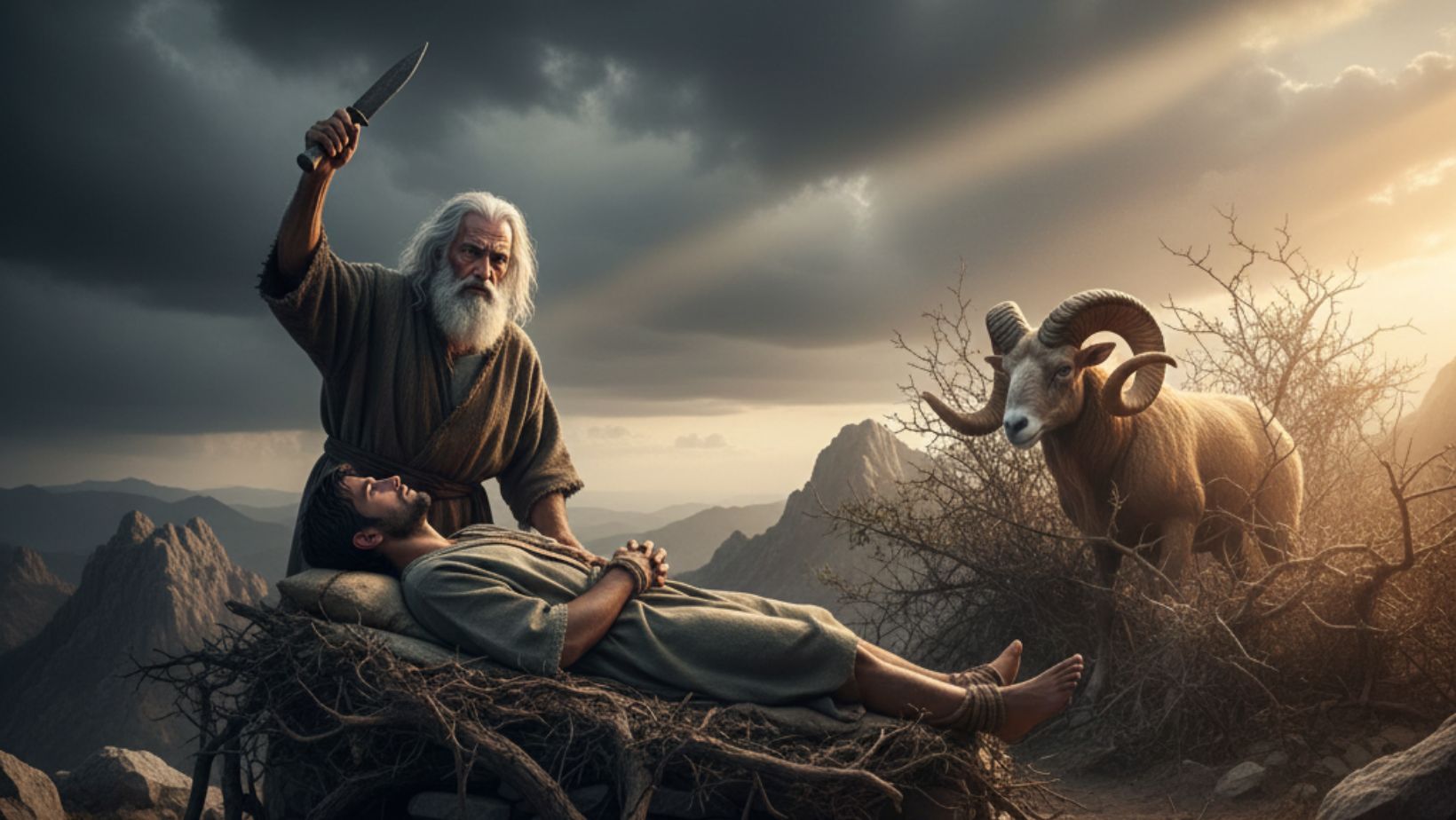
Genesis 22 is widely regarded as the theological summit of the Abraham narrative and one of the most poignant stories in the entire Bible. Known in Jewish tradition as the Akedah (The Binding), it presents the ultimate test of Abraham’s faith. After waiting 25 years for the promised son, Isaac, God commands Abraham to sacrifice him. The narrative explores the tension between God’s promise (that Isaac would build a nation) and God’s command (to kill Isaac). It resolves in a dramatic divine intervention where God provides a substitute ram, revealing His nature as Jehovah Jireh (The Lord Will Provide) and foreshadowing the substitutionary atonement of Jesus Christ.
1. The Supreme Test (Genesis 22:1–2 NLT)
1 Some time later, God tested Abraham’s faith. “Abraham!” God called. “Yes,” he replied. “Here I am.” 2 “Take your son, your only son—yes, Isaac, whom you love—and go to the land of Moriah. Go and sacrifice him as a burnt offering on one of the mountains, which I will show you.”
Commentary:
- The Nature of the Test (v. 1): The narrator immediately clarifies to the reader that this is a “test” (nissah). Abraham, however, does not know this. He experiences it as a raw, contradictory command from God.
- The Emotional Weight (v. 2): God’s command is agonizingly specific, piling up descriptions to highlight the cost:
- “Your son.”
- “Your only son” (Ishmael has been sent away; Isaac is the sole heir of the promise).
- “Whom you love.” (This is the first mention of the word “love” in the Bible).
- “Isaac” (The name means “Laughter”—God is asking him to kill his laughter).
- Moriah (v. 2): The location is significant. 2 Chronicles 3:1 identifies Mount Moriah as the site where Solomon built the Temple. Thus, the place where Abraham offers his son is the same place where sacrifices would later be offered for Israel’s sins, and likely near where Jesus (the ultimate Son) was crucified.
- Burnt Offering (v. 2): The command is for an olah—a sacrifice that is completely consumed by fire, signifying total surrender to God.
2. The Journey of Faith (Genesis 22:3–8 NLT)
3 The next morning Abraham got up early. He saddled his donkey and took two of his servants with him, along with his son, Isaac. Then he chopped wood for a fire for a burnt offering and set out for the place God had told him about. 4 On the third day of their journey, Abraham looked up and saw the place in the distance. 5 “Stay here with the donkey,” Abraham told the servants. “The boy and I will travel a little farther. We will worship there, and then we will come right back.” 6 So Abraham placed the wood for the burnt offering on Isaac’s shoulders, while he himself carried the fire and the knife. As the two of them walked on together, 7 Isaac turned to Abraham and said, “Father?” “Yes, my son?” Abraham replied. “We have the fire and the wood,” the boy said, “but where is the sheep for the burnt offering?” 8 “God will provide a sheep for the burnt offering, my son,” Abraham answered. And they both walked on together.
Commentary:
- Immediate Obedience (v. 3): As in the previous chapter, Abraham rises “early.” There is no record of hesitation, argument, or delay. The text describes his mundane actions (saddling, chopping wood) to slow the narrative pace, emphasizing his resolve.
- The Third Day (v. 4): The journey took three days. For three days, Isaac was “dead” in Abraham’s mind. This prefigures the three days of Christ in the tomb.
- Faith in Resurrection (v. 5): Abraham tells the servants, “We will worship… and then wewill come right back.”
- The Wood on the Son (v. 6): Abraham places the wood on Isaac’s shoulders. The imagery is striking: the son carrying the instrument of his own death up the mountain, parallel to Jesus carrying His cross.
- Isaac’s Question (v. 7): Isaac is observant. He notices the essential element is missing. His address, “Father?” and Abraham’s response, “Yes, my son?” highlights the tenderness of their relationship, making the impending act even more horrific.
- God Will Provide (v. 8): Abraham’s answer is prophetic: “God will provide a sheep.”
- Ambiguity: In Hebrew, it can be read as “God will provide Himself the lamb.” This is the core theology of the chapter—salvation is provided entirely by God, not by human effort.
3. The Intervention: Jehovah Jireh (Genesis 22:9–14 NLT)
9 When they arrived at the place where God had told him to go, Abraham built an altar and arranged the wood on it. Then he tied his son, Isaac, and laid him on the altar on top of the wood. 10 And Abraham picked up the knife to kill his son as a sacrifice. 11 At that moment the angel of the Lord called to him from heaven, “Abraham! Abraham!” “Yes,” Abraham replied. “Here I am!” 12 “Don’t lay a hand on the boy!” the angel said. “Do not hurt him in any way, for now I know that you truly fear God. You have not withheld from me even your son, your only son.” 13 Then Abraham looked up and saw a ram caught by its horns in a thicket. So he took the ram and sacrificed it as a burnt offering in place of his son. 14 Abraham named the place Yahweh-Yireh (which means “the Lord will provide”). To this day, people still use that name as a proverb: “On the mountain of the Lord it will be provided.”
Commentary:
- Isaac’s Submission (v. 9): Isaac, likely a teenager or young man (strong enough to carry the wood), could have overpowered his 100+ year old father. The text implies Isaac allowed himself to be bound (Akedah), submitting to his father’s will just as the father submitted to God’s.
- The Climax (v. 10): The narrative slows to a frame-by-frame description: built altar → arranged wood → tied son → laid him down → picked up knife. This heightens the tension.
- The Voice from Heaven (v. 11-12): The “Angel of the Lord” (often seen as the pre-incarnate Christ) stops the act at the last second.
- The Substitute (v. 13): Abraham sees a ram.
- In Place of His Son: This is the doctrine of Substitutionary Atonement. Isaac was condemned to die; the ram died instead of him. The ram takes the penalty so the son can go free.
- Yahweh-Yireh (v. 14): Abraham names the place, not the event. Yahweh-Yireh means “The Lord Will Provide” or literally “The Lord Will See.”
4. The Covenant Oath (Genesis 22:15–19 NLT)
15 Then the angel of the Lord called again to Abraham from heaven. 16 “This is what the Lord says: Because you have obeyed me and have not withheld even your son, your only son, I swear by my own name that 17 I will certainly bless you. I will multiply your descendants beyond number, like the stars in the sky and the sand on the seashore. Your descendants will conquer the cities of their enemies. 18 And through your descendants all the nations of the earth will be blessed—all because you have obeyed me.” 19 Then they returned to the servants and traveled back to Beersheba, where Abraham continued to live.
Commentary:
- Swearing by Himself (v. 16): As Hebrews 6:13 notes, since God could swear by no one greater, He swore by Himself. This indicates the immutability (unchangeableness) of His counsel. The promise is now irrevocable.
- Expanded Blessing (v. 17): The blessing is reiterated with military language (“conquer the cities of their enemies” / “possess the gate of his enemies”).
- Universal Blessing (v. 18): The “Seed” (singular, referring to Christ, per Galatians 3:16) will bless all nations. The ultimate result of Abraham’s obedience is the salvation of the world through Jesus.
- Return (v. 19): They return to Beersheba. Interestingly, Isaac is not explicitly mentioned in the return journey text, though he is obviously there. Some commentators see this as a literary device focusing on Abraham’s successful completion of the test.
5. Nahor’s Family (Genesis 22:20–24 NLT)
20 Soon after this, Abraham heard that Milcah, his brother Nahor’s wife, had borne Nahor eight sons. 21 The oldest was Uz, the next was Buz, followed by Kemuel (the ancestor of the Arameans), 22 Kesed, Hazo, Pildash, Jidlaph, and Bethuel. 23 (Bethuel became the father of Rebekah.) In addition to these eight sons from Milcah, 24 Nahor had four other children from his concubine Reumah. Their names were Tebah, Gaham, Tahash, and Maacah.
Commentary:
- Transition (v. 20-24): This genealogy seems out of place but serves a crucial narrative function. It introduces Rebekah (v. 23).
- Setting the Stage: Now that Isaac has been “received back from the dead” and the covenant confirmed, the next logical step is securing the line through marriage. This list shows that God has been preparing a bride for Isaac back in the old country, setting the stage for Genesis 24.
Theological Significance of Genesis 22
- Substitutionary Atonement: This is the clearest Old Testament picture of the Gospel. Just as the ram died in Isaac’s place, Christ died in our place.
- The Cost of Love: The phrase “Take your son… whom you love” gives us a glimpse into the heart of God the Father regarding the sacrifice of Jesus. Abraham was spared from killing his son; God was not.
- Faith vs. Reason: Abraham had to choose between God’s promise (Isaac is the heir) and God’s command (kill Isaac). He reconciled them through faith in God’s power to resurrect, proving that true faith trusts the Promiser more than the promise.
- Total Surrender: The story teaches that God requires first place in our hearts. An “Isaac” is anything we love so much that it threatens to take God’s place. We must be willing to lay it on the altar.
Practical Applications
- Holding Gifts Loosely: We must hold everything God gives us (family, career, dreams) with an open hand, ready to give it back if He asks.
- Trusting God in Contradictions: When life makes no sense—when God’s promises seem to contradict our reality—we are called to obey the last thing God told us to do and trust Him with the outcome.
- Worship as Sacrifice: Abraham called the act of sacrificing his son “worship” (v. 5). Worship is not just singing; it is the costly surrender of our will to God.
- God Provides (Jireh): We often want God to provide before we step out. Abraham found the provision only after he climbed the mountain and raised the knife. Provision often follows obedience.







Leave a Reply