
Genesis 25 acts as a bridge between the era of Abraham and the era of Jacob. It ties up the loose ends of Abraham’s life, recording his final marriage, the distribution of his estate, and his death. The narrative briefly accounts for Ishmael’s line before shifting the spotlight to Isaac’s family. The core drama of the chapter—and indeed the rest of Genesis—is the rivalry between Isaac’s twin sons, Jacob and Esau. This conflict begins in the womb, is defined by a divine prophecy of election (“the older will serve the younger”), and manifests in young adulthood when Esau recklessly trades his spiritual birthright for a bowl of soup. The chapter establishes the theme of the “struggle” that will define Jacob’s life.
1. Abraham’s Final Years and Death (Genesis 25:1–11 NLT)
1 Abraham married another wife, whose name was Keturah. 2 She gave birth to Zimran, Jokshan, Medan, Midian, Ishbak, and Shuah. 3 Jokshan was the father of Sheba and Dedan. Dedan’s descendants were the Asshurites, Letushites, and Leummites. 4 Midian’s sons were Ephah, Epher, Hanoch, Abida, and Eldaah. These were all descendants of Keturah. 5 Abraham left everything he owned to his son Isaac. 6 But before he died, he gave gifts to the sons of his concubines and sent them off to a land in the east, away from Isaac. 7 Abraham lived for 175 years, 8 and he died at a ripe old age, having lived a long and satisfying life. He breathed his last and joined his ancestors in death. 9 His sons Isaac and Ishmael buried him in the cave of Machpelah, near Mamre, in the field of Ephron son of Zohar the Hittite. 10 This was the field Abraham had purchased from the Hittites. There he was buried alongside his wife, Sarah. 11 After Abraham’s death, God blessed his son Isaac, who settled near Beer-lahai-roi.
Commentary:
- Keturah (v. 1): After Sarah’s death, Abraham remarries. This highlights his vitality (restored by God for Isaac’s conception) continued. Keturah is called a “concubine” in 1 Chronicles 1:32.
- Midian (v. 2): The most significant son mentioned is Midian. The Midianites play a major role in later history (Joseph is sold to Midianites; Moses flees to Midian and marries a Midianite).
- Protecting the Inheritance (v. 5-6): Abraham is careful to distinguish between his natural children and the Child of Promise.
- Isaac receives “everything he owned” (the estate and the covenant status).
- The other sons receive “gifts” (a cash settlement) and are sent “east” (Arabia/Transjordan). This prevents future territorial disputes over the Promised Land.
- Abraham’s Death (v. 8): The phrase “joined his ancestors” (or “gathered to his people”) suggests a belief in the afterlife, as his ancestors were buried in Mesopotamia, yet his body was buried in Canaan. It implies a reunion of souls, not bodies.
- Isaac and Ishmael Reunited (v. 9): The two brothers stand together at their father’s grave. It is a brief moment of peace between the two lines.
2. The Records of Ishmael (Genesis 25:12–18 NLT)
12 This is the account of the family of Ishmael, the son of Abraham through Hagar, Sarah’s Egyptian servant. 13 Here is a list, by their names and clans, of Ishmael’s descendants: The oldest was Nebaioth, followed by Kedar, Adbeel, Mibsam, 14 Mishma, Dumah, Massa, 15 Hadad, Tema, Jetur, Naphish, and Kedemah. 16 These twelve sons of Ishmael became the founders of twelve tribes named after them, listed according to their settlements and camps. 17 Ishmael lived for 137 years. Then he breathed his last and joined his ancestors in death. 18 Ishmael’s descendants occupied the region from Havilah to Shur, which is east of Egypt in the direction of Asshur. There they lived in open hostility toward all their relatives.
Commentary:
- Divine Fulfillment: God promised Abraham that Ishmael would father 12 princes (Genesis 17:20). This list confirms God kept that promise.
- Kedar and Nebaioth (v. 13): These names appear often in prophetic literature (Isaiah 60:7) representing Arab tribes.
- Hostility (v. 18): The NLT translates “lived in open hostility,” though the Hebrew can literally mean “settled in the face of his brothers.” It fulfills the prophecy of Genesis 16:12 (“he will be a wild donkey of a man… against everyone”).
3. The Birth of Jacob and Esau (Genesis 25:19–26 NLT)
19 This is the account of the family of Isaac, the son of Abraham. 20 When Isaac was forty years old, he married Rebekah, the daughter of Bethuel the Aramean from Paddan-aram and the sister of Laban the Aramean. 21 Isaac pleaded with the Lord on behalf of his wife, because she was unable to have children. The Lord answered Isaac’s prayer, and Rebekah became pregnant with twins. 22 But the two children struggled with each other in her womb. So she went to ask the Lord about it. “Why is this happening to me?” she asked. 23 And the Lord told her, “The sons in your womb will become two nations. From the very beginning, the two nations will be rivals. One nation will be stronger than the other; and your older son will serve your younger son.” 24 When the time came to give birth, Rebekah discovered that she did indeed have twins! 25 The first one was very red at birth and covered with thick hair like a fur coat. So they named him Esau. 26 Then the other twin was born with his hand grasping Esau’s heel. So they named him Jacob. Isaac was sixty years old when the twins were born.
Commentary:
- Recurring Barrenness (v. 21): Like Sarah, Rebekah is barren. This theological pattern emphasizes that the Covenant people are produced by divine power, not natural biology. Isaac prays (likely for 20 years, as he married at 40 and became a father at 60).
- The Struggle (v. 22): The Hebrew word ratsats implies a violent crushing or smashing. The conflict started before birth.
- The Oracle (v. 23): This is the key to the Jacob narrative.
- Physical Descriptions (v. 25-26):
- Esau: “Red” (admoni) and “Hairy” (se’ar). This sounds like “Seir” (the region of Edom) and “Edom” (Red). He is earthy, animalistic.
- Jacob: “Heel-grabber” (Ya’aqob). To grasp the heel was an idiom for tripping someone up, overreaching, or supplanting. His name literally means “He grasps the heel” or figuratively “Deceiver/Supplanter.”
4. Esau Sells His Birthright (Genesis 25:27–34 NLT)
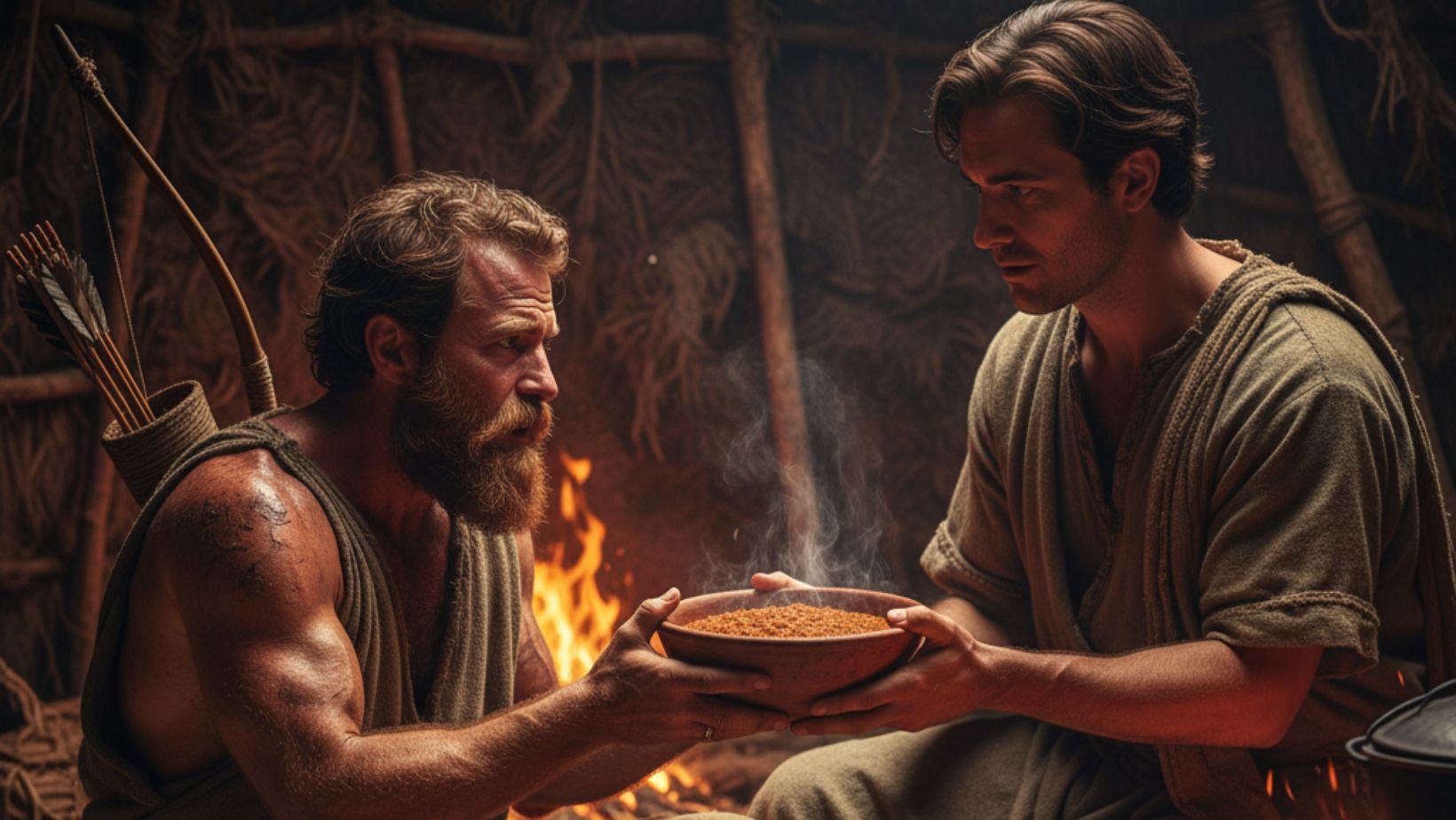
27 As the boys grew up, Esau became a skillful hunter. He was an outdoorsman, but Jacob had a quiet temperament, preferring to stay at home. 28 Isaac loved Esau because he enjoyed eating the wild game Esau brought home, but Rebekah loved Jacob. 29 One day when Jacob was cooking some stew, Esau arrived home from the wilderness exhausted and hungry. 30 Esau said to Jacob, “I’m starved! Give me some of that red stew!” (This is how Esau got his other name, Edom, which means “red.”) 31 “All right,” Jacob replied, “but trade me your rights as the firstborn son.” 32 “Look, I’m dying of starvation!” said Esau. “What good is my birthright to me now?” 33 “But first you must swear that your birthright is mine,” Jacob demanded. So Esau swore an oath, thereby selling all his rights as the firstborn to his brother, Jacob. 34 Then Jacob gave Esau some bread and lentil stew. Esau ate the meal, then got up and left. He showed contempt for his rights as the firstborn.
Commentary:
- Personality Clash (v. 27):
- Parental Favoritism (v. 28): The dysfunction of the family is rooted here. Isaac loves Esau for what he provides (wild game). Rebekah loves Jacob (perhaps because of the prophecy she received).
- The Trap (v. 29-30): Jacob is calculating. He catches Esau at a moment of physical weakness.
- “Red Stuff”: Esau is so frantic he doesn’t name the food, just points and says, “Give me some of that red, red!” (Hebrew: ha-adom, ha-adom). He is ruled by his appetite.
- The Birthright (Bekorah) (v. 31): The birthright included:
- A double portion of the material inheritance (Deuteronomy 21:17).
- Leadership of the family/clan.
- Spiritual stewardship of the Abrahamic Covenant (becoming the ancestor of the Messiah).
- The Transaction (v. 32-33): Esau claims, “I am dying.” This is hyperbole. He trades a multi-generational spiritual blessing for a single meal. He lives entirely for the “now.”
- Esau’s Contempt (v. 34): The text lists rapid-fire verbs: ate, drank, got up, left. He didn’t ponder the loss. The narrator concludes: “He showed contempt for his rights.” He is described in Hebrews 12:16 as “godless” or “profane” because he treated the holy as common.
Theological Significance of Genesis 25
- Sovereign Election: God chooses Jacob over Esau before birth. This demonstrates that God’s purpose in election stands not by works but by Him who calls (Romans 9:11). God is not bound by human traditions of primogeniture (firstborn rights).
- The Danger of Carnality: Esau represents the “flesh.” He sacrifices the permanent on the altar of the immediate. He values belly-filling over covenant-keeping.
- The Continuity of the Covenant: The transfer of the blessing from Abraham to Isaac, and the setup for its transfer to Jacob, shows that God preserves His promise despite the dysfunction of the families carrying it.
Practical Applications
- Valuing the Spiritual: We are often tempted to “sell our birthright” (integrity, purity, intimacy with God) for a “bowl of soup” (momentary pleasure, money, pride). We must weigh the immediate cost against the eternal value.
- Parental Wisdom: The favoritism of Isaac and Rebekah tore their family apart. Parents must avoid loving children based on performance or affinity.
- Patience in Suffering: Isaac and Rebekah waited 20 years for a child. Prayer is often the bridge between the promise given and the promise fulfilled.
- God Uses Flawed People: Jacob is a schemer and an opportunist, yet he is the chosen vessel. This gives hope that God uses us despite our character flaws, though He will spend a lifetime refining us (as He does with Jacob).
Possible Sermon Titles
- Trading the Future for the Now.
- The War in the Womb.
- The High Cost of Instant Gratification.
- Red Stew and Regret.
- When God Chooses the Second Born.
- Dysfunction in the Chosen Family.







Leave a Reply