
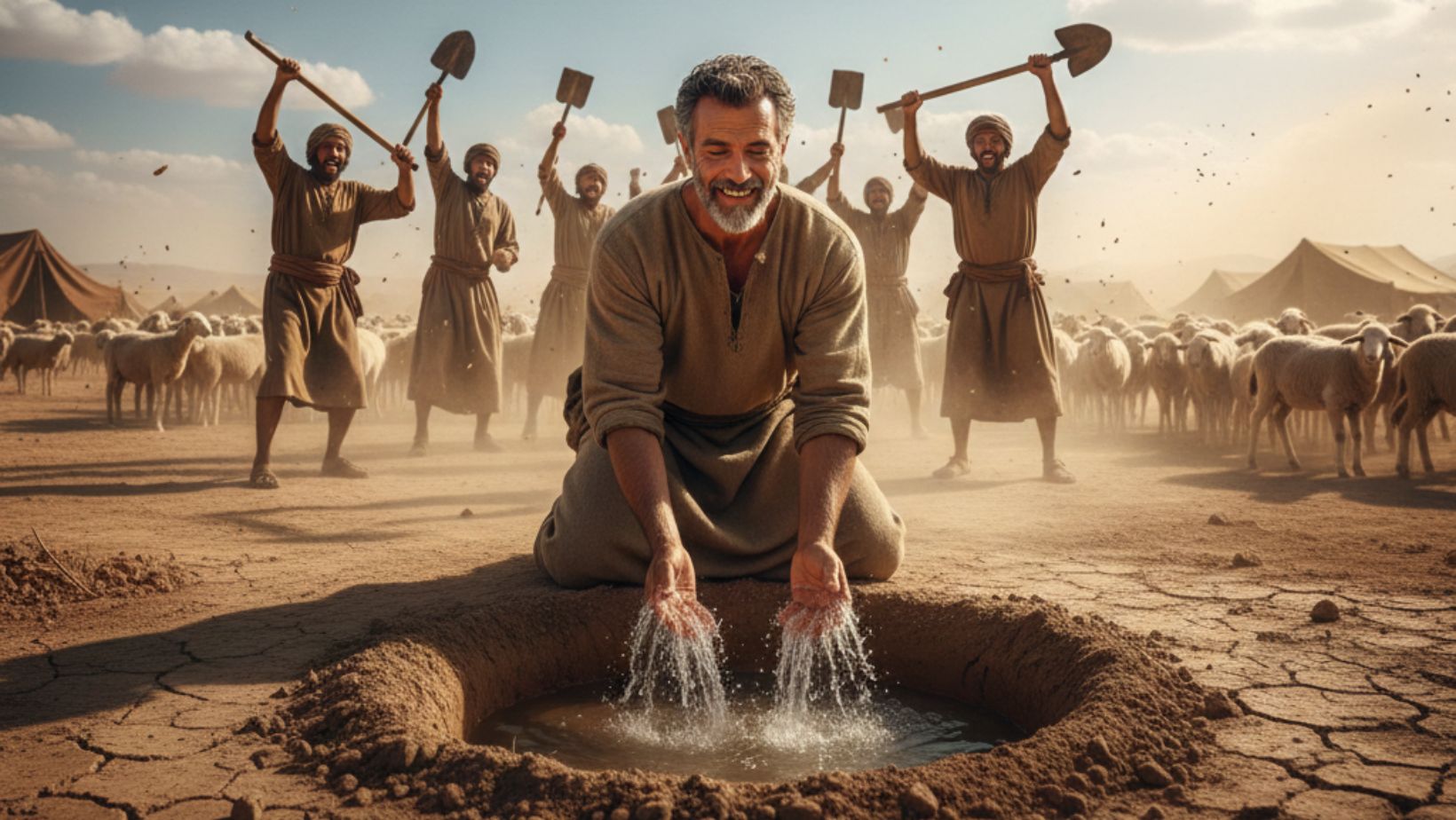
Genesis 26 is the only chapter in the Bible dedicated exclusively to the life of Isaac as the central protagonist. It serves as a validation of Isaac’s role as the legitimate heir to the Abrahamic Covenant. The narrative mirrors the life of his father, Abraham, in striking ways: a famine, a migration to Gerar, a deception regarding his wife, disputes over wells, and a non-aggression treaty with a foreign king. Through these events, God confirms that the promise given to Abraham is now personally vested in Isaac. The chapter portrays Isaac as a man of peace (meekness), who chooses to retreat rather than fight, eventually finding “broad spaces” (Rehoboth) where God blesses him abundantly.
1. Famine, Covenant, and Fear (Genesis 26:1–11 NLT)
1 A severe famine struck the land, as had happened before in Abraham’s time. So Isaac moved to Gerar, where Abimelech, king of the Philistines, lived. 2 The Lord appeared to Isaac and said, “Do not go down to Egypt, but do as I tell you. 3 Live here as a foreigner in this land, and I will be with you and bless you. I hereby confirm that I will give all these lands to you and your descendants, just as I solemnly promised Abraham, your father. 4 I will cause your descendants to become as numerous as the stars of the sky, and I will give them all these lands. And through your descendants all the nations of the earth will be blessed. 5 I will do this because Abraham listened to me and obeyed all my requirements, commands, decrees, and instructions.” 6 So Isaac stayed in Gerar. 7 When the men who lived there asked Isaac about his wife, Rebekah, he said, “She is my sister.” He was afraid to say, “She is my wife.” He thought, “They will kill me to get her, because she is so beautiful.” 8 But some time later, Abimelech, king of the Philistines, looked out from a window and saw Isaac caressing his wife, Rebekah. 9 Immediately, Abimelech called for Isaac and exclaimed, “She is obviously your wife! Why did you say, ‘She is my sister’?” “Because I was afraid someone would kill me to get her from me,” Isaac replied. 10 “How could you do this to us?” Abimelech exclaimed. “One of my people might easily have slept with your wife, and you would have brought guilt upon us.” 11 Then Abimelech issued a public proclamation: “Anyone who touches this man or his wife will be put to death!”
Commentary:
- The Parallel (v. 1): The narrator explicitly links this to “Abraham’s time.” Isaac is facing the same test his father did.
- The Prohibition (v. 2): Unlike Abraham, who went to Egypt during a famine (Gen 12), God commands Isaac, “Do not go down to Egypt.” Isaac is to trust God for provision within the boundaries of the Promised Land, even when the land looks dead.
- Personal Confirmation (v. 3-4): This is the first time God speaks the Covenant directly to Isaac. It is no longer just his father’s religion; it is now his. The promise includes: Presence (“I will be with you”), Land, Seed (“stars of the sky”), and Blessing.
- Abraham’s Obedience (v. 5): God cites Abraham’s track record as the basis for the blessing passing to Isaac. This is a key verse for the concept of merit—Abraham’s faithfulness secured blessing for his son.
- The Sin of the Father (v. 7): In a disappointing turn, Isaac repeats Abraham’s exact sin (Gen 12 and 20). Driven by fear of man, he lies about Rebekah. It illustrates that while faith can be inherited, character flaws can be mimicked.
- The Discovery (v. 8): The Hebrew word for “caressing” (metzachek) is a play on Isaac’s name (Yitzhak = laughter). Abimelech sees them “Isaac-ing” (laughing/playing intimately). The pagan king rebukes the patriarch for risking the moral safety of the kingdom.
2. Prosperity and the Well Disputes (Genesis 26:12–22 NLT)
12 When Isaac planted his crops that year, he harvested a hundred times more grain than he planted, for the Lord blessed him. 13 He became a very rich man, and his wealth continued to grow. 14 He acquired so many flocks of sheep and goats, herds of cattle, and servants that the Philistines became jealous of him. 15 So the Philistines filled up all of Isaac’s wells with dirt. These were the wells that had been dug by the servants of his father, Abraham. 16 Finally, Abimelech said to Isaac, “Leave us. You have become too powerful for us.” 17 So Isaac moved away to the Gerar Valley, where he set up their tents and settled down. 18 He reopened the wells his father had dug, which the Philistines had filled in after Abraham’s death. Isaac gave them the same names his father had given them. 19 Isaac’s servants also dug in the Gerar Valley and discovered a well of fresh water. 20 But then the shepherds from Gerar came and claimed the spring. “This is our water,” they said, and they argued over it with Isaac’s herdsmen. So Isaac named the well Esek (which means “argument”). 21 Isaac’s men then dug another well, but again there was a dispute over it. So Isaac named it Sitnah (which means “hostility”). 22 Abandoning that one, Isaac moved on and dug another well. This time there was no dispute over it, so Isaac named the place Rehoboth (which means “open space”). “At last the Lord has created enough space for us to prosper in this land,” he said.
Commentary:
- Supernatural Harvest (v. 12): Reaping a hundredfold yield during a famine is miraculous. It confirms God’s promise in verse 3.
- Economic Envy (v. 14-15): The Philistines react to God’s blessing with envy. Stopping up wells was an act of military aggression and sabotage in an arid climate. It was an attempt to erase Abraham’s history and Isaac’s survival.
- Isaac’s Non-Resistance (v. 17-21):
- Esek (Dispute): Isaac digs, they fight, he yields.
- Sitnah (Hostility/Accusation): The root word is satan (adversary). The conflict escalates.
- Response: Isaac does not retaliate. He follows the path of “turn the other cheek” centuries before the Sermon on the Mount. He trusts that God has more water elsewhere.
- Rehoboth (v. 22): Persistence pays off. Rehoboth means “Broad Places” or “Room.” Isaac recognizes that peace is a gift from God (“The Lord has created space”), not just a result of digging.
3. The Covenant at Beersheba (Genesis 26:23–33 NLT)
23 From there Isaac moved to Beersheba. 24 That night the Lord appeared to him and said, “I am the God of your father, Abraham. Do not be afraid, for I am with you. I will bless you and multiply your descendants, and I will do this for my friend Abraham.” 25 So Isaac built an altar there and worshiped the Lord. He set up his camp at that place, and his servants dug another well. 26 One day King Abimelech came from Gerar with his adviser, Ahuzzath, and also Phicol, his army commander. 27 “Why have you come here?” Isaac asked. “You obviously hate me, since you kicked me off your land.” 28 They replied, “We can plainly see that the Lord is with you. So we want to enter into a sworn treaty with you. Let’s make a covenant. 29 Swear that you will not harm us, just as we have never harmed you. We have always treated you well and sent you away in peace. And now look how the Lord has blessed you!” 30 So Isaac prepared a feast for them, and they ate and drank. 31 Early the next morning, they swore a solemn oath to each other. Then Isaac sent them home, and they left in peace. 32 That very day Isaac’s servants came and told him about a new well they had dug. “We’ve found water!” they exclaimed. 33 So Isaac named the well Shibah (which means “oath”). And to this day the town that grew up there is called Beersheba.
Commentary:
- Theophany at Beersheba (v. 24): God appears to reassure Isaac. The command “Do not be afraid” suggests Isaac was anxious about the constant Philistine hostility.
- Worship (v. 25): Isaac builds an altar. This is his public profession of faith, distinct from his father’s altars.
- The Treaty (v. 28): The Philistines realize they are fighting a losing battle because God is with Isaac. They come to sue for peace.
- Irony: They claimed they “sent him away in peace” (v. 29), rewriting history to sound benevolent, though they had actually been hostile. Isaac graciously accepts the treaty anyway.
- Shibah (v. 33): The discovery of water immediately follows the making of peace. The name Beersheba is reaffirmed (first named by Abraham in Gen 21, now confirmed by Isaac).
4. Esau’s Foreign Wives (Genesis 26:34–35 NLT)
34 At the age of forty, Esau married two Hittite wives: Judith, the daughter of Beeri, and Basemath, the daughter of Elon. 35 But Esau’s wives made life miserable for Isaac and Rebekah.
Commentary:
- Contrast: While Isaac works to secure the covenant peace, Esau undermines the covenant line.
- Hittite Wives: Marrying Canaanites (Hittites) was a direct violation of the principle Abraham established in Genesis 24. It showed Esau’s lack of spiritual sensitivity.
- Grief: These marriages brought “bitterness of spirit” (miserable life) to the parents, setting the stage for the family drama in Chapter 27.
Theological Significance of Genesis 26
- Grace Amidst Failure: God blesses Isaac with a hundredfold harvest immediately after he lies about his wife. This demonstrates that God’s covenant depends on His faithfulness, not human perfection.
- The Meek Inherit the Earth: Isaac’s refusal to fight for the wells anticipates Jesus’ teaching. By yielding his rights, Isaac eventually secures a better portion (Rehoboth) and wins the respect of his enemies.
- God of the Second Generation: God introduces Himself as “The God of Abraham.” Isaac has to learn that God has no grandchildren—he must have his own encounter and his own altar.
Practical Applications
- Persistence in Conflict: When faced with “well-blockers” (jealousy, opposition), the Christian response is often to move on and dig again rather than waste energy fighting. God has a “Rehoboth” for those who trust Him.
- Breaking Generational Cycles: Isaac repeated his father’s sin (lying). We must be aware of our family patterns and ask God for grace to break negative cycles.
- Prospering in Famine: Isaac sowed in a land of famine and reaped abundance. Believers are not limited by the economic climate of the world; our economy is from heaven.
- Peace-Making: Isaac’s feast for his enemies (v. 30) turned hostility into a treaty. Romans 12:20 says, “If your enemy is hungry, feed him.”
Possible Sermon Titles
- Digging Again the Wells of Your Fathers.
- Room to Grow: The Blessing of Rehoboth.
- Blessed in a Land of Famine.
- The Power of Walking Away (The Meekness of Isaac).
- Don’t Stop Digging.
- Sins of the Father, Faith of the Son.







Leave a Reply