
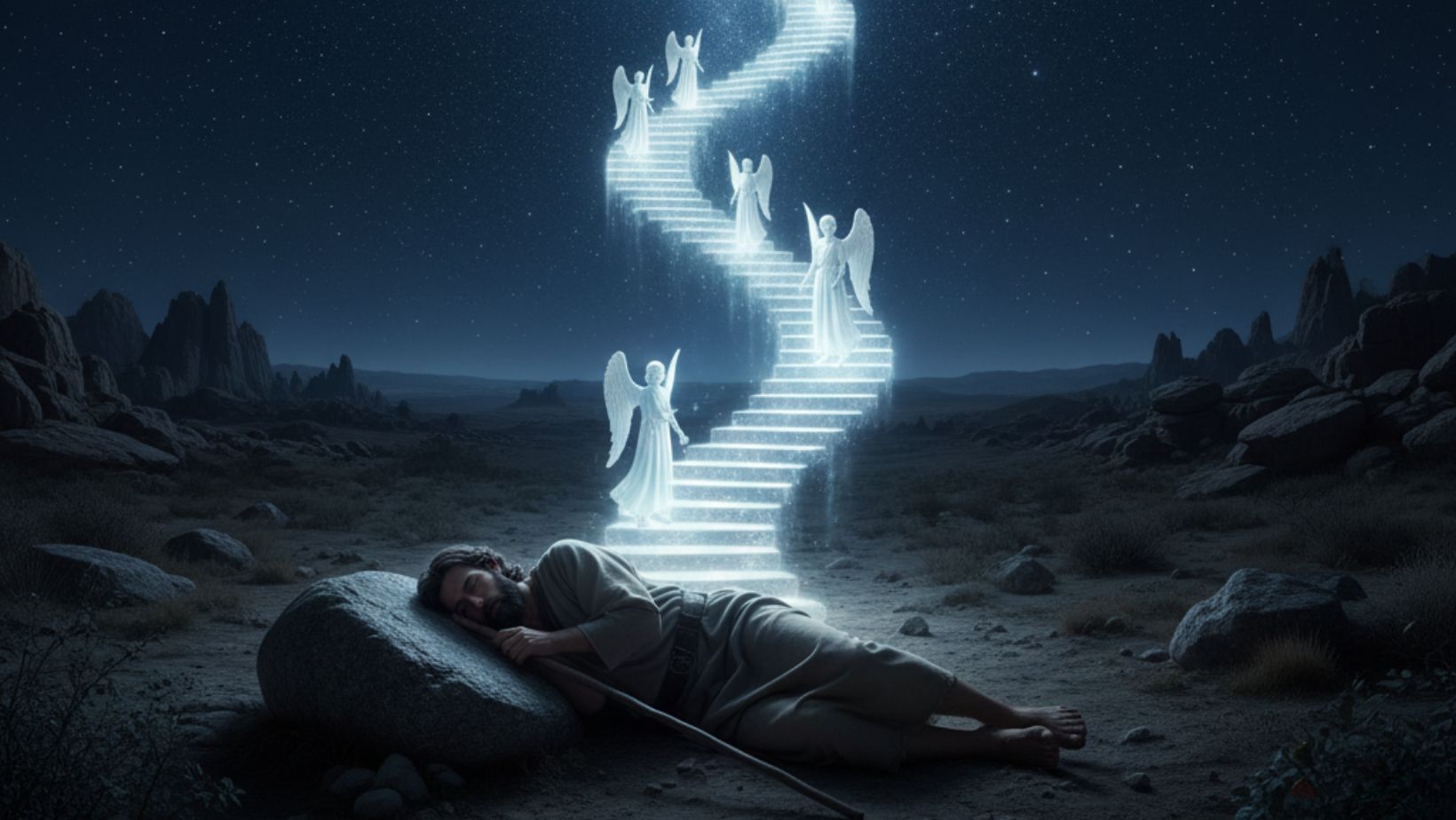
Summary of Genesis 28 Genesis 28 marks a pivotal transition in Jacob’s life. Forced to flee his home due to Esau’s murderous rage, Jacob transforms from a domestic schemer into a lonely exile. However, this journey becomes the setting for his first personal encounter with God. The chapter begins with Isaac knowingly sending Jacob away with the Blessing of Abraham, validating the “stolen” blessing of the previous chapter. It contrasts Esau’s continued spiritual clumsiness with Jacob’s profound spiritual awakening at Bethel. The centerpiece of the chapter is the famous “Jacob’s Ladder” dream, where God assures the fleeing fugitive that he is not alone—Heaven is connected to Earth, and the Covenant now rests on him.
1. Isaac Blesses Jacob and Esau’s Marriage (Genesis 28:1–9 NIV)
1 So Isaac called for Jacob and blessed him. Then he commanded him: “Do not marry a Canaanite woman. 2 Go at once to Paddan Aram, to the house of your mother’s father Bethuel. Take a wife for yourself there, from among the daughters of Laban, your mother’s brother. 3 May God Almighty bless you and make you fruitful and increase your numbers until you become a community of peoples. 4 May he give you and your descendants the blessing given to Abraham, so that you may take possession of the land where you now reside as a foreigner, the land God gave to Abraham.” 5 Then Isaac sent Jacob on his way, and he went to Paddan Aram, to Laban son of Bethuel the Aramean, the brother of Rebekah, who was the mother of Jacob and Esau. 6 Now Esau learned that Isaac had blessed Jacob and had sent him to Paddan Aram to take a wife from there, and that when he blessed him he commanded him, “Do not marry a Canaanite woman,” 7 and that Jacob had obeyed his father and mother and had gone to Paddan Aram. 8 Esau then realized how displeasing the Canaanite women were to his father Isaac; 9 so he went to Ishmael and married Mahalath, the sister of Nebaioth and daughter of Ishmael son of Abraham, in addition to the wives he already had.
Commentary:
- The Intentional Blessing (v. 1-4): Unlike the previous chapter where the blessing was stolen in the dark, here Isaac knowingly blesses Jacob. He confirms that Jacob is the carrier of the “blessing given to Abraham” (v. 4). This signifies Isaac’s acceptance of God’s will.
- El Shaddai (v. 3): Isaac invokes El Shaddai (God Almighty), the same title God used when promising fruitfulness to Abraham in Genesis 17:1.
- A “Community of Peoples” (v. 3): This is a new expansion of the promise. Jacob is not just to be a great nation, but an “assembly” (qahal) of peoples. This hints at the twelve tribes.
- Esau’s Observation (v. 6-8): Esau observes that his parents value purity of lineage. He realizes his Hittite wives are a source of grief to his father.
- Esau’s Solution (v. 9): In a misguided attempt to please his parents, Esau marries Mahalath, a daughter of Ishmael.
2. The Dream at Bethel: Jacob’s Ladder (Genesis 28:10–15 NIV)
10 Jacob left Beersheba and set out for Harran. 11 When he reached a certain place, he stopped for the night because the sun had set. Taking one of the stones there, he put it under his head and lay down to sleep. 12 He had a dream in which he saw a stairway resting on the earth, with its top reaching to heaven, and the angels of God were ascending and descending on it. 13 There above it stood the Lord, and he said: “I am the Lord, the God of your father Abraham and the God of Isaac. I will give you and your descendants the land on which you are lying. 14 Your descendants will be like the dust of the earth, and you will spread out to the west and to the east, to the north and to the south. All peoples on earth will be blessed through you and your offspring. 15 I am with you and will watch over you wherever you go, and I will bring you back to this land. I will not leave you until I have done what I have promised you.”
Commentary:
- The Setting (v. 10-11): Jacob is alone, vulnerable, and in the wilderness. The sun has set—a metaphor for his bleak situation. He uses a stone for a pillow, emphasizing his lack of comfort and home.
- The Stairway (v. 12): Traditionally called a “ladder” (sullam), it is likely a ziggurat-like stairway or ramp, common in ancient Near Eastern temples as a bridge between earth and the divine realm.
- Direction: The angels are ascending and descending. This suggests active, ongoing commerce between heaven and earth. God is not distant; He is involved.
- The Vision of God (v. 13): Yahweh stands “above it” (or beside him). This is a Theophany.
- The Promise Personalised (v. 13-14): God repeats the Abrahamic Covenant (Land, Seed, Blessing) directly to Jacob. This confirms that the blessing he “stole” from Isaac was indeed ratified by God.
- The Promise of Presence (v. 15): For a man fleeing his home, the most crucial promise is “I am with you.”
- Protection: “Watch over you.”
- Restoration: “Bring you back.”
- Perseverance: “I will not leave you until I have done what I have promised.”
3. Jacob’s Vow and the Stone Pillar (Genesis 28:16–22 NIV)
16 When Jacob awoke from his sleep, he thought, “Surely the Lord is in this place, and I was not aware of it.” 17 He was afraid and said, “How awesome is this place! This is none other than the house of God; this is the gate of heaven.” 18 Early the next morning Jacob took the stone he had placed under his head and set it up as a pillar and poured oil on top of it. 19 He called that place Bethel, though the city used to be called Luz. 20 Then Jacob made a vow, saying, “If God will be with me and will watch over me on this journey I am taking and will give me food to eat and clothes to wear 21 so that I return safely to my father’s household, then the Lord will be my God 22 and this stone that I have set up as a pillar will be God’s house, and of all that you give me I will give you a tenth.”
Commentary:
- Awareness of God (v. 16): “I was not aware of it.” Jacob realized that God is not confined to his father’s tent in Beersheba. God is also in the desolate wilderness.
- Holy Fear (v. 17): The presence of God elicits “dread” or “awe” (Hebrew yare). He calls the place the “Gate of Heaven.”
- The Pillar (v. 18): Jacob turns his stone pillow into a memorial pillar (matstsebah). Pouring oil was an act of consecration, setting it apart as holy.
- Bethel (v. 19): Beth-El means “House of God.” This site becomes a major center of worship in Israel’s history (and later, a center of idolatry).
- The Conditional Vow (v. 20-21): Jacob’s vow starts with “If.”
- Interpretation: Some see this as Jacob bargaining with God (typical of his character)—”If you protect me, then I’ll worship you.” Others see it as an inference of faith—”Since God will be with me…”
- Basic Needs: He asks only for “food to eat and clothes to wear.” He has been stripped of his desire for wealth and power; he just wants to survive.
- The Tithe (v. 22): Jacob promises to give back a “tenth” (tithe). This predates the Mosaic Law, following the example of his grandfather Abraham (Gen 14).
Theological Significance of Genesis 28
- Jesus as the Ladder: In John 1:51, Jesus applies this dream to Himself: “You will see heaven open, and the angels of God ascending and descending on the Son of Man.” Jesus is the Ladder—the only mediator and bridge between a holy God and sinful humanity.
- The God of the Exile: This chapter establishes that God is not a local deity tied to a shrine. He is the God of the traveler, the refugee, and the outcast. He meets Jacob in the “middle of nowhere.”
- Grace for the Deceiver: Jacob did not seek God; he was running away. God sought Jacob. The vision was an initiative of pure grace toward a flawed man who had just swindled his family.
- Sanctification of Space: Jacob realizes that common ground becomes holy ground when God reveals Himself there.
Practical Applications
- God is present when we don’t feel Him: Jacob said, “The Lord is in this place, and I was not aware of it.” We often feel abandoned in our “wilderness” seasons, but God is just as present there as in our seasons of blessing.
- Turning Pillows into Pillars: Jacob took the hard stone of his suffering (his pillow) and turned it into a monument of worship (a pillar). We should use our trials as testimonies of God’s faithfulness.
- The Assurance of Restoration: God promised to bring Jacob back. For believers, God promises that no matter how far we wander or how difficult the journey, He will bring us to our final home (Philippians 1:6).
- Giving Back: Jacob’s response to grace was generosity (“I will give you a tenth”). Stewardship is a natural response to experiencing God’s provision.
Possible Sermon Titles
- Stairway to Heaven: The Mediator We Need.
- When God Breaks Into Your Nightmare.
- “I Was Not Aware of It”: Finding God in the Wilderness.
- From Pillow to Pillar.
- The God of the Lonely Road.
- Bethel: The House of God.







Leave a Reply