
Genesis 37 marks a pivotal shift in the patriarchal narrative, moving from the broad history of Jacob’s family to the specific, dramatic journey of Joseph. This chapter is a masterclass in the complexities of family dynamics, exploring themes of favoritism, jealousy, and the mysterious workings of divine providence. It begins with Joseph as his father’s favorite, distinguished by a special robe and prophetic dreams that predict his future supremacy. These factors incite a murderous hatred in his brothers. While they initially plot to kill him, they eventually sell him into slavery to a passing caravan of Ishmaelites. The chapter ends with a tragic irony: while Jacob mourns the presumed death of his son, Joseph is being sold in Egypt to Potiphar, an officer of Pharaoh, setting the stage for the redemption of the entire house of Israel.
1. The Favorite Son and the Special Gift (Genesis 37:1–4 NLT)
1 So Jacob settled again in the land of Canaan, where his father had lived as a foreigner. 2 This is the account of Jacob and his family. When Joseph was seventeen years old, he was tending his father’s flocks. He was helping his half brothers, the sons of his father’s wives Bilhah and Zilpah. But Joseph reported to his father some of the bad things his brothers were doing. 3 Jacob loved Joseph more than any of his other children because Joseph had been born to him in his old age. So one day Jacob had a special gift made for Joseph—a beautiful robe. 4 But his brothers hated Joseph because their father loved him more than the rest of them. They couldn’t say a kind word to him.
Commentary:
- Settling in Canaan (v. 1): This contrasts with Esau’s move to Seir in the previous chapter. Jacob remains in the land of promise, living as a “foreigner,” acknowledging that the land is not yet legally his.
- The Character of Joseph (v. 2): At seventeen, Joseph is presented as a shepherd but also as a “tattletale.” His report of his brothers’ “bad things” establishes the moral friction between him and the sons of the concubines.
- The Root of Conflict (v. 3): Jacob repeats the mistake of his own parents (Isaac and Rebekah) by practicing blatant favoritism. Loving Joseph “more than any of his other children” creates a toxic family environment.
- The Beautiful Robe (v. 3): The Hebrew kethoneth passim (often translated as “coat of many colors”) likely refers to a long-sleeved, ornate robe reaching the ankles. Such a garment was unfit for manual labor, signaling that Joseph was being groomed for leadership or management rather than field work.
- The Silence of Hatred (v. 4): The brothers’ inability to “say a kind word” (literally: “speak peaceably”) indicates a total breakdown of relationship.
2. Joseph’s Prophetic Dreams (Genesis 37:5–11 NLT)
5 One night Joseph had a dream, and when he told his brothers about it, they hated him more than ever. 6 “Listen to this dream,” he said. 7 “We were out in the field, tying up bundles of grain. Suddenly my bundle stood up, and your bundles gathered around and bowed low before it!” 8 His brothers responded, “So you think you will be our king, do you? Do you actually think you will reign over us?” And they hated him all the more because of his dreams and the way he talked about them. 9 Soon Joseph had another dream, and again he told his brothers about it. “Listen, I have had another dream,” he said. “The sun, moon, and eleven stars bowed low before me!” 10 This time he told his father as well as his brothers, but his father scolded him. “What kind of dream is that?” he asked. “Will your mother and I and your brothers actually come and bow to the ground before you?” 11 But while his brothers were jealous of Joseph, his father wondered what the dreams meant.
Commentary:
- Divine Revelation vs. Human Pride (v. 5–7): These dreams are from God, yet Joseph’s decision to share them with his already-hateful brothers suggests a lack of social tact. The first dream (sheaves of grain) predicts their future dependence on Joseph for food.
- The Second Dream (v. 9): This dream expands the scope of Joseph’s authority to include his entire family—parents included. The “eleven stars” clearly represent his brothers.
- Reaction of the Father (v. 10–11): Even Jacob, the dreamer of Bethel, finds this offensive and “scolds” Joseph. However, while the brothers’ jealousy hardens into action, Jacob “wonders” (literally: “kept the matter in mind”), sensing a divine hand behind the visions.
3. The Conspiracy in Dothan (Genesis 37:12–24 NLT)
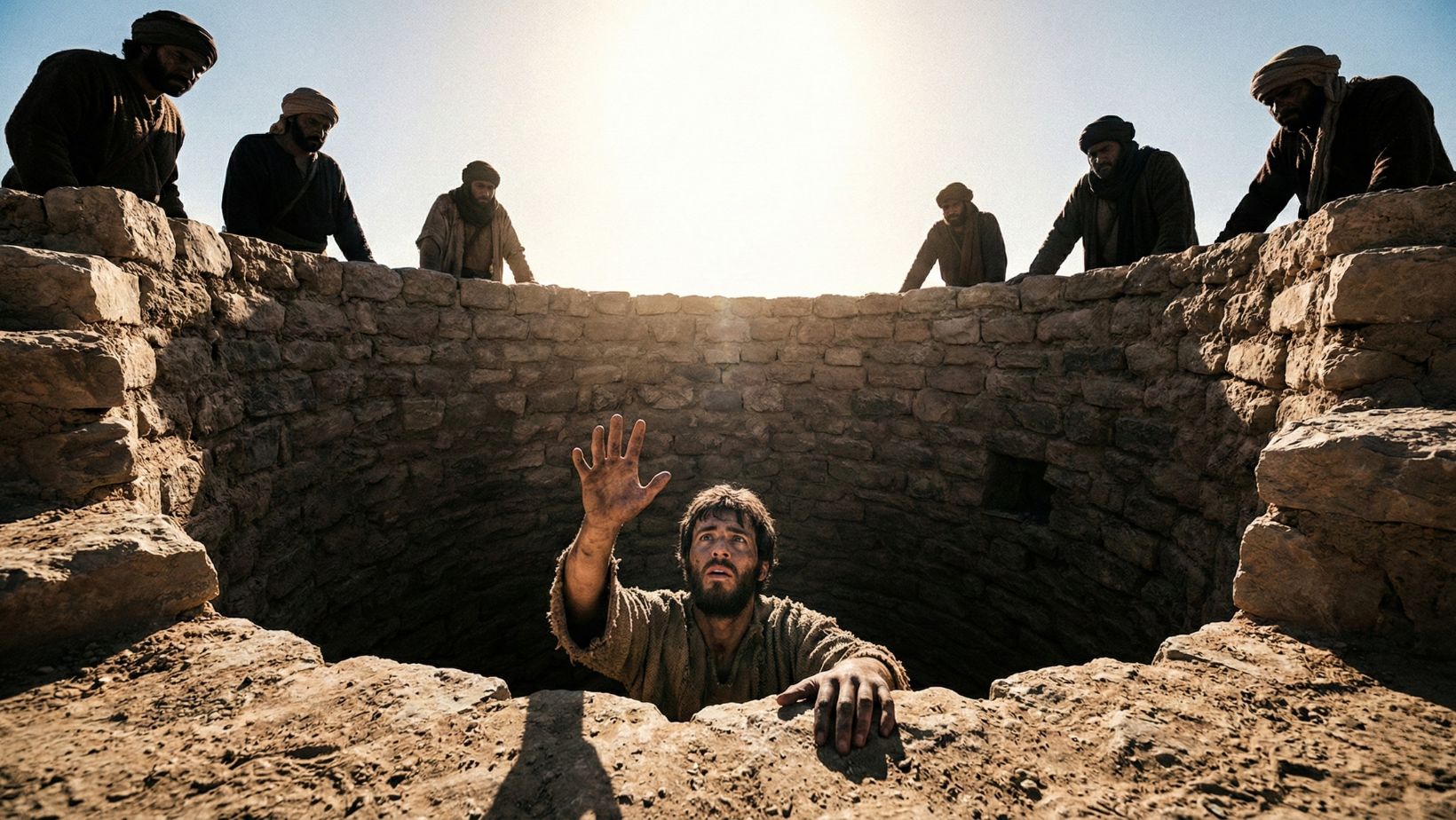
12 Soon after this, Joseph’s brothers went to pasture their father’s flocks at Shechem. 13 When they had been there for some time, Jacob said to Joseph, “Your brothers are pasturing the sheep at Shechem. Get ready, and I will send you to them.” “I’m ready to go,” Joseph replied. 14 “Go and see how your brothers and the flocks are getting along,” Jacob said. “Then come back and bring me a report.” So Jacob sent him on his way from the valley of Hebron, and Joseph arrived at Shechem. 15 When he arrived there, a man from the area noticed him wandering around the countryside. “What are you looking for?” he asked. 16 “I’m looking for my brothers,” Joseph replied. “Do you know where they are pasturing their sheep?” 17 “Yes,” the man told him. “They have moved on from here, but I heard them say, ‘Let’s go on to Dothan.’” So Joseph followed his brothers to Dothan and found them there. 18 When Joseph’s brothers saw him coming from a distance, they made plans to kill him. 19 “Here comes the dreamer!” they said. 20 “Come on, let’s kill him and throw him into one of these cisterns. We can tell our father, ‘A wild animal has eaten him.’ Then we’ll see what becomes of his dreams!” 21 But when Reuben heard of their scheme, he tried to save Joseph. “Let’s not kill him,” he said. 22 “Why should we shed any blood? Just throw him into this empty cistern here in the wilderness. Then you won’t lay a hand on him.” Reuben intended to rescue Joseph and return him to his father. 23 So when Joseph arrived, his brothers ripped off the beautiful robe he was wearing. 24 Then they grabbed him and threw him into the cistern. Now the cistern was empty; there was no water in it.
Commentary:
- The Journey to Shechem (v. 12–14): Shechem was a dangerous place for Jacob’s sons given the massacre they had committed there previously (Genesis 34). Jacob’s concern is practical, but Joseph’s obedience is absolute.
- The Intervening Stranger (v. 15–17): This “man” seems like a minor detail, but he is a vehicle of providence. Without this random encounter, Joseph would have returned home, and the redemptive plan in Egypt would never have begun.
- The Plot (v. 18–20): Their address of him as “the dreamer” shows that his visions were the primary source of their irritation. They sought to kill the dreamer to kill the dream.
- Reuben’s Intervention (v. 21–22): As the firstborn, Reuben is legally responsible for his brothers. His plan is a compromise—he hopes to appease their anger without committing murder, intending to circle back later to save the boy.
- The Empty Cistern (v. 24): A cistern was a pear-shaped pit dug into rock for storing rainwater. Being “empty” meant Joseph wouldn’t drown, but the smooth, inward-sloping walls made it an inescapable prison.
4. Joseph Sold into Slavery (Genesis 37:25–28 NLT)
25 Then, just as they were sitting down to eat, they looked up and saw a caravan of Ishmaelites coming toward them from Gilead. Their camels were loaded with gum, balm, and aromatic resin, which they were taking down to Egypt. 26 Judah said to his brothers, “What will we gain by killing our brother? We’d have to cover up the crime. 27 Instead of killing him, let’s sell him to these Ishmaelite traders. After all, he is our brother—our own flesh and blood!” And his brothers agreed. 28 So when the Ishmaelites, who were Midianite traders, came by, Joseph’s brothers pulled him out of the cistern and sold him to them for twenty pieces of silver. And the traders took him to Egypt.
Commentary:
- Callous Indifference (v. 25): The brothers sit down to eat while Joseph languishes in the pit. This detail highlights their extreme emotional detachment and cruelty.
- Judah’s Proposal (v. 26–27): Judah’s motivation is profit mixed with a shred of conscience. Selling him avoids the “bloodguilt” of murder while still removing the “problem” of Joseph forever.
- The Price of a Slave (v. 28): Twenty pieces of silver was the standard price for a male slave at the time (later codified in Leviticus 27:5).
- Ishmaelites and Midianites (v. 28): These terms are used interchangeably here to describe the caravan, likely because they were related nomadic tribes engaged in the same trans-desert trade.
5. The Deception of Jacob (Genesis 37:29–36 NLT)
29 Some time later, Reuben returned to get Joseph out of the cistern. When he discovered that Joseph was gone, he tore his clothes in grief. 30 Then he went back to his brothers and lamented, “The boy is gone! What will I do now?” 31 Then the brothers killed a young goat and dipped Joseph’s robe in its blood. 32 They sent the beautiful robe to their father with this message: “Look at what we found. Doesn’t this robe belong to your son?” 33 Their father recognized it immediately. “Yes,” he said, “it is my son’s robe. A wild animal has eaten him. Joseph has surely been torn to pieces!” 34 Then Jacob tore his clothes and dressed himself in burlap. He mourned deeply for his son for a long time. 35 His family all tried to comfort him, but he refused to be comforted. “I will go to my grave mourning for my son,” he would say, and then he would weep. 36 Meanwhile, the Midianite traders arrived in Egypt, where they sold Joseph to Potiphar, an officer of Pharaoh, the king of Egypt. Potiphar was the captain of the palace guard.
Commentary:
- Reuben’s Failure (v. 29–30): Reuben’s grief is likely rooted in both care for Joseph and fear of his father’s reaction.
- The Deceptive Robe (v. 31–32): The very object of Jacob’s favoritism becomes the tool of his deception. Dipping the robe in goat’s blood mirrors how Jacob himself once used goatskins to deceive his own father, Isaac (Genesis 27).
- The Grief of Jacob (v. 34–35): Jacob’s mourning is inconsolable. His statement “I will go to my grave [Sheol] mourning” shows that the light of his life has been extinguished.
- The Egyptian Connection (v. 36): This verse is the “cliffhanger.” While the family in Canaan is paralyzed by grief and lies, Joseph is entering the house of a high-ranking Egyptian official. God’s plan is moving forward in the dark.
Theological Significance of Genesis 37
- Sovereignty in Suffering: God is not mentioned once in this chapter, yet His presence is felt in the dreams, the “random” man in the field, and the timing of the caravan. It teaches that God works through human sin to accomplish His good ends.
- The Pattern of the Suffering Servant: Joseph is a “type” or foreshadowing of Christ. He is the beloved son, sent by his father to his brothers, rejected by his own, sold for the price of a slave, and eventually becomes the savior of those who rejected him.
- The Destructiveness of Sin: Favoritism, jealousy, and deception nearly destroy the family of the promise. It serves as a warning against the “rotten roots” of domestic discord.
Practical Applications
- Beware of Favoritism: Parents must guard against showing preference, as it breeds resentment that can last for generations.
- Trust the Dream, Not the Circumstance: Joseph’s dreams seemed impossible once he was in the pit. We must hold onto God’s promises even when our current reality looks like a “cistern.”
- The Danger of Envy: Envy is described in Proverbs as “rottenness to the bones.” The brothers’ envy led them to commit a crime that haunted them for decades.
Possible Sermon Titles
- The Dreamer in the Pit.
- The Coat of Conflict.
- Providence in the Shadows.
- When Brothers Betray.
- The Price of a Soul.







Leave a Reply