
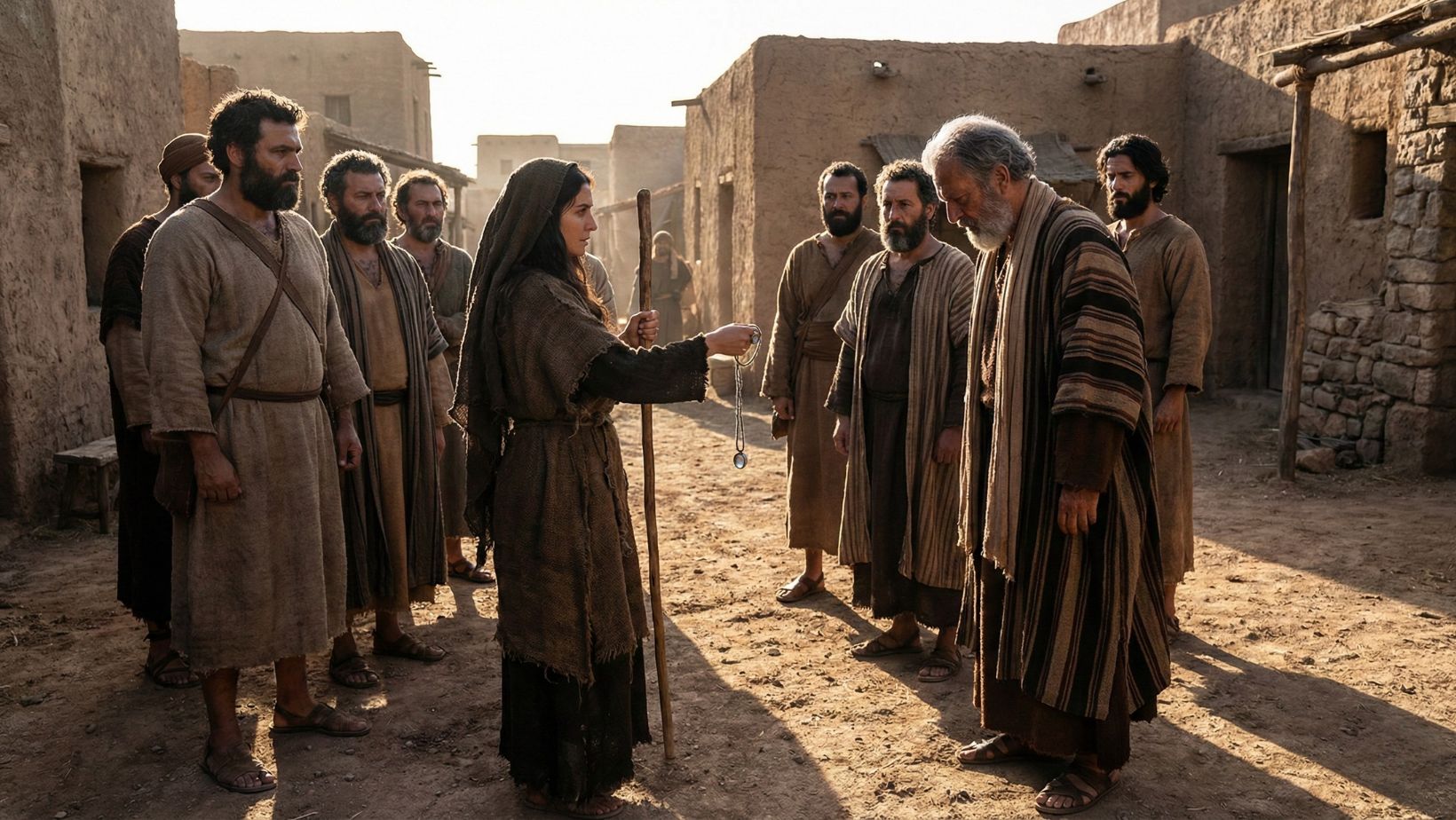
Genesis 38 is a deliberate and startling interruption in the Joseph narrative. While Joseph is being refined through suffering in Egypt, this chapter follows Judah, the brother who suggested selling Joseph. It chronicles Judah’s spiritual and moral decline as he leaves his family, marries a Canaanite woman, and father’s three sons. After the death of his two eldest sons due to their wickedness, Judah fails to fulfill his legal obligation to his daughter-in-law, Tamar. In a desperate act to secure her future and rights, Tamar disguises herself as a prostitute and conceives a child by Judah. When the truth is revealed, Judah is forced to acknowledge his own hypocrisy. This raw, gritty chapter is essential because it records the preservation of the Messianic line; despite the failures of man, God ensures that Perez is born—the ancestor of King David and Jesus Christ.
1. Judah’s Family in Canaan (Genesis 38:1–5 NLT)
1 About that time, Judah left his brothers and went to live in Adullam with a man named Hirah. 2 There he saw a Canaanite woman, the daughter of Shua, and he married her. 3 She became pregnant and gave birth to a son, and Judah named him Er. 4 Then she became pregnant again and gave birth to a son, and she named him Onan. 5 And when she gave birth to a third son, she named him Shelah. At the time of Shelah’s birth, they were living at Kezib.
Commentary:
- Departure from the Covenant (v. 1): Judah “left his brothers.” This indicates a spiritual distancing from the family of faith. He settles among the Canaanites, integrating into their culture.
- The Influence of Hirah (v. 1): Hirah the Adullamite becomes Judah’s companion. The company we keep often dictates the direction of our moral choices.
- Marriage to a Canaanite (v. 2): Judah violates the patriarchal principle of not marrying Canaanite women (a principle strictly held by Abraham and Isaac). He chooses a wife based on sight (“he saw”) rather than divine guidance.
- The Three Sons (v. 3–5): The birth of Er, Onan, and Shelah sets the stage for the coming crisis. Their names and births are recorded to establish the legal framework for the levirate obligations that follow.
2. The Wickedness of Er and Onan (Genesis 38:6–11 NLT)
6 In the course of time, Judah arranged for his firstborn son, Er, to marry a young woman named Tamar. 7 But Er was a wicked man in the Lord’s sight, so the Lord took his life. 8 Then Judah said to Er’s brother Onan, “Go and marry Tamar, as our custom requires of a brother-in-law. Have intercourse with her so she can have a child who will carry on your brother’s name.” 9 But Onan knew that the child would not belong to him. So whenever he had intercourse with his brother’s wife, he spilled his semen on the ground to keep her from having a child who would carry on his brother’s name. 10 The Lord considered this a wicked thing, so he took Onan’s life, too. 11 Then Judah said to his daughter-in-law, Tamar, “Go back to your parents’ home and remain a widow until my son Shelah grows up.” Judah was afraid that Shelah would also die, like his two brothers. So Tamar went to live in her father’s home.
Commentary:
- Divine Judgment (v. 7): The Bible is blunt: Er was so “wicked” that God personally intervened to end his life. This highlights that God was watching the moral state of the tribe of Judah closely.
- Levirate Marriage Custom (v. 8): This is the first mention of the custom later codified in the Law of Moses (Deuteronomy 25:5–6). Its purpose was to provide an heir for a deceased man and financial security for his widow.
- The Sin of Onan (v. 9–10): Onan’s sin was not just a sexual act but a violation of social justice and family loyalty. He wanted the pleasure of the relationship and the inheritance of the firstborn without the responsibility of providing an heir. His greed led to his death.
- Judah’s Deception (v. 11): Judah blames Tamar for his sons’ deaths, viewing her as a “black widow” rather than seeing his sons’ wickedness. He sends her away with a false promise to give her Shelah, effectively leaving her in social and economic limbo.
3. Tamar’s Plan and Judah’s Sin (Genesis 38:12–19 NLT)
12 Years later, after Judah’s wife had died and the time of mourning was over, Judah and his friend Hirah the Adullamite went up to Timnah to supervise the shearing of his sheep. 13 Someone told Tamar, “Look, your father-in-law is going up to Timnah to shear his sheep.” 14 Tamar was aware that Shelah had grown up, but no arrangements had been made for her to marry him. So she took off her widow’s clothing and covered her face with a veil to disguise herself. Then she sat beside the road at the entrance to the village of Enaim, which is on the road to Timnah. 15 Judah noticed her and thought she was a prostitute, since her face was covered. 16 So he stopped and compounded his sin by saying, “Look, let me have intercourse with you.” He didn’t know that she was his own daughter-in-law. “How much will you pay me?” she asked. 17 “I’ll send you a young goat from my flock,” Judah promised. “What will you give me to hold until the goat arrives?” she asked. 18 “Well, what do you want?” he asked. She replied, “I want your seal and its cord, and the walking stick you are carrying.” So Judah gave them to her. Then he had intercourse with her, and she became pregnant. 19 Afterward, she went home, took off her veil, and put on her widow’s clothing as usual.
Commentary:
- The Opportunity (v. 12–13): Sheep-shearing was a festive time, often associated with heavy drinking and loose morals. Tamar recognizes that Judah has broken his word regarding Shelah.
- The Disguise (v. 14): Tamar takes matters into her own hands. By sitting at the “entrance to Enaim,” she positions herself where a traveler would expect to find a cult prostitute.
- The Pledge (v. 17–18): Tamar asks for Judah’s most personal items:
- Seal and Cord: His signet ring, used to sign legal documents. It represented his identity and authority.
- Walking Stick: Often carved with family history; it was a symbol of his status as a tribal leader.
- The Transaction (v. 18): Judah is so blinded by lust that he hands over his “identification” to a stranger, leaving himself vulnerable to the very exposure that follows.
4. The Hypocrisy of Judah (Genesis 38:20–26 NLT)
20 Judah asked his friend Hirah the Adullamite to take the young goat to the woman and retrieve his seal and staff. But Hirah couldn’t find her. 21 He asked the men who lived there, “Where is the prostitute who was sitting beside the road at the entrance to the village?” “We’ve never had a prostitute here,” they replied. 22 So Hirah returned to Judah and told him, “I couldn’t find her. And the men of the village said they’ve never had a prostitute there.” 23 “Well, let her keep them,” Judah said. “We don’t want to be the laughingstock of the area. After all, I tried to send the goat.” 24 About three months later, word reached Judah: “Your daughter-in-law Tamar has been playing the prostitute and is now pregnant.” “Bring her out and burn her!” Judah shouted. 25 But as they were taking her out to kill her, she sent this message to her father-in-law: “The man who owns these things is the one who made me pregnant. Look at this seal and cord and walking stick. Who do they belong to?” 26 Judah recognized them immediately and said, “She is more righteous than I am, because I didn’t keep my promise to let her marry my son Shelah.” And Judah never slept with her again.
Commentary:
- Fear of Shame (v. 23): Judah’s primary concern is his reputation (“laughingstock”) rather than the morality of his actions.
- The Double Standard (v. 24): Judah is quick to demand the death penalty for Tamar’s “prostitution” while he himself had just sought out a prostitute. This is a classic example of religious and social hypocrisy.
- The Reveal (v. 25): Tamar’s timing is perfect. She does not accuse him publicly at first; she simply presents the evidence.
- Judah’s Repentance (v. 26): This is the turning point for Judah’s character. He admits, “She is more righteous than I am.” He acknowledges that her “sin” was driven by his own failure to provide her with justice. This moment of brokenness begins Judah’s transformation into the man who later offers his life for Benjamin in Egypt.
5. The Birth of Perez and Zerah (Genesis 38:27–30 NLT)
27 When the time came for Tamar to give birth, it was discovered that she was having twins. 28 While she was in labor, one of the babies reached out his hand. The midwife tied a scarlet thread around the wrist and said, “This one came out first.” 29 But then he drew back his hand, and out came his brother! “What!” the midwife exclaimed. “How did you break out first?” So he was named Perez. 30 Then the baby with the scarlet thread on his wrist was born, and he was named Zerah.
Commentary:
- The Struggle in the Womb (v. 28–29): Like Jacob and Esau, these twins struggle for the position of the firstborn.
- Perez (v. 29): His name means “Breach” or “Bursting Forth.” Though Zerah’s hand appeared first, Perez is the one who ultimately receives the blessing.
- Messianic Significance: Perez is the ancestor of Boaz, Jesse, David, and ultimately Jesus (Matthew 1:3). God used a situation of immense brokenness and sin to preserve the line of the Savior.
Theological Significance of Genesis 38
- The Sovereignty of God over Human Sin: This chapter proves that God can hit a straight mark with a crooked stick. Judah and Tamar’s actions were sinful, yet God used the outcome to fulfill His covenant.
- Preserving the Line: If Judah had remained integrated with the Canaanites, the distinct identity of the tribe would have been lost. This crisis forced Judah back toward his family and his identity as a son of Israel.
- Grace for the Outcast: Tamar is one of only five women mentioned in the genealogy of Jesus in Matthew 1. This highlights that the Gospel is for the broken and the marginalized.
Practical Applications
- Own Your Sin: Judah’s greatness began when he stopped blaming Tamar and said, “She is more righteous than I am.” True change begins with honest confession.
- The Danger of a Double Standard: We are often hardest on the sins in others that we are most guilty of ourselves.
- God’s Grace in the Mess: No matter how messy your family history or personal past, God can still use your life for His redemptive purposes.







Leave a Reply