
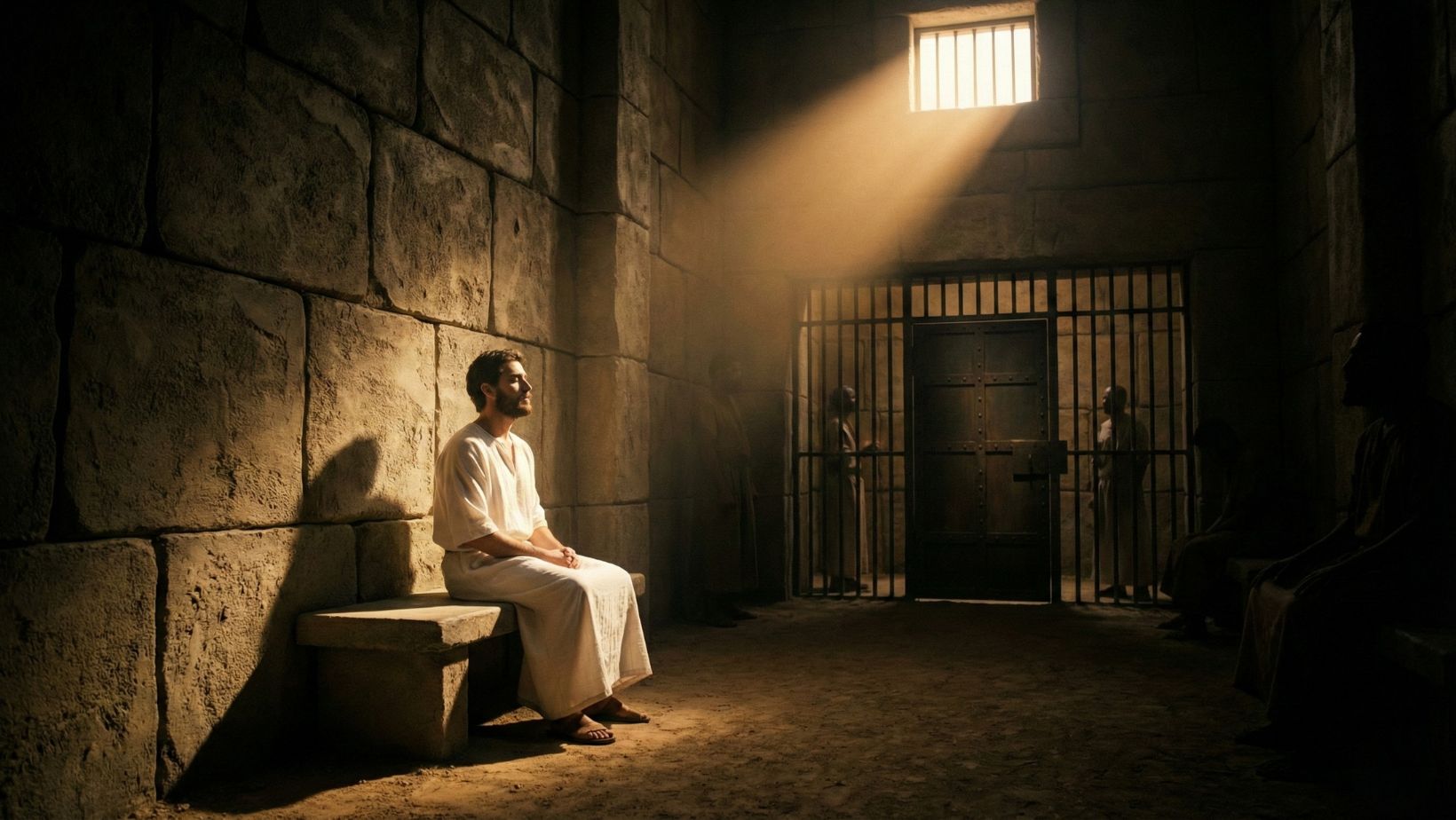
Genesis 39 shifts the focus back to Joseph, illustrating the profound contrast between his integrity in Egypt and Judah’s moral failure in Canaan. Despite being a slave in a foreign land, Joseph prospers because “the Lord was with him.” His life follows a “U-shaped” trajectory: he rises to manage Potiphar’s entire household, only to be cast into prison after a false accusation of attempted rape by Potiphar’s wife. Even in the darkness of a dungeon, Joseph’s character remains unblemished, and God’s presence remains constant. This chapter serves as a foundational study in resisting temptation, the reality of “blessing in the midst of suffering,” and the unwavering providence of God that works even through injustice.
1. Joseph’s Success in Potiphar’s House (Genesis 39:1–6 NLT)
1 When Joseph was taken to Egypt by the Ishmaelite traders, he was purchased by Potiphar, an Egyptian officer. Potiphar was captain of the guard for Pharaoh, the king of Egypt. 2 The Lord was with Joseph, so he succeeded in everything he did as he served in the home of his Egyptian master. 3 Potiphar noticed this and realized that the Lord was with Joseph, giving him success in everything he did. 4 This pleased Potiphar, so he soon made Joseph his personal attendant. He put Joseph in charge of his entire household and everything he owned. 5 From the day Joseph was put in charge of his master’s household and property, the Lord began to bless Potiphar’s household for Joseph’s sake. All his household affairs ran smoothly, and his crops and livestock flourished. 6 So Potiphar gave Joseph complete administrative responsibility over everything he owned. With Joseph in charge, Potiphar didn’t worry about a thing—except what kind of food to eat! Joseph was a very handsome and well-built young man.
Commentary:
- Divine Presence (v. 2): The phrase “The Lord was with Joseph” is the theological heartbeat of this chapter. It teaches that God’s presence is not tied to a location (the Promised Land) but to a person.
- A Blessing to Others (v. 5): Joseph becomes a fulfillment of the Abrahamic covenant—he is a blessing to the Gentiles. Potiphar’s household prospers specifically “for Joseph’s sake.”
- Total Trust (v. 6): Potiphar’s only concern was “what kind of food to eat,” a detail indicating the cultural Egyptian taboo against eating with foreigners. Joseph had reached the pinnacle of success available to a slave.
- Physical Description (v. 6): The mention that Joseph was “handsome and well-built” is not mere trivia; it sets the stage for the narrative conflict that follows.
2. The Temptation of Joseph (Genesis 39:7–12 NLT)
7 and Potiphar’s wife soon began to look at him with desire. “Come and sleep with me,” she demanded. 8 But Joseph refused. “Look,” he told her, “my master trusts me with everything in his entire household. 9 No one here has more authority than I do. He has held back nothing from me except you, because you are his wife. How could I do such a wicked thing? It would be a great sin against God.” 10 She kept putting pressure on Joseph day after day, but he refused to sleep with her, and he kept out of her way as much as possible. 11 One day, however, no one else was around when he went in to do his work. 12 She came and grabbed him by his cloak, demanding, “Come on, sleep with me!” Joseph tore himself away, but he left his cloak in her hand as he ran from the house.
Commentary:
- The Nature of Temptation (v. 7, 10): The temptation was direct (“Come and sleep with me”) and persistent (“day after day”). This was a test of endurance, not just a momentary impulse.
- Joseph’s Defense (v. 8–9): Joseph’s refusal is based on two pillars:
- Proactive Avoidance (v. 10): Joseph didn’t just say no; he “kept out of her way.” He understood that the best way to win a battle with lust is to avoid the battlefield.
- The Second Cloak (v. 12): For the second time in Joseph’s life, a garment is used against him. His “cloak” (this time his outer Egyptian garment) becomes the false evidence of his guilt.
3. The False Accusation (Genesis 39:13–20 NLT)
13 When she saw that she was holding his cloak and he had fled, 14 she called out to her servants. Soon all the men came running. “Look!” she said. “My husband has brought this Hebrew slave here to make fools of us! He came into my room to rape me, but I screamed. 15 When he heard me scream, he ran outside and left his cloak with me.” 16 She kept the cloak with her until her husband came home. 17 Then she told him her story. “That Hebrew slave you’ve brought unto us tried to come in and fool around with me,” she said. 18 “But when I screamed, he ran outside, leaving his cloak with me!” 19 Potiphar was furious when he heard his wife’s story about how Joseph had treated her. 20 So he took Joseph and threw him into the prison where the king’s prisoners were held. And there he remained.
Commentary:
- Racial and Social Tension (v. 14): Potiphar’s wife uses xenophobia to incite the servants, referring to Joseph as “this Hebrew slave.” She shifts the blame to her husband for bringing an outsider into the home.
- Potiphar’s Reaction (v. 19–20): While the text says Potiphar was “furious,” it is notable that he only threw Joseph in prison. In that era, the penalty for an attempted rape of a high-ranking official’s wife by a slave would typically be immediate execution. This suggests Potiphar may have had lingering doubts about his wife’s character or a lingering respect for Joseph’s integrity.
- The King’s Prison (v. 20): Even in his downfall, providence is at work. Joseph isn’t sent to a common dungeon but to the “king’s prison,” where he will eventually meet Pharaoh’s officials.
4. Prosperity in Prison (Genesis 39:21–23 NLT)
21 But the Lord was with Joseph in the prison and showed him his faithful love. And the Lord made Joseph a favorite with the prison warden. 22 Before long, the warden put Joseph in charge of all the other prisoners and over everything that happened in the prison. 23 The warden had no more worries, because Joseph took care of everything. The Lord was with him and caused everything he did to prosper.
Commentary:
- Unchanging Presence (v. 21): The chapter ends exactly as it began: “The Lord was with Joseph.” Prison walls cannot separate a person from God’s favor.
- Faithful Love (v. 21): The Hebrew word is hesed (covenant loyalty). Even in the pit, Joseph is experiencing the loyal love of God.
- Promotion in the Pit (v. 22): Joseph’s administrative gift is so undeniable that he effectively becomes the warden’s “warden.” His character and work ethic shine even in the darkest circumstances.
Theological Significance of Genesis 39
- The Presence of God in Adversity: Success is not defined by the absence of trouble, but by the presence of God in the trouble. Joseph’s “prosperity” occurred while he was a slave and a prisoner.
- Integrity as Worship: Joseph’s resistance to Potiphar’s wife shows that high-level integrity is a form of worship. He refused to sin because he loved God more than he loved pleasure or safety.
- Divine Irony: The very garment that “proved” Joseph’s guilt to man was a symbol of his innocence before God. God uses the “downward” steps of Joseph’s life to position him for the ultimate “upward” call to Pharaoh’s court.
Practical Applications
- Bloom Where You Are Planted: Whether in a palace or a prison, Joseph worked with excellence. We should serve God faithfully regardless of our current job title or social status.
- Run From Temptation: Joseph didn’t try to “reason” with Potiphar’s wife when she grabbed him; he ran. Sometimes the most spiritual thing you can do is flee.
- God’s Timing: Joseph was unjustly accused and forgotten, but God was using the prison as a waiting room for a promotion that would save the world.
Possible Sermon Titles
- Success in the Shadow of a Slave.
- Why I Can’t Do This: The Anatomy of a “No.”
- The Lord Was With Him: Prosperity in a Pit.
- Integrity Under Fire.
- When Doing Right Leads to Life Going Wrong.







Leave a Reply