
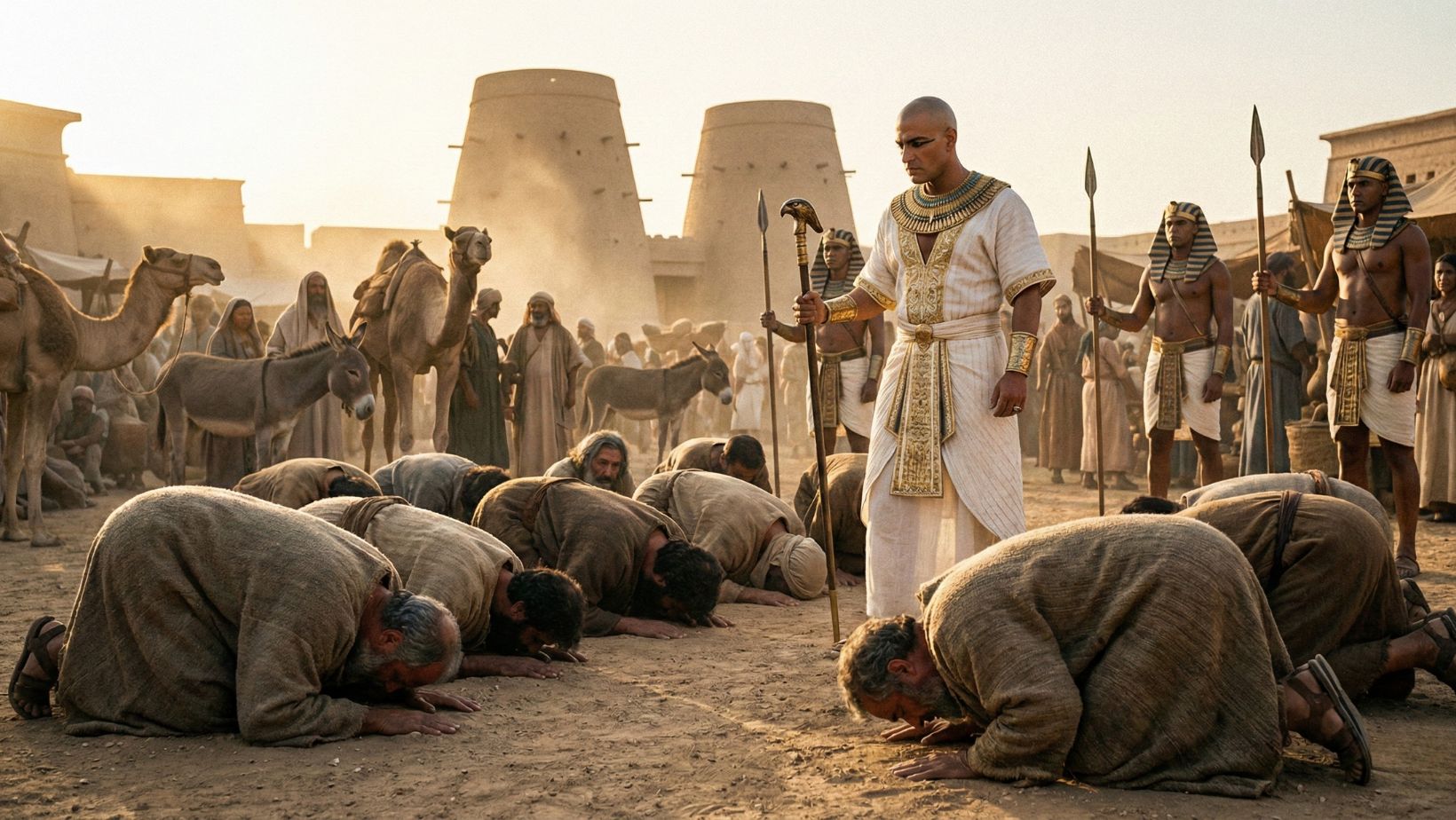
Genesis 42 begins the long-awaited fulfillment of Joseph’s dreams from chapter 37. As the global famine intensifies, Jacob sends ten of his sons to Egypt to buy grain, keeping Benjamin—the new favorite—at home for safety. When the brothers arrive, they bow before Joseph, the high-ranking Vizier, without recognizing him. Joseph, however, recognizes them immediately and decides to test their character rather than revealing his identity. He accuses them of being spies, imprisons them for three days, and ultimately demands they bring Benjamin to Egypt to prove their honesty. The chapter highlights the brothers’ awakening conscience as they interpret their misfortune as divine retribution for their crime against Joseph twenty years earlier. The narrative ends with the brothers returning to Canaan, their hearts heavy with the news that Simeon remains a hostage and the demand that they must return with Benjamin.
1. The Journey to Egypt (Genesis 42:1–5 NLT)
1 When Jacob heard that there was grain in Egypt, he said to his sons, “Why are you standing around looking at one another? 2 I have heard that there is grain in Egypt. Go down there, and buy some for us before we all starve to death.” 3 So Joseph’s ten older brothers went down to Egypt to buy grain. 4 But Jacob wouldn’t let Joseph’s younger brother, Benjamin, go with them, for fear that some harm might come to him. 5 So Jacob’s sons arrived in Egypt along with others to buy food, for the famine was as severe in Canaan as it was everywhere else.
Commentary:
- Jacob’s Initiative (v. 1): Jacob’s blunt question—”Why are you standing around looking at one another?”—suggests a household paralyzed by the crisis. It highlights the desperation that finally forced the brothers to travel to the land where they had sold Joseph into slavery.
- The Favoritism Continues (v. 4): Despite the tragedy of losing Joseph, Jacob has not changed his patterns. He protects Benjamin, the only other son of his beloved Rachel, showing that his old wounds of favoritism and fear are still very much alive.
- Fulfillment of Geography: The move from Canaan to Egypt is a common biblical motif for survival, but here it is the specific mechanism God uses to bring the guilty brothers into the presence of the one they wronged.
2. The First Bow: Dreams Fulfilled (Genesis 42:6–17 NLT)
6 Since Joseph was governor of Egypt and in charge of selling grain to all the people, it was to him that his brothers came. When they arrived, they bowed before him with their faces to the ground. 7 Joseph recognized his brothers instantly, but he pretended to be a stranger and spoke harshly to them. “Where do you come from?” he demanded. “From the land of Canaan,” they replied. “We have come to buy food.” 8 Although Joseph recognized his brothers, they did not recognize him. 9 And he remembered the dreams he’d had about them many years before. He said to them, “You are spies! You have come to see how vulnerable our land has become.” 10 “No, my lord!” they exclaimed. “Your servants have simply come to buy food. 11 We are all brothers—members of one family. We are honest men, sir! We are not spies!” 12 “Yes, you are!” Joseph insisted. “You have come to see how vulnerable our land has become.” 13 “Sir,” they said, “there are actually twelve of us. We, your servants, are all brothers, the sons of a man living in the land of Canaan. Our youngest brother is back there with our father, and one of our brothers is no longer with us.” 14 But Joseph insisted, “As I said, you are spies! 15 This is how I will test your verification. I swear by the life of Pharaoh that you will never leave Egypt unless your youngest brother comes here! 16 One of you must go and get your brother! The rest of you will stay here in prison. Then we will know whether or not you are telling the truth. I swear by the life of Pharaoh that if it turns out you don’t have a younger brother, then you are spies!” 17 So Joseph put them all in prison for three days.
Commentary:
- The Bow (v. 6): The brothers bowing “with their faces to the ground” is a direct, literal fulfillment of the dreams Joseph had at age seventeen (Genesis 37:7).
- Recognition and Disguise (v. 7–8): Joseph’s advantage is total. He speaks Egyptian through an interpreter, wears the regalia of a Vizier, and is now nearly 40 years old. To them, Joseph is dead or a lowly slave; they would never expect to see him on a throne.
- “One is No Longer With Us” (v. 13): The irony is thick. They stand before the very brother they claim is gone.
- The Accusation of Spies (v. 9): Joseph isn’t being petty or vengeful; he is testing them. By accusing them of being spies, he forces them to speak about their family, allowing him to learn if his father and Benjamin are still alive.
- Three Days in Prison (v. 17): This brief imprisonment gives the brothers time to reflect. It mirrors the “three days” Joseph often dealt with in his own journey (the three branches/baskets) and gives them a taste of the life Joseph lived for thirteen years.
3. The Awakening Conscience (Genesis 42:18–24 NLT)
18 On the third day Joseph said to them, “I am a God-fearing man. If you do as I say, you will live. 19 If you really are honest men, choose one of your brothers to remain in prison. The rest of you may go home with grain for your starving families. 20 But you must bring your youngest brother back to me. This will prove that you are telling the truth, and you will not die.” To this they agreed. 21 Speaking among themselves, they said, “Clearly we are being punished because of our brother. We saw his anguish when he pleaded for his life, but we wouldn’t listen. That’s why we’re in this trouble.” 22 “Didn’t I tell you not to sin against the boy?” Reuben asked. “But you wouldn’t listen. And now we must give an account for his blood!” 23 Of course, they didn’t know that Joseph understood them, for he had been speaking to them through an interpreter. 24 Joseph turned away from them and began to weep. When he regained his composure, he spoke to them again. Then he chose Simeon from among them and had him bound in sight of the others.
Commentary:
- “I Am a God-Fearing Man” (v. 18): This must have been shocking to hear from an Egyptian official. It was Joseph’s subtle way of signaling that he would act with justice, not whim.
- A Guilty Conscience (v. 21): After twenty years, the brothers’ first instinct in a crisis is to remember Joseph. This proves they have carried the weight of their crime every day. Their description of Joseph’s “anguish” adds a detail not found in chapter 37—that he had begged for mercy while in the pit.
- Reuben’s “I Told You So” (v. 22): Reuben tries to distance himself from the guilt, but as the eldest, he shares the collective failure of the family.
- Joseph’s Tears (v. 24): This is the first of several times Joseph weeps. His heart is not hardened; his “harshness” is a mask used to achieve a greater redemptive purpose—repentance in his brothers.
- Simeon as Hostage (v. 24): Simeon was the second oldest. By taking him, Joseph ensures the brothers must return. Some suggest Simeon may have been the most violent in the original plot against Joseph.
4. The Return to Canaan (Genesis 42:25–38 NLT)
25 Joseph then ordered his servants to fill the men’s sacks with grain, but he also gave secret instructions to return each man’s money at the top of his sack. He also gave them supplies for their journey. 26 So the brothers loaded their donkeys with the grain and headed for home. 27 But when they stopped for the night and one of them opened his sack to get grain for his donkey, he found his money in the opening of the sack. 28 “Look!” he exclaimed to his brothers. “My money has been returned; it’s here in my sack!” Their hearts sank. In terror they trembled and said to one another, “What has God done to us?” 29 When they came to their father, Jacob, in the land of Canaan, they told him everything that had happened to them… 35 As they emptied their sacks, there in each man’s sack was the bag of money he had paid for the grain! When they and their father saw the bundles of money, they were terrified. 36 Jacob exclaimed, “You are robbing me of my children! Joseph is gone! Simeon is gone! And now you want to take Benjamin, too. Everything is going against me!” 37 Then Reuben said to his father, “You may kill my two sons if I don’t bring Benjamin back to you. I’ll be responsible for him, and I promise to bring him back.” 38 But Jacob replied, “My son will not go down with you. His brother Joseph is dead, and he is all I have left. If anything should happen to him on your journey, you would send this grieving, white-haired man to his grave.”
Commentary:
- The Money in the Sacks (v. 25–28): Joseph’s act of kindness (returning the money) is interpreted by the brothers as a trap or a divine judgment. Their fear—”What has God done to us?”—shows they are now seeing the world through the lens of God’s sovereignty.
- Jacob’s Despair (v. 36): Jacob’s cry, “Everything is going against me!” (literally: “all these things are upon me”), is the height of irony. In reality, God was working for him by preserving Joseph and preparing a way to save the whole family.
- Reuben’s Foolish Vow (v. 37): Reuben offers to let Jacob kill his grandsons if he fails. This shows Reuben’s continued lack of wisdom and his inability to truly comfort his father.
- The Refusal (v. 38): Jacob is still gripped by the same favoritism that started the crisis. He refers to Benjamin as “all I have left,” effectively dismissing his other ten sons as secondary.
Theological Significance of Genesis 42
- The Power of Conscience: This chapter proves that time does not erase sin; only grace does. The brothers’ immediate connection of their trouble to their past sin shows that they have never found peace.
- Divine Irony: What the brothers see as a series of disasters (the spy accusation, the money in the sacks, Simeon’s arrest) are actually the “severe mercies” of God leading them toward reconciliation.
- The Testing of Repentance: Joseph tests them to see if they will abandon Simeon as they abandoned him. He is looking for a change of heart before he offers a change of relationship.
Practical Applications
- Face Your Past: Unconfessed sin is a weight that will eventually resurface during trials. It is better to deal with sin through confession than to wait for God to “corner” you in a crisis.
- God is for You, even when it feels “Against” You: Like Jacob, we often misinterpret our trials. When things seem to be falling apart, God may be pieceing together a much larger plan of redemption.
- True Kindness can be Terrifying: Sometimes God’s grace (the returned money) feels like a threat to a guilty heart. We must learn to receive God’s goodness without fear.
Possible Sermon Titles
- The Day the Dreams Bowed Down.
- When Your Past Catches Up With You.
- Everything is Against Me (Or is it?).
- The Severe Mercy of a Brother.
- A Waking Conscience.







Leave a Reply