
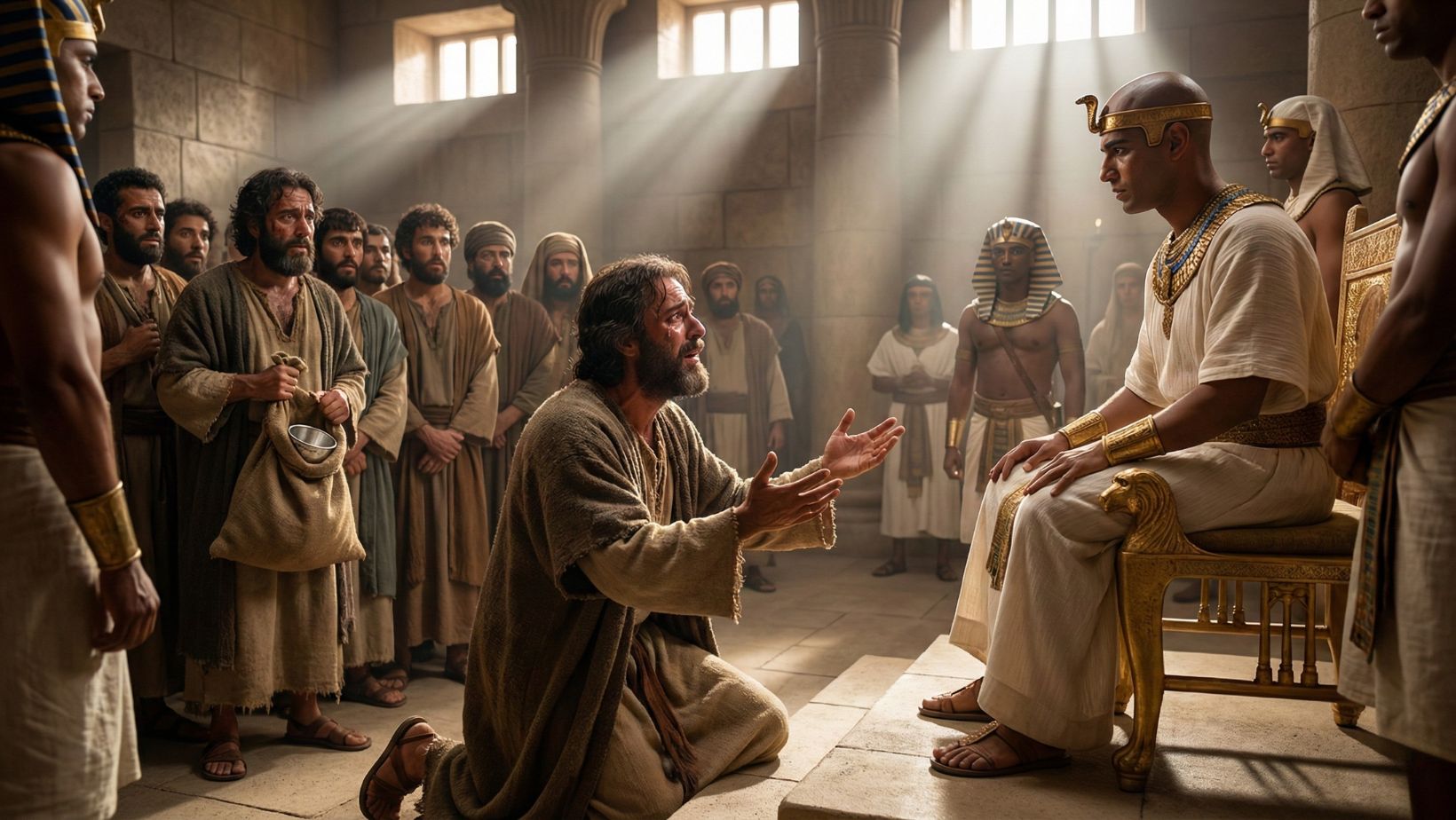
Genesis 44 contains the climax of the Joseph narrative and is widely considered one of the most emotional and literary masterpieces in the Old Testament. Having treated his brothers with hospitality in the previous chapter, Joseph now orchestrates the final, ultimate test of their character. He frames his younger brother Benjamin for theft to see if the other ten brothers will abandon him to save themselves, just as they had done to Joseph years earlier. The chapter moves from the brothers’ confident innocence to devastating despair, concluding with Judah’s impassioned plea for mercy. Judah’s speech, where he offers his own life as a substitute for Benjamin, serves as the catalyst that finally breaks Joseph’s resolve, proving that the brothers are truly transformed men.
1. The Trap: The Cup in the Sack (Genesis 44:1–13 NLT)
1 When his brothers were ready to leave, Joseph gave these instructions to his palace manager: “Fill each of their sacks with as much grain as they can carry, and put each man’s money back into his sack. 2 Then put my personal silver cup at the top of the youngest brother’s sack, along with the money for his grain.” So the manager did as Joseph instructed. 3 The brothers were up at dawn and were sent on their journey with their loaded donkeys. 4 But they had not gone far from the city when Joseph said to his palace manager, “Chase after them and stop them. When you catch up with them, ask them, ‘Why have you repaid my kindness with such evil? 5 Why have you stolen my master’s silver cup, which he uses to predict the future? What a wicked thing you have done!’” 6 When the manager caught up with them, he told them what Joseph had said. 7 “Sir,” the brothers responded, “why are you saying these things? We would never do such a thing! 8 Why, we even returned the money we found in our sacks on our first trip. So why would we steal silver or gold from your master’s house? 9 If you find his cup with any one of us, let that man die. And all the rest of us, my lord, will be your slaves.” 10 “That’s fair,” the man agreed. “But only the one who stole the cup will be my slave. The rest of you may go free.” 11 They all quickly took their sacks from the backs of their donkeys and opened them. 12 The palace manager searched the sacks, starting with the eldest and going down to the youngest. And the cup was found in Benjamin’s sack! 13 The brothers tore their clothing in despair. Then they loaded their donkeys again and returned to the city.
Commentary:
- The Nature of the Test (v. 1-2): Joseph creates a scenario that perfectly replicates the temptation of the past. By isolating Benjamin (Rachel’s other son) as the “problem,” Joseph gives the half-brothers a perfect excuse to leave him behind and return to their father with a story of “unfortunate events,” just as they did with Joseph.
- The Silver Cup and Divination (v. 5): The cup is described as one used to “predict the future.” In the ancient Near East, lecanomancy (reading shapes in oil poured on water in a cup) was common. While it is debated whether Joseph actually practiced this or merely used it as part of his Egyptian disguise to strike fear into them, the cup symbolized his authority and “supernatural” insight.
- The Rash Vow (v. 9): Confident in their innocence, the brothers unknowingly utter a death sentence: “let that man die.” This mirrors Jacob’s rash vow regarding the household idols in Genesis 31:32, which inadvertently condemned Rachel.
- The Search Strategy (v. 12): The steward searches from oldest to youngest to build suspense. The brothers breathe a sigh of relief as each sack is cleared, only to have their world collapse when the cup appears in the final sack.
- The Reaction (v. 13): “The brothers tore their clothing.” In Genesis 37, they stripped Joseph of his robe and sat down to eat. Here, they tear their own robes in grief. They do not abandon Benjamin; they all return. This is the first concrete sign of their corporate repentance.
Insight: False confidence often leads to rash promises. The brothers trusted their own righteousness, but God (through Joseph) was orchestrating a situation where they had to rely on mercy, not justice.
2. The Confrontation (Genesis 44:14–17 NLT)
14 Joseph was still in his palace when Judah and his brothers arrived, and they fell to the ground before him. 15 “What have you done?” Joseph demanded. “Don’t you know that a man like me can predict the future?” 16 Judah answered, “Oh, my lord, what can we say to you? How can we explain this? How can we prove our innocence? God has punished us for our sins. My lord, we have all returned to be your slaves—all of us, not just our brother who had your cup in his sack.” 17 “No,” Joseph said. “I would never do such a thing! Only the man who stole the cup will be my slave. The rest of you may go back to your father in peace.”
Commentary:
- Judah Takes the Lead (v. 14): Reuben was the firstborn, but Judah steps forward as the spokesperson and leader. He fulfills the prophecy that his brothers would praise and bow to him (Genesis 49:8).
- Confession of Guilt (v. 16): Judah asks, “How can we prove our innocence?” (literally: how can we justify ourselves?). He then makes a stunning admission: “God has punished us for our sins.” Judah knows they did not steal the cup, so he is not confessing to theft. He is confessing to the original sin—the selling of Joseph. He views this current tragedy as divine retribution for their past crime.
- Joseph’s Offer of Escape (v. 17): Joseph tightens the screws. He offers them exactly what they might secretly want: “The rest of you may go back to your father in peace.” If they leave Benjamin, they are free. If they stay, they are slaves. This is the moment of decision.
Insight: True repentance stops making excuses. Judah stops fighting the specific accusation (the cup) and accepts the sovereignty of God over their moral guilt.
3. Judah’s Intercession (Genesis 44:18–34 NLT)
18 Then Judah stepped forward and said, “Please, my lord, let your servant say just one word to you. Please, do not be angry with me, even though you are as powerful as Pharaoh himself. 19 “My lord, previously you asked us, ‘Do you have a father or a brother?’ 20 And we responded, ‘Yes, my lord, we have a father who is an old man, and his youngest son is a child of his old age. His full brother is dead, and he alone is left of his mother’s children, and his father loves him very much.’ 21 “And you said to us, ‘Bring him here so I can see him with my own eyes.’ 22 But we said to you, ‘My lord, the boy cannot leave his father, for his father would die.’ 23 But you told us, ‘Unless your youngest brother comes with you, you will never see my face again.’ 24 “So we returned to your servant, our father, and told him what you had said. 25 Later, when he said, ‘Go back again and buy us a little food,’ 26 we replied, ‘We can’t go unless you let our youngest brother go with us. We’ll never get to see the man’s face unless our youngest brother is with us.’ 27 “Then my father said to us, ‘As you know, my wife had two sons, 28 and one of them went away and never returned. Doubtless he was torn to pieces by some wild animal. I have never seen him since. 29 Now if you take this one away from me, too, and something happens to him, you will send this grieving, white-haired man to his grave.’ 30 “And now, my lord, I cannot go back to my father without the boy. Our father’s life is bound up in the boy’s life. 31 If he sees that the boy is not with us, his grief will kill him. And we, your servants, will be responsible for sending our father, your servant, to his grave in sorrow. 32 “My lord, I guaranteed to my father that I would take care of the boy. I told him, ‘If I don’t bring him back to you, I will bear the blame forever.’ 33 “So please, my lord, let me stay here as a slave instead of the boy, and let the boy return with his brothers. 34 For how can I go back to my father if the boy is not with me? I couldn’t bear to see the anguish this would cause my father!”
Commentary:
- The Masterpiece of Rhetoric (v. 18-34): This is considered one of the most moving speeches in all of literature. It is honest, humble, and persuasive.
- Focus on the Father (v. 19-31): Judah mentions his father (Jacob) 14 times in this speech. In Genesis 37, the brothers callously ignored the grief they would cause their father. Now, Judah is entirely motivated by compassion for his father’s pain. He has moved from self-preservation to sacrificial love.
- Acknowledging the “Dead” Brother (v. 20): Judah admits to the Egyptian ruler that Benjamin’s brother (Joseph) is dead. This shows he is not hiding the family history, though he is unaware he is speaking to that very brother.
- The Doctrine of Substitution (v. 33): This is the theological core of the chapter. Judah says, “Let me stay here as a slave instead of the boy.”
- He does not plead Benjamin’s innocence.
- He does not ask for mercy without a cost.
- He offers a life for a life.
- The Change of Heart: The man who proposed selling Joseph into slavery (Gen 37:26) now offers himself into slavery to save Joseph’s brother. The transformation is complete.
Insight: Judah’s offer is the clearest Old Testament picture of Christ. Just as Judah offered himself as a substitute to save his brother and restore him to the father, Jesus offered Himself to save us and restore us to God.
Theological Significance of Genesis 44
- Substitutionary Atonement: Judah serves as a “type” of Christ. He is the lion of the tribe of Judah who steps in to bear the penalty of the guilty (or in this case, the framed) to save the beloved son.
- Proof of Repentance: Repentance is not just feeling bad; it is acting differently in the same situation. The brothers proved their repentance not by their words, but by refusing to leave Benjamin behind.
- Providence and Testing: God (through Joseph) tests believers not to crush them, but to reveal what is in their hearts. The pressure of the cup revealed the gold of Judah’s character.
Practical Applications
- Bearing One Another’s Burdens: We are called to stand up for the vulnerable. When others are in trouble, the “Judah spirit” does not flee; it intervenes.
- Empathy for Parents/Others: Judah’s motivation was the avoidance of causing his father pain. Spiritual maturity involves considering how our actions affect the emotional well-being of others.
- Owning Your Past: When trouble strikes, it is healthy to examine our lives (as the brothers did) to see if God is bringing unresolved sin to the surface for healing.







Leave a Reply