
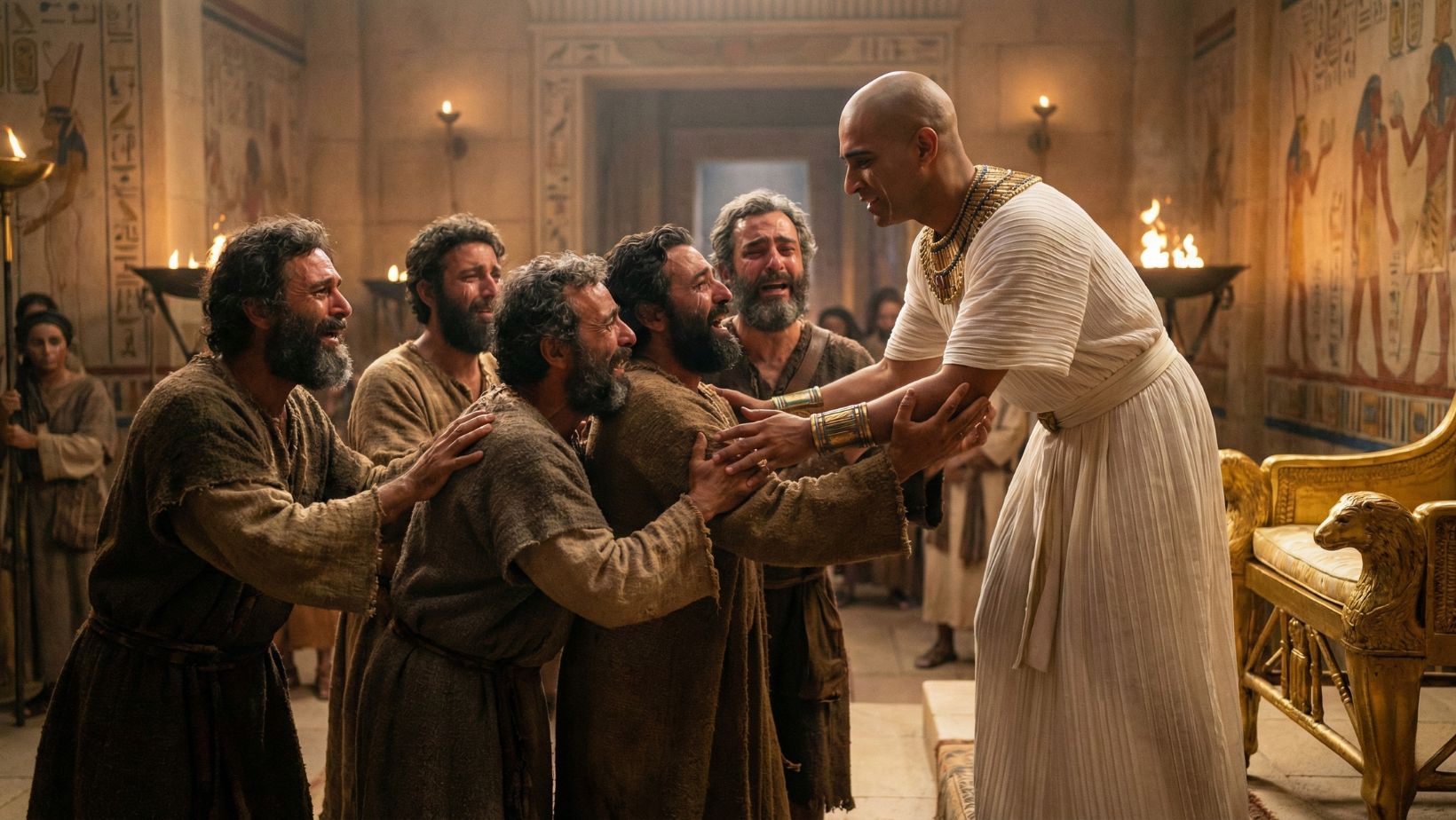
Genesis 45 is the emotional zenith of the Joseph narrative and arguably the theological centerpiece of the book. Following Judah’s sacrificial offer in the previous chapter, Joseph’s resolve crumbles, and he finally reveals his identity to his stunned brothers. The chapter transforms the narrative from a mystery-thriller into a story of profound redemption and providence. Joseph reframes years of suffering and betrayal not as a human tragedy, but as a divine strategy to “preserve life.” The focus shifts from the brothers’ guilt to God’s sovereignty, leading to a joyful reunion, Pharaoh’s generous invitation, and the revival of the aged patriarch Jacob, who prepares to move his entire clan to Egypt.
1. The Revelation and God’s Sovereignty (Genesis 45:1–8 NLT)
1 Joseph could stand it no longer. There were many people in the room, and he said to his attendants, “Out, all of you!” So he was alone with his brothers when he told them who he was. 2 Then he broke down and wept. He wept so loudly the Egyptians could hear him, and word of it quickly carried to Pharaoh’s palace. 3 “I am Joseph!” he said to his brothers. “Is my father still alive?” But his brothers were speechless! They were stunned to realize that Joseph was standing there in front of them. 4 “Please, come closer,” he said to them. So they came closer. And he said again, “I am Joseph, your brother, whom you sold into slavery in Egypt. 5 But don’t be upset, and don’t be angry with yourselves for selling me to this place. It was God who sent me here ahead of you to preserve your lives. 6 This famine that has ravaged the land for two years will last five more years, and there will be neither plowing nor harvesting. 7 God has sent me ahead of you to keep you and your families alive and to preserve many survivors. 8 So it was not you who sent me here, but God! He has made me a counselor to Pharaoh—manager of his entire palace and governor of all Egypt.
Commentary:
- The Emotional Break (v. 1-2): Joseph’s weeping is uncontrollable. After maintaining a stoic mask for months, the “dam breaks.” He ensures privacy (“Out, all of you!”) to protect his brothers’ reputation; he does not want the Egyptians to witness the shameful history of his family.
- The Shock (v. 3): The revelation “I am Joseph” is terrifying. The brothers are “speechless” (Hebrew bahal – terrified/dismayed). They are instantly confronted by the victim of their greatest crime, who now holds the power of life and death over them.
- Intimacy Restored (v. 4): Joseph invites them to “Come closer.” This physical gesture bridges the gap between the ruler and the subjects, re-establishing them as brothers. He identifies himself explicitly as the one “whom you sold,” forcing them to face the truth so he can forgive it.
- The Theological Pivot (v. 5-7): This is the key to understanding the life of Joseph. He uses the phrase “God sent me” three times. He does not deny their sin (“you sold me”), but he subordinates their human evil to God’s divine purpose.
- Preservation of Life (v. 7): Joseph understands that his suffering had a missional purpose: to save a “remnant.” This preserves the line of Abraham, through whom the Messiah would eventually come.
- Total Absolution (v. 8): “It was not you… but God.” Joseph releases them from the burden of their guilt. He views his position as “Father to Pharaoh” (a title for a vizier/counselor) as a divine appointment, not a personal achievement.
2. The Invitation to Goshen (Genesis 45:9–15 NLT)
9 “Now hurry back to my father and tell him, ‘This is what your son Joseph says: God has made me master of all Egypt. Come down to me immediately! 10 You can live in the region of Goshen, where you can be near me with all your children and grandchildren, your flocks and herds, and everything you own. 11 I will take care of you there, for there are still five years of famine ahead of us. Otherwise you, your household, and all your animals will starve.’” 12 Then Joseph added, “Look! You can see for yourselves, and so can my brother Benjamin, that I really am Joseph! 13 Go tell my father of my honored position here in Egypt. Describe for him everything you have seen, and then bring my father here quickly.” 14 Weeping with joy, he embraced Benjamin, and Benjamin did the same. 15 Then Joseph kissed each of his brothers and wept over them, and after that they began talking freely with him.
Commentary:
- Urgency (v. 9): Joseph commands them to “hurry.” He knows the famine is only in year two of seven (v. 6), and delay could be fatal for the aging Jacob.
- Goshen (v. 10): Joseph strategically selects Goshen. It was in the Nile Delta, rich in pastureland, and somewhat separated from the center of Egyptian culture. This allowed the Hebrews to prosper as shepherds (a profession despised by Egyptians) while maintaining their distinct cultural and religious identity.
- Economic Salvation (v. 11): Joseph promises to “take care” (literally: nourish/sustain) the entire clan. He uses his imperial resources to provide a welfare safety net for his family.
- Physical Reconciliation (v. 14-15): The weeping continues, specifically with Benjamin. But crucially, verse 15 says he kissed all his brothers. This includes Simeon (who he imprisoned) and the others who plotted his death.
- Restoration of Communication (v. 15): “After that they began talking freely.” Fear had silenced them; grace opened their mouths. Real relationship is restored only after forgiveness is assured.
3. Pharaoh’s Generosity (Genesis 45:16–20 NLT)
16 The news soon reached Pharaoh’s palace: “Joseph’s brothers have arrived!” Pharaoh and his officials were all delighted to hear this. 17 Pharaoh said to Joseph, “Tell your brothers, ‘This is what you must do: Load your pack animals and hurry back to the land of Canaan. 18 Then get your father and all of your families, and return here to me. I will give you the very best land in Egypt, and you will eat what the land produces.’ 19 “Then Pharaoh said to Joseph, “Tell your brothers, ‘Take wagons from the land of Egypt for your little ones and your wives, and bring your father here. 20 Don’t worry about your personal belongings, for the best of all the land of Egypt is yours.’”
Commentary:
- Pharaoh’s Delight (v. 16): The fact that Pharaoh is “delighted” speaks volumes about Joseph’s character. Joseph served Egypt so well that the King was eager to honor Joseph’s family.
- The Wagons (v. 19): This is a significant detail. Carts/wagons were high technology in the ancient world and were rare in the rough hill country of Canaan. Sending Egyptian transport was a sign of royal favor and provided the necessary means to move the elderly and children.
- Upgrade Mentality (v. 20): Pharaoh tells them to leave their “personal belongings” (furniture, household goods) because they will be replaced with “the best of all the land.” This signifies a total upgrade of their lifestyle—from famine-struck refugees to honored guests of the empire.
4. The Return to Canaan (Genesis 45:21–24 NLT)
21 So the sons of Israel did as they were told. Joseph gave them wagons, as Pharaoh had commanded, and supplies for the journey. 22 And he gave each of them new clothes—but to Benjamin he gave five changes of clothes and 300 pieces of silver. 23 He also sent his father ten male donkeys loaded with the finest products of Egypt, and ten female donkeys loaded with grain and bread and other supplies he would need on his journey. 24 So Joseph sent his brothers off, and as they left, he called after them, “Don’t quarrel along the way!”
Commentary:
- New Clothes (v. 22): In Genesis 37, the brothers stripped Joseph of his robe out of envy. Now, Joseph clothes them. This is a powerful symbol of covering their shame and restoring their dignity.
- Benjamin’s Portion (v. 22): Benjamin receives five times the clothing and 300 pieces of silver (interestingly, Joseph was sold for 20 pieces of silver). This is no longer a test, but a demonstration of overflow blessing on the son of Rachel.
- The Final Warning (v. 24): “Don’t quarrel along the way!” Joseph knows human nature. He anticipates that as the relief sets in, the blame game might start (“I told you we shouldn’t have sold him!”). He commands them to maintain the peace he has established.
5. Jacob’s Spirit Revives (Genesis 45:25–28 NLT)
25 And they left Egypt and returned to their father, Jacob, in the land of Canaan. 26 “Joseph is still alive!” they told him. “And he is governor of all the land of Egypt!” Jacob was stunned at the news—he couldn’t believe it. 27 But when they repeated to Jacob everything Joseph had told them, and when he saw the wagons Joseph had sent to carry him, their father’s spirits revived. 28 Then Israel said, “It must be true! My son Joseph is alive. I must go and see him before I die.”
Commentary:
- The Shock (v. 26): Jacob’s heart literally “went numb” or “fainted” (NLT “stunned”). The news was too good to be true, and perhaps he suspected his sons were mocking him again.
- The Evidence of the Wagons (v. 27): Words were not enough; Jacob needed visual proof. Seeing the Egyptian wagons—something his sons could not have acquired on their own—convinced him.
- Revival (v. 27): “Their father’s spirits revived.” The Hebrew implies a return to life. The return of Joseph is effectively a resurrection event for Jacob.
- Israel Speaks (v. 28): The text switches from calling him “Jacob” (the struggler) to “Israel” (the Prince with God). His faith and purpose are restored. His focus is singular: “I must go and see him.”
Theological Significance of Genesis 45
- The Doctrine of Concurrence: Verses 5-8 provide the classic biblical definition of concurrence—that human actions (even evil ones) and God’s will can operate simultaneously. The brothers sold Joseph (human agency), but God sent Joseph (divine agency).
- Typology of Christ: Joseph serves as a profound “type” of Jesus:
- Rejected by his brethren.
- Exalted to the right hand of the supreme power.
- Became the source of bread/life for the world.
- Forgives those who betrayed him and invites them to dwell with him.
- Remnant Theology: Joseph identifies his purpose as “preserving a remnant” (v. 7). This ensures the survival of the covenant family, keeping the line of promise (Abraham-Isaac-Jacob) alive.
Practical Applications
- Reframing Your Past: We must learn to look at our past trauma through the lens of God’s providence. Asking “What is God doing?” is more healing than asking “Why did they do this?”
- The Wagons of Grace: Sometimes people need tangible evidence (wagons) to believe the good news. Our actions of generosity often validate our message of the Gospel.
- Forgiveness is Complete: Joseph didn’t just say “I forgive you”; he provided for them, kissed them, and protected them. True forgiveness seeks the welfare of the offender.







Leave a Reply