
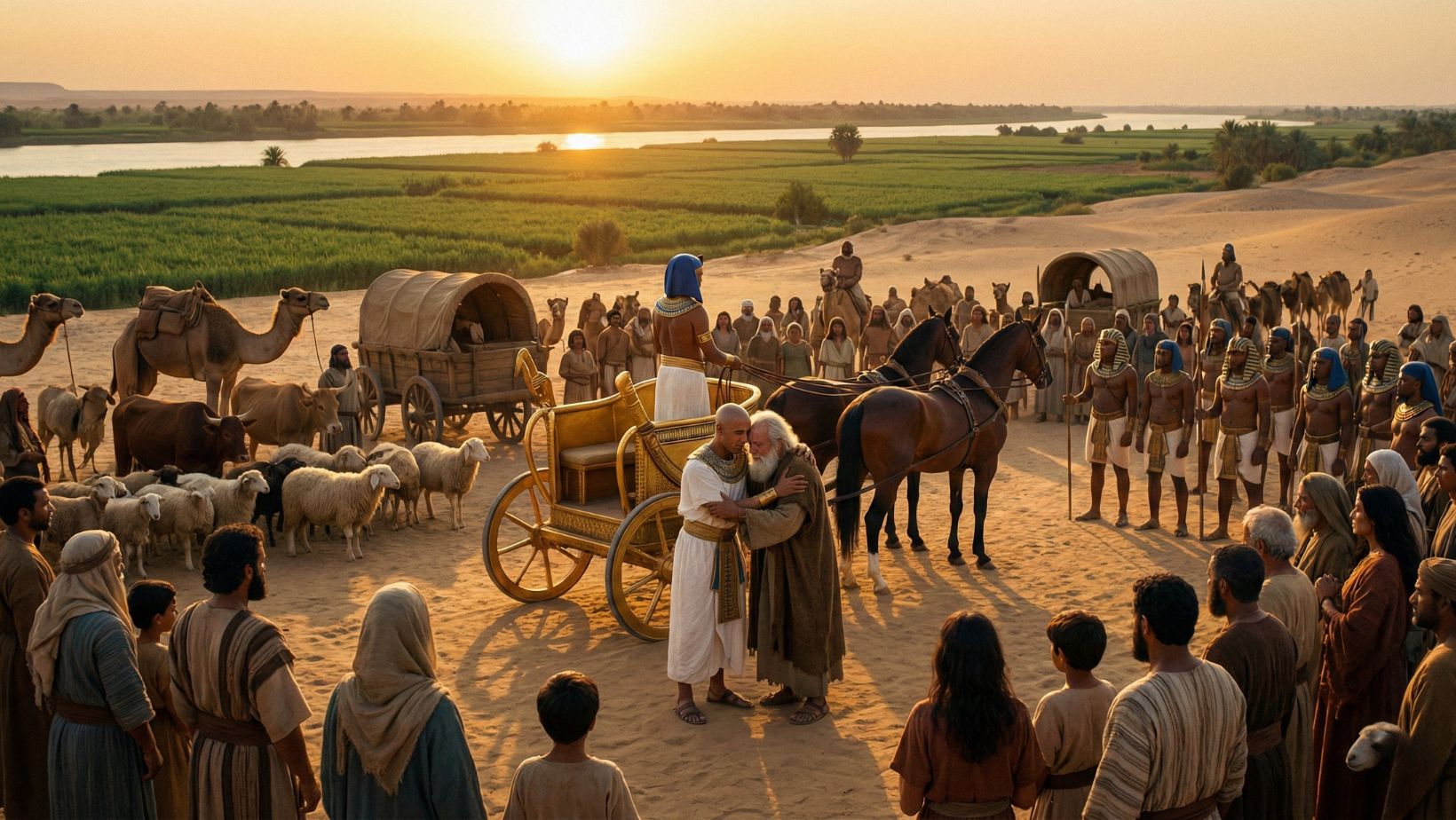
Genesis 46 records the historic migration of the chosen family from Canaan to Egypt, a move that would define Israel’s identity for the next 430 years. The chapter begins with a critical pause at Beersheba, where Jacob seeks divine permission to leave the Promised Land. God appears in a vision, reassuring him that this descent into Egypt is part of the divine plan to forge a “great nation.” The narrative then provides a detailed genealogical registry of the 70 family members who entered Egypt, serving as the “seed” of the future nation. The chapter concludes with the tearful, long-awaited reunion of Jacob and Joseph in Goshen, and Joseph’s shrewd political strategy to secure a safe, isolated settlement for his family as shepherds.
1. The Vision at Beersheba (Genesis 46:1–7 NLT)
1 So Israel set out with all that he owned, and when he reached Beersheba, he offered sacrifices to the God of his father, Isaac. 2 During the night God spoke to him in a vision. “Jacob! Jacob!” he called. “Here I am,” Jacob replied. 3 “I am God, the God of your father,” the voice said. “Do not be afraid to go down to Egypt, for there I will make your family into a great nation. 4 I will go with you down to Egypt, and I will bring you back again. You will die in Egypt, but Joseph will be with you to close your eyes.” 5 So Jacob left Beersheba, and the sons of Israel took their father, Jacob, their little ones, and their wives in the wagons Pharaoh had sent for them. 6 They also took their livestock and all the possessions they had acquired in the land of Canaan. So Jacob and his entire family went to Egypt— 7 sons and grandsons, daughters and granddaughters—all his descendants.
Commentary:
- The Pause at Beersheba (v. 1): Beersheba was the southernmost border of Canaan. Jacob stops here because he is terrified. His father Isaac had been explicitly forbidden by God to go to Egypt during a famine (Gen 26:2). Jacob needs to know if he is abandoning the covenant land or following God’s will.
- The Double Call (v. 2): “Jacob! Jacob!” The repetition of a name in Scripture often denotes a moment of deep intimacy and urgency (e.g., “Abraham, Abraham,” “Moses, Moses,” “Martha, Martha”).
- Divine Permission (v. 3): God gives him the green light: “Do not be afraid.” This confirms that while the Promised Land is the destination, Egypt is the incubator where the family will grow into a nation, protected from Canaanite assimilation.
- The Promise of Presence (v. 4): “I will go with you.” This is the most important assurance. The covenant God is not territorially bound to Canaan; He accompanies His people into exile.
- The Promise of Return (v. 4): “I will bring you back again.” This has a double meaning: Jacob’s body will be brought back for burial (Gen 50), and his descendants will return as a nation (the Exodus).
2. The Roll Call of the Seventy (Genesis 46:8–27 NLT)
8 These are the names of the descendants of Israel—the sons of Jacob—who went to Egypt: Reuben was Jacob’s oldest son. 9 The sons of Reuben were Hanoch, Pallu, Hezron, and Carmi. 10 The sons of Simeon were Jemuel, Jamin, Ohad, Jachin, Zohar, and Shaul (whose mother was a Canaanite woman). 11 The sons of Levi were Gershon, Kohath, and Merari. 12 The sons of Judah were Er, Onan, Shelah, Perez, and Zerah (though Er and Onan had died in the land of Canaan). The sons of Perez were Hezron and Hamul. 13 The sons of Issachar were Tola, Puah, Jashub, and Shimron. 14 The sons of Zebulun were Sered, Elon, and Jahleel. 15 These were the sons of Leah and Jacob who were born in Paddan-aram, in addition to their daughter, Dinah. The number of descendants through Leah was thirty-three. 16 The sons of Gad were Zephon, Haggi, Shuni, Ezbon, Eri, Arodi, and Areli. 17 The sons of Asher were Imnah, Ishvah, Ishvi, and Beriah, with their sister Serah. The sons of Beriah were Heber and Malkiel. 18 These were the sons of Zilpah, the servant given to Leah by her father, Laban. The number of descendants through Zilpah was sixteen. 19 The sons of Jacob’s wife Rachel were Joseph and Benjamin. 20 Joseph’s sons, born in the land of Egypt, were Manasseh and Ephraim. Their mother was Asenath, daughter of Potiphera, the priest of On. 21 Benjamin’s sons were Bela, Becher, Ashbel, Gera, Naaman, Ehi, Rosh, Muppim, Huppim, and Ard. 22 These were the sons of Rachel and Jacob. The number of descendants through Rachel was fourteen. 23 The son of Dan was Hushim. 24 The sons of Naphtali were Jahzeel, Guni, Jezer, and Shillem. 25 These were the sons of Bilhah, the servant given to Rachel by her father, Laban. The number of descendants through Bilhah was seven. 26 The total number of Jacob’s direct descendants who went with him to Egypt, not counting his sons’ wives, was sixty-six. 27 In addition, Joseph had two sons who were born in Egypt. So the total number of people in Jacob’s household who arrived in Egypt was seventy.
Commentary:
- The Structure: The genealogy is organized by the four mothers:
- The Number 70 (v. 27): This number is symbolic of completeness and totality in Hebrew thought. It stands in contrast to the millions who will leave Egypt in Exodus. From one man (Abraham) to 70 souls, to a nation as numerous as the stars.
- Note on Acts 7:14: Stephen mentions “75” people. This reflects the Septuagint (Greek OT) tradition which includes five additional grandsons of Joseph not listed in the Hebrew Masoretic text. Both numbers represent the “fullness” of the clan.
- Key Details:
3. The Reunion in Goshen (Genesis 46:28–34 NLT)
28 Jacob sent Judah on ahead to meet Joseph and get directions to Goshen. And when they all arrived there, 29 Joseph prepared his chariot and traveled to Goshen to meet his father, Israel. As soon as Joseph arrived, he embraced his father and wept on his shoulder for a long time. 30 Then Israel said to Joseph, “Now let me die, for I have seen you with my own eyes and know you are still alive.” 31 And Joseph said to his brothers and to his father’s entire household, “I will go to Pharaoh and tell him, ‘My brothers and my father’s entire household have come to me from the land of Canaan. 32 These men are shepherds, and they raise livestock. They have brought with them their flocks and herds and everything they own.’” 33 Then he said, “When Pharaoh calls for you and asks you about your occupation, 34 you must tell him, ‘We, your servants, have raised livestock all our lives, as our ancestors have always done.’ When you tell him this, he will let you live in the region of Goshen, for the Egyptians despise shepherds.”
Commentary:
- Judah’s Leadership (v. 28): Jacob sends Judah ahead. The brother who once sold Joseph is now the trusted liaison to him. This cements Judah’s status as the leader of the tribes (prefiguring the Davidic line).
- The Embrace (v. 29): This is one of the most tender moments in Genesis. Joseph presents himself in glory (chariot), but his reaction is purely filial. He weeps “for a long time” (literally “again and again”).
- Nunc Dimittis (v. 30): Jacob’s words, “Now let me die,” echo the sentiment of Simeon in the New Testament (Luke 2:29). His life’s drama is resolved; he has seen the salvation of his house.
- Strategic Segregation (v. 34): Joseph advises them to emphasize their identity as shepherds.
- The Abomination: Egyptians revered cattle and had a rigid caste system; they looked down on semi-nomadic herdsmen.
- The Benefit: By being “despised,” the Israelites would be left alone in Goshen. This isolation was crucial. If they had integrated into Egyptian urban life, they would have been assimilated religiously and culturally. Their social stigma became their spiritual shield.
Theological Significance of Genesis 46
- The God of the Transition: God meets Jacob at the border (Beersheba). He is the God of the threshold, present in the scary transitions between the known (Canaan) and the unknown (Egypt).
- Incubation: Egypt serves as the “womb” for Israel. In Canaan, the family was starting to intermarry (Judah, Simeon). In Egypt, the Egyptians’ racism (despising shepherds) forced Israel to stay together as a distinct, unmixed people group, allowing them to multiply into a nation.
- Election and Preservation: The detailed list of names affirms that God knows His people individually. They are not a nameless refugee caravan; they are the named seed of the covenant.
Practical Applications
- Seek God Before You Move: Like Jacob, we should pause at our “Beershebas” to seek God’s assurance before making major life transitions, even when the path seems obvious.
- Fear Not the “Descent”: Sometimes God’s path leads “down” into difficulty or a secular environment (Egypt) before it leads up to glory. We must trust His promise: “I will go with you.”
- Distinctiveness: Sometimes being “despised” by the culture (like the shepherds) is God’s way of keeping us holy and separate for His purposes. We should not always seek social acceptance if it costs us our identity.
Possible Sermon Titles
- Fear Not to Go Down.
- 70 Souls: The Seed of a Nation.
- The God of the Borderlands.
- Reunited at Last.
- Safe in the Place of Shame (Goshen).







Leave a Reply