
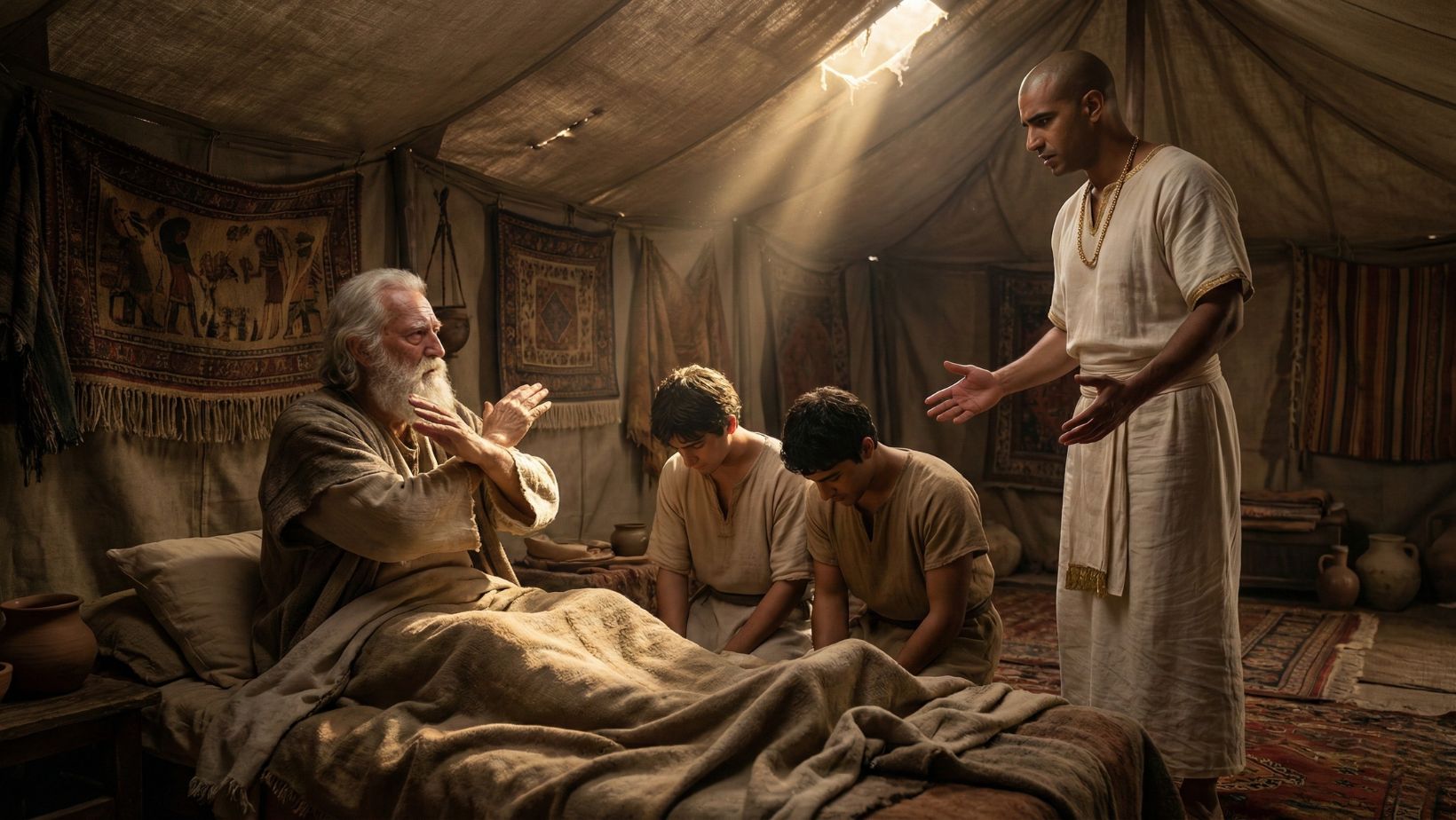
Genesis 48 records one of the most significant acts of succession in the Old Testament. As Jacob (Israel) approaches death, he summons his strength for a final, decisive act of patriarchal authority: the adoption and blessing of Joseph’s two sons, Ephraim and Manasseh. By elevating these two grandsons to the status of full sons, Jacob grants Joseph the “double portion” rights of the firstborn, effectively splitting the tribe of Joseph into two distinct tribes. The chapter highlights Jacob’s spiritual clarity at the end of his life. Unlike his father Isaac, who tried to bless based on physical preference, Jacob blesses based on prophetic insight, deliberately crossing his hands to favor the younger Ephraim over the older Manasseh, affirming that God’s election is based on grace, not birth order.
1. The Adoption of Joseph’s Sons (Genesis 48:1–7 NLT)
1 One day not long after this, word came to Joseph, “Your father is failing rapidly.” So Joseph went to visit his father, and he took with him his two sons, Manasseh and Ephraim. 2 When Joseph arrived, Jacob was told, “Your son Joseph has come to see you.” So Israel gathered his strength and sat up in his bed. 3 Jacob said to Joseph, “God Almighty appeared to me at Luz in the land of Canaan and blessed me. 4 He said to me, ‘I will make you fruitful, and I will multiply your descendants. I will make you a multitude of nations. And I will give this land of Canaan to your descendants after you as an everlasting possession.’ 5 “Now I am claiming as my own sons these two boys of yours, Ephraim and Manasseh, who were born here in the land of Egypt before I arrived. They will be my sons, just as Reuben and Simeon are. 6 But any children born to you in the future will be your own, and they will inherit land within the territories of their brothers Ephraim and Manasseh. 7 “Long ago, as I was returning from Paddan-aram, Rachel died in the land of Canaan. We were still on the way, a little distance from Ephrath (that is, Bethlehem). So with great sorrow I buried her there beside the road to Ephrath.”
Commentary:
- Gathering Strength (v. 2): The mention of Israel “gathering his strength” (literally: strengthened himself) indicates the solemnity of the moment. He forces his dying body to cooperate with his spirit to perform this legal act.
- Recalling Luz (v. 3): Jacob anchors this blessing in the covenant. He refers to El Shaddai (God Almighty) appearing at Luz (Bethel) in Genesis 28 and 35. He is not acting on his own whim; he is passing on the Abrahamic promise.
- The Great Adoption (v. 5): This is the legal pivot of the chapter. Jacob declares, “They will be my sons, just as Reuben and Simeon are.”
- Implication: Normally, grandsons share in their father’s inheritance. By elevating them to the rank of sons, Jacob gives them each a full share of the tribal allotment. This means Joseph effectively receives two shares (one for Ephraim, one for Manasseh), which is the right of the firstborn (Deut 21:17).
- The Shadow of Rachel (v. 7): Jacob suddenly reminisces about Rachel’s death. This seems disconnected, but it explains his motivation. Reuben (Leah’s son) had forfeited his firstborn rights due to sin (Gen 35:22). Therefore, Jacob transfers the rights to the firstborn of Rachel, his beloved wife. It is an act of love for her memory.
Insight: By adopting Ephraim and Manasseh, Jacob ensures that the “Egyptian” grandsons are fully grafted into the Hebrew covenant. Their identity is defined by God’s promise, not their mother’s Egyptian culture.
2. The Cross-Handed Blessing (Genesis 48:8–20 NLT)
8 Then Israel looked at Joseph’s sons and asked, “Who are these men?” 9 “They are the sons God has given me here,” Joseph replied to his father. Then Peter said, “Bring them over to me so I can bless them.” 10 Jacob was half blind because of his age and could hardly see. So Joseph brought the boys close to him, and Jacob kissed and embraced them. 11 Then Israel said to Joseph, “I never thought I would see your face again, but now God has let me see your children, too!” 12 Joseph moved the boys, who were at their grandfather’s knees, and he bowed with his face to the ground. 13 Then he positioned the boys in front of Jacob. With his right hand he directed Ephraim toward Jacob’s left hand, and with his left hand he put Manasseh at Jacob’s right hand. 14 But Jacob crossed his arms as he reached out to lay his hands on their heads. He put his right hand on the head of Ephraim, though he was the younger boy, and his left hand on the head of Manasseh, though he was the firstborn. 15 Then he blessed Joseph and said, “May the God before whom my grandfather Abraham and my father, Isaac, walked—the God who has been my shepherd all my life, to this very day, 16 the Angel who has redeemed me from all harm—may he bless these boys. May they preserve my name and the names of Abraham and Isaac. And may their descendants multiply greatly throughout the earth.” 17 But Joseph was upset when he saw that his father placed his right hand on Ephraim’s head. So Joseph lifted it to move it from Ephraim’s head to Manasseh’s head. 18 “No, father,” he said. “This one is the firstborn. Put your right hand on his head.” 19 But his father refused. “I know, my son; I know,” he replied. “Manasseh will also become a great people, but his younger brother will become even greater. And his descendants will become a multitude of nations.” 20 So Jacob blessed the boys that day with this blessing: “The people of Israel will use your names when they give a blessing. They will say, ‘May God make you as prosperous as Ephraim and Manasseh.’” In this way, Jacob put Ephraim ahead of Manasseh.
Commentary:
- The Position (v. 13): Joseph arranges the boys meticulously. In ancient culture, the right hand signified the transfer of power and authority. Joseph places Manasseh (the older) opposite Jacob’s right hand.
- The Crossing (v. 14): Jacob “crossed his arms” (Hebrew: sikkul – to act with insight/prudence). This was not a mistake of senility; it was a prophetic act.
- The God Who Shepherds (v. 15): This is the first time in Scripture God is called a “Shepherd” (Raah). Jacob looks back at his turbulent life—full of deceit, wolves, and wandering—and realizes God was herding him the entire time.
- The Angel (v. 16): Jacob equates God (v. 15) with “the Angel who has redeemed me.” This refers to the “Angel of the Lord” he wrestled with (Gen 32). This is a strong hint at the pre-incarnate Christ, whom he identifies as his Redeemer (Goel).
- Joseph’s Objection (v. 17-18): Joseph assumes his father is confused due to blindness. He tries to enforce the cultural norm of primogeniture (rights of the firstborn).
- “I Know It” (v. 19): Jacob insists. He repeats the pattern of Genesis: Abel over Cain, Isaac over Ishmael, Jacob over Esau, Joseph over Reuben. God often bypasses the “natural” choice to show that His blessing is by grace.
- The Prophecy: Indeed, the tribe of Ephraim became the dominant northern tribe of Israel (often the Northern Kingdom was simply called “Ephraim”), far outshining Manasseh in influence.
3. The Extra Portion (Genesis 48:21–22 NLT)
21 Then Israel said to Joseph, “Look, I am about to die, but God will be with you and will take you back to Canaan, the land of your ancestors. 22 And I give you an extra portion of the land, beyond what I have given your brothers. This is the land I took from the Amorites with my sword and bow.”
Commentary:
- Assurance of Return (v. 21): Jacob’s final words are about the land. He wants Joseph to know that Egypt is not the end of the story.
- The “Shechem” Play on Words (v. 22): The Hebrew word for “portion” here is Shechem (which means “shoulder” or “ridge”).
- Jacob is giving Joseph the literal city of Shechem (where Joseph’s bones were eventually buried, Joshua 24:32).
- He claims to have taken it “with my sword and bow.” This likely refers to the incident in Genesis 34 where his sons slaughtered the city. Though Jacob condemned the violence then, as the head of the clan, he took legal responsibility and possession of the conquest.
Theological Significance of Genesis 48
- God as Shepherd: Jacob introduces the metaphor that David would later immortalize in Psalm 23. God is not just a distant King, but a personal Guide who protects and feeds His sheep.
- Redemption from Evil: Jacob speaks of being “redeemed from all harm.” The word is goel, related to the Kinsman-Redeemer. Jacob recognizes that he didn’t survive by his wits, but by God’s rescue.
- Sovereign Election: The crossing of the hands reinforces the doctrine that God chooses whom He wills. Spiritual standing is not inherited by birth order or natural rights but is a gift of God.
Practical Applications
- Leaving a Spiritual Legacy: Jacob’s greatest gift to his grandsons wasn’t money, but the Covenant. We should strive to pass on our story of God’s faithfulness to the next generation.
- Trusting God’s “Crossed Hands”: Sometimes God blesses us in ways that don’t make sense to our logic or cultural expectations. We often want the “right hand” of immediate success, but God may have a different plan that leads to greater fruitfulness.
- Adopting the Outsider: Jacob brought his “Egyptian” grandsons into the fold. The church is called to adopt those from the “world” and give them a new identity as sons and daughters of the King.







Leave a Reply